
























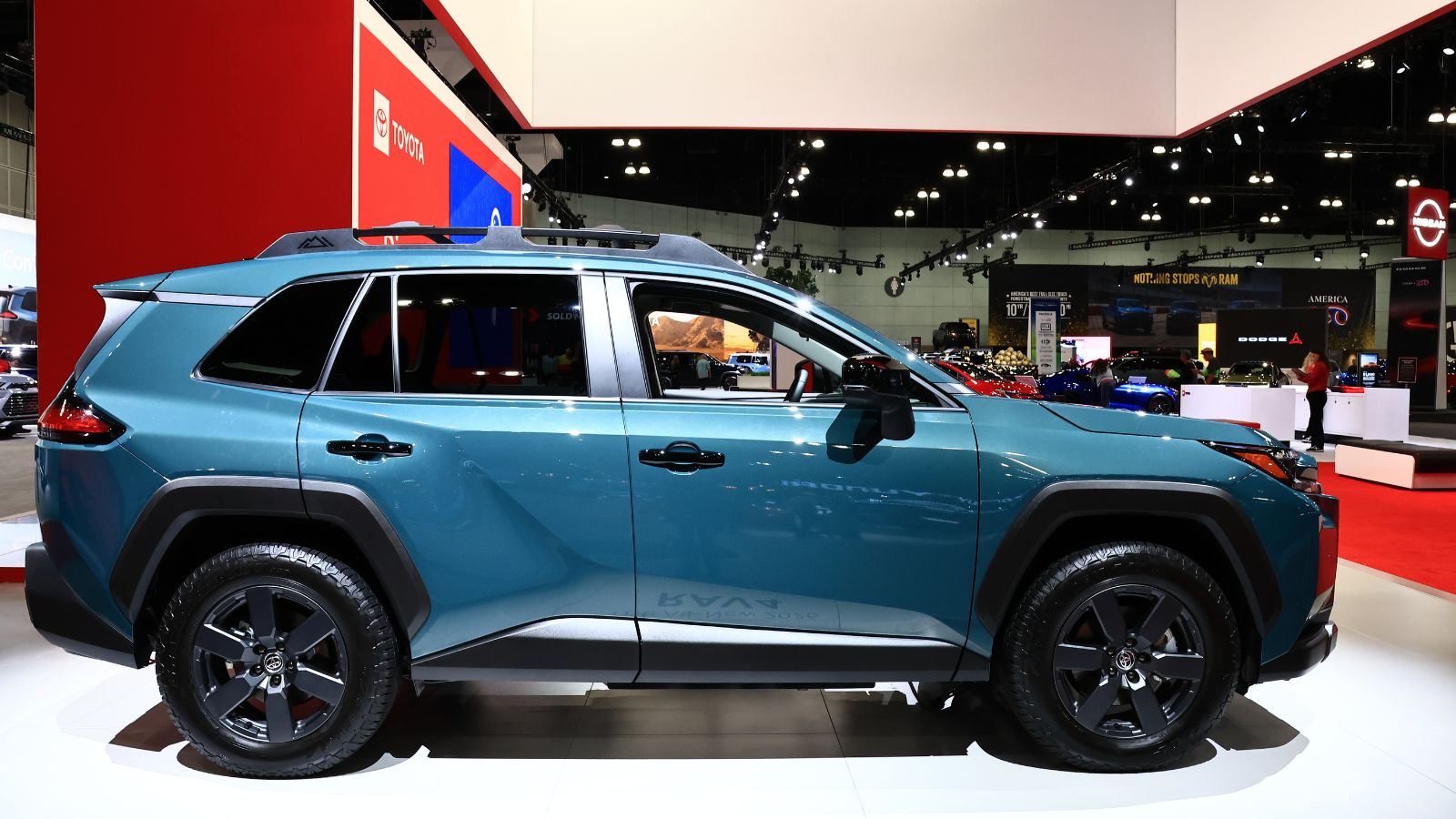
Toyota has begun building the redesigned 2026 RAV4 in Georgetown, Kentucky, giving its American dealer network a badly needed new source of inventory. The move is expected to add roughly 40,000 vehicles in 2026, yet the relief may arrive slowly. Dealers have been selling nearly every RAV4 they receive, customer waitlists have lengthened, and the model’s factory changeover sharply reduced deliveries during the first half of the year.
The shortage reflects strength and disruption at the same time. Toyota turned the RAV4 into an all-electrified lineup just as U.S. interest in hybrids accelerated, but retooling plants in Japan and Canada temporarily restricted supply. Kentucky production now becomes central to closing that gap.
Kentucky Joins the Race to Refill Dealer Lots
The first U.S.-built examples of the sixth-generation RAV4 began rolling out of Toyota’s Georgetown operation in June. The plant is expected to contribute about 40,000 RAV4s during 2026, supplementing shipments from Ontario and Japan. That figure is meaningful, but it is modest beside the scale of the nameplate. Toyota sold 479,288 RAV4s in the United States in 2025, so Kentucky’s planned contribution equals less than one month of last year’s average sales pace.
Georgetown is not a temporary overflow site. Toyota describes the Kentucky complex as its largest manufacturing plant in the world, with roughly 10,000 team members and more than 14 million vehicles produced since operations began. The factory already has deep experience building high-volume models such as the Camry. Adding the RAV4 gives Toyota another domestic lever when overseas and Canadian pipelines are strained, while allowing production teams to increase output gradually rather than rush a newly redesigned vehicle into showrooms.
Dealers Are Measuring Supply in Hours, Not Days
The pressure is most visible inside dealerships, where many RAV4s are reserved before they physically reach the lot. Prospective owners have reported waits of six to nine months for certain configurations, an extraordinary delay for a mainstream family crossover. These are vehicles generally purchased for commuting, school runs, grocery trips, and family vacations—not limited-production sports cars whose owners normally expect lengthy ordering processes.
Toyota sales executive Damon Rose described the shortage in unusually direct terms, saying the company had begun measuring RAV4 inventory in hours rather than days. The model recorded a 97.6% turn rate in May, meaning almost every RAV4 available for sale during the month found a buyer. Toyota trucks and SUVs collectively had only a 22-day supply at the beginning of June, compared with approximately 40 days for Honda’s competing trucks and SUVs. The RAV4’s position appears even tighter, leaving salespeople to match incoming allocations with waiting customers before vehicles arrive.
A Carefully Planned Changeover Still Created a Bottleneck
Toyota knew the redesigned model would create a difficult transition. The company warned dealers that RAV4 supplies would be thin during the first half of 2026 and delayed the new model’s production start while building additional inventory of the outgoing version. The plan was straightforward: stock enough 2025 vehicles to keep dealers supplied while factories switched equipment, validated new processes, and trained workers for the sixth-generation model.
The cushion disappeared faster than expected. Production of the new RAV4 began in Japan in December 2025 and in Canada in January 2026, but the first redesigned vehicles did not reach many U.S. customers until February. By then, inventories of the old model were nearly exhausted. Toyota sold 121,605 RAV4s in the United States through May, a 40% decline from the same period in 2025. The drop does not indicate collapsing interest. It shows how quickly a high-volume vehicle can fall down the sales rankings when factories cannot yet build enough units to match existing orders.
The Hybrid-Only Gamble Met the Market at the Right Moment
For 2026, Toyota eliminated the conventional gasoline-only RAV4 and made every version either a hybrid or a plug-in hybrid. The decision was less radical than it first appeared: electrified versions already represented more than half of RAV4 sales in 2024. The standard hybrid now produces 226 horsepower with front-wheel drive or 236 horsepower with all-wheel drive, while the most efficient front-drive configurations carry an EPA estimate of 43 mpg combined.
The timing has amplified demand. U.S. hybrid sales rose 37% during a recent two-month period marked by rapidly increasing gasoline prices, outpacing the broader new-vehicle market. Toyota’s electrified sales also rose strongly, supported by familiar hybrids such as the RAV4 and Camry. For many households, a conventional hybrid offers an uncomplicated compromise: lower fuel consumption without depending on home charging or changing long-distance driving habits. Toyota effectively placed its most popular crossover directly in the path of that shift, then encountered the harder problem of producing enough vehicles to satisfy it.
The RAV4 Is Too Important for Toyota to Leave Supply Constrained
The RAV4 is not simply another successful Toyota. It is one of the company’s largest-volume products and a foundation of its U.S. business. Americans bought 479,288 units in 2025, placing it behind only the country’s biggest full-size pickup nameplates in major sales rankings. Toyota says more than 6.4 million RAV4s have reached U.S. roads since the model arrived in 1996, while worldwide annual sales have surpassed one million.
That scale makes every missed delivery significant. Toyota Motor North America sold approximately 2.52 million vehicles in 2025, with electrified models accounting for 47% of the total. A prolonged RAV4 shortage can therefore reduce companywide volume even when showrooms remain busy. It can also push buyers toward the Honda CR-V, Hyundai Tucson, Kia Sportage, Subaru Forester, or Toyota’s own Corolla Cross and 4Runner. Dealers may retain some customers within the Toyota brand, but a family replacing an aging or damaged vehicle cannot always wait several months for a specific colour, drivetrain, or trim.
Kentucky’s Expansion Extends Beyond One Popular Crossover
The new RAV4 output fits into a broader investment program. Toyota announced $800 million for its Kentucky operation as part of a combined $1 billion commitment to plants in Kentucky and Indiana. The Kentucky spending will prepare the facility for its second battery-electric vehicle while increasing capacity for the Camry and RAV4. It is also part of Toyota’s previously announced plan to invest as much as $10 billion in its U.S. plants over five years.
That flexibility matters in a market where demand can shift faster than factory footprints. A facility capable of supporting high-volume hybrids alongside other electrified vehicles gives Toyota more room to adjust its production mix. Domestic RAV4 output can also reduce dependence on long shipping routes and provide another way to manage trade-related costs, although Canada and Japan remain essential suppliers. For Georgetown workers, the RAV4 brings another globally important product into a plant that began with the Camry four decades ago. For dealers, the value is simpler: more vehicles moving toward customers who have already raised their hands.
Canada and Japan Still Carry Much of the Load
Kentucky may be the newest source of 2026 RAV4s, but the North American supply chain remains deeply international. Toyota’s Ontario facilities in Cambridge and Woodstock assemble RAV4 hybrids, while plug-in hybrid versions are built in Japan. Canadian production of the sixth-generation model began in January after Toyota invested more than C$1.1 billion in the program. The company says its Canadian plants have produced over four million RAV4s since 2009 and employ more than 8,500 people.
The Ontario transition also helps explain the shortage. Toyota’s Canadian output fell sharply during the early stages of the model changeover, contributing to a decline in the automaker’s global production. By May, however, Toyota Canada reported a second consecutive record month for the redesigned RAV4 Hybrid, with sales up 113.3% from a year earlier. That rebound suggests the ramp-up is progressing, but the U.S. market is large enough to absorb production gains quickly. Kentucky is therefore an additional pillar, not a replacement for Canadian or Japanese manufacturing.
More Supply Will Help, but Buyers May Not Feel It Immediately
Adding 40,000 U.S.-built RAV4s should improve availability during the second half of 2026, but it will not instantly erase accumulated orders. Vehicles coming off a new assembly line must move through inspections, rail or truck transportation, regional distribution, and dealer allocation before reaching customers. Popular combinations can remain scarce even when total production rises, particularly when shoppers concentrate on the same trims, colours, and all-wheel-drive configurations.
Price also shapes the experience. The 2026 RAV4 Hybrid starts at $33,350 in the United States, about $2,100 above the previous gasoline model, although the comparison now includes standard hybrid hardware. Tight inventory gives dealers little reason to discount heavily and makes flexibility more valuable for shoppers. Buyers willing to consider several colours or contact nearby dealerships may find a vehicle sooner, while highly specific orders can take longer. Toyota’s challenge is no longer proving that Americans want a hybrid RAV4. It is restoring enough supply that purchasing one feels like a normal retail transaction rather than securing a limited allocation.