




















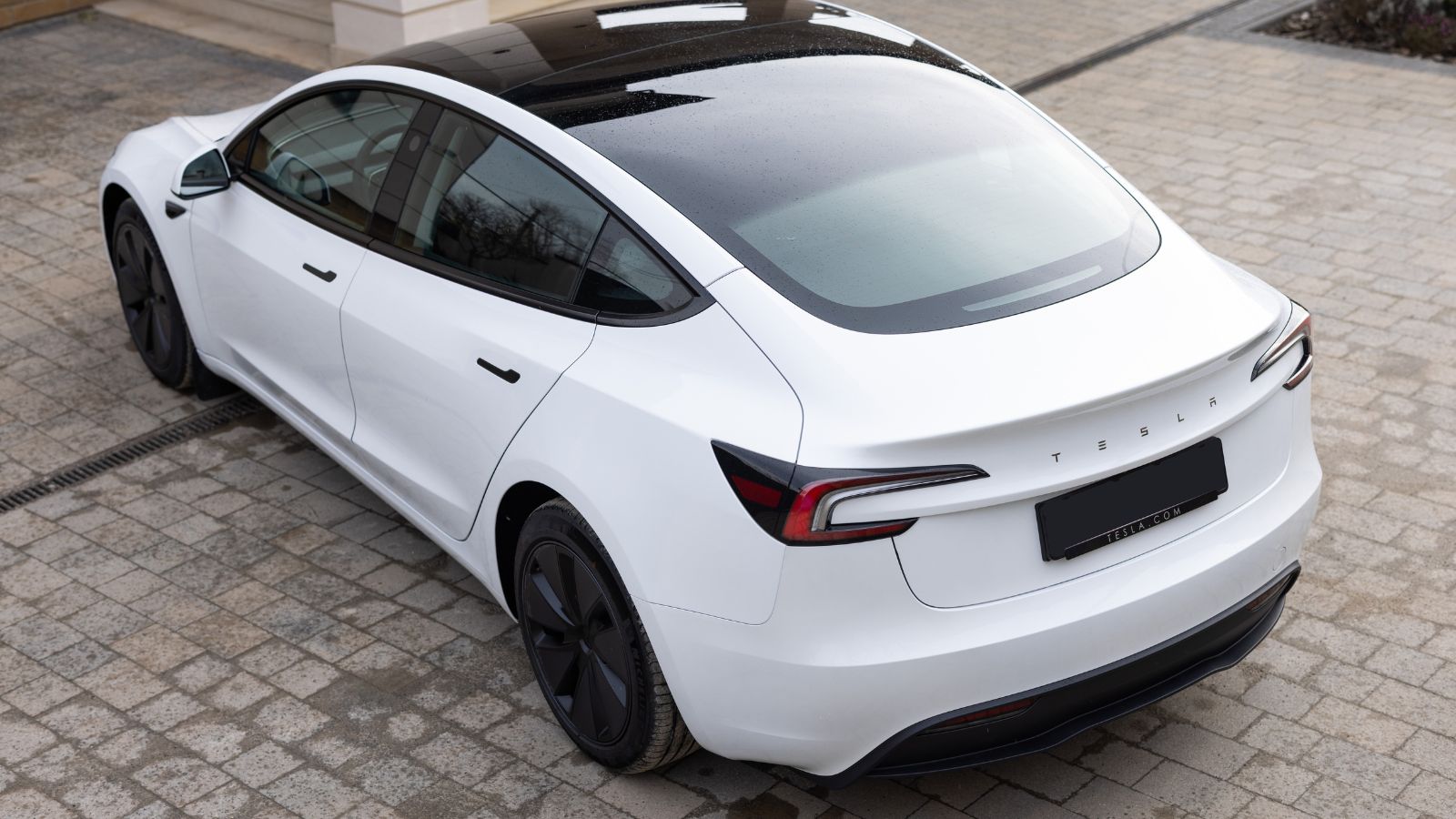
Tesla’s latest Model 3 refresh has reached Canada, bringing a more noticeable cabin upgrade than the modest change in screen dimensions might suggest. Canadian cars now get a 16-inch centre touchscreen, a dark headliner and several trim-specific changes, while the Premium All-Wheel Drive model also becomes quicker.
The rollout stops short of full feature parity with the United States, however. Tesla has just expanded Powershare support south of the border so compatible Model 3 and Model Y batteries can help keep a home running during a blackout. Canadian Model 3 buyers are not included. The difference highlights an increasingly important part of EV shopping: two cars that look nearly identical can offer very different capabilities depending on where they are sold.
The Model 3 Finally Gets Tesla’s Bigger 16-Inch Display in Canada
The most obvious change is directly in front of the driver. Tesla has replaced the Model 3’s previous 15.4-inch centre screen with a 16-inch display across the Canadian lineup. The increase of six-tenths of an inch sounds minor on paper, but this is not simply the old panel stretched slightly farther across the dashboard. Technical reporting on the new display identifies it as a higher-resolution QHD unit, moving from 1,920 by 1,200 pixels to 2,560 by 1,440. That means navigation maps, vehicle controls, camera feeds and entertainment all gain a noticeably denser display.
The change matters more in a Tesla than it might in a conventional sedan because so many functions are concentrated on that single screen. The Model 3 uses its touchscreen for climate settings, navigation, entertainment and numerous vehicle controls. Canadian cars also retain the separate eight-inch rear display for passengers. Tesla had already moved the Model Y to a larger 16-inch centre display, so the Model 3 update brings the two high-volume vehicles closer together inside.
A Black Headliner and Zen Grey Give the Cabin a Different Character
The screen is not the only visible cabin change. Canadian Model 3s now receive a black headliner as standard across the lineup, replacing the lighter material previously surrounding the upper portion of the cabin. Combined with the Model 3’s glass roof and wraparound interior lighting, the darker material gives the car a noticeably different atmosphere without requiring a full interior redesign. It is the kind of small change that can make an existing model feel newer when viewed from the driver’s seat.
Tesla has also changed the available upholstery on the Premium Rear-Wheel Drive and Premium All-Wheel Drive versions. The previous white option has been replaced with the newer Zen Grey interior on those trims. The Performance model remains different, retaining black or white interior choices rather than Zen Grey. Premium models can also be equipped with updated 19-inch Dark Nova wheels, which Canadian reporting says remain a C$2,000 upgrade over the standard 18-inch Photon wheels. The result is a refresh made up mostly of incremental changes rather than a wholesale redesign.
The Premium AWD Gets Quicker Without a Price Increase
The update is not entirely cosmetic. Tesla has shortened the Canadian Model 3 Premium All-Wheel Drive’s claimed zero-to-100-km/h time from 4.4 seconds to 4.0 seconds. Four-tenths of a second is substantial in a car that was already quick enough to outperform many traditional sport sedans in everyday acceleration. It also means buyers considering the AWD model are receiving a measurable performance improvement without Tesla attaching a higher base price to the refreshed vehicle.
Tesla’s published Canadian MSRP remains C$39,490 for the Model 3 Premium Rear-Wheel Drive, C$49,990 for the Premium AWD and C$74,990 for the Performance AWD. The least expensive version currently carries a Tesla-listed estimated range of 463 kilometres and a 6.2-second zero-to-100-km/h time. That creates a C$10,500 step from Premium RWD to Premium AWD before taxes and other charges. For buyers already considering the AWD car for winter traction, additional range or performance, the quicker acceleration therefore arrives as an added benefit rather than an extra-cost package.
U.S. Model 3 Buyers Just Gained a Much Bigger Energy Feature
The more significant difference appears when the car is parked at home. Tesla has expanded Powershare capability in the United States and Puerto Rico to newly ordered Model 3 and Model Y vehicles. Tesla says all examples ordered there after October 1, 2026, are Powershare-capable by default. Some cars produced earlier may also contain the necessary hardware, but Tesla tells owners to check the vehicle’s Additional Vehicle Information screen to see whether “Powershare Support” is enabled.
For a compatible Model 3, Powershare can do far more than charge the vehicle in reverse. When integrated with a compatible Powerwall and Tesla Wall Connector installation, energy stored in the car can be sent back into the home during an outage. Tesla estimates that Standard Model 3 and Model Y variants can provide up to two days of extended backup, while Premium and Performance versions can provide more than two days. Those estimates assume a 90-per-cent vehicle charge and average U.S. household consumption of 30 kWh per day, so actual duration can vary considerably.
Tesla’s Canadian Documentation Still Excludes Model 3 From Powershare
The Canadian situation is much clearer when Tesla’s two regional Powershare pages are compared. The U.S. documentation specifically names Model 3 and Model Y alongside Cybertruck. Tesla’s Canadian Powershare page, by contrast, states that Powershare is currently available only for Cybertruck and explicitly says it is not available for Model S, Model 3, Model X or Model Y. In other words, a newly configured Canadian Model 3 can receive the larger display and refreshed cabin without receiving the bidirectional energy capability Tesla now guarantees on qualifying new U.S. orders.
There is another Canadian limitation. Tesla’s Canadian support material says Powershare is currently unavailable for home-energy configurations that include Powerwall, with compatibility expected through a future over-the-air update. That documentation is still centred on Cybertruck rather than Model 3. Tesla has not provided a Canadian Model 3 activation date on those pages. For someone buying specifically because an EV could double as emergency household energy storage, that distinction is important: the newly refreshed Canadian Model 3 should not be purchased on the assumption that U.S. Powershare functionality is already included.
Portable Power and Home Backup Are Two Different Capabilities
The terminology can make the difference sound more complicated than it is. Vehicle-to-load, usually shortened to V2L, allows energy in an EV battery to run individual appliances, tools or electronic devices. Vehicle-to-home, or V2H, involves connecting the vehicle to household electrical equipment so the battery can support part or all of the house during an outage. Tesla groups these capabilities under the Powershare name, although the required hardware and supported vehicles vary by market.
For eligible U.S. Tesla vehicles, the company says a Gen 3 Mobile Connector and Tesla Outlet Adapter can turn the vehicle charge port into a 120-volt outlet capable of supplying up to 20 amps. Home backup is more involved and requires compatible home equipment. Canada’s Model 3 currently misses out on both advantages. Tesla’s Canadian shop listing for the Outlet Adapter says the accessory is currently available only with Cybertruck, while Canadian Model 3 reporting says the updated sedan has not received V2L. That makes the regional difference much larger than simply lacking a household-blackout mode.
Tesla’s Regional Rollouts Mean Similar Cars Can Have Different Hardware
The Canadian update demonstrates why Tesla buyers increasingly need to check the exact market and production configuration rather than relying only on a model name. The company frequently introduces equipment changes without waiting for a traditional annual model-year changeover. The 16-inch Model 3 display appeared in other markets before Canada, while the latest Canadian update arrived roughly a week after Tesla announced a related round of Model 3 changes in the United States.
Tesla itself warns Canadian customers that instructional material showing U.S.-market cars can contain features or subscriptions that are unavailable in Canada. The Powershare rollout is a particularly strong example because the difference is not simply software presentation or regulatory terminology. Tesla identifies the PCS2 Lite bidirectional inverter as part of the technical foundation for Powershare in compatible Model 3 and Model Y vehicles. That also means owners should be cautious about assuming every missing capability can eventually be unlocked with software. Tesla acknowledges that only some older U.S. Model 3 and Model Y vehicles contain compatible Powershare hardware.
Canadian Buyers Get a Better Model 3, but Feature Parity Is Still Incomplete
For someone shopping for a Model 3 primarily as an electric sedan, the Canadian update is largely positive. The price has not increased with the refresh, the centre display is larger and sharper, the cabin receives new finishes, and the Premium AWD becomes quicker. Canadian reporting also indicates Tesla began notifying customers with undelivered Model 3 orders about the updated specification, potentially allowing some buyers who ordered before the change to receive the refreshed hardware without cancelling and placing another order.
The calculation changes for anyone who sees an EV as part of a home-energy system. In the United States, Tesla is increasingly treating Model 3 and Model Y batteries as energy assets that can do useful work while the grid is down. In Canada, Tesla still officially limits Powershare to Cybertruck. Until Tesla updates its Canadian compatibility documentation, buyers should treat home backup and charge-port power output as unavailable on Model 3, regardless of what an equivalent U.S. car can do. The bigger screen is here. The much more consequential ability to send electricity back out of the battery is not.