







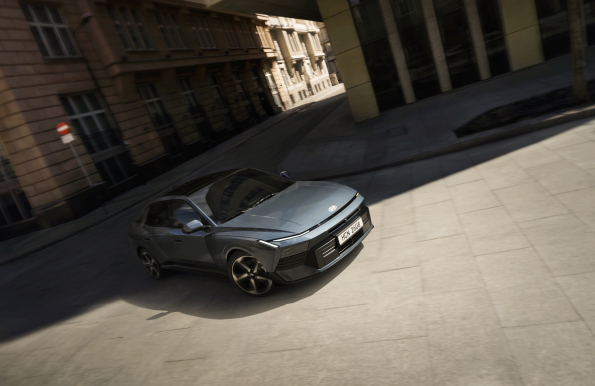
Hyundai has unveiled an entirely redesigned Elantra, introducing one of the most dramatic styling transformations in the compact sedan market.
The eighth-generation model made its North American debut at the Los Angeles Auto Show on November 19, 2026, featuring a substantially revised exterior, larger dimensions, a technology-focused interior and an upgraded hybrid powertrain.
The new 2027 Elantra adopts Hyundai’s distinctive Art of Steel design philosophy, replacing much of the outgoing model’s familiar styling with sharper edges, muscular bodywork and futuristic lighting.
Beyond its appearance, the sedan promises additional passenger space, improved connectivity and new comfort features designed to appeal to both first-time buyers and existing owners.
Hyundai has confirmed that the redesigned Elantra will arrive in Canada in early 2027, while the next-generation hybrid will follow as a 2028 model.
Hyundai Introduces an Entirely New Generation of Its Popular Compact Sedan
Hyundai officially revealed the redesigned Elantra at the 2026 Los Angeles Auto Show, marking the introduction of the eighth generation of one of its longest-running and most successful vehicles. The new model represents the sedan’s first complete generational redesign since the current version arrived for the 2021 model year. Although the Elantra received a significant exterior refresh for 2024, the latest transformation goes considerably further, introducing new body proportions, redesigned lighting and an entirely different interior layout.
The vehicle had previously appeared in South Korea under the Avante name, with its initial public unveiling taking place at the Busan Mobility Show in June 2026. The North American presentation provided additional details about the engines, technology and equipment intended for this market. Hyundai says the redesign reflects its commitment to making compact sedans desirable at a time when many automakers are concentrating on SUVs and crossovers. For buyers who still appreciate the lower driving position, manageable dimensions and fuel efficiency of a traditional sedan, the new Elantra offers a noticeably different interpretation of the familiar formula.
The Exterior Receives a Dramatic Art of Steel Transformation
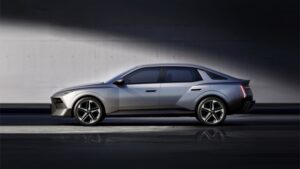
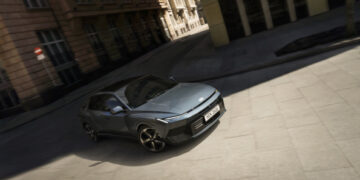
The most immediately noticeable change is the Elantra’s exterior styling. Hyundai has abandoned much of the outgoing model’s flowing appearance in favour of what it calls its Art of Steel design language. The new sedan features a longer-looking hood, wider fenders, sharp body creases and a more upright front end. Thin horizontal daytime running lights stretch across the front, while the main lighting elements are integrated into a heavily sculpted bumper. The overall effect is angular and futuristic, giving the compact car a considerably more assertive appearance.
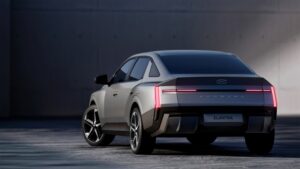
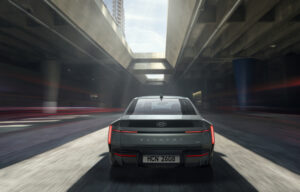
The transformation continues around the rear, where distinctive vertical lighting elements combine with a horizontal light signature to emphasize the vehicle’s width. Sculpted surfaces along the doors and rear quarters create additional visual depth. Hyundai has also introduced new exterior colours, including Graphene Green, Kodiak Blue and Volcanic Red. Despite the elaborate styling, the company reports an aerodynamic drag coefficient of 0.26 for both gasoline and hybrid versions. That figure suggests the design incorporates efficiency considerations alongside appearance. The unconventional look may divide opinions, but it gives the Elantra a recognizable identity in a segment traditionally associated with conservative exterior designs.
The New Elantra Is Longer and Wider Than Its Predecessor
Hyundai has increased the Elantra’s dimensions in an effort to deliver more interior space without moving the vehicle into a different market segment. The redesigned sedan measures approximately 4,795 millimetres long, 1,855 millimetres wide and 1,425 millimetres tall in gasoline form. Compared with the outgoing generation, overall length increases by 85 millimetres, while width grows by 30 millimetres. The wheelbase also expands by 30 millimetres to 2,750 millimetres, helping create more space between the front and rear seating areas.
Those changes are particularly meaningful for passengers in the back. Hyundai reports 993 millimetres of rear legroom, representing an improvement of 29 millimetres over the previous generation. Rear headroom increases to approximately 958 millimetres in the gasoline version, while shoulder room also improves. The company describes the resulting passenger accommodation as approaching midsize-sedan territory. For families, the added space could make installing child seats or carrying adult passengers more convenient. Rear air vents and USB-C charging ports further improve practicality. Nevertheless, the larger dimensions may slightly reduce the ease of parking in tight urban spaces, and actual comfort will depend on seating design as well as published measurements.
Hyundai Completely Redesigns the Dashboard and Interior Controls
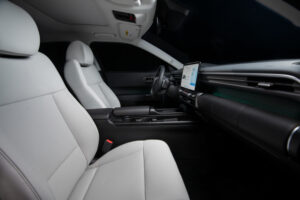
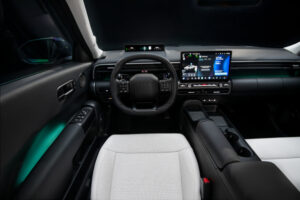
The interior receives a transformation almost as dramatic as the exterior. Hyundai has replaced the outgoing Elantra’s familiar dashboard arrangement with a cleaner, more symmetrical design that emphasizes horizontal surfaces and integrated technology. The centrepiece is a large 12.9-inch touchscreen running the company’s next-generation Pleos Connect system. Higher equipment levels can include a slim 9.9-inch digital information display positioned closer to the driver’s forward line of sight. The arrangement creates a more open-looking dashboard while concentrating important vehicle functions in clearly defined areas.
One particularly notable decision is Hyundai’s commitment to retaining physical controls. Despite the larger touchscreen, the company has preserved dedicated buttons and knobs for commonly used functions, including climate settings and audio adjustments. This contrasts with competing interior designs that increasingly require drivers to navigate touchscreen menus for routine operations. The new cabin also incorporates revised materials, redesigned seating and available ambient lighting. Hyundai describes its approach as balancing digital functionality with everyday usability. For drivers who frequently adjust temperature or audio settings while travelling, conventional controls may offer a welcome alternative to relying exclusively on the central screen.
New Pleos Connect Technology Brings Artificial Intelligence Into the Cabin
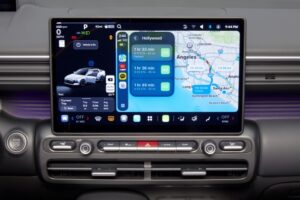
The redesigned Elantra introduces Hyundai’s Pleos Connect infotainment platform, developed using Android Automotive OS. The system is designed to provide a more customizable interface, improved connectivity and software features that can evolve throughout the vehicle’s lifespan. Wireless Apple CarPlay and Android Auto are supported, allowing compatible smartphones to connect without cables. Hyundai has also confirmed over-the-air software update capability, which can deliver supported improvements without requiring a visit to a dealership. For Canadian buyers, the company’s official preview highlights an available 14.6-inch central display on selected versions.
Another major addition is Gleo AI, a digital voice assistant designed to interpret more natural conversational commands. Hyundai says the technology can understand multiple requests and contextual instructions, potentially allowing occupants to adjust vehicle functions or obtain supported information without navigating through several menus. Other available technologies include Digital Key 2 Premium, dual wireless phone chargers and a 12-speaker Bang & Olufsen sound system. Front USB-C ports provide up to 100 watts of shared charging power, while rear passengers receive dedicated charging connections. Not every feature will be standard, and certain connected services may require an active data connection or depend on the vehicle’s equipment level.
The Gasoline Engine Remains Familiar, With Improvements to Refinement
Although the exterior and cabin have changed substantially, Hyundai is taking a more conservative approach to the standard Elantra’s engine. The 2027 gasoline model retains a 2.0-litre four-cylinder engine producing an estimated 147 horsepower and 132 pound-feet of torque. Power is delivered to the front wheels through Hyundai’s Intelligent Variable Transmission, a continuously variable-style automatic designed to balance fuel efficiency and everyday drivability. The company has made adjustments to the engine’s thermal management, lubrication and ignition systems, alongside changes intended to reduce transmission friction.
Hyundai is targeting fuel consumption of approximately 6.7 litres per 100 kilometres combined for appropriately equipped gasoline models, equivalent to its preliminary U.S. estimate of 35 miles per gallon. Final Canadian fuel-consumption ratings have not been announced. The familiar engine should offer predictable performance for everyday commuting, although the redesigned Elantra’s aggressive styling does not necessarily translate into a major horsepower increase. The gasoline model also retains a torsion-beam rear suspension, while receiving updated dampers and bushings. Hyundai says these changes are intended to improve ride comfort and reduce road noise, but independent driving evaluations will be needed to establish how noticeable those improvements are.
The 2028 Elantra Hybrid Gets More Power and Targets 4.4 L/100 km
The hybrid version receives more substantial mechanical upgrades. Hyundai has confirmed that the next-generation Elantra Hybrid will arrive as a 2028 model, combining a 1.6-litre four-cylinder gasoline engine with an upgraded electric motor and a six-speed dual-clutch transmission. Total system output rises from 139 horsepower in the outgoing model to 155 horsepower. The electric motor’s output increases from 32 kilowatts to 45 kilowatts, while the hybrid battery grows from 1.32 to 1.49 kilowatt-hours. These changes are designed to improve responsiveness while maintaining strong fuel efficiency.
Hyundai estimates that the new hybrid could achieve up to 53 miles per gallon combined under U.S. testing conditions, approximately 4.4 litres per 100 kilometres. This remains a manufacturer target rather than a certified Canadian rating. Interestingly, the preliminary figure is slightly less efficient than the highest-rated version of the outgoing American-market hybrid, despite the updated powertrain. The new version also introduces Smart Regenerative Braking 3.0, allowing drivers to adjust braking energy recovery using steering-wheel paddles. Under certain conditions, its strongest setting can bring the vehicle to a complete stop. The hybrid also receives an independent multi-link rear suspension, distinguishing it mechanically from the gasoline model.
A New Stay Mode Lets Hybrid Owners Run Climate Control While Parked
One of the most unusual features announced for the redesigned Elantra is Stay Mode, a function developed for the hybrid model that allows several electrical systems to operate while the vehicle is parked. Using energy stored in the high-voltage battery, the system can power climate control, audio, lighting, charging ports and selected convenience functions without continuously running the gasoline engine. Hyundai estimates that Stay Mode can operate for approximately 20 to 30 minutes when the battery is sufficiently charged, although actual performance will vary with temperature, battery condition and electrical demand.
The feature could be particularly useful during ordinary daily activities. A parent waiting in a school pickup area, for example, may be able to maintain cabin comfort without leaving the engine idling throughout the wait. Similarly, someone stopping during a longer road trip could use the vehicle’s entertainment and climate systems while remaining parked. The technology does not turn the Elantra into a fully electric vehicle, nor does it provide unlimited operation with the gasoline engine switched off. The system’s available duration depends on stored battery energy, and the vehicle must remain in Park. Nevertheless, it represents a practical application of hybrid technology beyond simply improving fuel economy.
Hyundai Is Adding More Safety Technology and a Quieter Driving Experience
The redesigned Elantra will also feature an expanded selection of driver-assistance systems under Hyundai’s SmartSense technology suite. Announced equipment includes Forward Collision-Avoidance Assist with pedestrian and cyclist detection, Blind-Spot Collision Warning, Rear Cross-Traffic Collision-Avoidance Assist and Lane Keeping Assist. Other available systems include Smart Cruise Control with Stop & Go, Driver Attention Warning, Safe Exit Warning and parking-distance sensors. Certain versions will also offer more advanced driver-monitoring functions. The exact combination of standard and optional features will depend on the final Canadian trim configurations.
Beyond electronic assistance, Hyundai says it has made structural improvements intended to strengthen the sedan and increase refinement. The new Elantra uses additional ultra-high-strength steel and reinforced body components, complemented by an acoustic windshield, revised mirror sealing and improved carpeting. Updated suspension components are intended to absorb road impacts more effectively and reduce unwanted noise. These changes could improve the experience of drivers who regularly travel on rough roads or spend substantial time on highways. However, manufacturer descriptions should not be confused with independently verified safety performance. Official crash-test results and comprehensive road-test evaluations will be needed before the new model’s real-world improvements can be assessed.
Canadian Buyers Can Expect the New Elantra in Early 2027
Hyundai Canada has confirmed that the redesigned Elantra is scheduled to arrive in the country in early 2027, giving Canadian buyers access to the new generation shortly after its North American introduction. The gasoline-powered version will arrive first, with the redesigned hybrid following later as a 2028-model-year vehicle. Canadian pricing has not yet been announced, nor has Hyundai finalized the complete Canadian trim structure. The company’s Canadian preview confirms that certain technologies, including the larger available 14.6-inch screen, will be offered, although final equipment details remain subject to change.
The new model will compete directly with established compact sedans such as the Honda Civic and Toyota Corolla, both of which remain important options for buyers seeking fuel-efficient transportation without moving into an SUV. Hyundai’s strategy appears to emphasize exterior design, passenger space and technology while preserving the Elantra’s appeal as an attainable vehicle. However, pricing will ultimately determine how competitive the redesign becomes, particularly as many Canadian households remain sensitive to vehicle financing and ownership costs. For now, the new Elantra represents an ambitious attempt to make the compact sedan feel modern and distinctive without abandoning the practicality that helped establish the nameplate’s popularity.