
























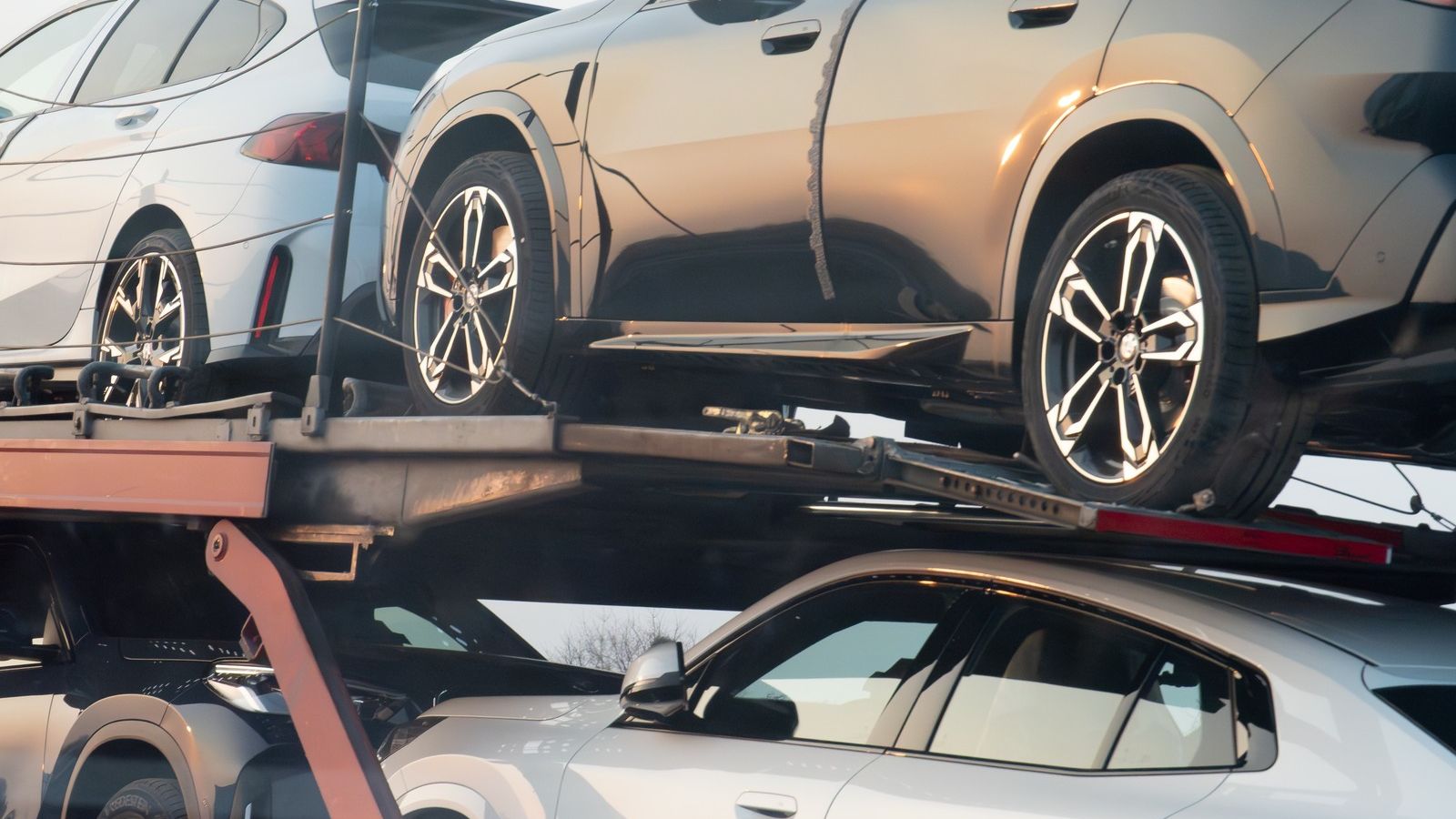
A $5.4-billion gap in Ontario’s automobile exports is now visible in the province’s own economic accounts. Figures released in its October 29, 2026 fall economic statement show that automobile shipments to the United States were worth $34.5 billion during the first eight months of 2026, down from $39.9 billion over the same period in 2024. Ontario reports a 13.7 per cent decline.
The numbers arrive as U.S. tariffs complicate decisions about where automakers build vehicles, where suppliers invest, and how long workers can count on steady shifts. Yet they also require careful interpretation: lower export value is not the same as a measured tariff bill, and some Ontario factories continue to win major investments. What emerges is a more uneven—and consequential—picture of the province’s industrial future.
The $5.4-Billion Decline Has a Specific Time Frame
Ontario’s latest figures compare January through August 2026 with January through August 2024, not the full calendar years and not simply one month against another. Automobile exports to the United States fell from a reported $39.9 billion to $34.5 billion. Subtracting those rounded totals produces the $5.4-billion gap in the headline. The province reports the underlying decline as 13.7 per cent, reflecting figures more precise than the rounded dollar amounts shown publicly.
That distinction matters because a headline-sized number can easily become mistaken for lost corporate profits, unpaid wages or tariff revenue. It is none of those measures. It represents the reduction in the declared value of a defined category of cross-border shipments during comparable eight-month periods. Ontario also reports a separate and much sharper fall in steel exports. Together, the figures give policymakers an unusually concrete view of how highly exposed manufacturing sectors have fared since trade tensions intensified.
Why 2024 Is the Benchmark—and What It Cannot Prove
Using 2024 as the comparison year makes economic sense: it captures trade before the latest round of U.S. measures began reshaping Canadian exports in 2025. But a two-year comparison cannot establish that tariffs caused every dollar of the decline. Automakers also respond to product changeovers, shifting consumer preferences, scheduled factory retooling, volatile exchange rates and changing demand across North America. Those influences can overlap, making any simple explanation incomplete.
Ontario’s own fall statement provides a reminder of the uneven pattern. The province says stronger automotive exports helped lift real economic growth in the second quarter of 2026, even though cumulative automobile exports to the United States remained below the corresponding 2024 total. Canada’s Parliamentary Budget Officer has similarly warned that actual trade outcomes reflect conditions beyond tariffs, including commodity prices and exporters’ adjustments. The credible conclusion is serious tariff pressure alongside a documented export decline—not a precise $5.4-billion tariff-only loss.
An Industry Built Around One Customer
Ontario’s automotive business was designed around the ability to sell into the larger U.S. market. A detailed federal economic-development briefing says automobiles and parts exported to the United States reached $60 billion in 2025, accounting for 96 per cent of Ontario’s automotive exports. That wider measure includes both finished vehicles and components, so it should not be confused with the province’s narrower automobile-export figure for the first eight months of 2026.
Such dependence leaves manufacturers with limited room to redirect production when access becomes more expensive. A stamping operation in southwestern Ontario may supply an assembly line across the border, while materials arrive from yet another supplier. Replacing that customer could require new tooling, certifications and contracts, rather than finding a different buyer. The federal briefing also notes that roughly 72 per cent of all Ontario goods exports went to the United States in 2025. The concentration extends beyond automobiles.
The 25 Per Cent Auto Tariff Is More Complicated Than It Sounds
U.S. trade rules impose a 25 per cent tariff on covered imported automobiles, but the treatment of qualifying Canadian vehicles depends on their content. Under the system, an importer of a vehicle meeting Canada–United States–Mexico Agreement rules can obtain approval to apply that tariff to the vehicle’s non-U.S. value rather than its entire value. Canadian trade officials also say qualifying auto parts are exempt from the corresponding 25 per cent parts tariff.
That structure reduces some costs but does not recreate tariff-free vehicle trade. Consider a qualifying vehicle containing parts made on both sides of the border: its U.S.-made content can lower the assessed tariff, while the rest remains exposed. Calculating that content requires documentation, and importers face compliance obligations as well as charges. For manufacturers deciding where to allocate models, even a partial duty changes the economics of assembling a vehicle in Ontario rather than inside the United States.
Smaller Suppliers May Feel the Pressure First
The recognizable casualties of an automotive downturn are often assembly plants, but their suppliers can have less flexibility. According to a March 2026 federal briefing, more than 95 per cent of Ontario’s automotive suppliers have fewer than 500 employees, yet these firms account for 61 per cent of the sector’s workforce. Many depend on a limited set of contracts and on production schedules at larger automakers.
When a plant reduces shifts, the impact can move quickly to businesses making seats, stampings, tooling and electronic components. Orders become harder to forecast while specialized equipment and skilled employees need financing. Ontario’s independent Financial Accountability Office modelled the parts industry as particularly vulnerable under an earlier tariff scenario, although those projections were hypothetical rather than a count of actual 2026 losses. For a small manufacturer, uncertainty over the next purchase order may be nearly as damaging as the tariff appearing on an invoice.
Factory Disruptions Have Become More Than a Forecast
The effects are visible in specific Ontario communities. In early October, Stellantis confirmed that Windsor Assembly would be down for three weeks covering October 19, October 26 and November 2. The company cited changing market conditions, including demand and tariffs. That schedule matters to workers planning household expenses and to nearby suppliers that rely on regular production, although a temporary shutdown does not itself establish a permanent loss of capacity.
Elsewhere, the union representing General Motors workers described the CAMI plant in Ingersoll as idled during August contract negotiations, with many members on indefinite layoff. At Brampton, Unifor has challenged Stellantis’s proposal to sell an assembly site to a defence manufacturer, warning that the move could end vehicle production there. Each case has its own causes and corporate decisions; none can be attributed mechanically to the provincial export total. Together, however, they demonstrate how trade uncertainty reaches the factory floor.
Ontario Is Still Winning Some Important Production
A weaker export picture does not mean every automaker is abandoning Ontario. Toyota began manufacturing the sixth-generation RAV4 in Woodstock in January 2026 and reported investment of more than $1.1 billion in the new model. Its Canadian operations employed more than 8,500 people across Cambridge and Woodstock, according to the company. Those plants show that high-volume hybrid production remains a meaningful part of the province’s automotive economy.
Ford is also retooling its Oakville complex for F-Series Super Duty trucks, a project Ontario says will support 1,800 direct jobs. The product change replaces earlier plans centred on battery-electric vehicles, illustrating how manufacturers are adjusting their strategies rather than following a single technological path. Neither investment guarantees that the wider sector will return to 2024 export levels. But both complicate a simple story of retreat: Ontario’s future may depend on which vehicle programs remain competitive enough to earn the next production commitment.
Steel’s Bigger Collapse Adds Another Warning
The same provincial document reveals an even steeper contraction in an industry closely connected to vehicle manufacturing. Ontario’s steel-product exports to the United States totalled $4.1 billion in the first eight months of 2026, compared with $8.4 billion during the corresponding months of 2024. The provincial government puts the decline at 50.6 per cent. That is a sharper proportional fall than the decline in automobile shipments, even though the categories measure different products.
Steel is used in cars, commercial trucks, equipment and construction, so weaker export demand has consequences well outside steel mills. The province says its steel sector employed more than 16,000 people in 2025, with additional employment across supply chains. It also links weaker U.S. sales to reduced production and layoffs. For communities with both steel and automotive employers, these serious pressures can overlap, creating anxiety that spreads from industrial paycheques to local businesses and municipal tax bases.
The Employment Exposure Reaches Beyond Auto Plants
Ontario says its automotive sector employed more than 100,000 people in 2025, before counting the wider network of jobs supported indirectly by manufacturing activity. Independent analysis shows why the exposure is not limited to one employer or one city. In a 2025 tariff scenario, the provincial Financial Accountability Office identified Windsor, Guelph, Brantford, Kitchener–Cambridge–Waterloo and London among the metropolitan areas most vulnerable to employment effects.
Those projections are not a tally of layoffs already suffered, and they were built around policies in place at the time. Their value is in showing the geography of risk. An assembly shift can sustain jobs in freight transportation, industrial maintenance, engineering and supplier plants. A prolonged slowdown can also weaken restaurant traffic, retail sales and the confidence needed to buy a family home. The key measure for families is not merely how many vehicles cross the border, but whether reliable work remains available locally.
Slower Growth Is Reaching Ontario’s Budget
The province’s latest fiscal update now projects real economic growth of just 0.5 per cent in 2026, down from the 1.0 per cent assumed in its spring budget. The government expects growth of 1.5 per cent in 2027. At the same time, its forecast deficit for fiscal 2026–27 has increased from $13.8 billion to $16.9 billion, widening by $3.1 billion. Tariffs are part of this outlook, although they are not the only cause.
For a government trying to protect factory jobs while funding hospitals, schools and infrastructure, slower growth reduces financial flexibility. Lower business activity can weaken tax receipts just as requests for training and industrial support increase. Ontario’s fiscal statement also points to geopolitical uncertainty and other economic headwinds. Its estimates are forecasts, not settled outcomes, but the direction is unmistakable: the province is navigating industrial disruption with materially less room for error than it expected earlier this year.
Governments Are Committing Billions to Keep Industry Competitive
On October 21, Prime Minister Mark Carney and Premier Doug Ford announced an $8.7-billion Canada–Ontario action plan covering steel, automotive manufacturing and critical minerals. For autos, the governments committed $2.5 billion over two years for capital projects involving equipment and upgraded production lines. Ottawa is providing $1.5 billion of that amount and Ontario $1 billion. The goal is to help factories build connected and electric vehicles as the market changes.
The wider funding plan includes more than $5 billion for steel and coordinated work on critical minerals. Ontario’s latest fall statement also proposes additional tax relief for qualifying business investments, while existing trade-support programs aim to help firms navigate tighter cash flow and diversify. These measures may preserve capacity, but announcements and factory output are not the same thing. Their effectiveness will be judged by whether manufacturers actually place orders, keep people working and commit future vehicle programs to Ontario.
New Batteries and New Markets Are a Longer-Term Answer
Ontario is defending a transition built around more than $46 billion in announced automotive and battery-related investment, according to its latest fall statement. Volkswagen subsidiary PowerCo’s $7-billion battery facility in St. Thomas is a centrepiece. Construction continues, but the company has pushed its expected start of operations from 2027 to 2029, underscoring that large commitments can shift as demand and technology evolve.
Trade diversification offers a different route to resilience, although finished vehicles cannot be redirected overnight. Statistics Canada reported that Canadian merchandise exports to destinations outside the United States in the first half of 2026 were 19.4 per cent higher than in the second half of 2025. Much of that improvement came from precious metals and energy, not Ontario-made automobiles. Building alternative automotive markets would require distribution networks, regulatory compatibility and fresh customer demand. For now, diversifying is a strategy for reducing dependence, not a replacement for U.S. orders.
The Next Test Is Trade Policy—and Actual Production
The outlook depends partly on negotiations that remain unresolved. U.S. officials declined to renew the North American trade agreement in its current form during the July 2026 joint review, although the agreement remains in force. Ontario’s fall statement models a slower-growth scenario in which the United States withdraws from that arrangement and maintains additional tariffs. In that case, the province projects real growth of only 0.5 per cent in 2027, compared with 1.5 per cent under its central forecast.
That is a scenario, not a prediction that withdrawal will happen. The useful indicators over coming months will be new export figures, assembly schedules, supplier orders and confirmed investments rather than political statements alone. A lasting tariff agreement could improve confidence, but plant allocations and consumer demand will still matter. Ontario’s $5.4-billion export decline is a serious warning precisely because recovering the gap will require more than a change in rhetoric.