























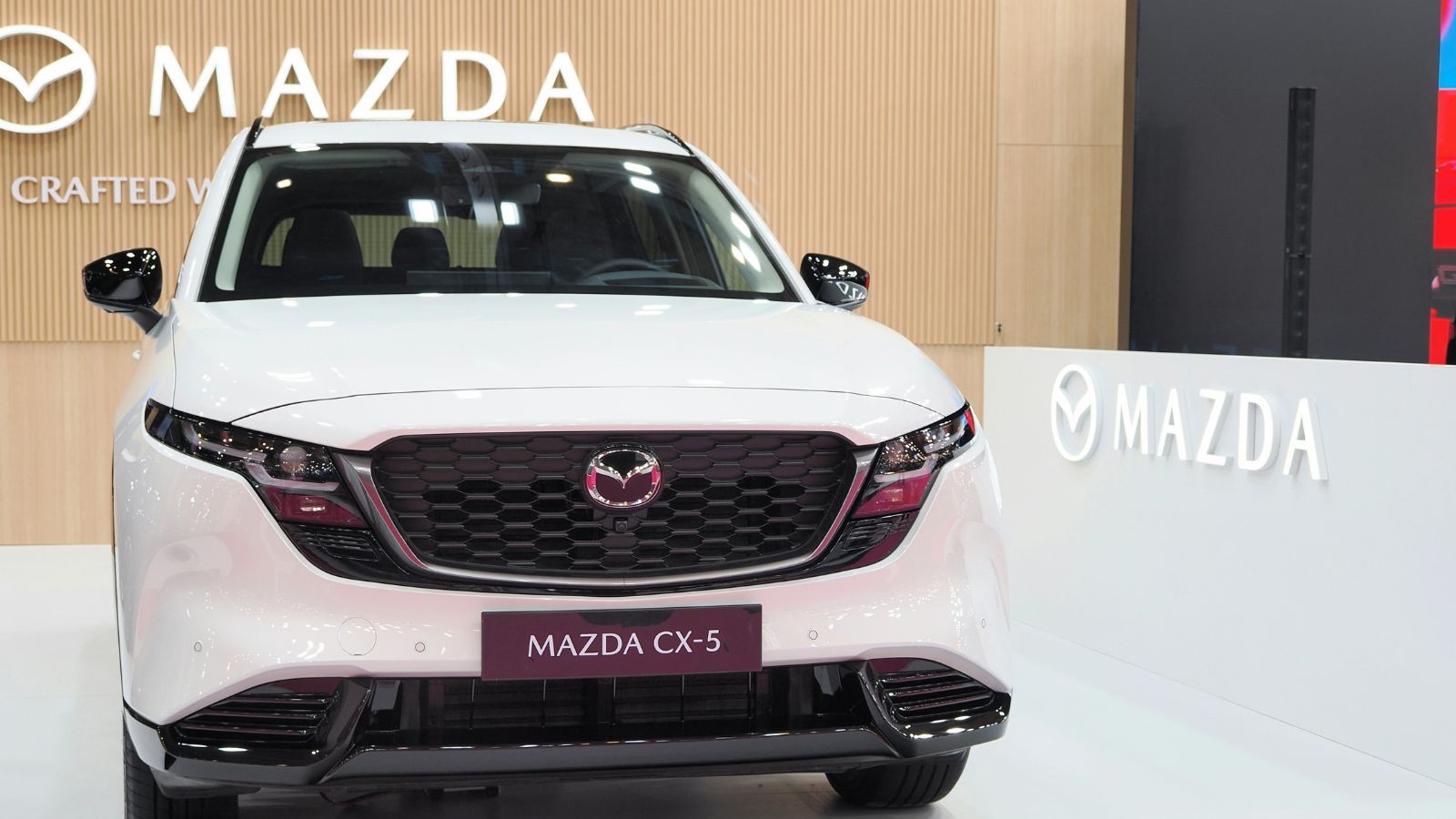
Mazda has kept the starting price of its 2027 CX-5 unchanged in Canada, but the figure shoppers actually need to budget for is considerably higher. The entry-level GX carries a manufacturer’s suggested retail price of $36,300, yet a $2,195 freight and pre-delivery charge raises that amount to $38,495 before sales taxes and other applicable expenses.
Announced on October 28, 2026, the new pricing brings modest increases for higher trims, additional safety equipment, and expanded Google Gemini technology. The 2027 CX-5 builds on the larger, redesigned generation introduced for 2026, retaining standard all-wheel drive and a familiar gasoline engine. For Canadian buyers, the biggest consideration may be how quickly the advertised price grows once equipment, delivery charges, and taxes enter the calculation.
The $36,300 Starting Price Comes With an Important Catch
Mazda Canada’s newly announced pricing puts the 2027 CX-5 GX AWD at $36,300 before additional charges. However, the manufacturer specifies another $2,195 for freight and pre-delivery expenses. That pushes the base vehicle to $38,495 before sales taxes, registration, and other applicable fees. The freight charge alone adds approximately six per cent to the advertised MSRP, making it an important consideration for households trying to keep their vehicle purchase within a fixed budget.
The distinction between MSRP and the actual purchase price can become significant during a dealership visit. A customer expecting to spend around $36,000 could discover that the vehicle already costs more than $38,000 before financing or optional equipment is considered. Mazda clearly identifies the delivery charge in its pricing disclosure and notes that retailers determine their own selling prices. Consequently, $38,495 is a manufacturer-based calculation rather than a guaranteed final dealership quote. Buyers comparing vehicles should consider the full pre-tax cost instead of relying solely on the headline figure.
Mazda Holds the Base Price Steady While Higher Trims Increase
The encouraging development for budget-conscious buyers is that Mazda has not increased the GX’s base MSRP from the redesigned 2026 model. Both model years carry the same $36,300 starting figure. The more expensive versions receive relatively modest adjustments, with each higher Canadian trim increasing by $200. The GS now starts at $39,400, compared with $39,200 previously, while the GT rises from $42,200 to $42,400. Mazda has also maintained the $2,195 freight and pre-delivery charge.
Those small increases produce a wider spread of actual pre-tax vehicle costs. Including freight, the 2027 GS reaches $41,595, while the GT comes to $44,595. A GT equipped with the panoramic roof starts at $46,595 with freight, and the GT Premium Package reaches $49,095. This pricing structure gives Mazda several distinct positions within the compact SUV market, but it also means customers shopping above the base model can quickly approach $50,000 before taxes. Choosing between trims therefore matters considerably more to the overall budget than the relatively small year-over-year increases.
The Base GX Includes More Equipment Than Its Price Suggests
Despite being Mazda’s least expensive 2027 CX-5, the GX arrives with several features that are often associated with more expensive vehicles. Standard equipment includes 17-inch alloy wheels, LED headlights, rain-sensing windshield wipers, heated front seats, and dual-zone automatic climate control. Inside, buyers receive cloth upholstery, a leather-wrapped steering wheel, a 10.25-inch digital instrument display, and a 12.9-inch central touchscreen. An eight-speaker audio system and two front USB-C charging ports are also included.
The GX additionally provides wired Apple CarPlay and Android Auto compatibility, Bluetooth connectivity, keyless entry, and push-button starting. Its rear seats recline and use a 40/20/40 split-folding arrangement, allowing passengers and longer cargo items to share the cabin more conveniently. The driver’s seat offers eight-way manual adjustment, while the front passenger has six-way adjustment. These details help explain why the GX remains a practical option for buyers who prioritize essential comfort and technology rather than luxury finishes. Importantly, the base model also receives the same standard all-wheel-drive system and gasoline powertrain as the more expensive versions.
The $39,400 GS Adds Features Canadians May Actually Use
Moving from the GX to the GS increases the MSRP by $3,100, bringing the starting figure to $39,400 before freight. In exchange, Mazda adds several conveniences that can make daily driving more comfortable, particularly during Canadian winters. The GS receives 19-inch alloy wheels, heated power-folding exterior mirrors, a windshield wiper de-icer, black roof rails, and a power rear liftgate with programmable height settings. These additions improve practicality without requiring buyers to purchase the much more expensive GT.
Inside, the GS upgrades to leatherette and cloth upholstery, a 10-way power-adjustable driver’s seat with lumbar support and memory settings, and a heated steering wheel. A windshield-projected head-up display also becomes standard, placing useful driving information closer to the driver’s field of vision. Wireless Apple CarPlay and Android Auto, wireless phone charging, rear passenger air vents, and an auto-dimming rearview mirror further distinguish this trim. For commuters frequently travelling in cold weather, the combination of a heated steering wheel and windshield de-icer may be particularly appealing. The GS offers a meaningful improvement in convenience while keeping the pre-tax, freight-included price at $41,595.
The GT Moves the CX-5 Into More Premium Territory
At $42,400 before freight, the 2027 CX-5 GT places greater emphasis on cabin comfort, upscale materials, and entertainment. Its $44,595 freight-included starting figure represents a substantial increase over the entry GX, but the additional money brings several notable upgrades. The GT features black leather-trimmed seating, ventilated front seats, heated rear outboard seats, and a six-way power-adjustable front passenger seat. These features are especially useful for households that regularly carry passengers or spend considerable time travelling.
The GT also includes a 12-speaker Bose premium sound system, SiriusXM 360L satellite radio, ambient lighting in the front door trim, and two additional USB-C ports for rear passengers. Exterior differences include 19-inch black metallic alloy wheels, distinctive LED signature lighting, and piano-black trim elements. However, the GT does not receive a more powerful engine than the GX or GS. All three versions share the same 187-horsepower gasoline four-cylinder. That makes the GT primarily a comfort and technology upgrade rather than a performance-focused model, an important distinction for customers expecting a substantial mechanical difference at the higher price.
Premium Packages Push the CX-5 Close to $50,000 Before Tax
Mazda offers two additional configurations for customers seeking more luxury and technology. The GT with Panoramic Roof starts at $44,400, adding a power-sliding panoramic moonroof to the standard GT equipment. Including freight, that version reaches $46,595 before sales taxes. The range-topping GT Premium Package begins at $46,900, or $49,095 with freight. The Premium Package requires the panoramic roof configuration, making it the most expensive version included in Mazda Canada’s October pricing announcement.
The Premium Package includes a larger 15.6-inch touchscreen, hands-free power rear liftgate, paddle shifters, driver monitoring, and Mazda’s Driver Personalization System. It also adds a sophisticated 360-degree camera system with multiple viewing modes, adaptive front lighting, additional cross-traffic braking functions, and Cruise and Traffic Support with Lane Change Assist. Buyers can increase the cost further by selecting certain premium exterior colours. Soul Red Crystal Metallic adds $500, while Machine Grey Metallic and Rhodium White Metallic cost $400 each. With optional finishes and applicable taxes, the most extensively equipped CX-5 can move noticeably beyond its already substantial advertised starting price.
A Larger Cabin Makes the Latest CX-5 More Family-Friendly
The 2027 CX-5 carries forward the major redesign Mazda introduced for the 2026 model year. That third-generation vehicle became approximately 4.5 inches longer than its predecessor, with most of the increase going into the wheelbase. Mazda also enlarged the rear door openings to make entering and exiting easier, particularly when parents are securing children in car seats. The expanded dimensions provide additional passenger room and a more practical cargo area, addressing concerns that the previous CX-5 could feel relatively compact compared with some competitors.
Mazda’s published specifications for the redesigned 2026 generation list 954 litres of cargo capacity behind the rear seats, compared with 871 litres for the 2025 model. Folding the rear seats increases available space to 1,882 litres, up from 1,680 litres previously. The cargo floor also has a lower loading height, helping when lifting luggage, grocery bags, or other bulky items into the vehicle. These improvements are relevant to the 2027 model because it retains the redesigned vehicle’s fundamental layout. For families choosing between similarly priced compact SUVs, everyday practicality may ultimately matter more than differences in dashboard appearance or wheel design.
Google Gemini Brings More Advanced Voice Controls to the Cabin
Technology represents another important part of Mazda’s updated CX-5 package. The 2027 model includes Google built-in, integrating Google Maps, compatible applications from Google Play, and the Gemini artificial intelligence assistant. Mazda Canada separately announced Gemini’s availability to eligible CX-5 owners on October 26, 2026. Instead of relying entirely on predetermined commands, the system can understand more natural conversations and follow-up questions. Drivers can request destinations, search for restaurants along a route, manage supported climate functions, and interact with entertainment or communication features using voice commands.
The technology could reduce the need to navigate touchscreen menus during everyday driving, although its usefulness will depend on connectivity and supported functions. Earlier Canadian reviews of the redesigned 2026 CX-5 identified the increased reliance on touchscreen controls as a potential drawback, particularly after Mazda removed numerous conventional buttons. There are also ongoing connectivity costs to consider. Mazda’s published connected-services terms describe a complimentary one-year trial, followed by a paid subscription for certain services unless compatible personal data connectivity is used. Buyers should confirm the specific terms applying to their 2027 vehicle, particularly if Google-powered features are central to their purchasing decision.
The Familiar 187-Horsepower Engine Remains the Only Announced Choice
Every 2027 CX-5 configuration in Mazda Canada’s newly announced pricing uses the company’s Skyactiv-G 2.5-litre four-cylinder gasoline engine. It produces 187 horsepower and 186 lb-ft of torque, runs on regular 87-octane gasoline, and is paired with a six-speed automatic transmission. Mazda’s i-Activ all-wheel-drive system is standard across the lineup. Drivers also receive Mi-Drive selectable modes, including Normal, Sport, and Off-Road settings, allowing the vehicle to adjust its driving characteristics for different conditions.
The engine provides familiar performance, although it does not offer the additional power once available from the previous generation’s turbocharged models. Canadian automotive reviewers testing the redesigned 2026 CX-5 praised its handling and ride comfort while noting that the naturally aspirated engine could become noisy during harder acceleration. Natural Resources Canada’s published ratings for the 2026 gasoline AWD model were 9.9 L/100 km in city driving, 7.9 L/100 km on highways, and 9.0 L/100 km combined. Those figures provide useful context for the carried-over powertrain, although buyers should confirm the official 2027 model-year fuel consumption label before making direct comparisons.
Standard Safety Equipment Adds Value Beyond the Price
One of Mazda’s confirmed changes for 2027 is the addition of Rear Seat Alert as standard equipment across the entire CX-5 lineup. The feature reminds drivers to check the back seat before leaving the vehicle. Mazda’s published CX-5 operating instructions describe a system that uses rear-door opening and closing activity to determine when a reminder may be necessary. It is not a sensor-based system that directly detects occupants, so physically checking the rear seats remains essential. The 2027 CX-5 also includes numerous standard driver-assistance features, including blind-spot monitoring, emergency braking functions, adaptive cruise control, traffic sign recognition, and front and rear parking sensors.
The redesigned 2026 CX-5 also earned the Insurance Institute for Highway Safety’s Top Safety Pick+ designation in the United States, achieving strong results in several crashworthiness and crash-prevention evaluations. That recognition applies specifically to the tested 2026 model, rather than constituting a separate 2027 rating. Canadian owners additionally benefit from Mazda’s unlimited-kilometre warranty program, which includes three years of new-vehicle coverage and roadside assistance, five years of powertrain coverage, and seven years of anti-perforation coverage, subject to warranty conditions. These protections can become significant for drivers covering substantial annual distances.
A Future Hybrid Could Complicate the Buying Decision
Although Mazda has announced prices for its 2027 CX-5 gasoline lineup, the company’s planned hybrid version remains an important unanswered question. Mazda previously confirmed that a hybrid powertrain would arrive in 2027, using its forthcoming Skyactiv-Z engine technology. However, the October 28 Canadian pricing announcement lists only gasoline-powered configurations. It does not establish a Canadian starting price, final fuel economy figures, or a detailed specification list for the hybrid. Buyers interested primarily in reducing fuel expenses should therefore avoid assuming that the announced $36,300 entry price will apply to the electrified version.
For those shopping for the gasoline CX-5 now, the central financial consideration remains the difference between the manufacturer MSRP and a complete dealership quote. Ontario’s motor vehicle regulator, OMVIC, requires registered dealers to include mandatory charges in advertised vehicle prices, apart from clearly disclosed HST and licensing costs; manufacturer MSRP announcements operate under different rules. Buyers should also ensure that applicable government levies, including Canada’s $100 automotive air-conditioning excise tax, are properly accounted for. With the GX already reaching $38,495 after freight and before additional expenses, the smartest comparison is the complete purchase price, not simply the number displayed most prominently in the advertisement.