













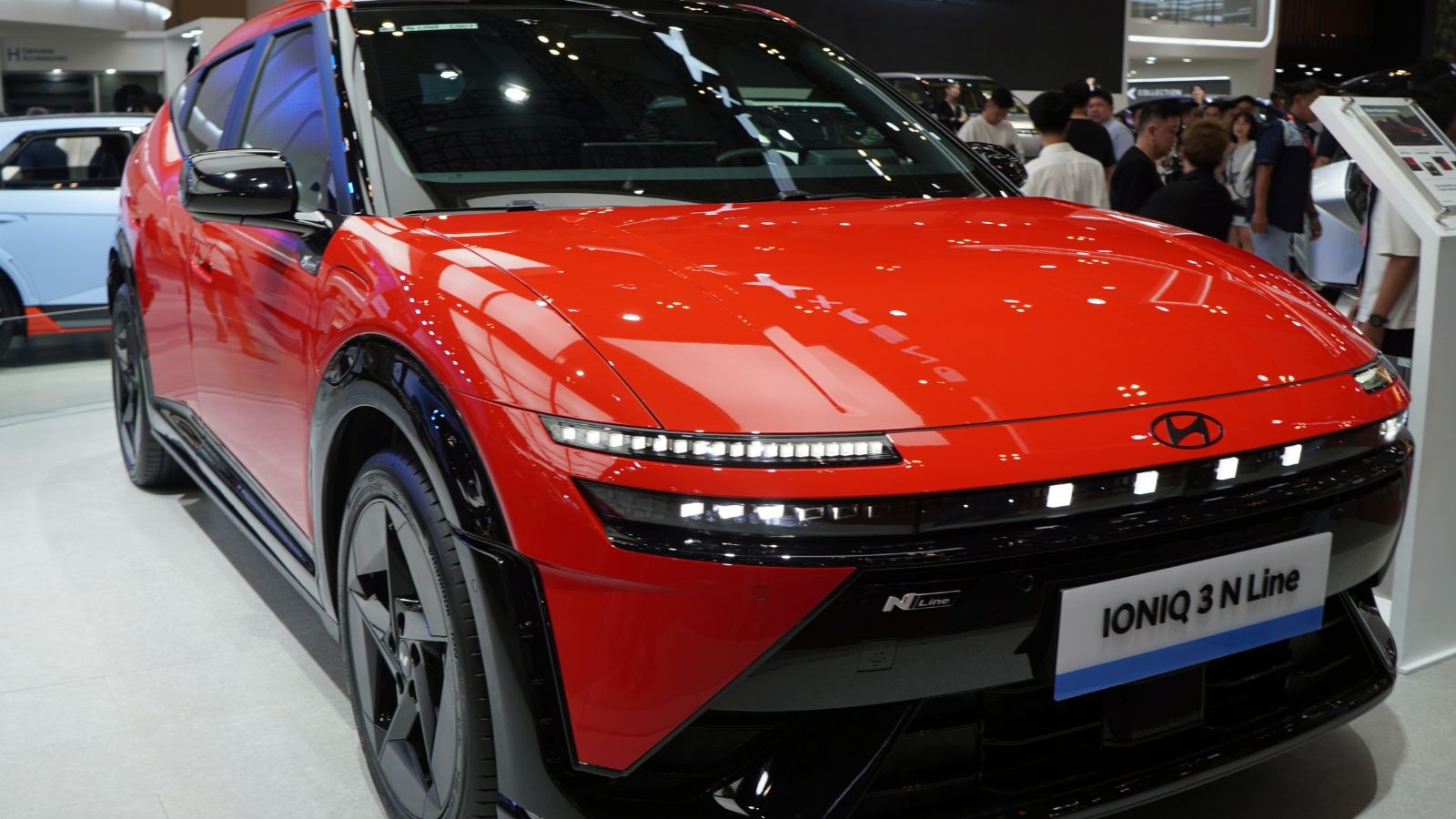
Hyundai’s newest affordable electric vehicle has made an unexpected appearance on American roads, raising questions about whether the South Korean automaker could reconsider its plans for North America. The compact IONIQ 3, already available to European buyers, was recently photographed driving in the United States despite Hyundai having no announced plans to sell it there.
The November 2026 sighting involves the sportier IONIQ 3 N Line, a version of the electric hatchback designed to combine distinctive styling with everyday practicality. With European pricing starting below £20,000 after government incentives and a long-range model offering nearly 500 kilometres of projected driving range, the vehicle represents a potentially attractive option for budget-conscious buyers.
However, the unexpected appearance does not establish that a North American launch is approaching, leaving Canadian and American drivers with an intriguing possibility rather than a confirmed new choice.
An Unexpected American Sighting Raises Questions About Hyundai’s Plans
The latest speculation began after automotive photographer KindelAuto captured images of a Hyundai IONIQ 3 N Line travelling on public roads in the United States. Electrek reported the sighting on November 24, 2026, drawing attention to a vehicle that Hyundai has primarily developed and marketed for European customers. The appearance was notable because the IONIQ 3 is already a production model overseas, rather than an early-stage concept awaiting its official unveiling.
The photographs do not establish why the vehicle was in America or whether Hyundai is conducting formal market evaluations. Automakers routinely transport vehicles between regions for engineering, validation, benchmarking and other purposes. Hyundai Motor Group vehicles such as the Kia EV5 and PV5 have also appeared in American testing without necessarily becoming available to U.S. consumers. The sighting therefore offers evidence that an IONIQ 3 has reached American roads, but not that dealerships are preparing to receive it.
Hyundai Has Already Ruled Out Immediate U.S. Sales Plans
Despite the excitement surrounding the photographs, Hyundai’s previously stated position remains unchanged. When MotorTrend asked about the vehicle following its April 2026 unveiling, a Hyundai Motor America representative confirmed that the company had no current plans to offer the IONIQ 3 in the United States. Hyundai nevertheless indicated that it continually evaluates market conditions and customer demand when deciding which vehicles belong in its American lineup.
That distinction matters because automotive product plans can evolve, particularly as manufacturers respond to changing consumer preferences and competition. However, no updated announcement confirming an American launch had emerged when Electrek published its November 24 report. The publication contacted Hyundai for clarification but had not received a response at the time of publication. For Canadian consumers, the situation is equally uncertain. Hyundai has not established a confirmed Canadian launch date, price or dealership availability for the IONIQ 3. Until the manufacturer makes a formal announcement, North American availability remains speculative.
European Buyers Can Already Purchase the IONIQ 3 at Surprisingly Low Prices
One reason the IONIQ 3 has attracted attention is its pricing in Europe, particularly the United Kingdom. Hyundai announced British pricing beginning at £22,245 for the entry-level Advance model equipped with a 42-kWh battery. After qualifying for the British government’s £3,750 Electric Car Grant, the starting price falls to £18,495. The larger-battery Advance version starts at £21,995 after the same incentive, making it an appealing option for buyers who prioritize driving range over additional luxury equipment.
The affordability becomes especially significant when compared with the higher prices traditionally associated with Hyundai’s larger IONIQ electric vehicles. However, British prices cannot be converted directly into hypothetical American or Canadian sticker prices. Taxes, import duties, equipment requirements, exchange rates and local incentives can all affect what consumers ultimately pay. The UK’s discounted price also depends on a government program that does not automatically apply elsewhere. Consequently, the IONIQ 3’s European affordability demonstrates its intended market positioning without establishing what a North American version might cost.
Two Battery Choices Offer Up to Nearly 500 Kilometres of Range
Hyundai offers the IONIQ 3 with two battery configurations designed for different driving needs. The standard-range version uses a 42.2-kWh battery and has a projected WLTP driving range of approximately 344 kilometres. Drivers requiring more flexibility can choose a 61-kWh battery, which delivers up to approximately 497 kilometres under European testing conditions, depending on the vehicle’s configuration. Both models use front-wheel drive, placing greater emphasis on efficiency and everyday usability than high-performance acceleration.
These figures could make the vehicle suitable for ordinary commuting, shopping and longer regional trips. A driver travelling 40 kilometres daily, for example, would theoretically consume less than one-eighth of the long-range model’s advertised battery range during a typical working day. Nevertheless, official range estimates are not guarantees. Highway speeds, freezing temperatures, cabin heating and wheel selection influence consumption. The European WLTP testing procedure also differs from American EPA certification, meaning buyers should not assume that the same distance figures would appear on a hypothetical Canadian or U.S. specification sheet.
The Compact Hatchback Offers More Interior Space Than Its Size Suggests
Although the IONIQ 3 is considerably smaller than Hyundai’s larger electric vehicles, its proportions prioritize usable passenger space. The standard model measures approximately 4,155 millimetres long, 1,800 millimetres wide and 1,505 millimetres tall. Its 2,680-millimetre wheelbase helps create a relatively spacious cabin within a footprint that remains manageable for crowded streets, parking garages and urban neighbourhoods. Hyundai describes the design as an Aero Hatch, combining a low front end with a carefully shaped roofline that balances aerodynamic efficiency and interior room.
Practicality extends to the vehicle’s cargo arrangements. Hyundai lists 441 litres of total storage capacity, including 322 litres in the conventional luggage compartment and another 119 litres in a concealed storage area called the Megabox. That additional space could be useful for charging cables, groceries or smaller belongings that owners prefer to keep out of sight. The IONIQ 3 also provides seating for five, although actual comfort will depend on passenger size and seating position. Its dimensions suggest a vehicle designed to accommodate everyday family responsibilities without requiring the footprint of a conventional SUV.
Charging Technology Keeps Costs Down Without Sacrificing Convenience
The IONIQ 3 uses a 400-volt electrical architecture based on Hyundai Motor Group’s E-GMP platform, distinguishing it from the higher-voltage systems associated with some larger IONIQ vehicles. Despite the less expensive electrical configuration, Hyundai reports that the standard-range battery can charge from 10% to 80% in approximately 29 minutes using suitable DC fast-charging equipment. The larger 61-kWh version requires roughly 30 minutes under the manufacturer’s stated conditions, giving both configurations relatively similar charging-stop durations.
For households with access to home charging, those fast-charging figures may be less important than the car’s everyday efficiency. Hyundai offers an 11-kW onboard AC charger, with a 22-kW option in European specifications. At compatible charging locations, that equipment provides flexibility for owners who cannot always rely on overnight residential charging. However, battery temperature, charger output and operating conditions can influence real-world charging speeds. Any future North American version would also require confirmation of its charging connector, compatibility with regional infrastructure and final equipment specifications before consumers could accurately compare charging convenience.
Hyundai’s New Infotainment System Brings Smartphone-Style Features Into the Cabin
Technology is another major selling point for the IONIQ 3. The compact hatchback is Hyundai’s first European model equipped with Pleos Connect, an infotainment platform based on Android Automotive OS. Depending on the trim, the system uses a 12.9-inch or 14.6-inch central touchscreen designed to provide access to navigation, connectivity features and vehicle settings. Higher specifications also offer a separate digital instrument display, giving drivers more information without relying exclusively on the central screen.
Hyundai has also equipped the vehicle with a selection of driver-assistance technologies that would traditionally be associated with more expensive models. Available features include Highway Driving Assist 2, a surround-view camera system, blind-spot monitoring technology and Memory Reverse Assist. The latter can help guide the vehicle backward along a previously recorded manoeuvre, potentially making difficult parking situations easier. However, these systems assist rather than replace the driver. Equipment also varies by trim and market, meaning the full technology package is not included with every entry-level IONIQ 3. The combination nevertheless helps explain why the vehicle has attracted interest beyond its relatively accessible pricing.
The Sportier N Line Version Was the Vehicle Photographed in America
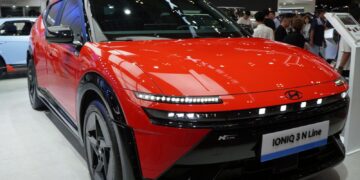
The particular IONIQ 3 reportedly photographed in the United States was not the least expensive version. Instead, KindelAuto’s images showed an N Line model, a trim distinguished by more aggressive exterior styling and additional equipment. In Britain, the range-topping N Line Evo features 19-inch alloy wheels, distinctive body details, a larger 14.6-inch infotainment display and additional camera-based assistance systems. Before government incentives, Hyundai lists the N Line Evo at £31,945, substantially more than the entry-level Advance configuration.
Importantly, the N Line designation should not be confused with Hyundai’s dedicated high-performance N vehicles. The European IONIQ 3 N Line uses a 61-kWh battery and produces approximately 135 metric horsepower, emphasizing appearance and equipment rather than exceptionally rapid acceleration. Hyundai’s European technical specifications list a 0–100 km/h time of approximately 9.6 seconds for the N Line. That makes the American sighting interesting from a product-positioning perspective: the vehicle photographed represents the premium end of the compact hatchback lineup, not necessarily the lower-cost configuration that would attract the most budget-conscious customers.
European Reviews Suggest Hyundai Has Built a Competitive Everyday EV
Early independent driving impressions provide additional context for why the IONIQ 3 has generated interest. Edmunds published its first-drive assessment in October 2026, describing the vehicle as practical, technologically advanced and surprisingly roomy for its compact dimensions. British automotive publications have also highlighted its competitive pricing, distinctive styling and generally comfortable driving characteristics. Rather than attempting to compete with powerful performance-oriented electric vehicles, the IONIQ 3 appears designed around the requirements of ordinary daily transportation.
Nevertheless, reviewers have identified compromises. Auto Express noted that rearward visibility can be affected by the unusual rear-window design, while some competitors deliver stronger acceleration. Top Gear also observed that real-world driving range can fall below official laboratory estimates, particularly in cooler conditions. Those limitations are important because affordability alone does not determine whether a car suits a particular household. Buyers must also consider visibility, ride comfort, energy consumption and usable space. Taken together, the reviews suggest a well-rounded compact EV rather than an uncompromising technical breakthrough.
Production in Türkiye Makes North American Expansion a More Complicated Decision
Unlike certain larger Hyundai electric vehicles manufactured in the United States, the IONIQ 3 is produced at the company’s İzmit facility in Türkiye. Hyundai developed the vehicle specifically for European customers, and its production arrangement reflects that regional strategy. Manufacturing closer to intended customers can help automakers coordinate supply, distribution and product requirements. The decision also means that an eventual North American launch would involve additional commercial considerations beyond simply adding the vehicle to dealership ordering systems.
Importing the IONIQ 3 into Canada or the United States would require Hyundai to evaluate regulatory compliance, logistics, pricing and expected sales volumes. Differences in safety requirements, equipment standards and market preferences could influence whether modifications were necessary. Tariff exposure and currency movements would also affect the economics of importing a relatively inexpensive vehicle from overseas. While none of these issues makes a North American launch impossible, they help explain why a successful European product is not automatically introduced elsewhere. Hyundai would need a convincing business case before committing to another market.
Canadian Drivers Still Face an Uncertain Wait for a Smaller IONIQ
For Canadian consumers, the IONIQ 3’s biggest appeal may be its combination of compact dimensions, practical range and relatively affordable European pricing. A smaller electric hatchback could offer an alternative to the SUVs and larger crossovers that dominate many dealership lineups. That possibility is particularly relevant for households seeking a second vehicle, commuters with predictable daily driving patterns or urban residents who value easier parking over additional cargo capacity.
However, there is no confirmed Canadian release date, Canadian-dollar price or local specification for the IONIQ 3 as of November 25, 2026. Hyundai has already demonstrated that the vehicle can be sold in Europe with competitive pricing and a substantial range, but American road photographs do not establish that the company’s regional strategy has changed. The clearest indications of a future Canadian launch would be an official announcement, regulatory documentation or confirmation from Hyundai Canada. Until then, the IONIQ 3 remains an intriguing example of an affordable electric vehicle that North American drivers can see, but cannot yet order through their local Hyundai dealerships.