





















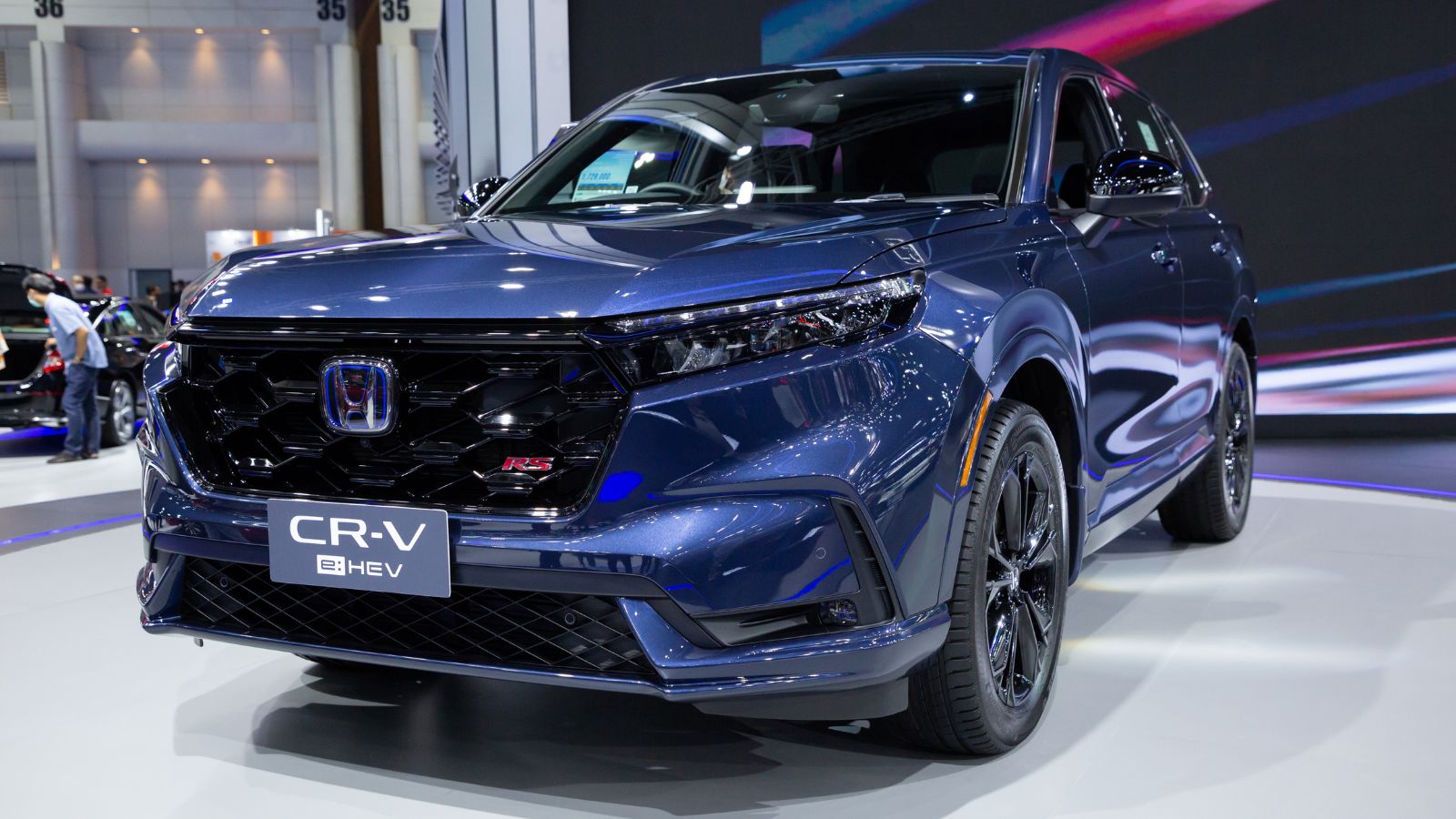
One of Canada’s most popular family SUVs is preparing for a major transformation. Honda has confirmed that the next-generation 2028 CR-V, arriving in 2027, will abandon gasoline-only engines in favour of an exclusively hybrid lineup. The decision marks a significant turning point for a vehicle that has been a familiar sight on Canadian roads for nearly three decades.
The change reflects how quickly Canadian buying habits are evolving. Hybrids already account for nearly 70% of CR-V sales, and Honda believes its next-generation technology can deliver even greater efficiency without sacrificing everyday practicality. However, eliminating the traditional gasoline option also raises important questions about affordability, performance, and what buyers can expect from one of Canada’s bestselling SUVs.
Gas-Only CR-Vs Will Disappear With the 2028 Redesign
Honda’s November 12 announcement confirms that the gasoline-only CR-V is approaching the end of its production run, but the transition will not happen immediately. The seventh-generation 2028 CR-V is scheduled to arrive in 2027, featuring an entirely hybrid-powered lineup. Honda’s current 2027 Canadian lineup still includes gasoline-powered LX 2WD, LX AWD and Sport models, alongside four hybrid variants. This means buyers shopping before the redesign arrives will still have traditional gasoline options.
The change represents more than an engine replacement. Honda is preparing to introduce a new platform, redesigned styling and an upgraded hybrid system simultaneously. The timing also carries historical significance, as 2027 marks the CR-V’s 30th anniversary in Canada. For a vehicle that has spent decades serving commuters, families and weekend travellers, the upcoming generation will mark one of its most substantial transitions. Honda is betting that the qualities responsible for the CR-V’s popularity can survive without a gasoline-only option.
Nearly 70% of Canadian CR-V Buyers Already Choose Hybrids
The decision to eliminate gasoline-only CR-Vs becomes easier to understand when examining Canadian sales. According to Honda Canada, hybrid models already represent nearly 70% of total CR-V sales. The CR-V Hybrid was also Canada’s bestselling hybrid vehicle in 2025, demonstrating that buyers have increasingly embraced gasoline-electric technology in the compact SUV segment. Honda says CR-V Hybrid sales are on pace to increase approximately 17% year over year in 2026.
That momentum extends across Honda’s Canadian lineup. The manufacturer achieved consecutive records for hybrid sales in 2024 and 2025, while electrified gasoline-electric models now account for nearly half of its new-vehicle sales in Canada. These figures suggest the company is responding to an established shift in customer preferences rather than attempting to create one. For dealerships, the transition could eventually simplify engine choices and inventory planning. For customers, it means the version already attracting most CR-V buyers will become the standard rather than an optional upgrade.
Today’s Fuel-Economy Numbers Explain the Attraction
Fuel consumption remains one of the strongest arguments for choosing a CR-V Hybrid. Honda’s published 2027 specifications show that the gasoline-powered CR-V with all-wheel drive consumes approximately 8.4 litres per 100 kilometres in combined driving. The comparable Sport Hybrid achieves approximately 6.4 L/100 km. That difference of two litres per 100 kilometres could translate into roughly 400 fewer litres of gasoline annually for a driver covering 20,000 kilometres under those rated conditions.
The advantage is particularly noticeable in city driving. The gasoline AWD model carries a city rating of 9.1 L/100 km, compared with 6.0 L/100 km for the standard hybrid. Stop-and-go traffic, school pickups and urban commutes are situations where electric assistance can deliver meaningful savings. Actual consumption will vary with temperature, traffic and driving habits, particularly during Canadian winters. Nevertheless, the existing numbers help explain why Honda sees hybrids as the CR-V’s future. Importantly, these figures describe the 2027 models, not the redesigned 2028 vehicle, whose official consumption ratings remain unannounced.
Honda’s Next Hybrid System Targets Even Greater Efficiency
The 2028 CR-V will introduce an upgraded version of Honda’s two-motor hybrid technology. Honda says its fifth-generation system is being engineered to improve efficiency by expanding the operating conditions in which the gasoline engine performs most effectively. Improvements to the hybrid drive unit are also intended to reduce energy losses. The company’s stated goal is to improve fuel economy by more than 10%, although finalized consumption ratings for the upcoming CR-V have not yet been released.
Efficiency is only part of the development program. Honda also expects its new powertrain to deliver improved performance and driving response. The current 2027 CR-V Hybrid produces 204 combined horsepower and 247 lb-ft of torque, compared with 190 horsepower and 179 lb-ft from the gasoline model. The next generation is expected to build on those strengths, but Honda has not disclosed its final output. For drivers accustomed to traditional gasoline engines, the appeal may extend beyond lower fuel bills to smoother acceleration and more immediate response in everyday traffic.
A New Electric All-Wheel-Drive System Is Coming
For Canadian drivers, one of the most interesting changes involves all-wheel drive. Honda has confirmed that the next-generation CR-V will incorporate a newly developed electric AWD unit designed to provide more precise and responsive motor control. The technology forms part of the company’s wider effort to improve driving dynamics across its upcoming hybrid lineup. Detailed specifications describing the CR-V’s final AWD configuration and performance capabilities have not yet been announced.
The potential benefits are particularly relevant in regions where drivers regularly encounter snow, slush, steep driveways and slippery intersections. More responsive control of driving force could help improve acceleration and stability when road conditions change. However, a sophisticated AWD system cannot replace appropriate tires or careful winter driving. Transport Canada recommends winter tires on all four wheels for cold, snowy and icy conditions because they improve traction, handling and braking. Ultimately, Canadian buyers will need independent winter testing to determine how much Honda’s new system improves real-world performance compared with the existing CR-V.
The 2028 CR-V Will Receive an Entirely New Platform
Honda is not simply installing a different hybrid engine into the current CR-V. The seventh-generation model will debut a newly developed platform intended to combine higher body rigidity with reduced weight. Engineers are also introducing a modular architecture that allows components to be shared more efficiently across multiple vehicles. Honda’s broader platform-development program targets improvements in vehicle stability, manufacturing efficiency and driving dynamics, potentially benefiting future models beyond the CR-V.
Those engineering changes could have practical consequences for everyday driving. A lighter, more rigid structure can help engineers improve handling and efficiency while maintaining the strength needed for a family SUV. Honda has also confirmed that the new CR-V will receive a bold exterior redesign, although complete dimensions and production styling details have not been announced. The challenge will be preserving the comfortable seating, usable cargo area and approachable driving experience that made the existing CR-V popular. Buyers will ultimately judge the redesign by how comfortably it handles a family road trip, not simply by the specifications beneath its bodywork.
The Biggest Concern Could Be a Higher Starting Price
Eliminating the gasoline engine could create an affordability challenge for Canadians who traditionally purchased entry-level CR-V models. Honda’s published Canadian prices for the 2027 lineup list the gasoline LX 2WD at approximately $40,728, while the least expensive hybrid, the Sport Hybrid, is listed at $49,647. Both figures include freight, pre-delivery inspection and specified fees but exclude taxes. The comparison also reflects differences in equipment and drivetrain, rather than just the cost of hybrid technology.
A closer comparison between 2027 Sport models shows the gasoline version listed at $47,128 and the Sport Hybrid at $49,647, a difference of approximately $2,519. The upcoming hybrid-only CR-V could narrow some equipment differences through revised trim packaging, but Honda has not announced 2028 pricing. That uncertainty matters because affordability includes more than fuel consumption. Financing costs, insurance, maintenance and long-term ownership expenses influence household budgets. Honda will need to demonstrate that its improved efficiency and standard performance deliver value without pushing the CR-V beyond the reach of price-conscious buyers.
Moving to Hybrid Power Does Not Mean Plugging In
The switch to an exclusively hybrid CR-V lineup does not mean owners will need charging stations or home electrical upgrades. Honda is introducing a conventional gasoline-electric hybrid system, rather than announcing a battery-electric or plug-in hybrid replacement. Conventional hybrids generate electricity while driving and recover energy through regenerative braking. Their batteries are charged by the vehicle itself, allowing drivers to continue refuelling at ordinary gasoline stations without relying on external charging infrastructure.
That distinction could make the transition easier for Canadians living in apartments, condominiums or older homes without dedicated charging equipment. The CR-V will still use gasoline, but its electric motors will help reduce consumption during everyday operation. Natural Resources Canada explains that conventional hybrids are particularly efficient in city driving, where repeated stops and lower-speed travel create opportunities for electric assistance. For households that regularly travel between cities or drive long distances, the familiar refuelling process remains attractive. The next-generation CR-V therefore represents a move toward greater electrification without requiring owners to change how they refuel their vehicles.
Cargo Capacity and Towing Will Be Important Trade-Offs
Efficiency improvements are appealing, but CR-V buyers also expect practicality. Honda’s published 2027 specifications reveal some differences between existing gasoline and hybrid versions. Gasoline CR-V models offer approximately 1,113 litres of cargo space behind the rear seats, while hybrids provide approximately 1,028 litres. With the rear seats folded, the figures increase to 2,166 and 2,030 litres, respectively. Although both configurations offer substantial storage, the difference can matter when carrying bulky luggage, camping equipment or large household purchases.
Towing capacity is another consideration. The current Canadian gasoline models are rated to tow up to 680 kilograms, while hybrid versions are rated up to 453 kilograms when properly equipped. That difference could matter for owners who occasionally tow lightweight utility trailers or recreational equipment. Honda has not confirmed whether the redesigned 2028 CR-V will improve these measurements. Its new platform could provide opportunities to reconsider packaging and capability, but any gains remain unverified. Buyers who depend on maximum cargo volume or towing capacity should examine the final specifications before assuming the hybrid-only model will match the outgoing gasoline version.
Toyota’s Hybrid-Only RAV4 Has Already Changed the Market
Honda’s announcement follows a similar shift by its closest compact SUV rival. Toyota introduced the redesigned 2026 RAV4 in Canada with an entirely electrified lineup consisting of conventional hybrids and plug-in hybrids. Its regular hybrid models feature a fifth-generation Toyota hybrid system, and every Canadian 2026 RAV4 receives standard all-wheel drive. Toyota rates the RAV4 LE AWD at an estimated 5.5 L/100 km combined, providing a benchmark that Honda’s redesigned CR-V will face when it arrives.
Competition between these two SUVs is especially significant because both have strong Canadian manufacturing connections and established reputations among family buyers. Toyota also offers a plug-in hybrid option, giving customers an additional level of electrification that Honda has not announced for the 2028 CR-V. The challenge for Honda will be demonstrating that its revised powertrain, driving characteristics, interior comfort and pricing can compete with Toyota’s latest offering. While the 2026 RAV4 and current 2027 CR-V provide useful context, a definitive comparison will require Honda’s final 2028 specifications and independent road testing.
Ontario’s Honda Factory Will Play a Major Role
The CR-V’s transition carries particular significance for Ontario’s automotive industry. Honda builds Canadian-market CR-Vs at its manufacturing facilities in Alliston, where production of the model began in 2012. The operation employs more than 4,000 people and serves as the North American lead plant for the CR-V. Honda reported producing approximately 401,000 vehicles at its Canadian facilities in 2025, illustrating the scale of the manufacturing operation supporting its domestic and North American business.
On November 9, 2026, Honda announced a $166-million capital investment in its Alliston facilities as part of a broader $867-million commitment that includes future planned spending and related expenses. The upgrades will support next-generation hybrid production, gasoline-powered models and engine manufacturing. The distinction is important: ending the gasoline-only CR-V does not mean Honda is abandoning gasoline engines across its manufacturing operations. Instead, the company is preparing its factories for a product mix increasingly shaped by hybrid demand. For Canadian suppliers, workers and local communities, that investment gives the CR-V’s transformation an economic significance beyond vehicle showrooms.
Several Important Questions Remain Before the 2028 CR-V Arrives
Although Honda has confirmed the new CR-V’s hybrid-only direction, several details remain unresolved. Canadian pricing, complete trim specifications, final horsepower, official fuel-economy ratings and detailed cargo measurements have not been released. Honda has also not provided a precise Canadian dealership launch date beyond the planned 2027 arrival. Buyers considering a purchase will need to distinguish between the performance goals Honda has announced and the specifications that will eventually appear on production vehicles.
The next generation will also test whether Honda can preserve the CR-V’s familiar appeal while eliminating one of its traditional purchasing options. Existing customers value the vehicle for its versatility, comfort and suitability for everyday family life. Better fuel efficiency and a more sophisticated drivetrain could strengthen those qualities, but affordability and practical capability will remain essential. With nearly seven in ten Canadian CR-V buyers already selecting hybrid power, Honda has substantial evidence supporting its decision. The remaining challenge is ensuring that an entirely hybrid-powered CR-V continues to satisfy Canadians who previously chose the gasoline version.