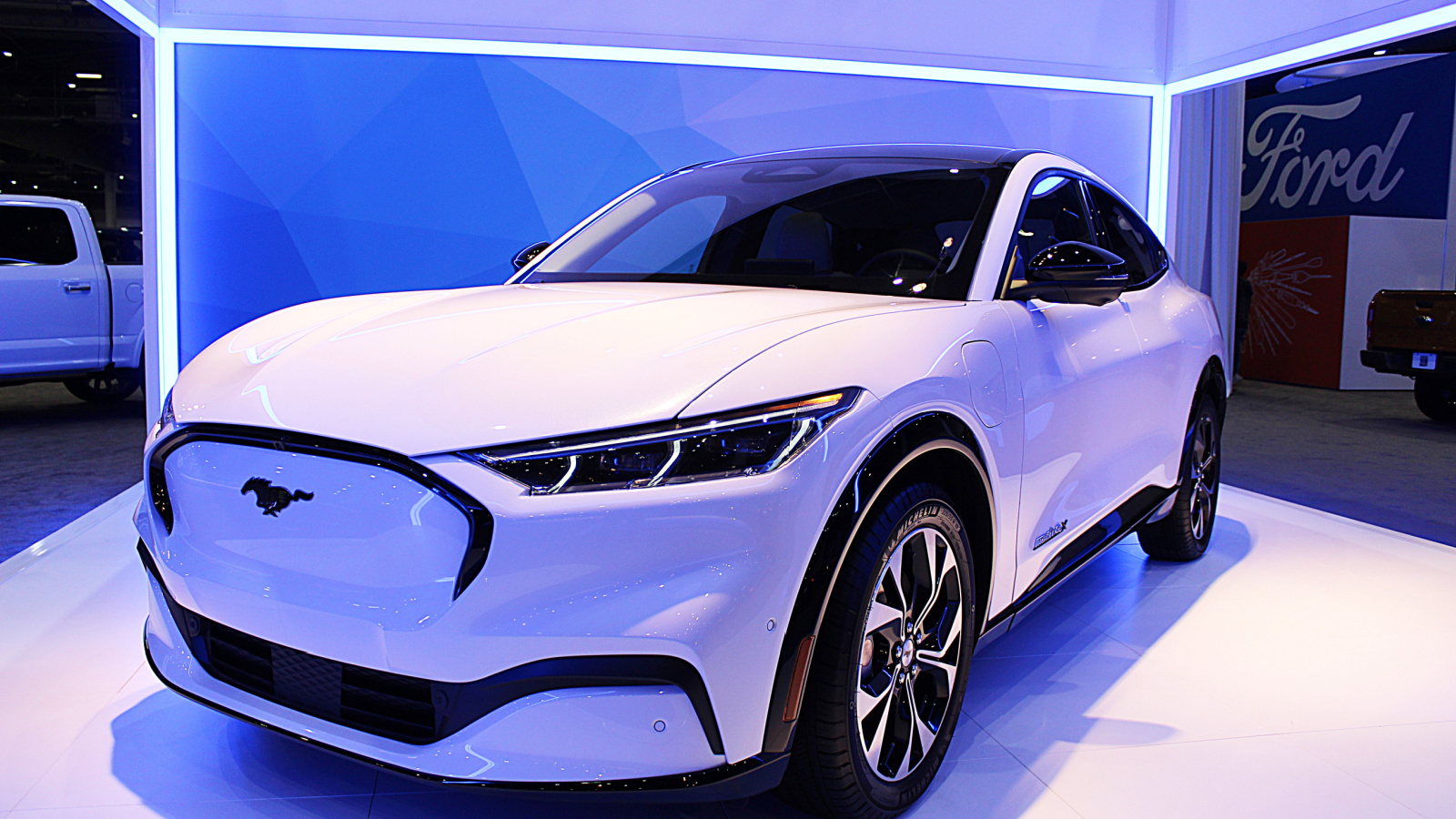
The Ford Mustang Mach-E is becoming difficult to miss on Canadian vehicle-shopping sites. One major marketplace can return 200 Mach-E results, while other listing databases show hundreds more new examples and an even larger pool once used vehicles are included. That visibility makes Ford’s electric crossover one of the most heavily represented EVs currently facing Canadian shoppers.
The numbers, however, require context. A 200-result page should not be confused with the country’s total dealer inventory, and a high listing count does not automatically mean hundreds of cars have been gathering dust. What the data does show is a competitive market with substantial Mach-E supply, frequent price adjustments, government incentives and considerably more choice than many EV buyers encountered only a few years ago.
The 200-Unit Figure Is Only Part of the Inventory Story
CarGurus searches for the Mustang Mach-E can display 200 Canadian results, which helps explain the eye-catching inventory number. The important limitation is that 200 appears to function as a result ceiling on some searches rather than a complete count of every Mach-E available nationwide. That distinction matters when evaluating whether dealers are truly “sitting on 200 units.” The visible supply is actually much larger when other databases are consulted.
AutoTrader recently showed more than 800 new Mustang Mach-E listings in Canada, while automotive-market database OmniaAuto reported 2,130 priced Mach-E listings from 399 sellers in its September 8 update. Of those, 1,764 were listed as 2026 models. OmniaAuto says its data is deduplicated to one vehicle per listing record, although marketplaces can still differ in how they classify dealer-ordered, incoming, demonstration and used vehicles. The safest conclusion is that Canada has abundant Mach-E availability—not that precisely 200 physical vehicles are sitting unsold on lots.
The Mach-E Is Exceptionally Visible Against Several EV Rivals
Even after accounting for differences among listing platforms, the Mach-E’s presence is striking. A recent AutoTrader snapshot returned 823 new Mustang Mach-E listings. By comparison, the same marketplace showed 131 new Hyundai Ioniq 5s, 199 new Kia EV9s and 63 new Volkswagen ID.4s in recently indexed searches. Those figures can move quickly as vehicles sell, arrive or are removed from dealer feeds, so they are better viewed as market snapshots than permanent rankings.
They nevertheless illustrate how aggressively Ford’s electric crossover is represented in dealer inventories. Tesla is difficult to compare directly because the company primarily sells through its own network rather than the traditional franchised-dealer system that populates third-party marketplaces. Chevrolet’s Equinox EV also has a substantial presence, with hundreds of electric Equinox listings appearing across new and used searches. For shoppers, the broader message is clearer than any single ranking: the Mach-E is available in unusually large numbers across Canada, giving buyers considerable freedom to compare colours, trims, drivetrains and advertised prices.
A Large Supply Does Not Mean Every Mach-E Is Sitting for Months
A long list of available vehicles can easily look like evidence of weak demand, but turnover data tells a more nuanced story. OmniaAuto’s September market snapshot found a median time to sell of approximately 18.1 days among 1,556 Mach-E listings that left the market. The middle half took roughly 8.6 to 32.1 days. Those numbers suggest many listed vehicles were moving through the market rather than simply occupying dealer lots indefinitely.
Pricing pressure was visible, though. OmniaAuto reported that 31.1 per cent of completed listings had their asking price reduced before leaving the market, with a typical reduction of about $1,828. Vehicles that were discounted took longer in that dataset—27.8 days compared with 14.9 days for those that were not discounted. That does not prove a price cut caused a slower sale; harder-to-sell vehicles may simply be more likely to receive reductions. It does show why raw inventory counts should not be interpreted alone. Supply, turnover and pricing behaviour tell different parts of the story.
Ford Has Made the 2026 Mach-E More Accessible on Price
Ford Canada currently advertises the 2026 Mustang Mach-E from $46,590 for the Select, while the Premium starts at $48,590. The performance-oriented GT moves considerably higher at $63,090, and the Rally starts at $68,590. That range gives dealerships several different versions to stock, which helps explain why one model can produce such a large number of listings without every vehicle competing for exactly the same buyer.
Range also varies substantially by configuration. Ford lists the standard-range rear-wheel-drive Select at approximately 406 kilometres, while standard-range eAWD is rated at 380 kilometres. An extended-range eAWD version reaches an estimated 483 kilometres. Premium buyers can choose an extended-range rear-wheel-drive configuration rated at as much as 515 kilometres. Those are Government of Canada-approved estimated figures, and real-world results depend on temperature, speed, accessories, battery condition and other factors. For Canadians comparing vehicles on dealer lots, checking the exact battery and drivetrain matters more than simply seeing “Mach-E” on the listing.
The Federal EV Incentive Gives Dealers Another Selling Tool
Canada’s Electric Vehicle Affordability Program significantly changes the numbers for qualifying versions. For 2026, eligible battery-electric vehicles can receive an incentive of up to $5,000. For vehicles subject to the regular price limit, the final transaction value must be $50,000 or less. The full amount is available on qualifying purchases and leases of at least 48 months, with shorter eligible leases receiving prorated support.
Transport Canada’s eligible-vehicle list includes multiple 2026 Mach-E configurations, including the Select RWD Standard Range, Select eAWD Standard Range, Premium RWD Extended Range and Premium eAWD Standard Range. Eligibility still depends on the individual transaction satisfying program rules, so the presence of a model name on the list does not mean every highly optioned Mach-E automatically receives $5,000. For dealerships carrying substantial stock, however, incentive eligibility provides an important way to make lower-priced trims more competitive. A buyer comparing a Mach-E near the $50,000 threshold with another EV should therefore calculate the final eligible transaction rather than comparing sticker prices alone.
Canadian EV Demand Has Started Growing Again
The larger Mach-E inventory is arriving during a Canadian EV market that has regained some momentum. Statistics Canada recorded 58,811 new zero-emission-vehicle registrations during the second quarter of 2026. That was 26.7 per cent higher than the same quarter of 2025 and up substantially from the 43,113 registrations recorded during the first quarter of 2026. Zero-emission vehicles represented 10.7 per cent of all new vehicle registrations in the quarter.
The total was also the highest quarterly number since the fourth quarter of 2024, when 81,216 new ZEVs were registered. Growth was not uniform across the country: Ontario registrations increased 46.6 per cent year over year, while British Columbia rose 31.5 per cent and Quebec increased 12.5 per cent. Those numbers make the Mach-E inventory situation more interesting. Dealers are not facing a Canadian market in which EV demand has disappeared entirely. Instead, they are competing for buyers in a recovering segment that now offers far more models, forcing established electric crossovers to fight harder on price and availability.
Ford Is Already Using Discounts and Allowances to Move Metal
Ford’s own Canadian shopping pages show that price competition is more than theoretical. A current promotional example for a 2026 Mustang Mach-E Select AWD combines the federal EV incentive with a $1,500 delivery allowance when eligibility requirements are met. Ford makes clear that participating dealers establish their own selling prices and may sell or lease vehicles for less, while inventory and program conditions can affect availability.
Individual dealer advertisements reinforce the same pattern. Some Canadian retailers are displaying Mach-Es below their original advertised or suggested prices, sometimes alongside government rebates. Such listings should be read carefully because discounts may depend on financing, leasing, loyalty programs, trade-ins or regional incentives. Still, the abundance of competing vehicles gives shoppers something that was scarce during earlier periods of vehicle shortages: alternatives. If one dealer’s colour, trim or price does not fit, another comparable Mach-E may be only a short drive away. That competitive pressure is one practical consequence of having so many vehicles advertised simultaneously.
One Model Name Covers a Surprisingly Broad Lineup
Part of the inventory story comes down to how many different Mach-Es Ford can put under the same badge. The 2026 lineup stretches from rear-wheel-drive Select models designed around lower pricing to all-wheel-drive Premium versions and higher-performance GT and Rally variants. Battery capacities include 73-kWh standard-range and larger extended-range packs, while horsepower varies substantially according to battery and drivetrain combination.
Ford lists 264 horsepower for a standard-range rear-wheel-drive configuration and 325 horsepower with standard-range eAWD. Extended-range eAWD Select and Premium configurations are rated at 370 horsepower. The GT moves to 480 horsepower, while its available performance upgrade raises torque to 700 lb-ft. The Rally also uses a 480-horsepower setup with 700 lb-ft of torque. This variety helps explain why dealers can carry significant Mach-E inventory without every unit being interchangeable. A commuter prioritizing range, an AWD buyer preparing for winter and someone wanting GT performance are technically shopping the same model family but looking at substantially different vehicles.
Heavy Inventory Could Be Good News for Canadian Buyers
The immediate advantage of a crowded listing page is choice. A buyer no longer has to assume that the only available Mach-E must be accepted at the advertised price simply because another one could take months to arrive. Ford’s own inventory system currently distinguishes among vehicles that have just arrived, units ordered by dealers and other available stock, while third-party marketplaces can also contain vehicles in transit. That is another reason to confirm whether a promising listing is physically available before travelling to a dealership.
Price data suggests competition is already affecting some transactions. With roughly three in ten completed Mach-E listings in OmniaAuto’s dataset receiving a price reduction before leaving the market, advertised MSRP is not always the final word. Yet the same dataset’s roughly 18-day median turnover argues against portraying every Mach-E as unwanted inventory. The Canadian story is instead one of plentiful supply meeting a recovering but increasingly competitive EV market. For shoppers, that combination may be more important than whether a particular search page stops counting at 200.
The Bigger Story Is Competition, Not Simply Unsold Cars
The Mach-E helped establish the idea that a mainstream North American automaker could sell an electric crossover alongside its familiar gasoline vehicles. The market surrounding it is now much tougher. Hyundai, Kia, Chevrolet, Nissan, Volkswagen and numerous premium brands offer electric crossovers, while Tesla remains a major direct competitor outside the conventional franchised-dealer model. More choices mean a vehicle can remain successful while dealers simultaneously face pressure to keep pricing attractive.
That is why the current listing numbers deserve a measured interpretation. A CarGurus page showing 200 results is real, but it is not proof that Canada has exactly 200 unwanted Mach-Es. Other sources show the actual advertised pool is much larger, while turnover data indicates many vehicles continue to find buyers. The more consequential development is how much leverage that supply creates. Canadian consumers can compare more inventory, search farther afield and pay closer attention to incentives and discounts. For Ford dealers, the challenge is making one Mach-E stand out when another similar one may be listed only a few clicks away.