










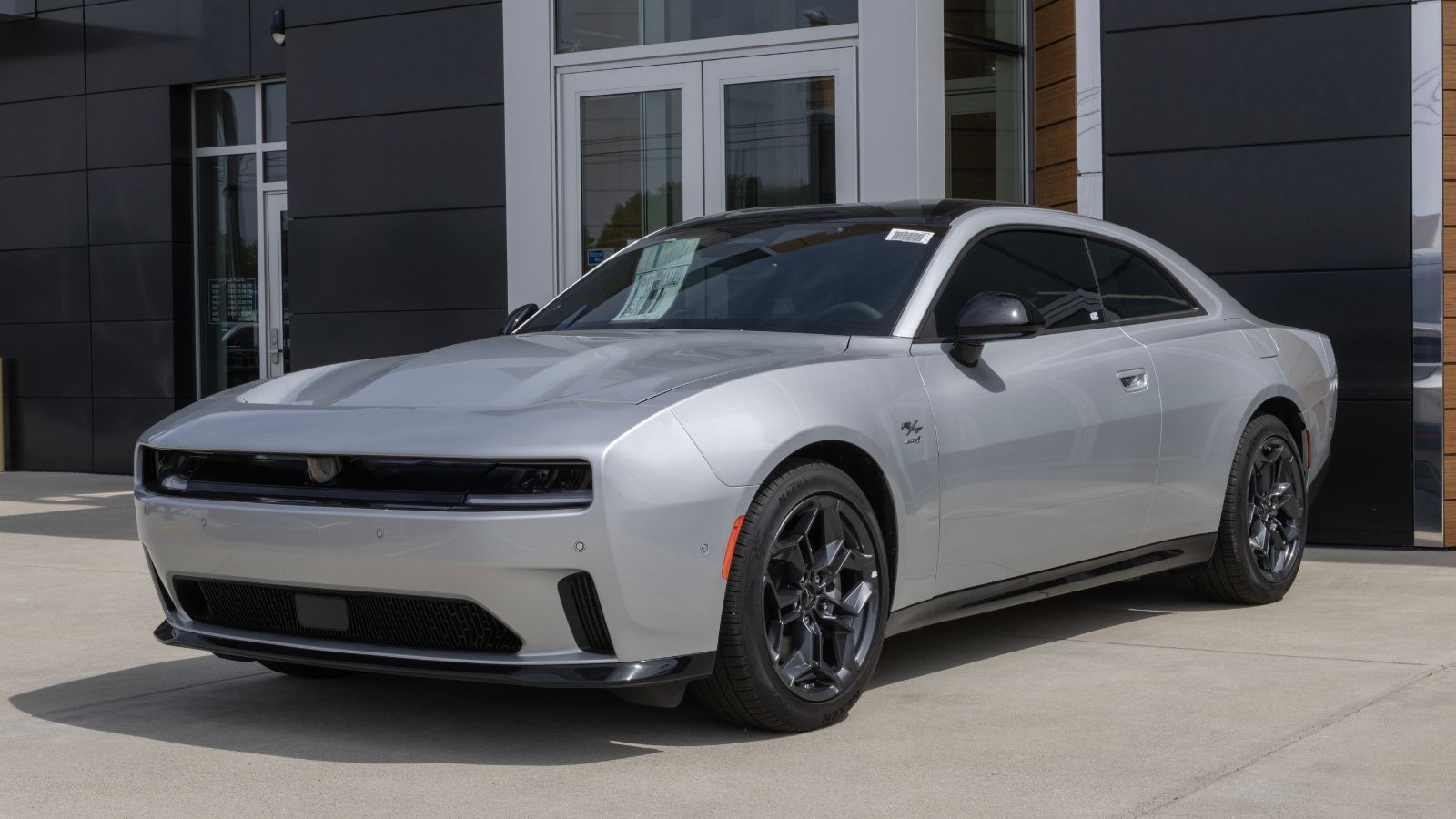
The Dodge Charger Daytona has vanished from Canada’s active online shopping listings, but the electric muscle car has not been cancelled. Stellantis told Canadian automotive publication Empty Tank that dealer inventory had run out, prompting the removal in early November 2026.
The company says the vehicle will return to its Canadian listings when stock becomes available again, although it has provided no timetable. The development leaves an unusual gap in Dodge’s lineup: a high-performance electric car assembled in Ontario is temporarily missing from the storefront meant to connect Canadian shoppers with vehicles. Behind that gap is a bigger story involving production decisions, changing model plans and the difficult transition from traditional muscle cars to electric performance.
A Missing Listing That Immediately Raises Questions
Someone visiting Dodge Canada may notice that the gasoline-powered Charger models remain in the current shopping experience while the electric Daytona is no longer presented as an available choice. Empty Tank reported on November 7 that the electric model had been removed in early November. For shoppers who remember the Daytona as the headline act of Dodge’s new generation, the absence is noticeable. There is a meaningful difference between a vehicle that cannot currently be located through dealership inventory and one that its manufacturer has formally discontinued.
The distinction is especially important because some Dodge Canada webpages still contain Daytona information, including an older 2025 model page and references within broader Charger material. Those lingering pages do not establish that a vehicle is in stock. Equally, the missing active listing does not mean every online mention has been erased. It is an availability story, not evidence of a complete digital shutdown.
Stellantis Says Canadian Dealer Inventory Is Exhausted
The explanation comes from Stellantis itself, according to Empty Tank, which contacted the automaker about the missing vehicle. The company said Canadian dealership inventory of the Charger Daytona had run out. Dodge’s online shopping tools are designed to help customers match their preferences with vehicles available through dealers; without inventory to display, keeping the model prominent as a shopping option becomes less useful. Stellantis said the listing would be restored when Canadian dealerships have electric Daytonas again.
What Stellantis did not provide is relevant: a date for fresh stock, a production schedule specific to the Canadian market or a breakdown of how many had been available before inventory was depleted. An empty pipeline can result from limited deliveries as well as strong buying activity. Without Canadian model-level sales and shipment figures, it would be premature to describe this development as a sales triumph—or as proof that production has stopped.
The Daytona Remains Part of Dodge’s Product Plans
A model’s absence from an inventory search can sound final, particularly for buyers watching automakers change their electric-vehicle strategies. But Stellantis explicitly told Empty Tank that the Charger Daytona had not been discontinued. That position is consistent with Dodge’s previously announced 2027 Charger programme, which continues to include the all-electric Daytona Scat Pack alongside gasoline-powered versions. The company’s product plans and the vehicles actually available on dealer lots, however, are not the same thing.
That distinction matters to someone considering whether to hold off on purchasing another performance car. A manufacturer can continue to advertise a future variant while current stock is unavailable, and it can revise delivery plans without formally cancelling a nameplate. Dodge has identified the electric Daytona as part of the Charger family. For Canada, the unanswered question is not whether the name survives, but when the advertised product can once again be purchased through ordinary channels.
The Situation Has a Direct Connection to Windsor, Ontario
The Charger’s Canadian roots make this more than a routine website update. Dodge builds the new-generation Charger at Stellantis’ Windsor Assembly Plant in Ontario, using a platform designed to accommodate electric and combustion powertrains. That means the Daytona and its gasoline SIXPACK siblings share a production home, even though their propulsion systems differ. For workers and families tied to the plant, the ability to keep both versions in the market has significance beyond a single model’s online availability.
Stellantis has also made commitments to the Windsor operation. In December 2025, the company announced that it had surpassed 1,000 new hires for a third shift, citing anticipated demand for Chargers and Chrysler minivans. Those investments underline the importance of the plant in the company’s plans. Yet an inventory shortage alone reveals little about shift schedules or future employment; Stellantis has not attributed the Daytona’s disappearance to any new Windsor production stoppage.
The EV Was Designed to Challenge Muscle-Car Expectations
When Dodge introduced the eighth-generation Charger in March 2024, electricity arrived before the new gasoline-powered models. The first two-door Daytona was announced in two configurations: an R/T rated at up to 496 horsepower and a Scat Pack at 670 horsepower. Both offered all-wheel drive, departing from the rear-wheel-drive image associated with American muscle cars. Dodge also developed its Fratzonic Chambered Exhaust system to give the electric Charger an audible personality rather than leaving its acceleration almost silent.
The Scat Pack’s manufacturer-estimated figures remain striking: zero to 60 mph in 3.3 seconds and a quarter-mile run of 11.5 seconds, with 627 pound-feet of torque. Those are performance claims rather than guaranteed results in every condition. The challenge for Dodge has never been power alone. It has been convincing enthusiasts that instant electric acceleration, distinctive styling and a synthesized sound experience can preserve enough of the character that made previous Chargers desirable.
A 2026 Trim Decision Had Already Complicated the Lineup
The current absence follows an earlier change that narrowed the electric Charger’s choices. In May 2025, Dodge said production of the Daytona R/T would be postponed for the 2026 model year while it assessed the effect of U.S. tariffs. That decision removed the 496-horsepower entry point from the 2026 electric range, leaving the more powerful Scat Pack as the focus. Dodge described the step as a postponement rather than a permanent cancellation.
The move was relevant because the car is built in Canada for a North American market exposed to cross-border trade uncertainty. The Canadian Press reported that Stellantis intended to continue producing other electric Charger variants and said the R/T decision would not affect Windsor employment. None of that establishes that tariffs directly caused November’s inventory situation. Still, the episode shows how external trade policy had already influenced which electric Charger configurations Stellantis was prepared to build and offer.
Gasoline-Powered Chargers Still Give Buyers an Alternative
While the Daytona is missing from active Canadian availability listings, the combustion-engine Charger remains an option. Dodge’s SIXPACK range uses a twin-turbocharged 3.0-litre inline-six rather than the HEMI V8 engines familiar to longtime Charger fans. The standard-output R/T is rated at 420 horsepower, while the higher-output Scat Pack produces 550 horsepower. Dodge markets the new Charger in both two-door and four-door forms, giving shoppers choices beyond the fuel-versus-electricity debate.
For a buyer who wants the Charger’s broad stance and performance image without arranging home charging, the gasoline models may be easier to accommodate in everyday life. They are not perfect substitutes, however. A 550-horsepower turbocharged six delivers power differently from a 670-horsepower dual-motor EV, and operating costs, sound and driving habits can affect the choice. The continued presence of the SIXPACK also demonstrates why the disappearance of the electric listing should not be mistaken for the disappearance of the Charger nameplate itself.
The Four-Door Electric Version Is Still a Missing Piece
Dodge outlined an ambitious body-style expansion for the new Charger. Its 2024 launch materials anticipated four-door electric Daytona variants after the two-door cars, and later Canadian marketing pages carried projected availability dates that have since passed. Yet Empty Tank reported in November 2026 that only the two-door electric Charger had been offered in Canada. The four-door gasoline Charger, by comparison, was already part of the market. That matters because practicality can be decisive for buyers seeking performance without giving up easy rear-seat access.
It also illustrates why future vehicle announcements should not be confused with confirmed local deliveries. Dodge’s broader lineup material includes references to four-door Daytona models, but those references do not establish that Canadian customers can find one on a dealer lot today. Until Stellantis announces a Canadian timetable, the four-door EV remains an outstanding part of the original product promise rather than a reliably available shopping choice.
A 2027 Charging Upgrade Offers a Sign of Continuity
One indication that Dodge continues to plan around the electric Charger is its charging strategy for the 2027 model year. Stellantis announced that the 2027 Daytona would be its first vehicle launched with a built-in North American Charging Standard port. That allows the car to use compatible Tesla Supercharger equipment without an adapter required by earlier Charger Daytonas. The change responds to a practical ownership concern: performance may draw attention, but dependable public charging access often determines whether an EV fits a household’s routines.
Stellantis has also said eligible earlier Daytona model years can access compatible Superchargers using an approved adapter. These announcements do not establish when another electric Charger will appear on Canadian dealer lots. They do, however, indicate continuing technical support and future planning for the nameplate. For prospective buyers, charging compatibility is a feature to compare, particularly when considering remaining older-model vehicles versus a future 2027 car.
Running Out of Stock Is Not the Same as Strong Demand
The Canadian inventory explanation needs to be weighed against sales data. Stellantis reported just 767 U.S. Charger battery-electric sales in the first nine months of 2026, down from 7,075 during the same period in 2025. Third-quarter U.S. deliveries fell to 233 from 2,776 a year earlier. These are U.S., not Canadian, sales figures, but they caution against treating a lack of Canadian dealer inventory as automatic evidence that the electric Charger is flying off lots.
The wider Canadian EV market tells a different, broader story. Statistics Canada counted 58,811 new zero-emission vehicle registrations in the second quarter of 2026, representing 10.7% of all new registrations. Battery-electric registrations increased 37.4% year over year. Demand for electrified vehicles can grow overall even while a high-performance model struggles. Without more Canadian Daytona figures, the most supportable conclusion remains simple: Stellantis says stock is gone, but the reason for that imbalance is not fully disclosed.
Buyers Now Face an Open-Ended Wait
For Canadians seeking an electric Charger, the next useful development will be a confirmed return of dealer inventory, not merely another webpage. Stellantis told Empty Tank the Daytona would be listed again once vehicles become available, but it did not identify a date. Shoppers can contact Dodge dealerships directly to ask whether a suitable car is physically in stock, allocated or incoming, and should distinguish a dealer’s general model advertisement from confirmed availability.
The same applies to trim, price and charging equipment. A previously marketed R/T, a Scat Pack from an earlier model year and a future NACS-equipped Daytona may differ in specifications and availability. Before committing to a purchase, buyers should obtain written confirmation of the vehicle and terms. For now, the absence of a current listing creates inconvenience and uncertainty, not a definitive ending. Dodge has kept the electric Charger in its plans; Canadian shoppers still await an inventory update.