


























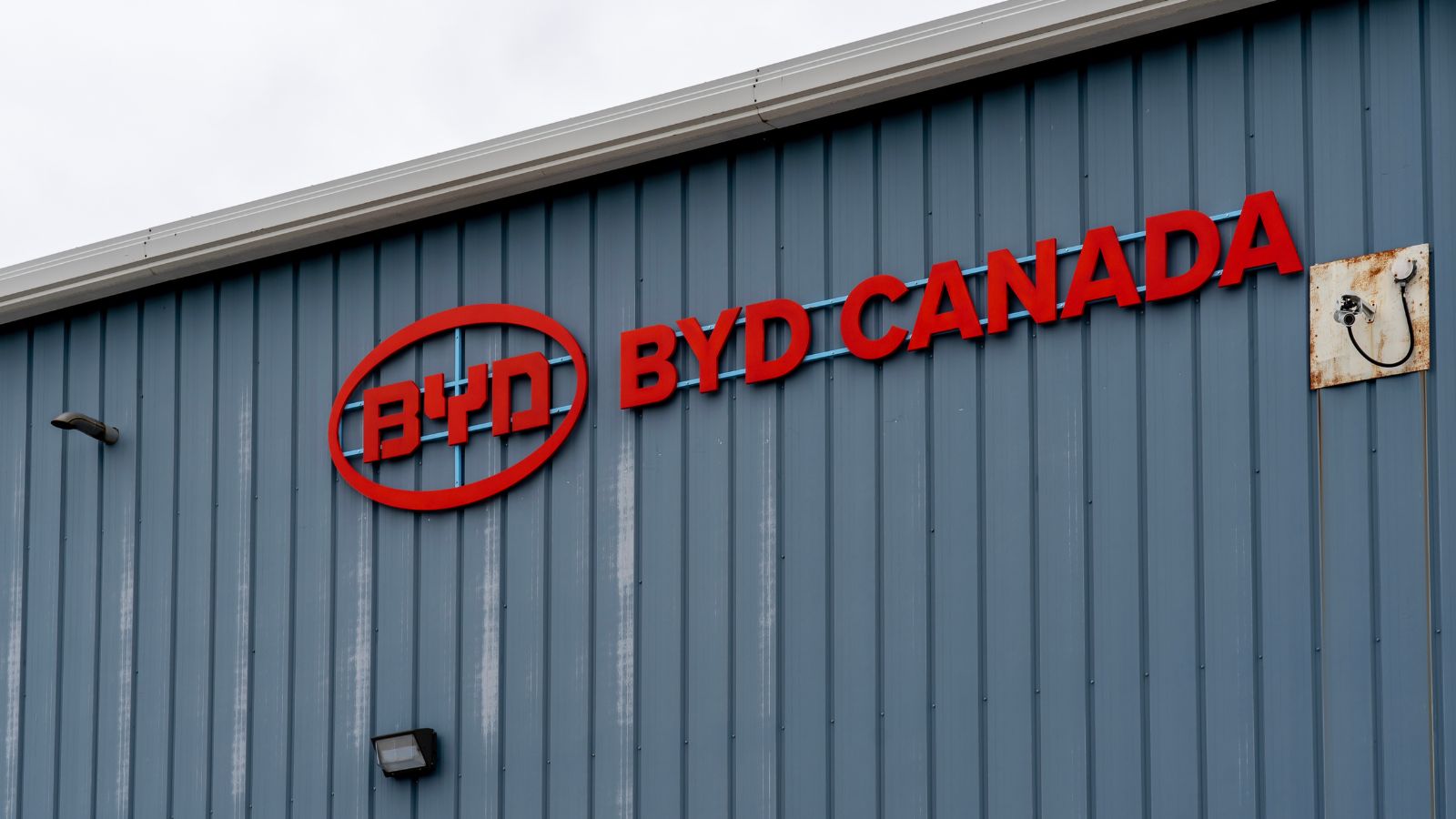
Canada’s electric-vehicle market has gained a new storefront, but for now the doors are digital and firmly closed. BYD has established a dedicated Canadian website carrying a prominent “Coming Soon” message, giving the Chinese automaker its clearest official consumer-facing presence in the country to date. What the page does not provide may be just as important: there are no Canadian vehicle prices, confirmed model lineup, dealer locator, launch date, reservation system or ordering portal.
The timing nevertheless matters. BYD has been hiring Canadian staff, exploring a dealership network and positioning itself for a market dramatically reopened by Ottawa’s new quota for Chinese-built electric vehicles. The website moves that preparation into public view, while carefully stopping short of turning anticipation into an actual sales launch.
The Website Is Real, but the Canadian Showroom Is Not Open Yet
BYD’s Canadian page makes the company’s intentions considerably more tangible than another job posting or industry rumour. Canada now appears as an official BYD market on the automaker’s global web infrastructure, with both English and French versions available. The Canadian site introduces BYD, its battery and charging technology, vehicle-safety achievements and global sales scale. It also identifies a Canadian business presence in Markham, Ontario. For potential buyers who have watched months of speculation about whether BYD would actually proceed with a Canadian expansion, the shift from indirect preparation to a consumer-facing web page is notable.
Yet the site is still closer to a corporate introduction than an online dealership. Visitors cannot select a Canadian model, compare trim levels, calculate payments or find an authorized retail location. No Canadian MSRP is displayed and no firm arrival date appears. That distinction is important because automotive websites are often built in stages. Establishing the local domain, legal framework and marketing material can happen well before certified vehicles and dealer inventory are ready for customers. “Coming Soon,” in this case, is meaningful—but deliberately unspecific.
BYD’s Own Fine Print Makes Clear That Reservations Have Not Started
The strongest evidence that Canada has not reached the retail-launch stage appears in BYD’s own Canadian terms of use. The company explicitly states that its website does not currently permit vehicle purchases, leases, financing applications, reservations, pre-orders or deposits. That wording removes much of the ambiguity surrounding the new page. Someone encountering the Canadian branding might reasonably assume that a reservation program is about to appear, but BYD has formally separated its online presence from any transaction process for the moment.
The terms became effective on August 3, 2026, suggesting that the legal foundation for the Canadian web operation was being assembled before the “Coming Soon” page attracted widespread attention later in August. The site lists BYD Canada Company Limited and a Markham address, reinforcing that Canadian preparations extend beyond a translated global landing page. Still, nothing in those legal documents establishes what Canadians will eventually pay, which vehicles will be offered or when contracts can actually be signed. Until BYD activates a configurator, reservation mechanism or dealer sales process, prospective customers remain observers rather than buyers.
Hiring Suggests BYD Is Building the Organization Behind the Website
The Canadian website is appearing alongside a much less glamorous but arguably more consequential sign of expansion: recruitment. Recent reporting identified roughly 11 Canadian management and professional vacancies associated with BYD operations, including positions connected to sales, marketing, dealer-network development, operations, infrastructure, legal affairs, human resources, product management and regional sales. Several Toronto-area roles were structured as on-site positions, while additional openings appeared in Vancouver, giving the company an employment footprint spanning two of Canada’s largest EV markets.
Those roles help explain why the web launch deserves attention even though it contains little product information. A new automaker needs far more than vehicles at a port. Dealer contracts must be negotiated, marketing campaigns localized, parts systems established, technicians supported, warranties administered and regulatory obligations managed. A network-development manager, for example, becomes valuable months before a showroom opens because franchise locations need property, financing, construction plans and operating agreements. The emerging Canadian staff therefore gives the “Coming Soon” message more weight: the website is appearing while BYD is simultaneously assembling some of the people required to turn a market-entry plan into an operating retail business.
A 20-Dealer Ambition Has Been Reported, but BYD Still Has Not Published a Retail Map
Canadian dealership planning predates the new website by several months. In March, automotive retail consultant Farid Ahmad said his Markham-based firm was working with BYD as the automaker pursued a Canadian dealer network. The reported objective was roughly 20 dealerships during the first year of operations, beginning in the Greater Toronto Area before expanding into Vancouver, Montreal and Calgary. Three possible GTA locations were reportedly already being discussed at that stage. That is substantially more concrete than speculation about which BYD model might appear first.
Even so, the difference between a network target and an opened dealership remains substantial. BYD’s Canadian website currently provides no dealer locator and does not publicly identify any authorized passenger-vehicle retailers. Site negotiations can also change before stores open, meaning an early target should not be treated as a final list of locations. What the dealership work demonstrates is that BYD has considered a conventional physical retail footprint rather than relying entirely on online sales. For Canadian customers, that could eventually matter for service access, warranty repairs and test drives—issues that become particularly important when an unfamiliar brand enters a market dominated by manufacturers with established national networks.
Ottawa’s New China-EV Quota Changed the Economics of a Canadian Launch
BYD’s renewed Canadian momentum would be difficult to understand without the dramatic shift in federal trade policy during 2026. Canada had imposed a 100% surtax on Chinese-made electric vehicles in 2024, creating a formidable obstacle for companies hoping to import competitively priced cars from Chinese factories. That changed on March 1, 2026. Under a new Canada-China arrangement, the surtax was repealed for vehicles admitted under a country-specific quota, with eligible imports instead facing Canada’s 6.1% most-favoured-nation tariff.
The initial annual quota is 49,000 vehicles. Its first six-month period, running from March through August 2026, makes 24,500 vehicles available on a first-come, first-served basis. The second period begins September 1 with another 24,500 vehicles plus unused volume carried forward from the first period. Longer term, the quota is scheduled to grow by 6.5% annually, while an increasing portion is to be reserved for vehicles imported at $35,000 or less. The policy does not guarantee BYD market share, but it removes the tariff wall that previously made a mainstream launch far harder to justify.
The Missing Canadian Price May Become BYD’s Most Important Number
Price is likely to determine whether BYD becomes merely another EV brand in Canada or a genuine source of competitive pressure. The company has built much of its global growth around extensive vertical integration, battery expertise and vehicles positioned across a broad range of price categories. Yet Canadian shoppers still have no official MSRP to compare with established products from Chevrolet, Hyundai, Kia, Tesla, Ford or other manufacturers. That silence is particularly important because a widely circulated claim earlier in 2026 that a BYD model would start around C$25,000 was traced to an imposter social-media account rather than a verified company announcement.
There is another wrinkle: imported Chinese-built BYDs would not automatically receive Canada’s new federal Electric Vehicle Affordability Program incentive. For 2026, the program can provide up to $5,000 for eligible battery-electric vehicles and up to $2,500 for qualifying plug-in hybrids, generally when the final transaction value is $50,000 or less. However, eligible vehicles must be manufactured in Canada or in a country with which Canada has a free-trade agreement. China does not meet that condition. A BYD would therefore need to overcome that potential incentive disadvantage through its own sticker price, equipment level or other value proposition.
BYD Is Introducing Its Technology Before It Introduces Its Canadian Cars
Without Canadian models to promote, BYD’s website focuses heavily on the technology that distinguishes the company globally. One of the most prominent features is its second-generation Blade Battery paired with the company’s FLASH Charging system. BYD says the system can move a battery from 10% to 70% state of charge in five minutes and reach 97% in nine minutes under specified conditions. The Canadian page also emphasizes cold-weather performance, a logical subject for a country where winter charging speed can have a major effect on EV usability.
Those claims should not be interpreted as confirmation that a Canadian BYD will immediately support the full charging performance advertised on the global technology page. Achieving extreme charging rates requires compatible vehicles, batteries and unusually powerful charging infrastructure. The website also showcases BYD’s dual-mode hybrid systems and various safety achievements, but it does not say which technologies will be attached to Canadian-market vehicles. The emphasis nevertheless reveals how BYD appears to be introducing itself: not simply as a low-cost Chinese car brand, but as a large technology company trying to compete on batteries, electrified powertrains, charging speed and engineering scale.
BYD Would Be Entering a Canadian EV Market That Is Growing Again
The Canadian market awaiting BYD is different from the one that experienced a sharp EV slowdown in 2025. Statistics Canada recorded 169,972 zero-emission vehicle sales during 2025, down 35.7% from the previous year, as changes to incentive programs weighed on demand. Momentum has since improved. In June 2026 alone, Canadians bought 21,876 new zero-emission vehicles, a 56.1% year-over-year increase. ZEVs accounted for 11.5% of all new vehicles sold that month, compared with 7.9% a year earlier.
BYD would also be arriving with enormous global scale behind it. The company reported approximately RMB 804 billion in 2025 revenue and about 4.6 million new-energy-vehicle sales worldwide. That scale provides manufacturing and supply-chain advantages that few new entrants possess, but Canadian success will still depend on local fundamentals: competitive pricing, dependable dealerships, parts availability, winter performance, financing and customer confidence. For now, the Canadian website answers one important question—BYD is visibly preparing a place for Canada. The questions that matter most at the dealership level remain unanswered.