
























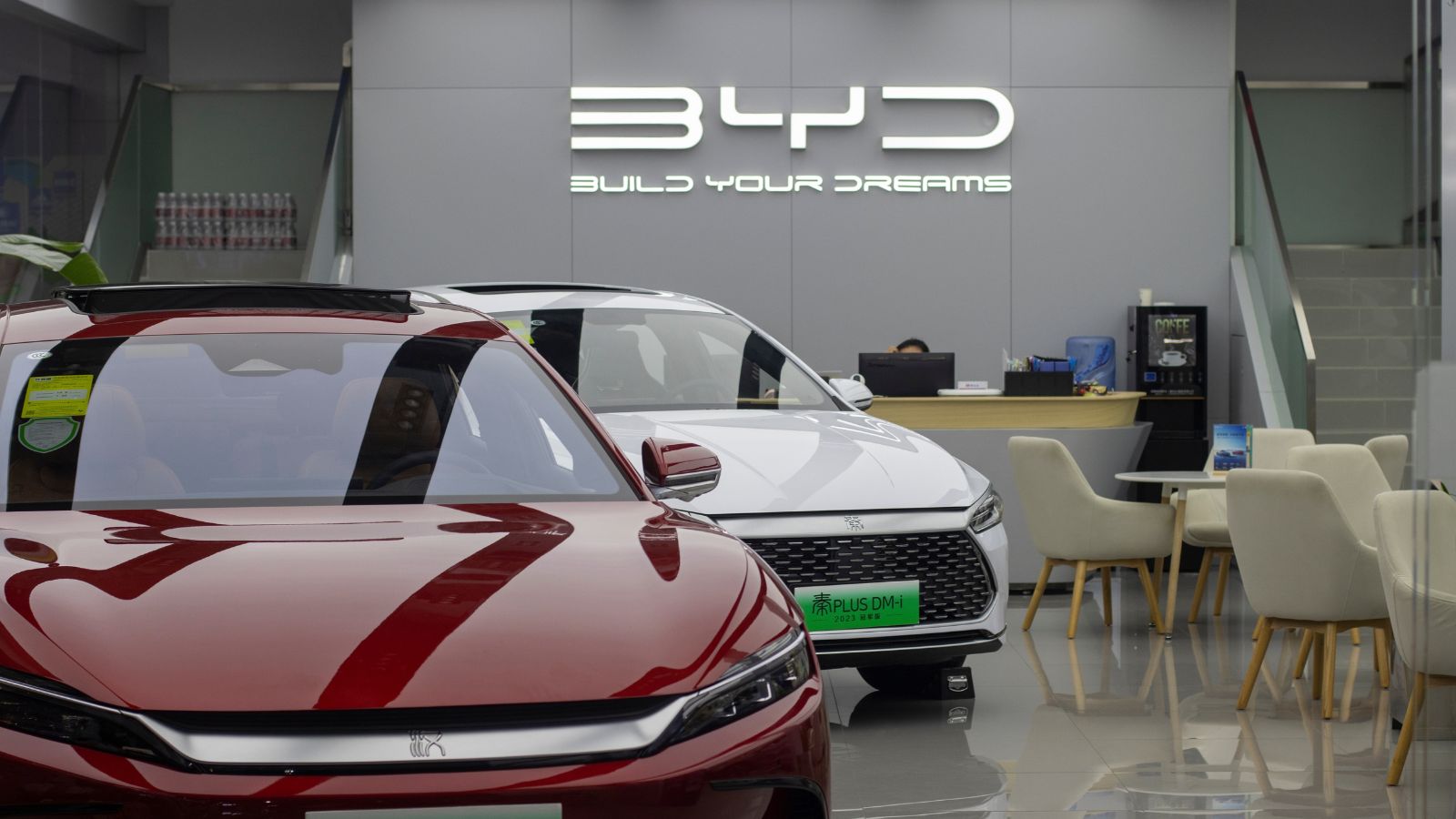
BYD has given one of its smallest electric SUVs a meaningful upgrade, adding substantially more claimed range while keeping the entry price firmly in budget-EV territory. The 2027 Yuan Up Feichi Edition, the China-market model closely related to the Atto 2 sold internationally, starts at 74,800 yuan, reported at roughly US$11,070 at launch. The refreshed lineup now stretches to 501 kilometres of claimed electric range under China’s CLTC testing cycle.
There is an important distinction behind those eye-catching numbers: the US$11,070 starting model does not provide 501 kilometres of range. That figure belongs to higher-priced versions. Even with that clarification, the combination of new batteries, revised pricing, updated cabin equipment and an unusually low entry point shows how aggressively BYD continues to compete in China’s crowded electric-car market.
The US$11,070 Starting Price Comes With 301 Km of Range
BYD has maintained the Yuan Up’s 74,800-yuan entry price for the new Feichi Edition. CnEVPost converted that figure to approximately US$11,070 when the vehicle was announced. That starting model is the 301KM Linghang, however, and not one of the newly introduced 501-km versions. It uses a 32-kWh battery and carries a claimed 301-kilometre CLTC driving range. The distinction is important because the headline numbers can otherwise make it appear that BYD is selling a 501-km electric crossover for barely more than US$11,000.
The first 501-km model, called the 501KM Chaoyue, has a list price of 94,800 yuan. Contemporary currency conversions put that at roughly US$14,000 to US$14,150. A more highly equipped 501KM Zhuoyue version costs 104,800 yuan, or roughly US$15,500. Those prices remain striking for an electric crossover, but they also show why the price and maximum-range figures should be considered two separate bookends of the updated model range rather than specifications belonging to the same vehicle.
Five Versions Give Buyers Three Different Range Levels
The 2027 Feichi Edition is being offered in five versions, allowing BYD to spread the Yuan Up across several price points without abandoning the smaller batteries that helped establish it as an affordable urban EV. The lineup begins with one 301-km model at 74,800 yuan. It then moves to two 401-km versions priced at 81,800 yuan and 89,800 yuan, before reaching the new 501-km versions at 94,800 yuan and 104,800 yuan.
BYD is also using promotional pricing to make those numbers more aggressive. Eligible customers can receive a limited-time 5,000-yuan trade-in subsidy, reducing the effective prices to between 69,800 yuan and 99,800 yuan. Another significant change occurs in the middle of the range: the least expensive 401-km Feichi Edition costs 81,800 yuan, compared with a previous 99,800-yuan starting point for a 401-km configuration. That 18,000-yuan reduction comes with equipment differences, demonstrating how BYD is using both specification changes and lower pricing to broaden the model’s appeal.
A 51.13-kWh Battery Pushes Maximum Range to 501 Km
Range is the central technical upgrade. BYD has added a 51.13-kWh lithium-iron-phosphate battery to the Chinese Yuan Up lineup, allowing two versions to claim 501 kilometres between charges under the CLTC testing procedure. The previous range ceiling was 401 kilometres, meaning the new battery increases the headline figure by exactly 100 kilometres, or almost 25 percent. The existing 32-kWh and 45.12-kWh batteries remain available, providing rated CLTC ranges of 301 kilometres and 401 kilometres respectively.
The testing standard deserves attention. The 501-kilometre number is a Chinese CLTC certification figure, not an EPA or European WLTP rating. Drivers in other countries therefore should not interpret it as 501 kilometres of guaranteed real-world driving or assume an internationally sold Atto 2 would receive the same official rating. Weather, speed, heating and air-conditioning use, terrain and driving style can all affect actual EV range. What can be said with certainty is that BYD has increased the largest battery offered in this Chinese model and raised its certified domestic range substantially.
BYD Has Actually Reduced Peak Motor Power
More range has not come with more performance. In an unusual move for a model-year update, BYD has standardized the Feichi Edition around a lower-powered front electric motor. All five versions use a permanent-magnet motor producing 70 kW, or roughly 94 horsepower, together with 180 Nm of torque. Previous Yuan Up configurations were available with either that 70-kW unit or a considerably more powerful 130-kW motor producing around 174 horsepower.
That means even the new 501-km versions receive the 70-kW setup. BYD appears to have prioritized affordability, efficiency and a simpler product structure rather than trying to make the updated model quicker. The strategy fits the Yuan Up’s role as a compact, value-focused electric crossover intended largely for everyday transportation. It also creates an interesting trade-off for shoppers familiar with earlier high-output versions: the new Feichi Edition can travel farther in its largest-battery form, but buyers wanting the strongest available acceleration may find some earlier or export-market configurations more powerful.
The Cabin Gets More Than a Cosmetic Refresh
The basic dimensions have not changed. The Yuan Up remains 4,310 millimetres long, 1,830 mm wide and 1,675 mm tall, riding on a 2,620-mm wheelbase. BYD has instead concentrated much of the visible update on colours, wheels and the cabin. New yellow and blue exterior finishes join the selection, while higher specifications can receive newly designed 17-inch low-drag alloy wheels. The familiar compact proportions remain intact, which should help preserve the model’s city-friendly footprint.
Inside, BYD has fitted a redesigned two-spoke steering wheel and moved the transmission selector to a steering-column stalk, helping free space around the centre console. Equipment reported for the refreshed model includes a 12.8-inch central display, an 8.8-inch digital instrument panel and BYD’s DiLink 100 cockpit system. Available conveniences include heated and ventilated front seats, rear ventilation outlets, a six-way electrically adjustable driver’s seat and a 50-watt air-cooled wireless phone charger. These are features increasingly being used to distinguish inexpensive Chinese EVs from traditional stripped-down entry models.
Driver Assistance Depends Heavily on the Version Chosen
BYD has not simply placed every major technology feature into every Feichi Edition. Driver-assistance equipment differs significantly between trims. CnEVPost reported that the cheaper 401-km Linghang version does without BYD’s God’s Eye C driver-assistance system, while the 89,800-yuan 401KM Huoli version includes it. Equipped vehicles can support functions such as highway and urban-expressway navigation assistance, adaptive cruise control, automated valet parking and remote parking assistance.
The same distinction occurs farther up the range. The 501KM Chaoyue does not receive God’s Eye C, showing that choosing the larger battery does not automatically bring BYD’s more advanced assistance package. That creates a purchasing decision between range, technology and price instead of a straightforward progression in which every feature appears as the price climbs. A 360-degree panoramic camera system is nevertheless listed across the refreshed lineup by Chinese launch coverage. As with any assistance technology, these systems remain driver-assistance functions rather than a replacement for an attentive driver.
The Update Arrives as the Yuan Up Gains Sales Momentum
BYD is refreshing the Yuan Up at a time when the model already has meaningful volume behind it. Chinese sales data cited by CarNewsChina put Yuan Up sales at 22,958 vehicles in August 2026, an increase of 13.2 percent from July. The broader Yuan family, which also contains other BYD SUVs, reached a record 84,550 vehicles during August according to data compiled by CnEVPost. The numbers help explain why BYD is refining the current formula rather than dramatically changing the vehicle’s dimensions or positioning.
The broader company is operating at much greater scale. BYD reported 440,293 new-energy vehicle sales globally during August, including 189,466 vehicles sold overseas. That international expansion is also why the naming requires care. The Yuan Up is sold as the Atto 2 in a number of export markets, but overseas versions can use different battery capacities, motors, prices and certification standards. The 2027 Feichi Edition announced on September 17 is therefore best understood as the latest Chinese Yuan Up specification, rather than confirmation that every global Atto 2 market will immediately receive the same 501-km configuration.