

















Tesla’s newest self-driving software is already making an appearance on Canadian roads, offering an early glimpse of how the company’s latest technology handles Toronto’s busy urban environment.
On November 21, 2026, Toronto Tesla owner Chansoo Byeon shared videos showcasing Full Self-Driving (Supervised) version 15 navigating downtown streets and Chinatown. The footage reveals Tesla’s redesigned driving visualization, which presents surrounding traffic and planned movements from an overhead perspective.
The development comes as Tesla begins distributing its latest software update to a limited group of owners, ahead of a broader rollout anticipated in December.
While the videos confirm that the technology has reached at least one vehicle in Canada, questions remain about availability, real-world performance, and how quickly other Canadian drivers will receive the update.
Toronto Tesla Owner Shares One of Canada’s First FSD v15 Demonstrations
Toronto Tesla owner Chansoo Byeon has provided Canadian drivers with an early look at the company’s latest Full Self-Driving software. On November 21, Byeon shared footage showing version 15 operating in downtown Toronto, shortly after Tesla began distributing the update to its initial group of customers. The video places the vehicle’s real-world surroundings alongside its newly redesigned touchscreen visualization, allowing viewers to compare what the cameras capture with what the software displays. Rather than relying on a conventional navigation map alone, the interface reconstructs nearby roads, vehicles, and the planned driving route. The demonstration offers a particularly interesting perspective because Canadian owners often follow major software announcements while waiting to learn when the newest features will become available in their own vehicles.
Byeon subsequently shared another recording from Toronto’s Chinatown neighbourhood during nighttime driving conditions. The second clip expanded the initial demonstration beyond a daytime downtown setting and highlighted how the redesigned display appears after dark. Earlier, the owner had also posted footage indicating that the software update was installing. Together, the recordings provide evidence that Tesla’s newest system is already operating on Canadian streets, even though the company has not confirmed a broader domestic rollout. They are early demonstrations, however, rather than comprehensive evaluations of the software’s safety or reliability. A short recording can illustrate how a feature looks and behaves during a particular journey, but it cannot establish how consistently the system performs across thousands of different driving situations.
Downtown Toronto Provides a Demanding Environment for Assisted Driving
Toronto presents a particularly relevant setting for evaluating advanced driver-assistance technology. Its downtown transportation network must accommodate cars, pedestrians, cyclists, streetcars, delivery vehicles, and other road users sharing limited street space. The city’s Vision Zero Road Safety Plan specifically prioritizes vulnerable road users, including pedestrians, cyclists, older adults, and schoolchildren. For software designed to interpret surrounding traffic and make driving decisions, this environment presents considerations that extend well beyond maintaining a steady speed on a highway. Urban driving requires constant awareness of intersections, changing traffic patterns, road markings, and people moving unpredictably near vehicles.
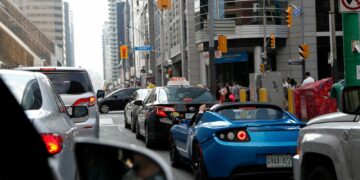
The significance of Byeon’s recordings comes partly from their location. A demonstration on familiar Toronto streets gives Canadian motorists a more relatable view of the technology than promotional footage captured on roads elsewhere. The Chinatown recording is especially interesting because it shows the new interface during nighttime operation, when visibility and environmental interpretation become important considerations. However, neither recording should be treated as proof that the software has mastered Toronto’s most challenging road conditions. The footage does not establish comprehensive performance at streetcar stops, complicated intersections, or pedestrian-heavy crossings. Those situations would require additional testing, including longer journeys and documented driver interventions, before meaningful conclusions about reliability could be drawn.
Tesla Reality View Changes How Drivers See the Road
One of the most noticeable changes introduced with Full Self-Driving v15 is Tesla Reality View, a redesigned driving visualization that presents the surrounding environment from an elevated, virtual-camera perspective. Instead of displaying roads and vehicles primarily through simplified computer-generated shapes, the system produces a more detailed representation of what is happening around the car. Tesla says the visualization is generated in real time by the same end-to-end driving model responsible for controlling the vehicle. The interface includes navigation arrows indicating planned turns and parking markers showing where the system intends to stop. Tesla’s vice-president of AI software, Ashok Elluswamy, has explained that the purpose extends beyond improving the screen’s appearance. The new display is intended to communicate the vehicle’s planned actions more clearly to its human supervisor.
For drivers, this could address a familiar challenge with automated assistance: understanding what a vehicle intends to do before it makes a manoeuvre. An approaching turn, lane change, or parking decision may become easier to anticipate when the planned action appears directly within the visualization. Tesla also allows drivers to choose between a full-screen view, a traditional map, a split-screen arrangement, and a quieter display mode. The update therefore provides different ways to monitor the same journey, depending on the driver’s preferences. Importantly, Reality View is an AI-generated representation rather than an unmodified camera feed. Its appearance should not be mistaken for an independent guarantee that every road feature or potential hazard has been correctly identified.
Tesla Claims Major Improvements to Its Driving Intelligence
Beyond the redesigned touchscreen, Tesla says version 15 introduces substantial changes to the underlying artificial intelligence responsible for interpreting road conditions. According to the company’s release notes, the software uses an upgraded vision encoder shared with technology developed for Tesla’s Robotaxi operations and Optimus humanoid robots. Tesla says the system was trained using millions of internet videos to improve its ability to interpret unfamiliar situations. The company also claims a 25-fold improvement in its critical intervention rate, a measure related to situations requiring human intervention. This is one of the most significant claims associated with the update, although Tesla has not publicly provided sufficient methodological details to establish that its vehicles are 25 times safer in real-world driving.
The distinction matters because software performance and collision prevention are not interchangeable measurements. A system might require fewer interventions during a particular collection of driving scenarios without demonstrating an equivalent reduction in crashes across public roads. Tesla’s latest improvements are nevertheless relevant to drivers interested in the progression of assisted-driving technology. Better interpretation of signs, changing surroundings, and unexpected objects could influence how confidently the software responds to unfamiliar conditions. For Canadian motorists, the central question will be whether these improvements translate into consistently smoother, more predictable behaviour on roads that include winter weather, dense urban traffic, and complex intersections. Longer-term performance data and independently evaluated results will be more informative than a single company-reported improvement figure.
Navigation and Parking Are Becoming More Personalized
Tesla’s latest software also introduces changes designed to improve how vehicles navigate the beginning and end of a journey. Version 15 uses an end-to-end learning approach informed by route preferences gathered from Tesla’s vehicle fleet. For now, Tesla says this improvement primarily applies to the beginning and final portions of a trip, with broader route optimization planned for subsequent releases. The update also introduces parking-location suggestions based on a driver’s previous parking history. Rather than simply navigating toward a destination, the system can display multiple possible parking locations on the touchscreen. These changes suggest an increasing emphasis on the practical details that drivers encounter before reaching their destination and after arriving nearby.
Consider a routine trip to a downtown office, shopping centre, or residential building. Reaching the correct street does not necessarily mean reaching the most useful stopping location. An entrance may be on the opposite side of a building, while the driver’s preferred parking area could be located around the corner. A system that remembers previous parking choices could make these final moments more convenient. The ability to display several options also gives the driver additional information when deciding where to stop. However, Tesla has not established that every preferred parking location will be available or appropriate during subsequent visits. Parking restrictions, temporary construction, and changing traffic conditions remain important considerations, particularly in busy Canadian city centres.
Speed Camera Detection and Bike Rack Support Add Practical Features
Version 15 introduces a new Speed Camera Slowdown feature that allows Full Self-Driving to reduce speed when the system detects a speed camera. Tesla’s release notes explain that drivers can override the slowdown by pressing the accelerator or selecting a faster driving profile. If the slowdown is cancelled twice at the same camera, the vehicle can remember that location and avoid repeating the automatic response there. The feature arrives at an interesting time for Ontario drivers. Provincial changes ended municipalities’ authority to operate automated speed-enforcement cameras effective November 14, 2025. Toronto has since been pursuing alternative road-safety measures, including traffic calming and improvements around school safety zones. Consequently, the usefulness of Tesla’s new camera-detection capability will depend partly on local enforcement arrangements and where the vehicle is driven.
Another practical addition is Bike Rack Mode, designed for vehicles carrying bicycles or similar accessories mounted to a trailer hitch. When this mode is activated, Tesla says drivers can use FSD while the vehicle is equipped with an appropriate rack. The software adjusts its arrival behaviour by pulling over near the destination without reversing. However, the setting also disables several functions, including Autopark, Summon, and backup warning sounds. These restrictions are important because a rear-mounted accessory changes the vehicle’s effective dimensions and can affect how safely it manoeuvres in confined areas. For Canadian owners who regularly transport bicycles for recreational trips, the feature could remove a previous inconvenience, provided they understand the limitations and remain responsible for maintaining adequate clearance around the vehicle.
Tesla Says v15 Is Better at Identifying Road Hazards and Difficult Conditions
Road-hazard detection is another major focus of Tesla’s latest software update. The company says version 15 improves recognition of traffic signs, small animals, road debris, chains, potholes, and other surface details. The release notes also describe improved avoidance of deep standing water, together with adjustments to how the vehicle selects speeds in school zones and poor weather. These improvements could be especially relevant in Canada, where drivers encounter seasonal changes in road conditions. A Toronto commuter might face heavy rainfall during one journey, damaged pavement during another, and restricted visibility on an early winter morning. Software capable of recognizing a wider range of hazards could potentially reduce unnecessary manoeuvres or improve responses to changing conditions.
However, Tesla’s announced improvements should not be interpreted as proof that version 15 can safely manage every Canadian weather scenario. Transport Canada warns that driver-assistance systems may perform poorly, or not function at all, in rain, snow, and other conditions affecting visibility. Snow-covered lane markings, low-contrast road surfaces, and poorly visible obstacles remain important challenges for systems that depend on interpreting their surroundings. Tesla’s latest release notes describe intended improvements, but they do not provide independently validated results demonstrating how version 15 performs across a complete Canadian winter. The Toronto videos offer an early indication of the software operating in local urban environments, not a substitute for testing during snowstorms, freezing rain, or other severe weather events.
The Rollout Is Starting With Newer Tesla Hardware
Although the Toronto recordings have generated interest, Full Self-Driving v15 is not yet available to every Canadian Tesla owner. The initial software release began on November 21, 2026, with version 15.0.1 appearing in software build 2026.38.6.11. Early software-tracking reports have associated that build with vehicles equipped with Tesla’s newer Hardware 4, also known as AI4. Initial tracking observations included Model Y vehicles, although those sightings should not be interpreted as a complete list of eligible models. Byeon’s Toronto footage confirms the presence of v15 on Canadian streets, but it does not independently establish the exact software build installed on his vehicle or how many other Canadian owners have already received access.
Owners of older Tesla vehicles face additional uncertainty. Cars equipped with Hardware 3 have continued receiving versions of Tesla’s earlier FSD software, including the separate v14.3 Lite branch. Tesla has not confirmed that these vehicles will receive an equivalent version of v15 or announced a specific timetable for such an upgrade. Meanwhile, Elon Musk stated on November 21 that a wider release of v15 is expected in December 2026. That statement provides a general indication of Tesla’s plans, but it does not establish a guaranteed Canadian distribution date. Software availability can depend on hardware, vehicle configuration, market, and other eligibility requirements, meaning two Canadian owners may receive different updates despite driving vehicles from the same manufacturer.
Full Self-Driving Still Requires Human Supervision
Despite its name and increasingly sophisticated capabilities, Tesla’s Full Self-Driving technology remains a supervised driver-assistance system. Tesla explicitly states that its currently available features do not make a vehicle fully autonomous or replace the person behind the wheel. Drivers must remain attentive, monitor traffic conditions, and be prepared to intervene whenever necessary. This distinction is particularly important as version 15 introduces an increasingly realistic display that can make the software appear more capable. Under Ontario’s guidance for driver-assistance technologies, motorists remain responsible for safely operating their vehicles, regardless of whether automated steering or acceleration features are engaged. The ability to navigate streets without constant steering input does not eliminate the driver’s legal responsibilities.
Independent road-safety organizations have also emphasized the importance of maintaining driver attention while using partially automated systems. The Insurance Institute for Highway Safety evaluates driver monitoring, attention warnings, and emergency safeguards because automated assistance can encourage motorists to become less engaged with their surroundings. Its earlier evaluations do not establish how Tesla’s new version 15 performs, but they highlight why supervision remains essential. Tesla says the latest update improves its camera-based driver monitoring, including recognition of attention when motorists wear hats or sunglasses. Nevertheless, the Toronto demonstrations do not provide sufficient evidence to determine how reliably those safeguards operate. The technology’s progress will ultimately need to be measured through safe, repeatable performance rather than the apparent confidence of its driving movements.
Canadian Tesla Owners Are Watching for the Next Software Release
For Canadian Tesla owners interested in trying the latest software, availability remains the immediate question. Tesla currently lists Full Self-Driving (Supervised) at $99 per month on its Canadian website, with subscriptions available through the Tesla app or eligible vehicle touchscreens. However, paying for the service does not guarantee immediate access to version 15. Drivers can check their vehicle’s installed software through the touchscreen’s software menu, while Tesla distributes eligible updates over the air. The first documented v15.0.1 release is associated with software build 2026.38.6.11, although availability depends on vehicle hardware and Tesla’s distribution schedule. Owners should therefore distinguish between having an active FSD subscription and receiving the newest software generation.
The Toronto recordings represent an important early milestone, but the larger Canadian story is still developing. Musk’s anticipated December expansion could bring version 15 to additional drivers, although Tesla has not provided a confirmed Canadian release schedule. More owner demonstrations may eventually reveal how the software handles familiar local challenges, including construction zones, complex intersections, changing weather, and winter road conditions. For now, Byeon’s videos provide a timely look at the direction Tesla is taking with assisted driving: more detailed visualizations, personalized navigation, and increasingly ambitious artificial-intelligence capabilities. Whether those developments produce measurable improvements in reliability and safety will become clearer as more Canadian vehicles receive the update and the technology encounters a wider range of real-world driving conditions.