





















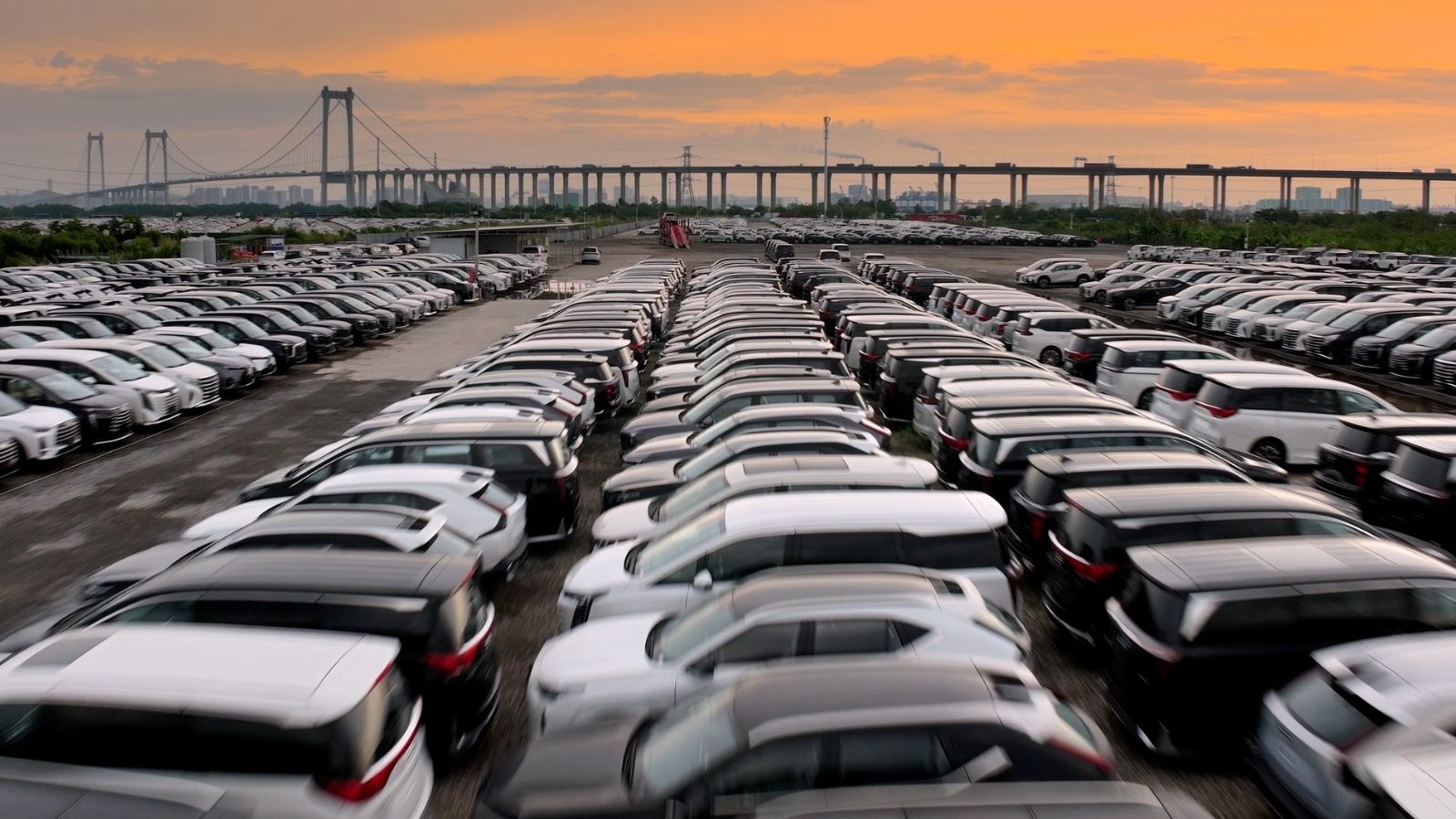
For Canadian motorists, crossing into the United States could eventually involve more than presenting a passport and answering questions at the border. The vehicle they drive may become a deciding factor.
A growing bipartisan effort in Washington seeks to permanently restrict Chinese-connected vehicles from American roads, with proposed legislation that could also prevent Canadian and Mexican residents from driving certain Chinese-built cars into the country.
Republican Senator Bernie Moreno says lawmakers are approaching an agreement on tougher restrictions, while major American labour organizations are pressing Congress to act. The proposed crackdown comes as Canada prepares to welcome more Chinese electric vehicles, creating the possibility that a car legally purchased and registered in Canada could be prohibited from entering the United States.
Canadian Drivers Could Be Turned Away Because of Their Vehicles
A Canadian motorist driving to Detroit for a weekend getaway or crossing into Buffalo for a shopping trip could eventually face an unexpected restriction. Under legislation being negotiated in Washington, certain Chinese-built vehicles would not be permitted to enter the United States, even when they are legally registered in Canada. Republican Senator Bernie Moreno confirmed the intended cross-border reach of the proposed restrictions in comments reported by Reuters on November 24, 2026. The proposal would affect the vehicle’s eligibility to enter American territory rather than simply whether it could be sold at an American dealership.
The distinction is significant for Canadians who regularly travel across the border for work, family visits, entertainment, or vacations. A driver could meet ordinary travel requirements yet still be unable to bring a prohibited vehicle across. However, the restrictions have not become a new blanket prohibition on Canadian motorists. Their precise implementation would depend on the final legislation, its approval by Congress, and the rules established for enforcement.
Republican and Democratic Senators Are Working Together on the Ban
The proposed crackdown has attracted support from both major American political parties, reflecting concerns that extend beyond the usual disagreements over trade. Republican Senator Bernie Moreno of Ohio and Democratic Senator Elissa Slotkin of Michigan introduced the Connected Vehicle Security Act of 2026 in April. The legislation would strengthen restrictions on the importation, manufacturing, sale, and distribution of connected vehicles associated with China and other designated foreign adversaries. The Senate Commerce Committee advanced the legislation in July, and an amended version was formally reported in September.
Momentum has continued into November. On November 23, Moreno indicated that negotiations were nearly complete and expressed hope that the House of Representatives could vote as early as the following week, with Senate action afterward. However, earlier attempts to accelerate approval encountered objections, particularly over how Chinese investments in established international manufacturers would be treated. The negotiations demonstrate both the breadth of support for tougher restrictions and the difficulty of writing legislation that targets Chinese automotive companies without unintentionally disrupting other manufacturers.
Existing American Restrictions Already Make Chinese Cars Difficult to Sell
The latest proposals build on restrictions established before the current congressional negotiations. In January 2025, the Biden administration finalized regulations targeting connected-vehicle technology associated with China and Russia. The rules, which took effect in March 2025, introduced restrictions on certain connected-vehicle software beginning with model year 2027 and relevant communications hardware beginning with model year 2030. They also prohibit manufacturers sufficiently connected to China or Russia from selling covered new connected vehicles in the United States beginning with model year 2027, even when those vehicles are manufactured on American soil.
These measures have already created substantial obstacles for Chinese automakers seeking access to American customers. U.S. tariffs exceeding 100% on Chinese electric vehicles have added another financial barrier. However, the existing regulatory framework primarily addresses commercial transactions, vehicle technology, and manufacturer eligibility. The proposed restrictions on Canadian and Mexican drivers would extend the government’s approach by addressing vehicles temporarily entering American territory. In practical terms, preventing a Chinese vehicle from being sold in the United States is different from preventing a Canadian visitor from driving one across the border.
Canada’s Decision to Welcome Chinese EVs Has Raised the Stakes
The disagreement has become more consequential following Canada’s decision to ease restrictions on Chinese electric vehicles. In January 2026, Prime Minister Mark Carney announced an arrangement allowing an initial annual quota of 49,000 Chinese EVs to enter Canada at a reduced tariff rate of 6.1%. The arrangement replaced the previous 100% additional surtax for eligible vehicles within the quota, which took effect on March 1. Canadian officials have presented the policy as a way to improve vehicle affordability, encourage investment, and strengthen the country’s electric-vehicle supply chain.
The change is already producing measurable results. According to a November 16 update from Global Affairs Canada, 16,211 vehicles had been imported under the arrangement since March, with roughly half carrying import prices below $35,000. The quota is also scheduled to expand annually, with a growing portion reserved for lower-priced vehicles. For Canadian buyers, that could create more choices in an expensive automotive market. However, the proposed American restrictions introduce an additional consideration: whether a reasonably priced vehicle purchased in Canada would remain practical for someone who frequently drives into the United States.
A Separate Border-Specific Bill Would Target Even Short Visits
The cross-border restrictions are not simply an incidental consequence of the broader effort to prohibit Chinese vehicles. In June 2026, Senator Elissa Slotkin introduced the Protecting America from Chinese Cars Act, a separate proposal specifically designed to prevent certain connected vehicles from entering American territory. Its language covers vehicles manufactured or designed in China, as well as vehicles produced by manufacturers with more than 15% ownership or control linked to designated foreign-adversary countries. The legislation also identifies Russia, Iran, and North Korea, making its proposed scope broader than Chinese-branded automobiles alone.
The bill provides a potential enforcement framework. U.S. Customs and Border Protection would be required to develop implementing regulations within 90 days of enactment, including a list of prohibited vehicles. The restrictions would begin 30 days after those regulations were published. Manufacturers could seek special authorizations based on national security assessments, although those approvals would face strict conditions. Importantly, the proposal contains no general exemption for ordinary tourist visits. Slotkin has specifically emphasized that even a single-day trip in a prohibited vehicle could be prevented. These provisions remain proposed rather than operational requirements.
National Security Concerns Are Driving Much of Washington’s Opposition
The American government’s primary security argument centres on the technology installed in modern vehicles. Connected cars can contain cameras, microphones, navigation equipment, wireless communications systems, and software that exchanges information with manufacturers or service providers. American officials are concerned that such systems could potentially expose sensitive location information, collect intelligence about infrastructure, or be manipulated remotely by foreign adversaries. The Department of Commerce has identified particular risks involving software and hardware linked to China and Russia. These concerns are not limited to electric vehicles, since gasoline-powered and hybrid cars can also contain sophisticated connected systems.
Privacy concerns extend across the automotive industry. A 2023 Mozilla Foundation examination of 25 major car brands found that all collected more personal information than the researchers considered necessary, while 84% reserved the ability to share or sell personal data. These findings illustrate broader industry vulnerabilities rather than proving that individual Chinese vehicles conduct espionage. Canada is also examining the issue. On November 18, Transport Minister Steve MacKinnon acknowledged that Ottawa would review potential restrictions involving Chinese EVs at sensitive government and military facilities. The Canadian review has not established a general prohibition.
Chinese Ownership Could Complicate Restrictions on Familiar Car Brands
Determining which vehicles qualify for prohibition is more complicated than identifying a Chinese company logo. The proposed American legislation considers where a vehicle is manufactured, where it is designed, and who controls the manufacturer. One earlier version establishes a threshold of more than 15% ownership by entities connected to designated foreign-adversary countries. That approach has created complications for established international automakers. Mercedes-Benz, for example, has Chinese investors collectively holding nearly 20% of the company. Lawmakers have been negotiating changes intended to ensure the German manufacturer is not unintentionally excluded from the American market.
Volvo presents another example because it is majority-owned by China’s Geely Holding. In May 2026, Volvo secured a specific authorization from the U.S. Department of Commerce allowing it to continue importing and selling connected vehicles. Polestar, another automaker with Geely ties, was denied comparable authorization for new vehicles beginning with model year 2027. Senator Moreno has indicated that the latest negotiated legislation is intended to protect Mercedes-Benz and Volvo from an outright ban. These distinctions matter because a vehicle’s manufacturing location, brand identity, and corporate ownership do not necessarily tell the same story.
Millions of Cross-Border Car Trips Make the Restrictions Significant
Driving remains an essential part of the relationship between Canada and the United States, especially for communities located near major border crossings. Statistics Canada reported that Canadian residents returned from approximately 1.7 million trips to the United States by automobile in September 2026. Nearly 65% of those automobile trips were completed on the same day. The figures demonstrate how frequently the border is crossed for relatively short visits, rather than exclusively for extended vacations. Shopping, family gatherings, medical appointments, sporting events, and business commitments can all involve the kind of driving that a vehicle-specific restriction could complicate.
The proposed legislation could be particularly consequential for residents of communities such as Windsor, Sarnia, and Niagara Falls, where nearby American destinations are part of everyday regional life. Consider a family purchasing an affordable Chinese-made EV for commuting and errands in Ontario. A future American prohibition could force that household to arrange different transportation for occasional trips to Michigan or New York. The legislation would not prevent Canadians from travelling to the United States simply because they owned a Chinese vehicle, but it could remove the option of bringing that particular car. For frequent cross-border travellers, vehicle eligibility could become an important purchasing consideration.
American Automakers and Labour Unions See a Much Bigger Economic Threat
The proposed restrictions are also part of a wider struggle over the future of the global automotive industry. According to the International Energy Agency’s Global EV Outlook 2026, Chinese automakers supplied approximately 60% of electric cars sold worldwide in 2025. China also accounted for nearly three-quarters of global electric-car production, while its electric-car exports doubled to more than 2.5 million vehicles. That manufacturing scale has helped Chinese companies compete internationally on price and technology, creating pressure on established automakers operating in North America and Europe.
American labour organizations view the proposed ban as a measure to protect domestic manufacturing employment and industrial competitiveness. On November 23, the International Brotherhood of Teamsters, representing approximately 1.3 million members, urged lawmakers to approve tougher restrictions before Congress concludes its remaining business for the year. Major automotive manufacturers and industry groups have also expressed support for keeping Chinese automakers out of the American market. However, restrictions aimed at protecting domestic production can create competing interests for consumers, particularly Canadians seeking more affordable vehicles. The debate consequently involves both national security and a difficult question about how much competition governments should permit in strategically important industries.
Trump’s Position Adds Uncertainty to What Happens Next
Despite the increasingly aggressive proposals coming from Congress, President Donald Trump has expressed a more complicated position on Chinese automotive investment. In September 2026, Trump said he would be open to Chinese automakers establishing manufacturing operations in the United States, provided they employed American workers. He distinguished that possibility from allowing Chinese companies to manufacture vehicles in Mexico and export them into the American market. His comments created tension with lawmakers and industry groups demanding broader restrictions. Several major automotive organizations subsequently urged the administration to maintain barriers against Chinese manufacturers entering the United States.
As of November 24, 2026, the tougher congressional ban had not become law, and the final wording of the negotiated compromise remained unsettled. Lawmakers were discussing possible votes before the end of the year, but approval was not guaranteed. For Canadian drivers, the most important development will be whether the eventual legislation explicitly prohibits temporary vehicle entry and how American border authorities implement those restrictions. Until then, the proposed ban should not be mistaken for a universal prohibition already operating at every border crossing. Nevertheless, the debate highlights a growing possibility that purchasing a vehicle legally in Canada may not automatically guarantee the ability to drive it into the United States.