






















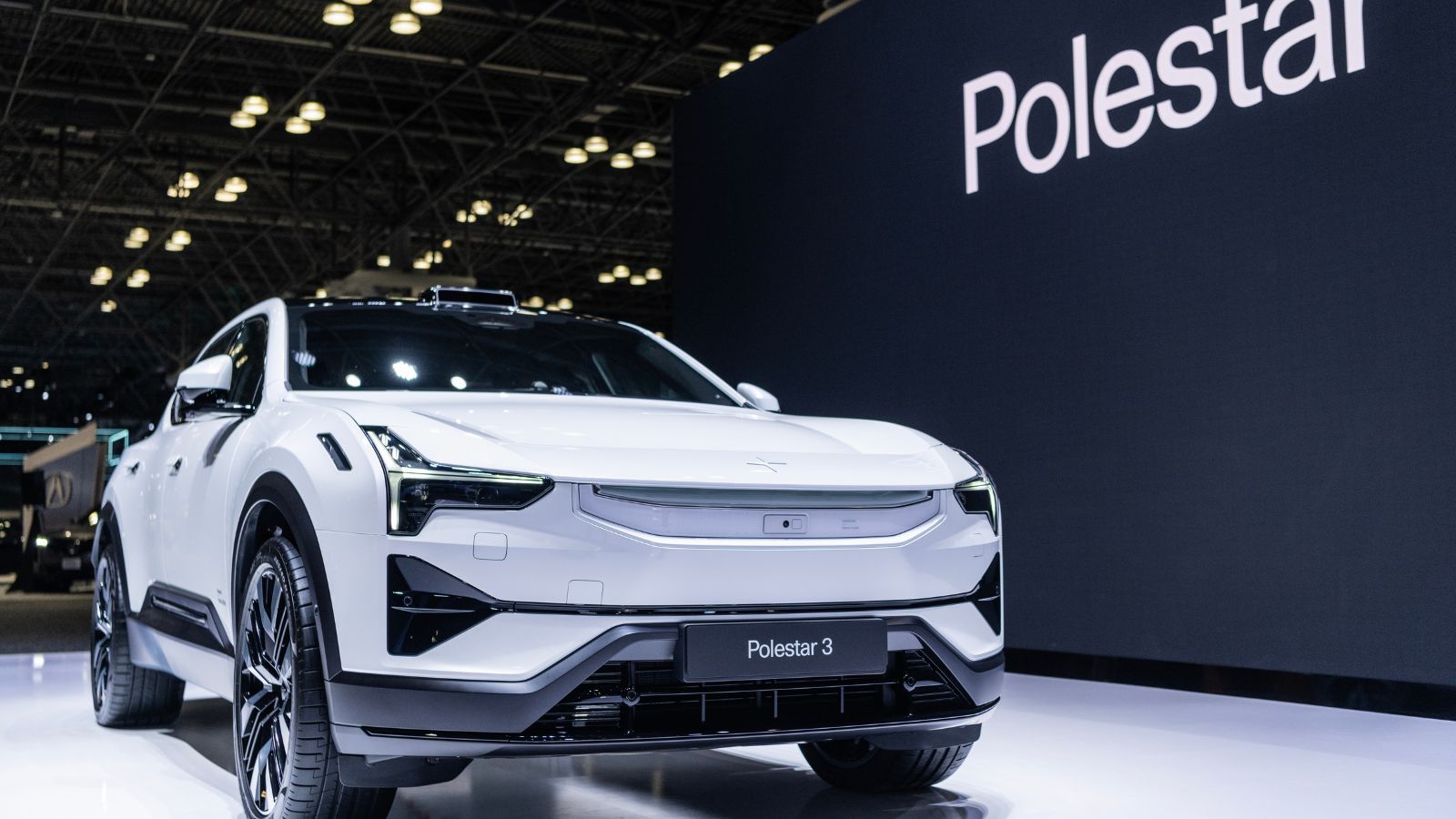
The electric SUV that became famous for having no rear window is finally getting one. Polestar has introduced a more practical version of its Polestar 4, replacing the original coupe-like rear design with a taller roofline, a conventional rear window, and considerably more room for luggage.
The redesigned Polestar 4 SUV offers up to 655 litres of cargo space behind the rear seats, an increase of 129 litres over the coupe, along with additional headroom for passengers. But Canadians interested in the more practical model face a different timeline. Although the vehicle has already been tested overseas as a 2027 model, a new Canadian automotive report indicates that versions destined for Canada will arrive as 2028 models, with local pricing still to be announced.
Why Polestar Is Bringing Back the Rear Window
When the original Polestar 4 arrived, its missing rear window was not an oversight. Engineers deliberately removed it to allow the rear roof structure to sit farther back, creating a longer panoramic glass roof and a distinctive aerodynamic profile. Instead of looking through conventional rear glass, drivers relied on a roof-mounted camera displaying a live image through a digital rear-view mirror. Polestar argued that this arrangement provided a wider view behind the vehicle, unobstructed by passengers, headrests, or luggage. It was an unconventional decision that helped distinguish the electric crossover from its competitors, although it also required drivers to adapt to a screen rather than a familiar reflection.
The new Polestar 4 SUV takes a more traditional approach without abandoning the original design entirely. A conventional rear window and optical rear-view mirror are standard, while the camera-based digital mirror remains available as an option. There is even an integrated rear wiper and washer to help maintain visibility in rain, snow, and road spray. That seemingly ordinary equipment could be particularly welcome during Canadian winters, when dirty slush regularly collects on vehicle windows. Importantly, Polestar is not replacing the windowless coupe. Both versions will coexist, giving customers a choice between a dramatic fastback design and a more conventional SUV configuration.
The Extra 129 Litres of Cargo Space Comes With an Important Detail
Cargo capacity is among the biggest improvements, although the figures require some explanation. The Polestar 4 SUV provides 655 litres of rear storage with its rear seats upright when cargo space is measured up to the interior roof. That represents an increase of 129 litres compared with the original coupe. However, when measured only to the top of the rear seatbacks, the SUV offers 530 litres, approximately 30 litres more than its sibling. The distinction matters because most everyday cargo, including groceries and smaller suitcases, is usually carried below the rear window rather than stacked all the way to the ceiling.
For larger loads, the redesigned body becomes considerably more useful. Folding the 60/40-split rear seats expands capacity to 1,665 litres, compared with 1,536 litres in the coupe. That additional volume could make a noticeable difference when transporting bulky furniture, sporting equipment, or several large travel bags. The SUV also includes a 15-litre front storage compartment, an adjustable luggage floor, and a power-operated tailgate. The taller cargo opening and more upright rear body should make awkward items easier to accommodate. Rather than simply increasing the overall dimensions of the vehicle, Polestar has concentrated on making the existing footprint more versatile for families and active owners.
A Taller Roof Creates More Space Without Making the SUV Much Larger
Despite its more substantial appearance, the new Polestar 4 SUV remains remarkably close to the coupe in exterior dimensions. Both vehicles measure 4,840 millimetres in length and share a 2,999-millimetre wheelbase. Including their exterior mirrors, they measure 2,139 millimetres wide. The SUV stands approximately 22 millimetres taller, at 1,556 millimetres, but its straighter roofline creates a larger improvement inside. Rear passengers receive an additional 25 millimetres of headroom, which may sound modest on paper but can make a meaningful difference for taller occupants. The extra space is achieved largely through reshaping the rear rather than stretching the vehicle into something more difficult to park.
The redesigned roof also adds versatility beyond the passenger compartment. Standard roof rails support loads weighing up to 100 kilograms while driving, with Polestar specifying a static roof-load capacity of 300 kilograms. Those figures could appeal to owners interested in roof-mounted equipment, provided the weight and installation requirements are respected. A panoramic glass roof remains part of the design, while an optional electrochromic version can adjust its tint to reduce incoming sunlight in markets where the feature is offered. Together, the changes make the SUV more suitable for longer journeys without sacrificing the proportions that gave the original Polestar 4 its distinctive appearance.
Two Motor Options Deliver Up to 544 Horsepower
Underneath its redesigned bodywork, the Polestar 4 SUV retains the Sustainable Experience Architecture platform shared with the coupe. International specifications list two powertrain configurations, both equipped with a 100-kWh battery. The entry-level Rear motor version uses a single electric motor producing 272 horsepower and 343 Nm of torque, sending power to the rear wheels. Polestar quotes a 0–100 km/h acceleration time of 7.3 seconds. Buyers seeking considerably stronger performance can choose the Dual motor all-wheel-drive configuration, which produces 544 horsepower and 686 Nm of torque. That version reaches 100 km/h in a claimed 3.9 seconds, giving the larger-bodied SUV acceleration comparable with many high-performance vehicles.
Driving range is equally important, particularly for Canadian motorists covering long distances between communities. Polestar lists a targeted range of up to 630 kilometres for the Rear motor version and 600 kilometres for the Dual motor model under the European WLTP testing cycle. Those figures should not be mistaken for Canadian-certified range estimates. Official Canadian ratings for the new SUV have not yet been published, and actual driving distances will depend on temperature, speed, road conditions, and equipment choices. For context, the existing Polestar 4 coupe is rated for up to 499 kilometres in rear-wheel-drive form and 451 kilometres with all-wheel drive under the EPA cycle. The new SUV’s Canadian specifications will ultimately determine how closely its real-world performance compares.
Fast Charging Remains Familiar, With Winter Range an Important Consideration
The new SUV uses a 400-volt electrical architecture, rather than the newer 800-volt systems found in some competing electric vehicles. Its maximum DC fast-charging capability is 200 kW, with Polestar advertising a 10-to-80-percent charging time of approximately 30 minutes under suitable conditions. Standard AC charging operates at up to 11 kW, requiring about 11 hours for a full charge at that power level. A faster 22-kW AC charging option is offered in selected international markets, reducing the quoted full-charge time to roughly 5.5 hours. Whether that higher-capacity onboard charger will be available on the Canadian 2028 model remains unconfirmed.
For Canadian drivers, the difference between laboratory performance and winter conditions deserves particular attention. Cold temperatures affect battery efficiency and increase the energy required to heat a vehicle’s cabin, potentially reducing available driving range. The Polestar 4 SUV includes an energy-saving heat pump designed to recover and use thermal energy more efficiently. Battery preconditioning and careful charging-stop planning can also help improve the experience during colder weather. However, a maximum charging rating does not mean the vehicle will maintain that speed throughout an entire charging session. Battery temperature, charging-station output, and the battery’s state of charge all influence the result. Owners travelling between major cities will still need to consider charging infrastructure and weather conditions when planning longer journeys.
Polestar Retunes the Suspension for Better Handling and Comfort
The changes extend beneath the redesigned rear bodywork. Engineers have revised suspension components to accommodate the SUV’s altered proportions and load-carrying abilities while preserving the sporty character associated with Polestar. According to technical details reported from the international media launch, rear springs are approximately 12 percent stiffer, while front springs have been softened by 6 percent. Anti-roll bars, dampers, steering calibration, and traction-control settings have also received adjustments. These improvements are not exclusive to the new body style; Polestar is introducing related chassis revisions to the updated coupe as well. The objective is to deliver more precise steering and greater comfort without making the vehicle feel disconnected from the road.
Early driving impressions suggest the work has produced tangible results. Journalists testing the SUV on winding roads in southern Spain and at the Ascari circuit reported more consistent steering feedback and improved body control. A Canadian reviewer recorded average energy consumption of 23.5 kWh/100 km during a spirited drive in the Dual motor version, although that figure represents one test rather than a standardized efficiency rating. The optional Performance package adds recalibrated ZF semi-active dampers, Brembo brakes, and 22-inch wheels with performance tires. That equipment is intended for drivers seeking sharper handling, while the regular suspension configurations are designed to balance control with everyday comfort. Canadian road conditions will provide another test of how well that balance works.
Camping Mode and Vehicle-to-Load Add More Everyday Versatility
Polestar is also expanding the vehicle’s usefulness beyond driving. The Polestar 4 SUV introduces Camping mode, which allows occupants to maintain selected comfort and entertainment functions while parked. Climate control, interior lighting, infotainment, and device-charging connections can remain available during an overnight stay. International versions also feature vehicle-to-load technology, commonly called V2L, enabling the main battery to supply up to 3.3 kW of electrical power through a compatible adapter. During a manufacturer-organized driving event in Spain, Polestar demonstrated the capability by powering campsite equipment, including lighting and heated sleeping arrangements. It is an appealing addition for motorists interested in camping or other outdoor activities.
However, several details remain important for Canadian buyers. A recent Canadian first-drive report noted that the availability of V2L on locally delivered vehicles has not been confirmed. Meanwhile, the minimalist dashboard continues to rely heavily on digital controls, including a 15.4-inch central touchscreen using Google built-in software. Features such as mirror adjustment, air-vent positioning, and certain steering-wheel settings are managed through the interface rather than separate physical controls. Automotive reviewers have praised the cabin’s design and materials while questioning whether some straightforward adjustments require too much attention. The added technology creates new possibilities, but prospective owners will still need to decide whether Polestar’s screen-focused approach suits their driving preferences.
Built in South Korea, but North American Rules Complicate the Launch
The Polestar 4 SUV is being manufactured in Busan, South Korea, at a facility operated by Renault Korea. That production location is important because Polestar’s manufacturing arrangements have been shaped by changing trade policies and regulatory requirements. Canada introduced a 100-percent surtax on Chinese-made electric vehicles in October 2024, creating another obstacle for manufacturers relying on Chinese factories. The federal government repealed that surtax effective March 1, 2026, replacing it with an import quota and permit system. Meanwhile, Polestar’s South Korean production program has continued. The company confirmed in September that SUV production had ramped up and that its first vehicles had already been shipped from the factory, with initial global customer deliveries expected during the fourth quarter of 2026.
The situation is considerably different south of the Canadian border. In June 2026, Polestar announced that the U.S. Department of Commerce had declined its request for authorization to sell vehicles from the 2027 model year onward under American connected-vehicle regulations. Those rules address national security concerns involving certain Chinese- or Russian-linked automotive technology and manufacturers, meaning production in South Korea does not automatically resolve the restrictions. Polestar can continue selling eligible existing inventory in the United States and supporting current customers, but its plans for newer American-market vehicles remain constrained. Canada, by contrast, remains among the markets the company has identified for continued investment. The result is an unusual situation in which Canadians could eventually gain access to a newer Polestar 4 variant that American customers cannot purchase through normal new-vehicle sales channels.
What Canadians Know — and Still Don’t — About the 2028 Model
The Canadian launch timeline is arguably the biggest outstanding question. When the new SUV was introduced internationally, early Canadian coverage described it as a 2027 model and suggested deliveries could begin as early as the final quarter of 2026. More recent information paints a different picture. In a Canadian first-drive report published on October 28, The Car Guide explained that although its journalists tested a 2027 Polestar 4 SUV overseas, vehicles destined for Canada would carry a 2028 model-year designation. The publication also indicated that the Canadian arrival would occur later than the initial international rollout. However, a 2028 model-year designation does not necessarily mean deliveries will begin during calendar year 2028. An exact Canadian showroom arrival date has not been firmly established in the available announcements.
Pricing is another unanswered question. The current Polestar 4 coupe starts at $64,900 MSRP in Canada for the rear-wheel-drive version, providing a useful reference point but not a confirmed price for the redesigned SUV. Canadian buyers will also need final information on equipment packages, government-certified driving range, charging features, and the availability of vehicle-to-load technology. For some households, the existing coupe may remain appealing because of its dramatic styling and familiar performance. Others may find the conventional rear window, larger luggage area, and increased rear headroom worth waiting for. The new Polestar 4 SUV addresses several practical compromises of the original design. Whether it becomes the better Canadian purchase will depend on the final price, specifications, and availability.