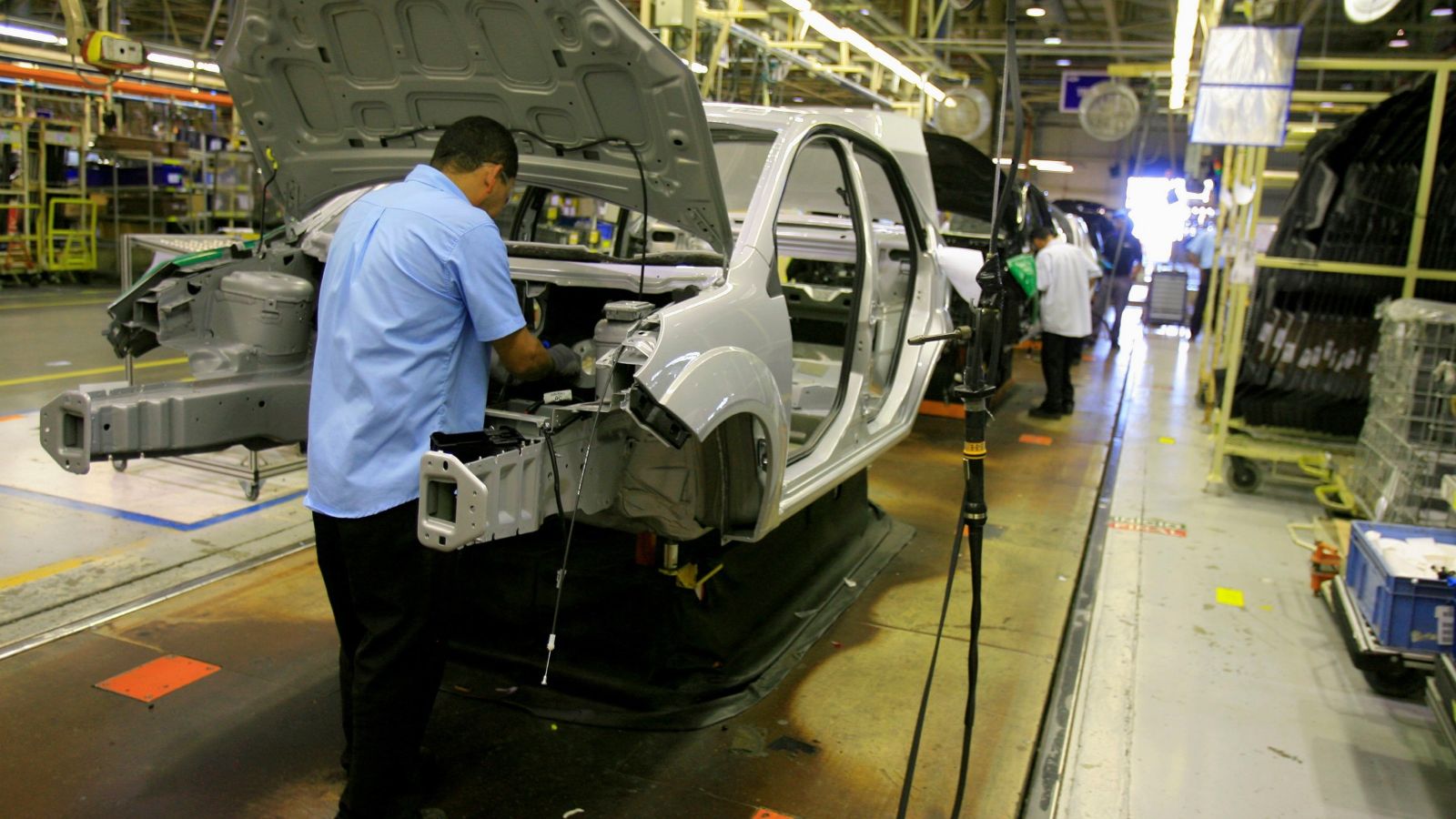
A century-old Quebec vehicle manufacturer is receiving federal financial support as American tariffs threaten the competitiveness of Canadian-built buses.
On October 16, 2026, Ottawa announced an $18.5-million investment in Prevost, a motorcoach manufacturer based in Sainte-Claire, Quebec, and part of the Volvo Group. The funding will support an $87.5-million modernization project intended to maintain 1,265 full-time-equivalent jobs while preparing the company for a new generation of vehicles.
The investment comes as Canadian manufacturers face growing pressure to adapt to U.S. trade restrictions without sacrificing production or skilled employment.
Beyond protecting existing jobs, the project aims to develop cleaner propulsion technologies, modernize coach manufacturing and create opportunities for students entering the industry. For Sainte-Claire, where Prevost has manufactured vehicles since 1924, the announcement represents another important chapter in the community’s manufacturing history.
Ottawa’s $18.5 Million Is Part of a Much Larger Manufacturing Investment
The federal government announced the funding on October 16 through its Strategic Response Fund, a program designed to help Canadian industries adapt to trade disruptions and strengthen their competitiveness. Joël Lightbound, Minister of Government Transformation, Public Works and Procurement and Quebec Lieutenant, made the announcement on behalf of Industry Minister Mélanie Joly. Ottawa’s contribution will support the development of Prevost’s One Prevost Platform, a project valued at $87.5 million. The federal investment represents approximately 21% of the total project cost, making it a significant contribution to the manufacturer’s modernization plans.
The remaining $69 million represents the portion of the project budget not covered by the announced federal contribution, although the government’s release does not provide a complete breakdown of its financing. Rather than funding the purchase of finished vehicles, the project focuses on developing manufacturing capabilities and next-generation transportation technology. Ottawa says the work will strengthen Prevost’s supply chain, expand research and development, and generate new intellectual property in Canada. For the manufacturer, the investment offers financial support during a period when changing trade conditions and emerging vehicle technologies are making long-term production decisions more complicated.
The 1,265 Jobs Are Being Maintained, Not Newly Created
The employment commitment is one of the announcement’s most important details. According to Innovation, Science and Economic Development Canada, the project will maintain 1,265 full-time-equivalent positions in Canada. That means the funding is intended to support existing employment rather than create 1,265 entirely new jobs. Full-time-equivalent employment is a standardized measure of working hours, so it should not automatically be interpreted as a count of 1,265 individual employees. The government describes the positions as being threatened by tariff-related pressures, but it has not announced that all those workers were scheduled for layoffs.
For a community such as Sainte-Claire, protecting established manufacturing employment carries considerable economic significance. Factory wages help support households, while regular manufacturing activity generates demand for transportation companies, maintenance services and local suppliers. An employee who has spent years developing specialized skills may also face substantial disruption if the employer reduces production or relocates operations. The federal commitment is intended to lessen those risks while giving Prevost room to modernize. Still, maintaining employment over the long term will ultimately depend on completed investments, stable production and sufficient customer orders, not simply the amount of public funding announced.
A 10% American Bus Tariff Explains the Urgency Behind Ottawa’s Decision
Canadian motorcoach manufacturers are operating under a trade environment that changed substantially in late 2025. On October 17 of that year, U.S. President Donald Trump signed a proclamation introducing new tariffs on imported medium- and heavy-duty vehicles and buses. The measures took effect on November 1, 2025. While most covered medium- and heavy-duty trucks faced a 25% tariff, imported buses, including motorcoaches, faced a separate 10% duty. The American government justified the restrictions under Section 232 of the Trade Expansion Act, citing national security and concerns about reliance on foreign manufacturing.
A particularly important detail is that the bus tariff does not provide the same relief available to certain trucks under the Canada-United States-Mexico Agreement. Canada’s Trade Commissioner Service confirms there is no CUSMA-compliant or U.S.-content exemption from the 10% duty on imported buses. This makes the measure relevant to Canadian-built motorcoaches even when manufacturers participate in integrated North American supply chains. Tariffs increase the cost of importing affected vehicles into the United States, potentially squeezing manufacturer margins or raising costs for customers. Ottawa has not disclosed exactly how much revenue Prevost has lost because of the duty, but the federal announcement explicitly identifies American trade actions as a reason for supporting the company’s competitiveness.
Sainte-Claire Has Been Building Prevost Coaches for More Than a Century
Prevost’s roots stretch back to 1924, when Eugène Prévost, a Quebec cabinetmaker known for producing church pews and school furniture, received a commission to build a wooden coach body on a truck chassis. What began as a specialized woodworking job eventually developed into a major transportation manufacturing business. The company established a bus production facility in Sainte-Claire in 1937 and later expanded into modern motorcoaches serving passenger transportation operators across North America. That history helps explain why manufacturing employment remains closely associated with Prevost’s identity and the surrounding community.
The business has also evolved considerably from its original family-owned beginnings. Volvo acquired sole ownership in 2004, connecting Prevost with a global manufacturer headquartered in Gothenburg, Sweden. The Canadian operating company, Volvo Group Canada Inc., is headquartered in Montréal. Prevost continues to manufacture coaches in Sainte-Claire while benefiting from Volvo’s engineering and product-development resources. In March 2026, Prevost reported holding the largest share of the North American motorcoach market, citing American Bus Association sales data. Its H3-45 was also identified as the best-selling 45-foot motorcoach based on S&P Global Mobility registration data. These figures demonstrate the company’s established commercial position, even as tariffs and new technology create uncertainty.
The One Prevost Platform Could Reshape How Future Buses Are Built
The centrepiece of the new investment is the One Prevost Platform, a vehicle architecture intended to support different propulsion technologies. Instead of focusing exclusively on conventional diesel engines or fully electric vehicles, Prevost plans to accommodate multiple technologies, including low-emission and zero-emission solutions. This approach provides flexibility as transportation operators reconsider their long-term fleet requirements. A company running highway coaches across large distances may have different needs from a public agency operating predictable commuter routes, particularly when charging infrastructure and operating schedules vary.
The federal government says the project will also improve supply-chain capabilities and strengthen Canadian research and development. A platform designed around multiple powertrains could eventually create opportunities to standardize components, simplify future model development and adjust products as new technologies become commercially viable. Those are potential advantages rather than confirmed performance improvements: the announcement does not provide detailed engineering specifications or a timetable for completing the architecture. What is clear is that Prevost intends to preserve its ability to compete across several transportation technologies instead of depending on a single approach. That flexibility may prove valuable as fleet operators balance emissions requirements, operating costs and vehicle reliability.
Prevost Plans an Electric X-Series and a New Commuter Motorcoach
Prevost president François Tremblay identified two concrete product ambitions in the October announcement: electrifying the company’s X-series model and developing a new commuter motorcoach for the public sector. The existing X3-45 family includes highway and commuter configurations, with the commuter version designed around regular passenger movement and features such as accessible boarding arrangements and comfortable seating. The newly funded work is intended to build on those capabilities while allowing Prevost to serve customers seeking cleaner transportation. The company has not disclosed final prices, battery specifications or confirmed delivery dates for the vehicles associated with this investment.
Electrification is not an entirely new direction for Prevost. In April 2022, the company announced an earlier five-year development program supported by Quebec provincial funding. That initiative aimed to create a fully electric motorcoach with a proposed driving range of 400 kilometres, alongside technology for converting diesel coaches to electric propulsion. The provincial government committed a $15.15-million forgivable loan and a $7.5-million non-repayable contribution. The earlier announcement demonstrates that the manufacturer has been developing electric transportation technology for several years. However, previous range targets and development objectives should not be mistaken for confirmed specifications of the newly announced platform. Successful commercialization will require testing, production preparation and customers willing to adopt the finished vehicles.
Prevost’s American Customers Make Continued U.S. Market Access Essential
Prevost has strong commercial relationships south of the border, where large transportation operators depend on its coaches for scheduled service, tourism and passenger transportation. One notable customer is New York City’s Metropolitan Transportation Authority. In 2023, Prevost announced a contract covering as many as 381 motorcoaches, including a firm order for 250 vehicles scheduled for delivery during 2025 and 2026. The company described it as the largest contract in its history. In April 2026, Prevost also announced that the agency was expected to receive its 1,000th Prevost motorcoach during the year, highlighting the scale of the relationship.
Private transportation businesses provide another example of the company’s American customer base. Connecticut-based DATTCO purchased three X3-45 motorcoaches in 2025 after evaluating competing manufacturers, with the vehicles entering service that July. Prevost also operates 13 company-owned parts and service centres and more than 55 mobile service units across Canada and the United States. These relationships illustrate why American trade barriers matter even to a company with an established reputation. A transportation operator considering a major fleet purchase must evaluate acquisition costs, maintenance support and long-term operating expenses. If tariffs change that calculation, Prevost must find ways to remain competitive without sacrificing the manufacturing capabilities that helped establish its market position.
Electric Motorcoaches Could Benefit From Canada’s Changing Public Transit Market
The move toward cleaner buses is supported by substantial public policy initiatives. In 2021, the federal government introduced the $2.75-billion Zero Emission Transit Fund to help Canadian communities purchase zero-emission public transit and school buses, develop charging infrastructure and prepare their operations for electrification. The program was designed to support the broader federal objective of helping deploy 5,000 zero-emission buses. These measures reflect the growing importance of public transportation in Canada’s efforts to reduce greenhouse gas emissions and modernize municipal fleets.
However, electrifying buses requires more than replacing a diesel engine with a battery. The federal program’s planning guidance identifies route requirements, charging locations, vehicle storage and maintenance arrangements as important considerations when introducing zero-emission fleets. Long-distance motorcoaches face additional operational questions, especially when vehicles spend extended periods travelling between cities. Battery range, charging speed, passenger capacity and daily utilization can all influence purchasing decisions. A newly developed Prevost electric coach would therefore need to meet the requirements of the operators expected to use it. The manufacturing investment may help the company compete for future demand, but it is separate from the transit funding program and does not itself guarantee that public agencies will purchase Prevost vehicles.
The Federal Funding Is Part of Canada’s Wider Response to U.S. Tariffs
The Prevost announcement is part of a broader Canadian industrial policy response to American trade restrictions. Ottawa has committed $5 billion through the Strategic Response Fund to help businesses affected by tariffs modernize operations, diversify markets and protect employment. In February 2026, Prime Minister Mark Carney announced a new automotive strategy that allocated $3 billion from that fund, alongside up to $100 million through the Regional Tariff Response Initiative, to support the sector’s adjustment. The policy places particular emphasis on sustaining Canadian manufacturing while encouraging the development of cleaner and more advanced transportation technologies.
The government has also introduced procurement measures intended to strengthen opportunities for domestic suppliers. Canada’s Buy Canadian Policy began taking effect in December 2025, giving Canadian businesses and Canadian-made content greater consideration in federal purchasing decisions. These requirements primarily concern federal procurement and should not be interpreted as an automatic guarantee of contracts from provincial or municipal transit agencies. For Prevost, the combination of targeted industrial funding and domestic procurement priorities could improve the environment for future investment. Still, public spending brings legitimate questions about measurable results. The important test is whether government support encourages competitive production, research and lasting employment that can continue beyond the initial funding commitment.
The Next Test Will Be Turning Federal Support Into Lasting Manufacturing Jobs
The announcement gives Prevost a clearer development plan, but several important details remain unresolved. Ottawa has confirmed the $18.5-million contribution, the $87.5-million project value, the objective of maintaining 1,265 full-time-equivalent jobs and the commitment to 156 student co-op terms. It has not published a complete timetable for the One Prevost Platform, detailed financial terms of the federal contribution or final production specifications for the planned vehicles. Those details will matter when assessing whether the investment delivers its intended benefits.
The strongest evidence of success will come from measurable developments: sustained employment in Canada, student training opportunities, progress in research and engineering, new vehicle launches and commercial orders. Continued manufacturing activity in Sainte-Claire will be particularly important because the project is explicitly intended to preserve the company’s long-term presence in the community. For workers and their families, federal support offers reassurance at a difficult moment for Canada’s manufacturing sector, but it does not remove every uncertainty created by U.S. trade policy. Prevost has survived more than a century of technological and economic change. Ottawa’s latest investment is intended to help it navigate the next transition while keeping Canadian workers involved in building the vehicles of the future.