


























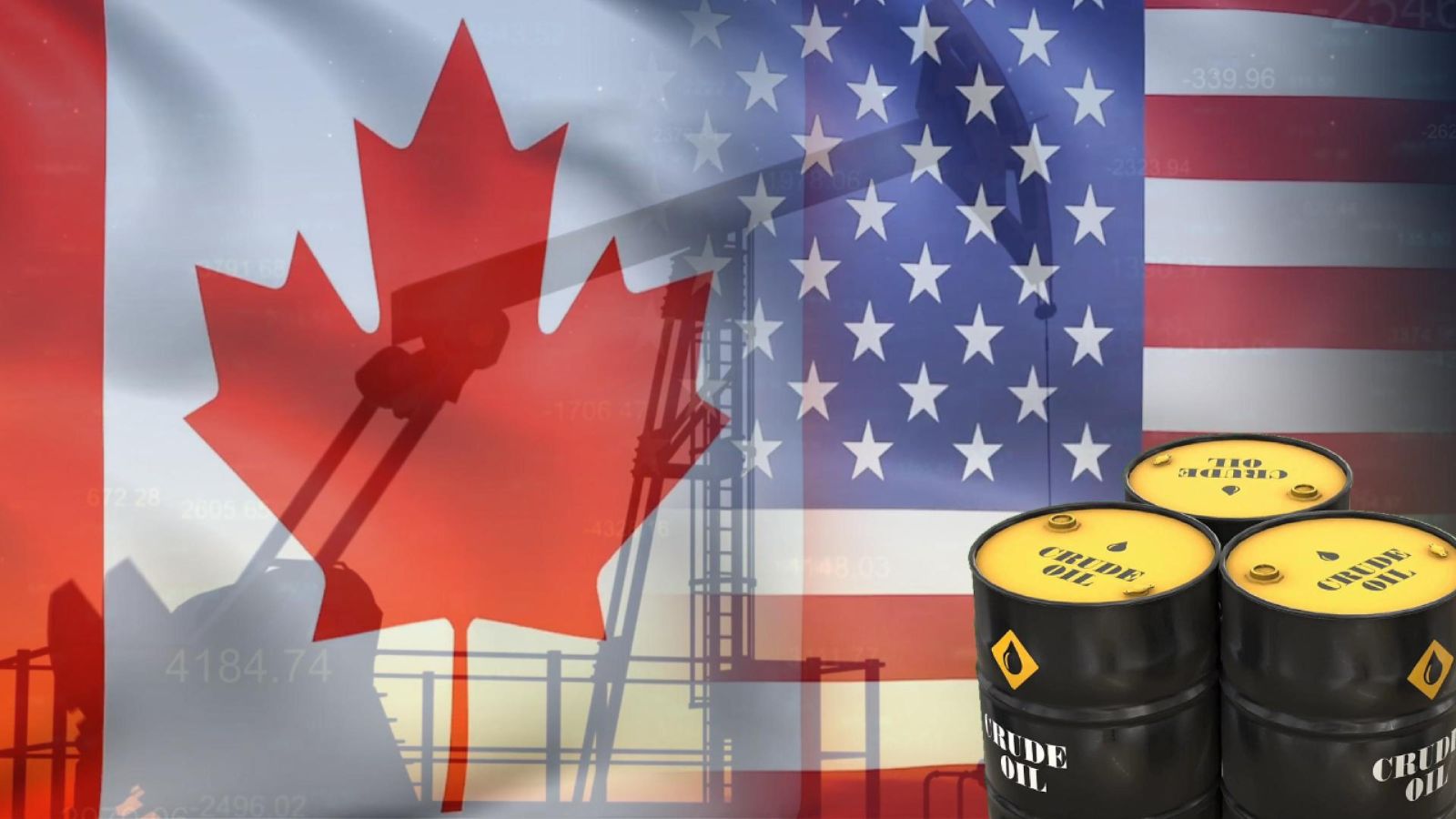
Prime Minister Mark Carney used a Sunday conversation with U.S. President Donald Trump to deliver two messages at once: Canada supports efforts to stop attacks on energy infrastructure in Ukraine, and it intends to remain a major energy supplier to the United States.
The October 11 call came as diesel prices and geopolitical tensions put fuel supplies back near the centre of North American politics. Ottawa said Canada would continue maximizing oil and diesel exports to the U.S., describing those flows as supporting well over one million barrels of diesel production per day. Behind that unusually specific assurance is one of the world’s most deeply integrated energy relationships — and a growing debate over where Canadian energy fits as Washington searches for additional diesel supplies.
The Sunday Call Put Energy Security at the Centre of the Conversation
Carney’s call with Trump was initially framed around the war in Ukraine. According to the Prime Minister’s Office, Carney thanked Trump for his efforts toward an energy ceasefire between Russia and Ukraine and said Canada strongly supported an arrangement that would stop attacks on energy infrastructure and civilians. The important qualification was that Russia had to comply. Ukrainian President Volodymyr Zelenskyy had publicly said Kyiv was prepared to support a reciprocal halt in strikes on energy facilities but was still awaiting details from Washington while Russian attacks continued.
Ottawa then added a distinctly North American component to the readout. Canada, the statement said, would continue maximizing its exports of oil and diesel to the United States, with those energy supplies supporting more than one million barrels of diesel per day. That assurance matters because Carney has repeatedly rejected suggestions that Canada should deliberately interrupt energy shipments as leverage in its disputes with Washington. Even as the bilateral trade relationship has become more confrontational, the federal government has continued to present Canadian energy as something the United States can reliably count on.
Canada Is Already One of the Foundations of the U.S. Fuel System
The scale of Canadian energy entering the United States makes Carney’s statement considerably more significant than a routine promise between neighbours. Canada exported about 4.3 million barrels per day of crude oil in 2025, according to the Canada Energy Regulator, and roughly 3.9 million barrels per day went to the United States. Canada supplied 63.4% of all crude oil imported by the U.S. that year. Those shipments were worth approximately C$126.1 billion, before even counting natural gas, natural gas liquids and refined fuels.
The relationship remains enormous in 2026. U.S. Energy Information Administration data show American crude imports from Canada reached roughly 4.16 million barrels per day in July, the latest monthly data available when Carney and Trump spoke. Canada also exports finished petroleum products south. In 2025, it shipped about 340,000 barrels per day of refined petroleum products to the U.S., although that category includes gasoline, diesel, heating oil, jet fuel and other products rather than diesel alone. For American fuel markets, Canadian energy is therefore present at two stages: as finished products crossing the border and as crude that American refineries turn into transportation fuels.
What Ottawa’s “Million Barrels of Diesel” Claim Actually Means
One part of the PMO statement deserves careful interpretation. Canada is not directly exporting more than one million barrels every day of finished diesel fuel to the United States. The Canada Energy Regulator’s trade data show that total Canadian exports of all refined petroleum products to the U.S. averaged about 340,000 barrels per day in 2025. The government’s wording instead referred to exports of both oil and diesel that ultimately “yield” more than one million barrels of diesel per day, meaning crude oil processed after it reaches American refineries appears to be part of Ottawa’s calculation.
That interpretation is consistent with refinery statistics, although the government did not release its methodology. U.S. refineries imported about 4.16 million barrels per day of Canadian crude in July 2026, while distillate fuel represented about 30% of average U.S. refinery output in recent months. Applying that broad national yield to Canadian crude illustrates how more than 1.2 million barrels per day of distillate production could theoretically be associated with those feedstocks. It is not a precise barrel-for-barrel accounting — refinery configurations and crude blends differ — but it explains why Ottawa’s figure can be much larger than Canada’s direct diesel exports.
America’s Diesel Squeeze Makes Canadian Supply More Valuable
The timing of Carney’s reassurance is particularly important because diesel has become an unusually expensive commodity in the United States. The U.S. Energy Information Administration reported that retail diesel averaged $6.29 per gallon in September 2026 and forecast that prices would remain above $6 during October before gradually easing. East Coast distillate inventories were 32% below their five-year seasonal average in September, leaving the market vulnerable to refinery disruptions, shipping problems and geopolitical shocks.
Diesel also plays an outsized role in the physical economy. Trucks carrying groceries and manufactured goods, farm equipment, construction machinery and large parts of the freight system rely on distillate fuels. U.S. distillate product supplied averaged about 3.9 million barrels per day in 2025. Against that benchmark, energy originating in Canada and capable of supporting more than one million barrels of daily diesel output represents a substantial component of the system. It does not mean one quarter of every gallon consumed in America can be physically traced to Canada, but it demonstrates the scale involved. For Washington, keeping Canadian crude flowing smoothly is therefore directly connected to the effort to stabilize fuel costs.
Trump’s Russian Diesel Deal Complicates the Canadian Message
The call occurred only two days after Trump announced an agreement under which Russia would return substantial volumes of diesel to American and global markets. Trump said Russia would initially provide more than 300,000 metric tonnes, followed by 500,000 tonnes in November, another one million tonnes afterward and potentially several million additional tonnes depending on Russian refinery conditions. The U.S. Treasury Department subsequently issued General License 135, authorizing transactions involving the sale, delivery and importation of Russian-origin diesel despite sanctions that had restricted energy trade with Moscow.
Carney took a notably different position when he spoke with Zelenskyy on the same Sunday. The Prime Minister’s Office said Carney told the Ukrainian president that the U.S.-Russia diesel agreement ran directly against Canadian and allied efforts to promote peace because additional fuel sales would provide Russia with revenue that could help finance its war. That creates a delicate diplomatic balance: Ottawa opposes opening another revenue channel for Russian energy while simultaneously reassuring Washington that Canada can remain a dependable supplier. Carney’s approach appears designed to separate Trump’s proposed energy ceasefire from the controversial Russian fuel arrangement rather than treating them as a single policy.
Pipelines Make the Canada-U.S. Relationship Difficult to Replace Quickly
Geography gives Canadian crude an advantage that overseas suppliers cannot easily reproduce. Western Canadian production moves into the United States through an established network of pipelines connected directly to major refining centres. The Enbridge Mainline alone averaged approximately 3.08 million barrels per day at its Manitoba-U.S. border point in 2025. The Keystone system provides another major route into the U.S. Midwest and Gulf Coast, while Trans Mountain supplies British Columbia, Washington State and overseas customers through its Pacific marine terminal.
The refinery system on the other side of the border has also evolved around those flows. Many Midwest and Gulf Coast plants are capable of processing heavy Canadian crude, including oil-sands-derived barrels that require more sophisticated equipment than lighter crude. In 2024, about 63% of Canada’s U.S.-bound crude went to the Midwest. Pipelines accounted for 89% of Canadian crude exports overall. That infrastructure cannot simply be recreated by purchasing an equivalent number of barrels somewhere else. Tankers can bring alternative crude to coastal refineries, but the economics, specifications and transportation routes differ. Canadian supply is valuable not merely because of volume, but because the physical system has been built around it.
Carney Is Promising Reliability While Trying to Reduce Dependence
Maintaining large U.S. exports does not mean Carney wants Canada to remain permanently dependent on one customer. His government has increasingly presented energy policy as a two-track strategy: preserve Canada’s reputation as a reliable supplier to existing buyers while building enough infrastructure to give producers additional choices. Earlier in 2026, Carney rejected calls to weaponize Canadian energy exports during trade negotiations, arguing that reliability itself is an economic asset that could be damaged if Canada became known for cutting off customers during political disputes.
At the same time, Ottawa is trying to expand access to Asian and other international markets. The Trans Mountain Expansion, which entered service in 2024, nearly tripled the system’s capacity to about 890,000 barrels per day and helped more than triple Canadian crude exports to non-U.S. destinations from earlier levels. On October 1, Carney promoted the proposed Pacific Link pipeline as another route toward diversification, saying roughly 90% of Alberta’s oil still goes to the United States and outlining plans for an additional one million barrels per day of West Coast export capacity. The strategy is therefore diversification without abrupt disengagement from the American market.
The Broader Trade Fight Makes the Energy Commitment More Striking
Canada and the United States are making these energy commitments while simultaneously fighting over tariffs. Washington imposed another round of measures against Canadian goods during the summer of 2026, prompting Ottawa to answer with surtaxes on selected U.S. products. Carney suspended trade negotiations in August after rejecting the American terms on offer. During that confrontation, he pointed out that much of the U.S. merchandise trade deficit with Canada exists because Americans purchase enormous amounts of Canadian energy — a reminder that what appears as a trade imbalance on paper also reflects U.S. demand for crude oil, gas and electricity.
Energy flows have nevertheless continued. Statistics Canada reported that Canadian energy exports rose 4.7% in August, with refined petroleum exports jumping 17.4%. Higher diesel shipments to several destinations, including the United States, were an important contributor. Overall Canadian exports to the U.S. climbed 8.1% that month, pushing Canada’s bilateral merchandise trade surplus to C$11.2 billion. The figures illustrate why oil and diesel are difficult to separate from the wider economic relationship. Even during a tariff fight, refiners, producers, pipeline companies, truckers and consumers on both sides of the border remain connected by everyday commercial demand.
The Reaffirmation Is as Much About Reliability as Production
Carney’s Sunday statement ultimately sends a message beyond the number of barrels involved. At a moment when the United States is searching globally for diesel supplies, dealing with elevated fuel prices and considering sanctioned Russian barrels, Canada is positioning itself as the familiar alternative: geographically close, connected by pipelines and already embedded in the American refining system. That does not guarantee lower diesel prices by itself. Refinery outages, crude prices, inventory levels, freight costs and global conflicts all influence what motorists and businesses eventually pay.
The more important signal is that Ottawa does not appear prepared to turn Canadian oil into an immediate political weapon against Washington, despite one of the most difficult periods in Canada-U.S. trade relations in decades. Carney is simultaneously pursuing additional export markets, defending sanctions against Russia and telling Trump that existing North American energy flows will continue. The next test will be whether the proposed Russia-Ukraine energy ceasefire actually changes conditions on the ground and whether Russian diesel meaningfully enters the market. Until then, Canada’s role is less hypothetical: millions of barrels of Canadian crude are already moving south every day, and American refineries continue turning much of that supply into the fuels that keep the continent moving.