

























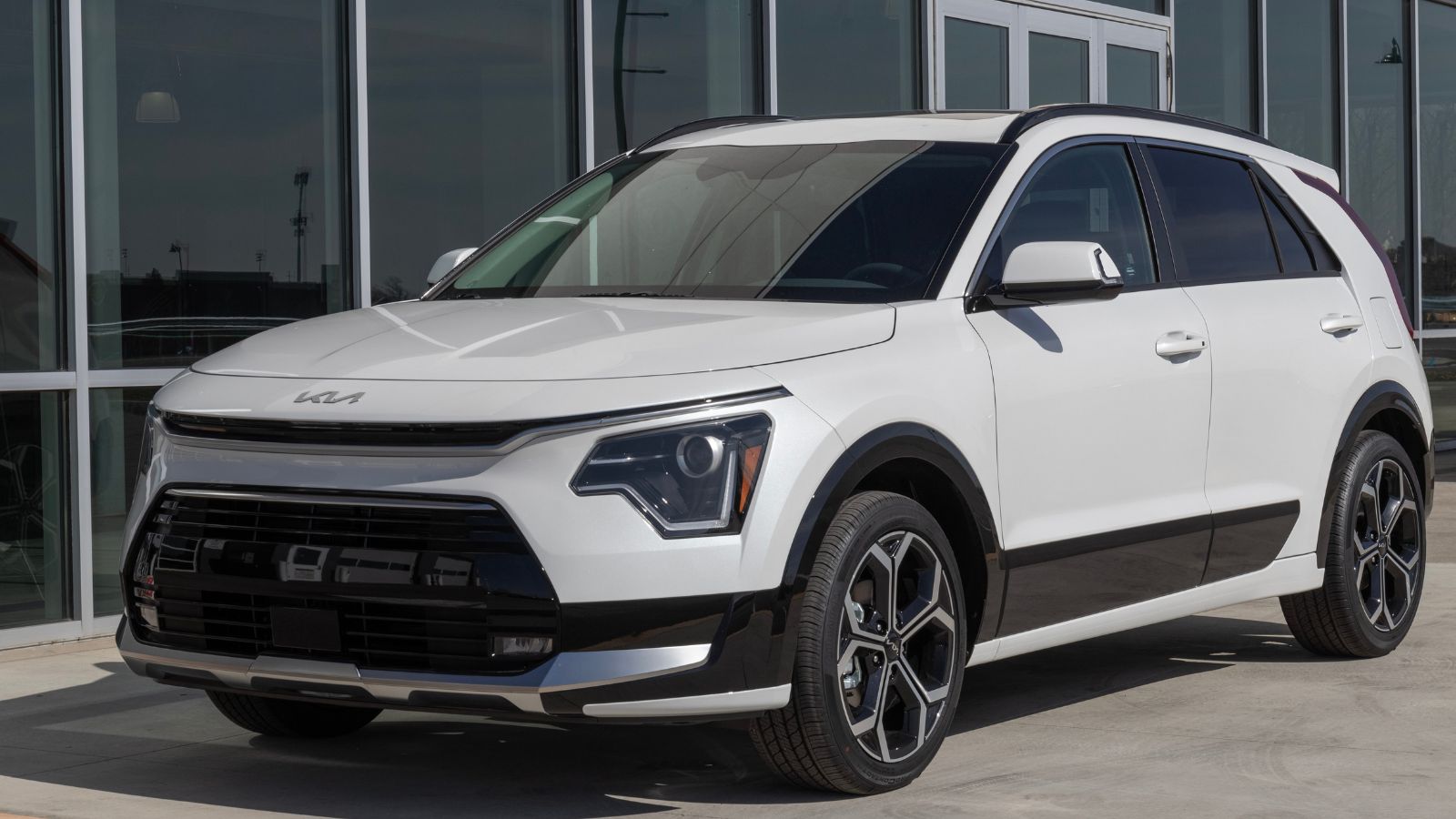
Kia is preparing to remove one of Canada’s most fuel-efficient small crossovers just as hybrids are becoming more popular. The Niro will leave the Canadian lineup after 2026, despite selling a record 10,021 units last year and posting another 21% increase during the first half of 2026. South of the border, Kia is taking a different approach. American buyers will receive a refreshed 2027 Niro, now offered exclusively as a conventional hybrid after the plug-in-hybrid and battery-electric versions were discontinued. The split is striking because the Niro appears well suited to current Canadian buying patterns: it is relatively affordable, uses as little as 4.4 L/100 km and requires no charging. Kia’s decision suggests the company sees greater potential in newer products such as the Seltos Hybrid, EV3 and EV4 than in keeping another similarly sized electrified crossover on Canadian dealer lots.
Canada Is Dropping a Model That Just Had Its Best Year
Kia Canada has confirmed that the Niro will disappear from its lineup at the end of 2026. The timing is unusual because sales have been moving in the opposite direction. Canadian Automobile Dealers Association figures show 10,021 Niros were sold in 2025, up 45.9% from 6,867 in 2024. That made 2025 the nameplate’s strongest Canadian year since arriving here in 2017.
Momentum continued into 2026. The Car Guide reports that Kia delivered 5,449 Niros in Canada during the first six months, approximately 21% more than during the same period in 2025. That percentage is specifically a first-half comparison rather than a full-year growth rate. The decision therefore does not look like the conventional retirement of a model whose sales have collapsed. Kia Canada has not publicly provided a detailed financial explanation for eliminating the Niro. Instead, the move comes as several newer electrified products begin occupying similar price and size territory, giving the company other ways to serve efficiency-minded customers without retaining the Niro nameplate.
More Than 10,000 Canadians Bought One Last Year
The scale of the Niro’s recent improvement makes its departure more surprising. CADA recorded only 5,581 Canadian sales in 2023. Volume climbed to 6,867 in 2024 before jumping to 10,021 in 2025. In two years, annual Niro sales therefore increased by almost 80%. The model accounted for about 4.4% of sales within the Canadian subcompact-SUV segment measured by CADA last year, despite competing against much higher-volume gasoline crossovers.
Supply history also makes the recent numbers notable. Niro volume fell to only 1,234 units in 2022 as Kia transitioned between generations, before rebounding sharply once the second-generation model became established. The current generation arrived for 2023 with hybrid, plug-in-hybrid and fully electric versions sharing essentially the same practical crossover package. Canada proved particularly receptive to that broad electrified range. Discontinuing the entire nameplate after such a strong recovery illustrates an important reality of the modern auto business: sales performance alone does not guarantee survival when manufacturers are reorganizing lineups around new platforms, powertrains and overlapping models.
The Regular Niro Hybrid Was the Most Accessible Version
The conventional Niro Hybrid arguably makes the Canadian decision hardest to understand from a consumer perspective. Kia Canada rates lower Niro Hybrid trims at just 4.4 L/100 km combined. The powertrain pairs a 1.6-litre gasoline engine with an electric motor, producing 139 horsepower and 195 lb-ft of combined torque through a six-speed dual-clutch transmission. Unlike a plug-in hybrid or EV, it does not need to be connected to a charger.
Its practicality is equally conventional. The Niro seats five and provides 646 litres of cargo volume with its rear seats upright, expanding to 1,805 litres when they are folded. The Car Guide lists an all-in Canadian starting price of about $33,811 and identifies the Niro as the second-cheapest conventional hybrid in Canada after the Toyota Corolla Hybrid. There is a trade-off: every Niro is front-wheel drive, with no AWD option. Still, for urban and suburban drivers prioritizing fuel consumption over off-road ability or high performance, the combination of crossover space and exceptionally low gasoline use gave the model an unusually clear purpose.
U.S. Buyers Get a Refreshed Niro Instead
Kia America is taking almost the opposite approach for 2027. Rather than abandoning the Niro entirely, it has refreshed the crossover and simplified it around one powertrain. The American 2027 lineup is exclusively hybrid, using the familiar 1.6-litre gasoline engine and electric motor for a combined 139 horsepower. Five versions are offered: LX, S, EX, SX and SX Touring. U.S. pricing begins at US$29,890 before a US$1,495 destination charge.
The update is more substantial than a simple carryover. Kia redesigned the front and rear styling, added its newer Star Map lighting treatment and revised the cabin. Available technology now includes Kia’s newer Connected Car Navigation Cockpit, over-the-air updates, Highway Driving Assist 2, a surround-view camera and Blind-Spot View Monitor. Engineers also revised suspension tuning, ride comfort and cabin noise. Kia America says the Niro has built a distinctive position during approximately a decade on the market and continues to resonate with customers. In Canada, that same refreshed vehicle simply will not be offered.
America Also Dropped the EV and Plug-In Hybrid
Keeping the Niro in the United States does not mean every version survived. Kia first eliminated the American Niro plug-in hybrid after the 2025 model year, citing changing market conditions. The Niro EV was subsequently discontinued as well, leaving remaining dealer inventory to be sold down. For 2027, the United States gets only the standard hybrid. Kia has effectively reduced a three-powertrain family to one model optimized around fuel economy and straightforward ownership.
That strategy reflects changes elsewhere in Kia’s American electric lineup. The Niro EV used a 64.8-kWh battery and offered an EPA-estimated range of roughly 253 miles, but it faced newer electric competitors and significant overlap with Kia’s dedicated EV products. Kia America has since introduced the smaller EV3, while the Niro Hybrid can occupy a different role without competing directly for the same customer. Canada is taking the simplification one step further by eliminating the Niro itself. In both countries, Kia is moving away from the idea that one nameplate needs conventional hybrid, plug-in and full-electric versions.
The New Seltos Hybrid Is an Obvious Canadian Replacement
Canadian Niro shoppers will soon have another Kia option that addresses one of the outgoing model’s biggest weaknesses. The completely redesigned 2027 Seltos will introduce its first hybrid powertrain by the end of 2026. Kia Canada says it uses a 1.6-litre four-cylinder hybrid system with a six-speed dual-clutch transmission—the same basic engine-and-transmission concept associated with the Niro—but in a newer and somewhat larger crossover package.
More importantly for Canada, the Seltos Hybrid will offer available electric all-wheel drive. The Niro has always been front-wheel drive only, an obvious limitation in a market where AWD remains a popular feature for winter conditions. The new Seltos also sits on a longer platform, with its wheelbase stretched by 60 millimetres compared with the previous generation. Kia has increased passenger and cargo room and equipped the lineup with standard features such as heated front seats and a 12.3-inch multimedia screen. Kia has not explicitly said that the Seltos Hybrid is the reason the Niro is disappearing, but the amount of overlap makes it a natural showroom successor.
Kia Is Also Replacing the Niro EV With Newer Electric Models
The electric side of the Niro’s role is becoming easier to replace. Kia has ended production of the Niro EV as it shifts attention toward newer vehicles developed as dedicated electric models. In Canada, the company has launched the EV4 and EV5 and is preparing additional battery-powered products. The Car Guide has specifically pointed to the smaller EV3 as an eventual alternative to the Niro EV, although Canadian model availability and timing have evolved as Kia adjusts its regional product plans.
The outgoing Niro EV offered 201 horsepower, front-wheel drive and a Canadian-rated maximum range of 407 kilometres. Its starting all-in price was approximately $48,726 before available incentives and manufacturer discounts, according to The Car Guide. By comparison, the newer EV4 entered Canada at a lower starting price while offering as much as 552 kilometres of rated range in long-range form. That illustrates the difficulty of keeping an older EV competitive as battery platforms improve. A Niro Hybrid can remain compelling because 4.4 L/100 km is still excellent; an electric Niro faces faster-moving competition on price, charging and range.
Canada’s Hybrid Boom Makes the Timing Especially Unusual
The broader Canadian market is currently moving toward exactly the type of powertrain found in the Niro Hybrid. Statistics Canada says registrations of conventional hybrid-electric vehicles increased 39.5% in the second quarter of 2026 compared with the same period one year earlier. That was the largest year-over-year increase among the fuel categories it tracks, narrowly ahead of the 37.4% increase for battery-electric vehicles. Gasoline-vehicle registrations, meanwhile, fell 7.3%.
In total, Canadians registered 91,868 conventional hybrids during the second quarter. Unlike Statistics Canada’s zero-emission category, these vehicles cannot be plugged in and do not qualify as ZEVs; they simply combine an internal-combustion engine with electrical assistance to reduce fuel consumption. That makes them relevant to consumers who want lower fuel bills without arranging home charging or changing how they refuel. The Niro fits that formula almost perfectly. Its removal therefore reflects Kia’s product-planning choices more than a lack of Canadian interest in hybrids as a technology. Hybrid demand nationally is expanding quickly even as this particular hybrid prepares to disappear.
Canada and the U.S. Are Getting Increasingly Different Kia Lineups
The Niro is part of a much broader divergence between Kia’s Canadian and American showrooms. Canada receives models that are unavailable south of the border, including the EV4 and EV5, while several U.S.-market vehicles are absent or delayed here. The Car Guide notes that Canadians currently miss products including the K5 sedan, while other models have faced Canadian availability changes because of demand, manufacturing decisions and cross-border trade conditions.
The 2027 Niro demonstrates how far those differences can extend. Kia America sees enough value in the model to invest in redesigned styling, new cabin technology and a five-trim hybrid lineup. Kia Canada has decided that its approximately 200 dealers can cover the same customers through other vehicles. Neither strategy necessarily predicts what happens in another country. Automakers increasingly allocate products according to regional regulations, currency, tariffs, manufacturing sources, dealer demand and overlap with locally important models. Two buyers living a few kilometres apart on opposite sides of the border can consequently face surprisingly different choices from the same global brand.
The Niro Leaves Behind a Difficult Combination to Replicate
No single replacement reproduces everything the Niro Hybrid offered. The Seltos Hybrid should provide more SUV-like styling, additional space and available all-wheel drive, but its Canadian price and final fuel-economy ratings are still being finalized. A battery-electric EV3 or EV4 eliminates gasoline entirely but requires charging and can cost more. A larger Sportage Hybrid provides additional room and power but moves buyers into another size and price class. The Niro occupied an unusually narrow middle ground.
That helps explain why some buyers may miss it more than raw sales rankings suggest. It was neither a performance vehicle nor a particularly rugged crossover. Its appeal came from ordinary qualities: five usable seats, a sizable cargo area, low fuel consumption and a footprint manageable in crowded cities. More than 10,000 Canadian purchases in 2025 demonstrate that this combination had found an audience. Kia’s challenge is not merely replacing those annual sales with another nameplate. It is ensuring customers who valued the Niro’s specific balance of efficiency, price and practicality can still find a suitable vehicle inside the brand.
Strong Sales Do Not Always Save a Nameplate
The Niro’s Canadian exit is a reminder that modern model decisions are increasingly about portfolio strategy rather than simply whether a vehicle sells. Kia already has one of the industry’s broadest mixtures of gasoline, hybrid, plug-in and battery-electric vehicles. Adding a hybrid Seltos while maintaining a Niro Hybrid of nearly the same size would create more internal competition. Dedicated EV platforms are simultaneously making the Niro EV less essential, while the plug-in version has already been phased out.
For Canada, the risk is that Kia is removing a proven product before its replacements have demonstrated the same appeal. For the United States, the company has chosen a less disruptive route by preserving the Niro’s strongest remaining powertrain. The contrast will make 2027 an interesting real-world test. American shoppers will be able to choose the refreshed hybrid Niro, while Canadian buyers will be steered toward the Seltos Hybrid and newer dedicated EVs. If those vehicles absorb the outgoing Niro’s customers, the decision will look disciplined. If they do not, Kia will have retired a growing nameplate at precisely the wrong moment.