





















• About
  • Contact
AutoIgloo
  • News & Trends
    Debit Tap Processing Fees Rise 75% for Some Canadian Auto-Parts and Home-Supply Merchants

    Debit Tap Processing Fees Rise 75% for Some Canadian Auto-Parts and Home-Supply Merchants

    Top U.S. Senate Democrat Targets Trump’s Canada Tariffs, but Election Gains Offer No Guaranteed Relief for Auto Makers

    Top U.S. Senate Democrat Targets Trump’s Canada Tariffs, but Election Gains Offer No Guaranteed Relief for Auto Makers

    Ontario EV Owners Face a 10-to-1 Electricity Price Gap Under New November Rates

    Ontario EV Owners Face a 10-to-1 Electricity Price Gap Under New November Rates

    Nova Scotia CAA Auto Insurance Renewals Bring Credit-Score Discounts and a 30% Coverage Increase

    Nova Scotia CAA Auto Insurance Renewals Bring Credit-Score Discounts and a 30% Coverage Increase

    GM’s Chinese Joint-Venture Sales Collapse 51% as SAIC’s Own Brand Jumps 33%

    GM’s Chinese Joint-Venture Sales Collapse 51% as SAIC’s Own Brand Jumps 33%

    Toronto Battery Maker Lands $26-Million Deal to Convert Diesel Trucks to Electric Across Canada and U.S.

    Teamsters Say Some Canadian Trucking Firms Cut Driver Costs 20–30% by Misclassifying Workers

  • Car Reviews
    Mitsubishi Outlander Review: Is It Still the Underrated Family SUV?

    Mitsubishi Outlander Review: Is It Still the Underrated Family SUV?

    19 Cars With Windshields That Crack Constantly on Canadian Highways

    Subaru Forester vs Toyota RAV4: Which SUV Is Better for Canadian Winters?

    20 Cars Canadians Should Avoid If They Hate Expensive Windshield Replacements

    Hyundai Tucson vs Kia Sportage: Which Compact SUV Is the Better Everyday Buy?

    BYD, CATL and Xiaomi Are in the Mix for Xi’s Washington Trip as Canada and U.S. Split on Chinese EV Access

    Toyota RAV4 Plug-In Hybrid vs Regular Hybrid: Which One Should Canadians Buy?

    17 Vehicles That Are Quietly Getting Crushed by Insurance Costs in Canada

    Honda CR-V Hybrid Review: The Family SUV That Plays It Safe

    2026 Toyota RAV4 vs Honda CR-V: Which SUV Makes More Sense for Canadians?

    2026 Toyota RAV4 vs Honda CR-V: Which SUV Makes More Sense for Canadians?

  • Buying Guides
    Mitsubishi Outlander Review: Is It Still the Underrated Family SUV?

    Mitsubishi Outlander Review: Is It Still the Underrated Family SUV?

    16 Used SUVs That Suddenly Don’t Look Like Smart Buys in Canada

    Nissan Rogue vs Honda CR-V: Which SUV Feels Better After the Test Drive?

    19 Cars With Windshields That Crack Constantly on Canadian Highways

    Subaru Forester vs Toyota RAV4: Which SUV Is Better for Canadian Winters?

    Mazda CX-5 vs Mazda CX-50: Which One Feels More Premium for the Money?

    Mazda CX-5 vs Mazda CX-50: Which One Feels More Premium for the Money?

    17 Vehicles That Are Quietly Getting Crushed by Insurance Costs in Canada

    Honda CR-V Hybrid Review: The Family SUV That Plays It Safe

    18 Cars With Parts Prices So Wild They’re Becoming Hard to Own in Canada

    Is the New Toyota RAV4 Still the Safest Bet in Canada?

  • Comparisons
    19 Cars With Windshields That Crack Constantly on Canadian Highways

    Subaru Forester vs Toyota RAV4: Which SUV Is Better for Canadian Winters?

    21 Vehicles With the Best Real-World Fuel Economy in Canada (Not Just the Sticker)

    Toyota Corolla Cross vs Honda HR-V: Which Small SUV Is Less Compromised?

    20 Cars Canadians Should Avoid If They Hate Expensive Windshield Replacements

    Hyundai Tucson vs Kia Sportage: Which Compact SUV Is the Better Everyday Buy?

    BYD, CATL and Xiaomi Are in the Mix for Xi’s Washington Trip as Canada and U.S. Split on Chinese EV Access

    Toyota RAV4 Plug-In Hybrid vs Regular Hybrid: Which One Should Canadians Buy?

    Honda Asked Suppliers for 30% Parts Cost Cuts as $9.4-Billion Savings Drive Hits Global Supply Chain

    Why Some Buyers Are Choosing Older Hondas Over Newer SUVs

    25 EV Charging Mistakes Canadians Make in March (That Wreck Range)

    Why Some Canadians Are Choosing Hybrids Over Full EVs Again

  • EVs & Hybrids
    BYD, CATL and Xiaomi Are in the Mix for Xi’s Washington Trip as Canada and U.S. Split on Chinese EV Access

    Toyota RAV4 Plug-In Hybrid vs Regular Hybrid: Which One Should Canadians Buy?

    Geely Auto’s Core Profit Jumps 46% as Chinese EV Expansion Accelerates — With Canada Now Opening to Geely-Owned Lotus

    Geely Confirms Canadian Vehicle Sales for 2027 as Chinese Automakers Challenge Established Brands

    18 Cars That Will Feel Dated Fast as New Chinese EVs Arrive

    12 EVs Now Price Below $41,000 in Canada—Fiat 500e Falls Under $30,000 With Rebate

    The Used EV Question Canadians Should Ask Before Buying One

    The Used EV Question Canadians Should Ask Before Buying One

    Why Some EV Owners Are Getting Sticker Shock From Home Charging Setups

    Why Some EV Owners Are Getting Sticker Shock From Home Charging Setups

    20 Signs Your Car Battery Is About to Leave You Stranded

    Canadian Auto Jobs Become a Central Fault Line as Ottawa Reveals Why It Rejected U.S. Vehicle Terms

  • More
    • Pricing & Deals
    • Winter Driving
    • Ownership & Maintenance
No Result
View All Result
AutoIgloo
No Result
View All Result

Home » News & Trends

⁠South Korea Extends Fuel-Tax Cuts as High Oil Prices Put Canada’s Pump-Cost Debate Back in Focus

Nate Brewer by Nate Brewer
September 18, 2026
Reading Time: 7 mins read
A A
Photo Credit: Shutterstock

Photo Credit: Shutterstock

466
SHARES
1.5k
VIEWS
Share on FacebookShare on Twitter

The price displayed above a fuel pump has once again become a shorthand for a much bigger global problem. South Korea is extending temporary fuel-tax reductions through November as instability in the Middle East keeps crude oil expensive and governments search for ways to soften the impact on households and businesses.

The decision has particular resonance in Canada, where gasoline costs have climbed sharply from a year ago and Ottawa has already extended its own temporary federal fuel-excise-tax suspension. With crude benchmarks hovering around US$100 a barrel and fuel costs feeding into transportation and inflation, both countries are confronting a familiar dilemma: governments can reduce the tax portion of a litre of fuel, but they have far less control over the global oil market setting much of its underlying cost.

South Korea Extends Relief Through November

South Korea will keep its existing fuel-tax reductions in place through November 30, extending a measure that had been scheduled to expire at the end of September. The government is maintaining a 15% reduction on gasoline taxes and deeper 25% reductions on diesel and butane. Officials said the decision reflects concern about the public’s fuel-cost burden and the possibility of renewed volatility in international oil markets as Middle East tensions continue.

The extension is notable because Seoul is not treating the current surge as a short-lived price spike that can simply be ignored. Earlier extensions had already carried the cuts through July and then September. Keeping them for another two months effectively acknowledges that global energy uncertainty remains capable of reaching household budgets quickly. For a commuter filling a car or a small business operating delivery vehicles, the policy does not eliminate high fuel prices. It instead reduces one component of the final pump price while global markets remain unsettled.

Diesel Gets More Protection Because the Cost Travels Through the Economy

The difference between South Korea’s 15% gasoline-tax reduction and its 25% cut for diesel is deliberate. The finance ministry has emphasized diesel’s importance to logistics and industrial activity, while butane is commonly used by small commercial trucks. That makes fuel policy about more than the amount paid by motorists. When trucks, delivery fleets and industrial vehicles become more expensive to operate, those costs can eventually appear in freight bills, shop prices and business margins.

Seoul is also layering temporary measures around the major Chuseok travel period. Authorities said 226 gas stations on state-financed expressways would offer fuel prices 100 won per litre lower from September 24 through September 27, while daytime electric-vehicle charging discounts were also planned. The holiday measures are separate from the national fuel-tax reduction, but they illustrate the same approach: reduce highly visible transportation expenses at moments when millions of households are especially likely to feel them.

Oil Above US$100 Keeps Governments Under Pressure

Crude prices remain the force that neither Seoul nor Ottawa can set by decree. Brent crude was trading around US$104 a barrel during September 18 trading, while West Texas Intermediate was roughly US$102 to US$103. Prices had retreated from recent highs, but both benchmarks remained around the psychologically important US$100 level after renewed conflict and infrastructure disruptions created fresh uncertainty over global supply.

Recent pressure has centred on the Middle East. Damage to Saudi Arabia’s East-West Pipeline, threats to tanker movements and disruptions involving key regional shipping routes have forced traders to continually reassess how much crude can safely reach world markets. Saudi Arabia has attempted to offset some disruption by arranging additional shipments through Oman, helping prices ease from their peaks. Yet the episode demonstrates why pump prices can change faster than household budgets can adjust. Even an oil-producing country such as Canada participates in a globally priced market for crude and refined products, leaving motorists exposed to international shocks.

Canada Has Already Turned to Its Own Fuel-Tax Holiday

South Korea’s announcement comes only days after Canada reinforced a remarkably similar affordability strategy. Ottawa announced that the temporary suspension of the federal fuel excise tax would continue through January 31, 2027. The tax had initially been reduced to zero on April 20, 2026, removing the normal 10-cent-per-litre federal excise levy on gasoline and four-cent levy on diesel during the relief period.

The government’s current schedule would restore only half of the normal tax from February 1 through March 31, 2027, before returning to the full statutory rates on April 1. Ottawa estimates the extension itself will have an additional fiscal impact of approximately $2.9 billion and bring total estimated federal fuel-tax relief in 2026-27 to $5.3 billion. Canada had already eliminated the federal consumer carbon price in April 2025, meaning the latest debate is no longer simply about carbon pricing. It increasingly concerns how much conventional fuel taxation governments should temporarily surrender when crude prices spike.

Canadian Drivers Are Paying Far More Than a Year Ago

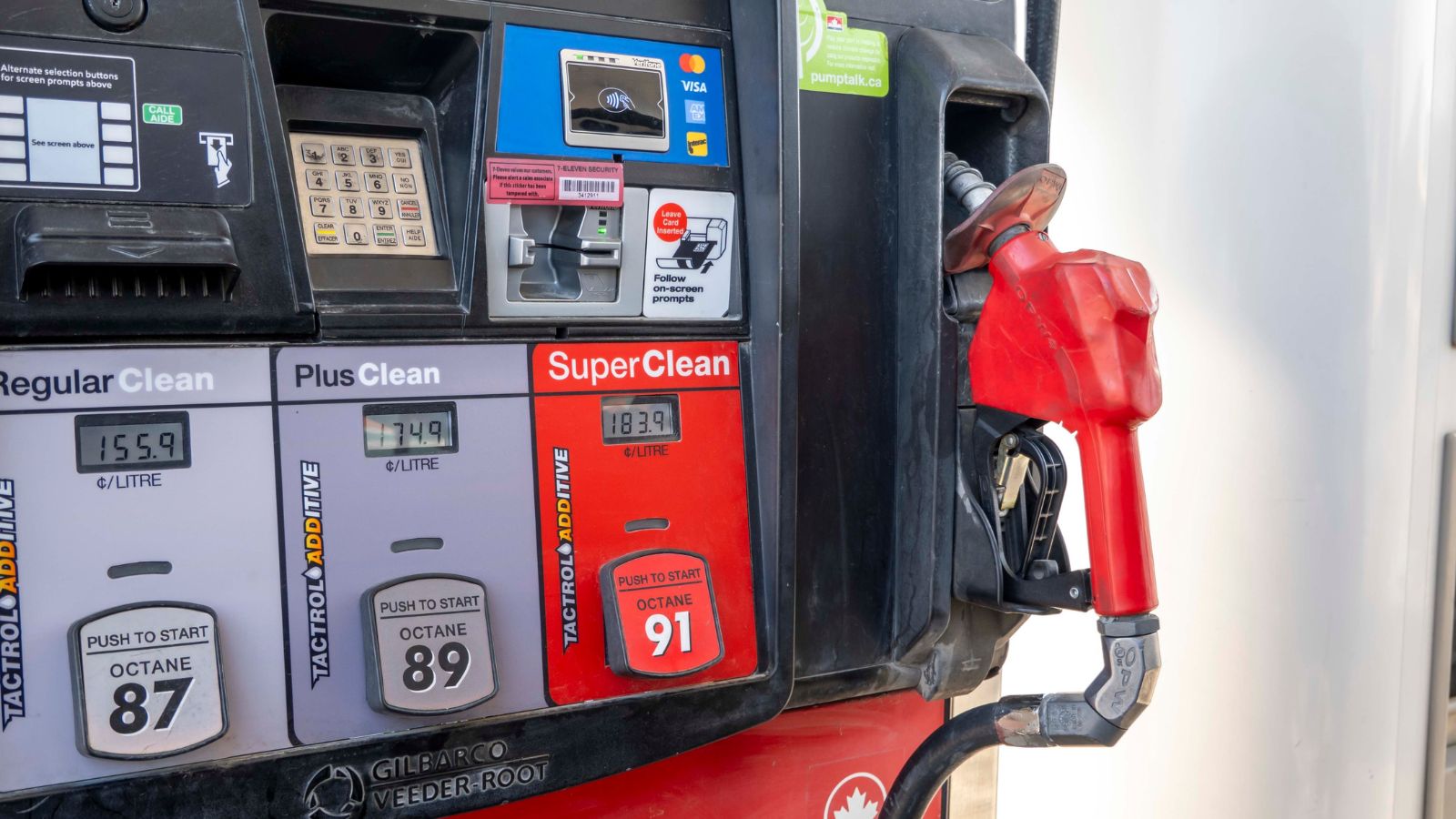
The pressure behind Ottawa’s response is visible in current pump data. CAA’s daily national average put regular gasoline at 183.4 cents per litre early on September 18. That was slightly below the previous day’s 183.9 cents, but substantially above the 176.6-cent average recorded one week earlier and the 167.9-cent level a month earlier. A year ago, the same national measure stood at only 137 cents per litre.

For an ordinary 50-litre fill, today’s national average works out to roughly $91.70. At last year’s average, the same volume would have cost about $68.50 — a difference of more than $23 on a single visit to the station. That kind of increase explains why fuel prices attract outsized attention even when other categories of household spending are growing more slowly. Fuel is purchased repeatedly, its price is displayed in giant numbers beside major roads, and many commuters cannot immediately reduce the kilometres they travel.

A National Average Hides Canada’s Complicated Fuel Market

Canadian motorists do not all experience an oil shock in the same way. Pump prices vary because crude costs are only one part of the final number. Refining margins, transportation expenses, retail competition, seasonal fuel requirements, local supply conditions, exchange rates and provincial or regional taxes can all widen the difference between what drivers pay in separate parts of the country. CAA identifies crude supply, refining capacity, geopolitical conflict and the value of the U.S. dollar among the variables affecting Canadian gasoline prices.

The tax structure is equally layered. Although the federal excise levy is temporarily suspended, GST or HST treatment and provincial fuel taxes remain relevant, while some metropolitan areas have additional transportation-related levies. That helps explain why a drop in crude does not necessarily produce identical overnight savings nationwide. Canada can therefore have a national debate about fuel affordability while households see very different numbers on their local signs. The global shock is shared, but the final retail price remains distinctly regional.

Gasoline Is Already Leaving a Mark on Canadian Inflation

Statistics Canada’s August inflation report shows why policymakers are watching fuel so closely. The Consumer Price Index was 3.0% higher than a year earlier, matching July’s annual inflation rate. Gasoline prices, however, were 22.8% above August 2025 levels. The increase was slightly slower than July’s 25.7% rise, but it remained large enough that Statistics Canada specifically identified elevated gasoline prices as an important influence on the inflation picture.

The contrast becomes clearer when gasoline is removed. Statistics Canada reported that CPI excluding gasoline increased 2.4% year over year in August, compared with the 3.0% headline figure. Transportation prices overall were up 7.5%. That does not mean every additional dollar spent on fuel translates directly into broader inflation, but energy costs have unusually wide reach. A higher gasoline bill affects commuters immediately, while more expensive diesel and jet fuel can work through trucking, agriculture, aviation and tourism, spreading the consequences beyond households that personally visit filling stations.

Diesel May Matter Even More Than Regular Gasoline

Regular gasoline receives most of the public attention because it is the price most motorists see every week, but diesel can produce a wider economic ripple. Trucks move food and consumer goods, farms rely on diesel-powered machinery, and construction and industrial operations consume substantial amounts of fuel. When diesel becomes substantially more expensive, companies must either absorb those costs, improve efficiency or attempt to recover some of them through higher prices.

That explains why South Korea is maintaining a larger tax reduction for diesel than gasoline and why Canadian energy analysts have focused on diesel during the latest oil disruption. The timing is particularly sensitive for agriculture because September overlaps with harvest activity in many regions. A family can sometimes postpone a discretionary drive, but a farmer cannot indefinitely postpone harvesting a crop and a freight company cannot simply stop transporting groceries. The broader fuel-cost debate therefore extends beyond motorists and into the cost structure of the economy itself.

Tax Cuts Can Reach the Pump, but the Pass-Through Is Not Guaranteed

Temporary fuel-tax cuts have an intuitive appeal: remove a fixed tax and the retail price should fall by roughly the same amount. Canada’s government said gasoline prices declined by 11 cents per litre on the first day of the federal excise-tax suspension in April, when the 10-cent gasoline levy was removed. Academic evidence, however, suggests the amount ultimately reaching consumers can depend on market competition, supply constraints and how fuel retailers respond.

Recent economic research examining earlier fuel-tax holidays has found meaningful but sometimes incomplete pass-through. Yale’s Budget Lab used an 80% consumer pass-through rate as its central estimate when studying a U.S. federal gas-tax proposal, while a 2026 study of Italy’s temporary fuel-tax reduction found pass-through of roughly 65% at less competitive stations and around 80% where competition was stronger. The evidence suggests tax relief can reduce prices, but it should not be assumed that every cent of forgone government revenue will always appear as an identical cent of consumer savings.

The Bigger Debate Is About What Temporary Relief Can Accomplish

Canada and South Korea are demonstrating both the usefulness and the limits of fuel-tax policy. Governments can change domestic taxes quickly, producing relief without waiting for new vehicles, infrastructure or energy projects. Canada’s current suspension removes as much as 10 cents per litre in federal gasoline excise tax, while South Korea is maintaining sizeable percentage reductions. For households facing repeated fill-ups, those reductions are tangible even if they do not reverse the entire rise in fuel costs.

The harder question begins when temporary measures last through repeated oil shocks. Canada’s planned $5.3 billion in fuel-tax relief represents revenue the government will not collect, while global crude prices can still overwhelm a fixed tax saving. Seoul is simultaneously emphasizing diversified energy supplies and monitoring oil availability, underscoring the distinction between cushioning a price shock and eliminating its cause. As long as crude remains near triple-digit levels, Canada’s pump-cost discussion is therefore likely to remain centred on that trade-off: immediate consumer relief versus the fiscal and structural limits of tax cuts.


Recommended.

B.C. Reopens Highway 97 Through Wildfire Zone for 12 Hours a Day — With No Stops Allowed

B.C. Reopens Highway 97 Through Wildfire Zone for 12 Hours a Day — With No Stops Allowed

August 17, 2026
Toronto Battery Maker Lands $26-Million Deal to Convert Diesel Trucks to Electric Across Canada and U.S.

Toronto Battery Maker Lands $26-Million Deal to Convert Diesel Trucks to Electric Across Canada and U.S.

October 28, 2026

Trending.

Canada’s Ballard Puts a 250,000-Mile Performance Guarantee Behind Hydrogen Buses

Canada’s Ballard Puts a 250,000-Mile Performance Guarantee Behind Hydrogen Buses

October 2, 2026
10 Reasons the Canadian Car Market Feels Different Heading Into Summer

Canadian Auto Sales Rise 3.4% for a Fourth Straight Month—but 2026 Still Trails Last Year

October 3, 2026
PBO Warns U.S. Tariff War Threatens Up to 185,000 Canadian Jobs, With Auto Manufacturing Among Hardest Hit

PBO Warns U.S. Tariff War Threatens Up to 185,000 Canadian Jobs, With Auto Manufacturing Among Hardest Hit

October 21, 2026
22 Ways Canadians Accidentally Void Their Vehicle Warranty

B.C. Drivers Vote Today on the Future of ICBC Insurance as Parties Clash Over Private Competition and No-Fault Coverage

October 24, 2026
15 Vehicles Canadians May Want to Avoid Before May Long Weekend

Tesla Buyers in Canada Are Reporting Fresh Model Y Delivery Delays as Some Orders Slip Into October and November 2.

September 27, 2026
  • About
  • Contact
  • Privacy Policy
  • Disclaimer
  • Editorial Policies
  • Terms and Conditions
A Revir Media Group Website

2026 Autoigloo - © All rights reserved

No Result
View All Result
  • News & Trends
  • Car Reviews
  • Buying Guides
  • Comparisons
  • EVs & Hybrids
  • More
    • Pricing & Deals
    • Winter Driving
    • Ownership & Maintenance

2026 Autoigloo - © All rights reserved

This website uses cookies. By continuing to use this website you are giving consent to cookies being used. Visit our Privacy and Cookie Policy.




