




















China’s auto market is undergoing a transition that is becoming difficult to describe as gradual. During the first three weeks of August, production of conventional-fuel light vehicles plunged 59% from the same period a year earlier, while new-energy vehicles captured 64.3% of passenger-car retail sales. The figures show how dramatically the centre of gravity has shifted toward electrified models.
There is an important complication, however. China’s new-energy vehicle, or NEV, category includes battery-electric and plug-in hybrid vehicles, so the 64.3% figure does not represent battery EVs alone. More importantly, electrified vehicles are gaining share while the entire Chinese passenger-car market remains weak. The result is a transformation driven by both the rise of newer powertrains and a striking contraction in demand for traditional gasoline cars.
Gasoline-Car Production Is Contracting at Extraordinary Speed
The most dramatic figure in the latest market update is on the factory side. China produced about 270,000 conventional-fuel light vehicles during the first three weeks of August, a 59% decline from the comparable period in August 2025 and 15% below the same portion of July. Production of hybrids and plug-in hybrids combined also declined, reaching roughly 259,000 units, down 20% year over year. These are partial-month figures rather than final August totals, but the magnitude of the gasoline-car decline is difficult to dismiss as ordinary seasonal volatility.
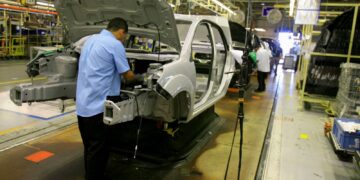
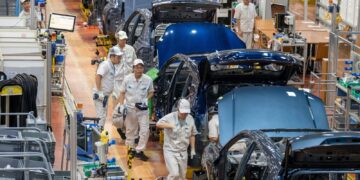
Automakers typically adjust factory schedules when inventories, dealer orders and expected demand weaken, making production a useful signal of where manufacturers believe the market is heading. The shift was already visible in July, when production of conventional gasoline-powered light vehicles fell more than 50% from a year earlier. What now appears to be happening is not simply an expansion of China’s electrified fleet. Manufacturers are actively reallocating production capacity away from vehicles that depend entirely on internal-combustion engines as dealerships face a rapidly changing mix of consumer demand.
EV Market Share Is Rising Even Though EV Sales Are Down
A 64.3% market share might normally suggest booming demand, but China’s August numbers tell a more complicated story. Passenger NEV retail sales reached about 614,000 units between August 1 and August 23, down 12% from the same period in 2025 and 2% from the equivalent portion of July. Total passenger-vehicle retail sales were even weaker, falling 22% year over year to approximately 956,000 units. Because conventional vehicles declined faster than electrified ones, NEVs captured a larger portion of a shrinking market.
That distinction matters when interpreting the transition. NEVs are not gaining share solely because millions of additional consumers suddenly entered showrooms looking for electric cars. They are also benefiting from the much steeper retreat of gasoline vehicles. Year-to-date passenger NEV retail sales through August 23 stood at approximately 6.283 million units, down 12% from a year earlier, while total passenger-car retail sales were down 20%. The industry can therefore be simultaneously experiencing weaker absolute sales and a historic increase in electrified market penetration.
July Showed This Was More Than a One-Month Distortion
August did not produce the shift out of nowhere. In July, passenger NEV retail sales totalled roughly 951,000 units, down 3.9% from a year earlier, yet their share of passenger-car retail sales reached a record 65.1%. Total passenger-vehicle retail sales fell 20.9% to about 1.461 million units. Retail sales of conventional internal-combustion vehicles were down approximately 41%, while pure gasoline models experienced an even steeper 44% decline.
The progression is striking when compared with earlier years. NEVs accounted for about 51.1% of passenger-car retail sales in July 2024 and roughly 54% in July 2025 before jumping above 65% this July. That means a powertrain category that had only recently crossed the halfway mark is now approaching two-thirds of the retail market. Battery-electric models have been particularly resilient: approximately 647,000 were sold at retail in July, up 6% year over year, even while plug-in hybrid sales declined. The mix inside the electrified category is therefore changing alongside the broader move away from gasoline.
Fuel Costs Are Making the Economics Harder for Gas Cars
Operating costs have become another factor in the widening gap. The China Passenger Car Association said domestic gasoline prices had risen substantially during 2026 as higher international oil prices and disruptions around the Strait of Hormuz fed into fuel costs. By July, the association calculated that Chinese gasoline prices had increased by a cumulative 1,575 yuan per metric ton during the year. For households comparing two similarly priced vehicles, recurring fuel expenses can make an electrified alternative increasingly attractive.
At the same time, the cost structure of Chinese EVs has improved. Industry representatives cited by Chinese state media have pointed to lower battery-material costs, integrated manufacturing techniques and increasingly large production runs as reasons some NEVs can now compete directly with gasoline models on sticker price. The comparison is no longer always between an expensive electric car and a cheaper combustion model. In many mass-market segments, buyers can choose between similarly priced vehicles but face very different energy and maintenance costs. That competitive reality puts additional pressure on automakers trying to keep traditional gasoline models profitable at high production volumes.
Beijing Still Favours NEVs, Though Incentives Are Less Generous
Government policy remains an important part of the picture, although 2026 brought a meaningful change. New-energy vehicles purchased in 2024 and 2025 qualified for a full vehicle-purchase-tax exemption of up to 30,000 yuan per passenger vehicle. For purchases made in 2026 and 2027, the benefit was reduced to a 50% tax reduction capped at 15,000 yuan. That policy step-down contributed to unusually weak NEV sales early in 2026 as some consumers had brought purchases forward to capture the larger 2025 benefit.
Even with the reduced tax treatment, China’s trade-in program continues to tilt incentives toward electrified vehicles. Under the 2026 scrappage program, qualifying consumers replacing an older vehicle with an eligible NEV can receive a subsidy equal to 12% of the new vehicle’s price, capped at 20,000 yuan. A qualifying gasoline vehicle with an engine of two litres or less receives 10%, capped at 15,000 yuan. Replacement transactions without scrapping also offer larger maximum support for NEVs. The policy gap is not enormous, but across millions of purchases it reinforces the market’s direction.
Exports Are Becoming a Pressure Valve for Chinese Factories
Weak domestic demand does not mean Chinese factories have lost their appetite for production. Increasingly, vehicles that cannot easily be absorbed at home are being directed abroad. China exported roughly 923,000 vehicles in July, according to CPCA data reported by Reuters, an increase of 88.2% from a year earlier. NEV exports rose 147.8%, and electrified models accounted for more than half of passenger-vehicle exports. Chinese manufacturers have consequently intensified expansion in Europe, Southeast Asia, Latin America, the Middle East and other markets.
The difference between domestic retail and manufacturer wholesale figures reinforces that trend. During August 1–23, Chinese manufacturers wholesaled about 714,000 passenger NEVs, 5% more than a year earlier, even though domestic NEV retail sales were down 12%. Year-to-date NEV wholesale volume reached roughly 8.962 million units, up 7%. That gap does not translate one-for-one into exports because wholesale data also capture inventory and domestic distribution, but it demonstrates why overseas markets matter increasingly to factory utilization. For manufacturers, electrification and globalization are becoming two parts of the same strategy.
China Could Finish August Near Another EV-Share Record
Before the latest weekly numbers were released, the CPCA estimated that August passenger NEV retail sales could reach approximately 1.04 million vehicles, about 9.4% higher than July. That would produce an estimated market penetration rate of 65.8%, above July’s record 65.1%. Overall passenger-car retail sales were projected at around 1.58 million units, still down 21.7% year over year. The forecast therefore anticipated the same basic pattern seen throughout the summer: a struggling overall market in which electrified vehicles continue taking share from combustion models.
Reaching that forecast will require a strong finish. With approximately 614,000 NEVs sold through August 23, roughly 426,000 additional vehicles would have to be retailed during the final eight days. Month-end promotions, new-model orders and activity around the Chengdu Auto Show could help. Even if the final figure misses the projection, however, the larger direction is difficult to overlook. A 59% decline in conventional-fuel production alongside an NEV retail share above 64% suggests China’s automakers increasingly regard gasoline-only passenger cars as the contracting side of their home market.