




















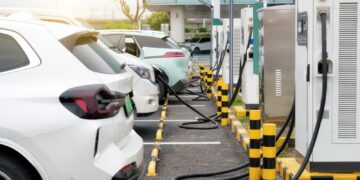

Rivian’s newly launched R2 is barely into its first months with public customers, and some early owners are already being asked to change how they charge. The automaker has reportedly contacted a limited number of R2 drivers about an inspection involving part of the high-voltage DC fast-charging system, with affected owners advised to avoid DC fast charging until their vehicles have been checked.
The situation does not currently appear to be a fleet-wide recall, and no affected vehicle count has been publicly disclosed. Still, the precaution attracts attention because fast charging is one of the R2’s central selling points. For early adopters who expected the compact electric SUV to handle long trips with quick charging stops, even a temporary restriction can significantly change how the vehicle is used.
Rivian Is Contacting Selected R2 Owners Directly
Reports of the issue emerged after R2 owners shared communications they said came directly from Rivian service personnel. In one in-app exchange dated August 19, an owner was told that the vehicle needed an inspection related to its high-voltage distribution system. When the owner specifically asked whether DC fast charging should be avoided before the scheduled service appointment, Rivian reportedly recommended holding off as a precaution. Other owners have described receiving telephone calls asking them to arrange similar inspections, suggesting the company is identifying potentially affected vehicles rather than issuing a blanket instruction to every R2 on the road.
That distinction matters. There is currently no published number showing how many R2s are involved, and reports have not established that every early-production vehicle shares the condition. Owners who have not been contacted therefore should not automatically assume their vehicle has the same problem. At the same time, the targeted nature of the outreach means checking Rivian app messages, voicemail and the vehicle’s service history is particularly important. The clearest information available so far comes from individual service communications rather than a broad public safety campaign.
The Inspection Focuses on a High-Voltage Charging Connection
The service procedure described in owner-shared information focuses on the connection between the DC fast-charging connector and the vehicle’s DCFC header assembly. Technicians are reportedly checking that joint for an improper gap and for signs of abnormal heat. If the connection fails Rivian’s inspection, reports indicate that both the DCFC header assembly and DCFC connector assembly are replaced. That makes this more than a software check: the investigation concerns physical hardware carrying substantial electrical current during a fast-charging session.
Electrical connections become particularly important when large amounts of current are flowing through a relatively small contact area. Excess resistance at a poor electrical connection can generate heat, which helps explain why Rivian’s reported inspection procedure includes checks for thermal abnormalities. The company’s R2 owner documentation also treats high-voltage components as technician-only equipment and warns owners against opening, modifying or attempting repairs on high-voltage systems themselves. In practical terms, this is not a situation where an owner should attempt to inspect or tighten charging hardware in a driveway.
A DC Fast-Charging Pause Does Not Mean the R2 Cannot Be Charged
The reported precaution is specifically about DC fast charging, which is the high-powered charging used primarily during longer journeys. The R2 also supports conventional AC charging. Rivian certification documentation describes Level 1 charging from a 120-volt source and Level 2 charging from a 240-volt source, with the vehicle’s onboard charger converting that AC electricity for the battery. Rivian’s NACS portable charger, for example, is rated at up to 7.6 kW and can use either 120-volt or 240-volt outlets.
That gives affected owners an important distinction while waiting for an inspection. Someone who normally plugs in overnight at home may experience considerably less disruption than a driver who relies on highway fast chargers or has no home-charging option. Rivian has not publicly announced a universal prohibition on AC charging for the R2, and the owner reports specifically describe advice to pause DC fast charging. Because individual service instructions can differ, however, an affected owner should follow the guidance attached to that particular vehicle rather than assuming that another owner’s service conversation applies identically.
The R2 Pushes Considerable Current During Fast Charging
The R2’s fast-charging performance helps explain why every connection in the DC pathway needs to function properly. Rivian advertises the ability to replenish the R2 from 10% to 80% in less than 30 minutes under suitable conditions. Independent tests of an R2 Performance have recorded peak charging power of roughly 229 kW and current near 600 amps at compatible equipment. Rivian was also reported to have confirmed that the vehicle can request roughly 630 amps when conditions permit, an unusually high current level for a roughly 400-volt EV architecture.
Those figures should not be interpreted as evidence that high-current charging caused the condition Rivian is investigating. No such causal conclusion has been publicly established. They do illustrate why connection quality and thermal management are serious engineering considerations. High charging power is achieved not simply by plugging into a charger advertised at hundreds of kilowatts; the vehicle, charging cable, connector, adapter when applicable, and electrical contacts all have to safely handle the session. A physical connection that falls outside specification therefore warrants attention even when the vehicle otherwise drives normally.
There Is No Public R2 Safety Recall Listed Yet
One of the most important facts is what has not happened. Reporting on the service campaign says no associated R2 filing had appeared with the U.S. National Highway Traffic Safety Administration when the issue became public. Public recall databases likewise showed no safety recall for the 2027 R2 at that point. The phrase “engineering investigation recall” reportedly appeared in one owner’s Rivian service communication, but that internal terminology should not be confused with a formally announced federal safety recall.
Automakers can investigate a suspected manufacturing or component problem before determining whether it meets the threshold for a formal recall. A company may inspect a subset of vehicles, identify production batches, replace questionable components and collect engineering data while the scope is being established. If Rivian ultimately concludes that a safety-related defect exists across a defined population, additional regulatory action could follow. Conversely, the company could determine that only a small batch requires corrective work. Until Rivian or regulators publish a campaign number, affected VIN range and remedy, describing the matter as a confirmed fleet-wide recall would go beyond the available evidence.
The Timing Is Sensitive Because R2 Production Is Still Ramping
Rivian began customer R2 production at its Normal, Illinois, plant in April 2026 and announced the first public customer deliveries in June. That makes the vehicles involved part of a particularly young fleet. By early August, Rivian said R2s were continuing to roll off the line and that reservation holders were receiving ordering invitations in waves. The company has positioned the smaller SUV as the model capable of bringing the Rivian brand to a much broader market than the more expensive R1T and R1S.
Early production periods are closely watched for exactly this reason. Hardware that performed correctly during validation can encounter manufacturing variation when production volume rises and thousands of components begin moving through a commercial supply chain. Rivian says R2 development included tens of thousands of miles on individual test vehicles and testing in environments ranging from extreme cold to desert heat. Even extensive validation, however, does not eliminate the possibility of a component or assembly issue emerging after customer production begins. The speed with which such issues are identified and resolved becomes part of the launch story.
Fast Charging Is Too Important to the R2 Experience for This to Linger
Rivian has made charging access a prominent part of the R2 proposition. The vehicle uses a native NACS port, and Rivian currently advertises access to more than 21,000 compatible Tesla Superchargers across the United States and Canada in addition to the Rivian Adventure Network and other compatible public chargers. Rivian has also cited U.S. Department of Energy figures showing nearly 15,000 Level 3 charging locations and more than 70,000 fast-charging ports nationwide in early 2026. For a vehicle designed partly around road-trip capability, that network is an important feature rather than a minor convenience.
That is why clarity will matter as Rivian’s investigation progresses. Owners need to know which VINs are affected, whether the condition is confined to a production batch, how long inspections take and whether replacement parts are readily available. For now, the prudent message is narrower than some alarming interpretations suggest: selected owners are being contacted, affected vehicles are being inspected, and those owners are reportedly being told not to use DC fast charging until that inspection is completed. What happens next depends on what Rivian’s engineers find.