

























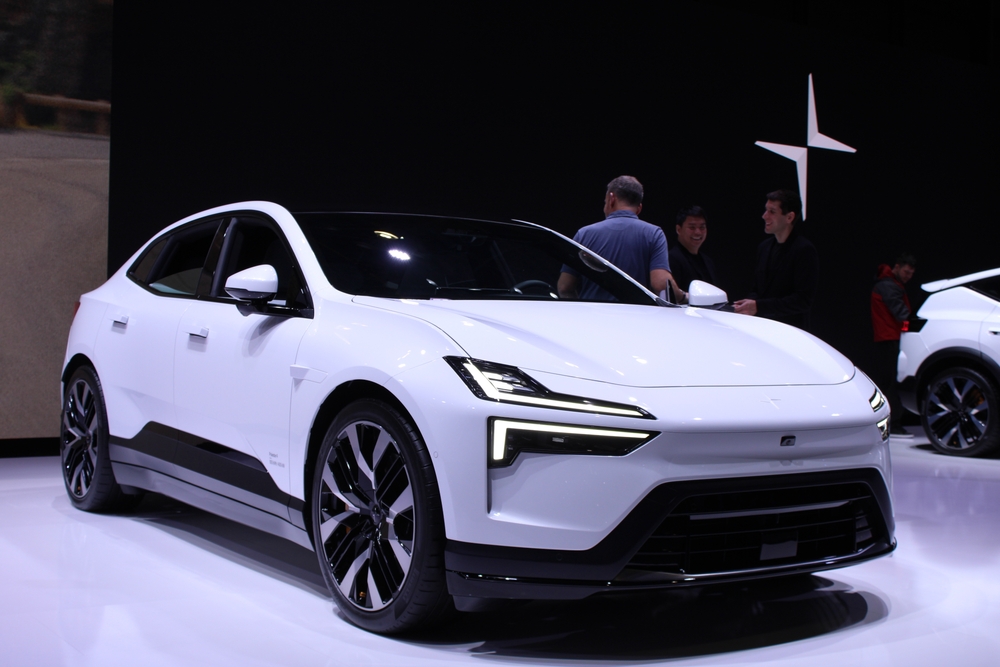
Two neighbouring auto markets are sending sharply different signals about the same electric-car company. The Trump administration has denied Polestar permission to sell new vehicles in the United States beginning with the 2027 model year, effectively forcing the Swedish EV brand out of the new-car market once its remaining inventory is gone. The regulation behind the decision was finalized under the Biden administration, but President Donald Trump’s Commerce Department delivered the authorization denial that made the cutoff real.
North of the border, Canada has moved in the opposite direction. Ottawa has reopened a limited pathway for Chinese-built EVs, allowing the Polestar 2 to return for 2027 after tariffs had pushed it out. For buyers, workers and automakers, the split shows how quickly a car’s corporate ownership and manufacturing origin can matter as much as its price, range or performance.
The U.S. Cutoff Begins With the 2027 Model Year
The American restriction is tied specifically to the 2027 model year, rather than an immediate seizure of vehicles or cancellation of every Polestar already on the road. The U.S. Commerce Department’s Bureau of Industry and Security declined to grant Polestar a specific authorization under the Connected Vehicles Rule. Under the current regulatory framework, the company cannot introduce or sell new 2027-model-year vehicles in the United States. Polestar can still clear its existing inventory of Polestar 3 and Polestar 4 vehicles, while privately owned and used Polestars remain legal to drive and resell.
That distinction matters to someone who recently leased a Polestar or has been considering a discounted vehicle sitting at an American retailer. The brand is not disappearing overnight, but its new-car pipeline now has an expiry date. Polestar has promised to maintain customer support and access to its service network, yet the commercial operation surrounding those owners will inevitably shrink without fresh inventory. What might have looked like a technical compliance dispute has therefore become a practical market exit, leaving dealerships, employees and customers to manage the consequences.
Building Cars in America Was Not Enough to Save Polestar
The most striking part of the decision is that factory location did not protect Polestar. The Polestar 3 is assembled at Volvo’s plant in South Carolina, while the Polestar 4 sold in the United States is produced in South Korea. Neither vehicle currently offered to American buyers is arriving from a Chinese assembly line. Even so, the federal rule reaches beyond the country stamped on a vehicle-identification label. It also examines corporate control and connected systems, including software enabling cellular links, Wi-Fi, Bluetooth, satellite communication and certain automated-driving functions.
Polestar’s difficulty comes from its close relationship with Zhejiang Geely Holding, the Chinese automotive group that controls the brand and has provided financing, engineering resources and manufacturing support. Under the regulation, a connected-vehicle manufacturer owned by, controlled by or subject to the jurisdiction of China can be restricted even when the finished vehicle is built somewhere else. That makes the case a warning for the wider industry. Moving an assembly line may help an automaker avoid tariffs, but it may not overcome a national-security rule focused on software, data access and corporate governance.
Volvo Received Permission, but Polestar Did Not
The contrast with Volvo Cars makes the situation more complicated. Volvo is also majority-owned by Geely, sells connected vehicles and operates within the same broader automotive family. Nevertheless, the Commerce Department granted Volvo a specific authorization allowing it to continue selling connected vehicles in the United States. Polestar applied through the same regulatory system and was denied. The government has not published a detailed comparison explaining every factor that separated the two outcomes, leaving Polestar retailers and customers questioning why one Geely-linked brand could stay while the other had to leave.
Volvo said its approval followed discussions with American authorities about governance, technology and data security. Polestar, meanwhile, has historically depended heavily on Geely and Volvo for vehicle platforms, manufacturing, financing and after-sales operations. That does not prove any particular Polestar is unsafe, nor did the government identify a specific vehicle that had secretly collected information from an owner. The restriction is preventive, based on potential access and corporate control. Still, the result is unusually severe: a company headquartered in Sweden, listed on Nasdaq and manufacturing one of its vehicles in America is considered too closely connected to China for future U.S. sales.
Canada Reversed Its 100 Per Cent Chinese-EV Surtax
Canada had erected its own barrier against Chinese-made EVs, but it was based primarily on trade and industrial policy rather than connected-car security. Ottawa imposed a 100 per cent surtax on electric vehicles made in China, on top of the regular 6.1 per cent tariff. That made the China-built Polestar 2 commercially difficult to sell and helped force it out of the Canadian new-car market. The model remained available in several other countries, but Canadian customers were left with Polestar’s newer and generally more expensive SUVs.
The policy changed on March 1, 2026. Under a new Canada-China trade arrangement, Ottawa lifted the 100 per cent surtax and established an initial annual quota allowing as many as 49,000 Chinese EVs to enter at the standard 6.1 per cent most-favoured-nation tariff. The quota is expected to grow by 6.5 per cent annually. The agreement also includes an affordability provision that will gradually reserve a larger portion of the quota for vehicles priced below C$35,000. Polestar reacted quickly, announcing within months that its Chinese-built fastback would return to Canadian showrooms.
The Returning Polestar 2 Is Powerful, but Not Cheap
The 2027 Polestar 2 is not being presented as an inexpensive Chinese EV. Canadian pricing begins at C$69,900 before freight, taxes and other charges, and only one well-equipped configuration is being offered: the Long range Dual motor. It produces 310 kilowatts, equivalent to 421 horsepower, sends power to all four wheels and accelerates from zero to 100 km/h in a claimed 4.5 seconds. Its preliminary estimated driving range is 447 kilometres, enough for ordinary commuting and many intercity trips without positioning the car as a budget alternative.
Polestar has simplified the lineup by making its Pilot, Plus and Climate packages standard. Those packages include equipment such as advanced driver-assistance features, a panoramic roof, premium audio, heated rear seats, a heated steering wheel and a heat pump intended to improve cold-weather efficiency. A newer Qualcomm Snapdragon processor is designed to make the Android-based infotainment system more responsive. The result is a familiar model with worthwhile updates rather than an entirely new generation. For Canadians who valued its restrained styling and practical hatchback opening, the return restores an option that tariffs—not an absence of buyers—had removed.
Canada Becomes Polestar’s Remaining North American Opportunity
Canada will not replace the United States in population or potential sales volume, but it has suddenly become one of Polestar’s most strategically useful North American markets. The company says more than 7,300 Polestar 2 vehicles were put on Canadian roads before the model’s temporary withdrawal. Its return restores a three-car lineup alongside the Polestar 3 and Polestar 4, providing retailers with an entry point below the brand’s two SUVs. That is important because a showroom stocked only with expensive crossovers can struggle to attract drivers who originally discovered Polestar through its lower and more distinctive fastback.
The broader Chinese-EV quota is designed to be controlled rather than unlimited. Federal briefing documents estimate that 49,000 vehicles represent less than three per cent of Canada’s annual new-vehicle market. Polestar will also have to compete for room within that allocation against China-built models from much larger manufacturers. Its C$69,900 price means it will not count toward the affordable portion reserved for vehicles below C$35,000. Even so, Canada now offers something the United States does not: a legal pathway for selling a China-built connected EV without first satisfying Washington’s test of corporate ownership, software development and potential foreign control.
Current U.S. Owners Are Promised Support, but Questions Remain
For existing American owners, Polestar’s promise to continue service is significant, but it cannot remove every concern. Vehicles require years of warranty work, software updates, replacement parts, collision repairs and access to trained technicians. Polestar says customers will retain access to its service network and that existing warranties will remain in effect. Remaining new inventory can also be sold. However, dealerships normally justify investments in tools, buildings and specialized employees through a continuing supply of new vehicles. Once that supply ends, maintaining wide service coverage can become harder and less profitable.
The human impact is already visible in the uncertainty expressed by owners and retailers. Dealers must determine how aggressively to discount remaining cars, how many technicians to retain and how to manage leases that could be returned years after new-car sales stop. Owners may also worry about resale values even though their vehicles remain legal and supported. One shopper might view a heavily discounted Polestar 3 as an opportunity, while another sees a future trade-in risk. The federal action does not cancel warranties, but the quality of the long-term ownership experience will depend on how consistently Polestar funds parts, software and service operations after its American retail footprint contracts.
Polestar Is Retreating to Europe as the Auto Market Fragments
Polestar’s American retreat comes at a difficult, although not hopeless, point in its development. The company reported an estimated 30,423 global retail sales in the first half of 2026, described as a record for the brand. Second-quarter sales, however, declined four per cent from the same period a year earlier to 17,296 vehicles. Chief executive Michael Lohscheller has acknowledged that the United States was not profitable for Polestar, making the forced withdrawal easier to absorb than the loss of a core market would have been. Europe already generates close to 80 per cent of the company’s retail volume.
The larger lesson extends beyond one relatively small EV manufacturer. The United States is constructing a security wall around vehicle software, corporate ownership and data systems, while Canada has reopened a tariff-controlled lane for Chinese production in exchange for wider trade access. A vehicle can consequently be assembled in America and barred from future American sales, while a Chinese-built model from the same brand is welcomed back in Canada. Consumers in neighbouring countries may increasingly face different vehicle choices and prices. For automakers, globalization is being replaced by regional rulebooks, duplicated supply chains and political tests that engineering alone cannot solve.