














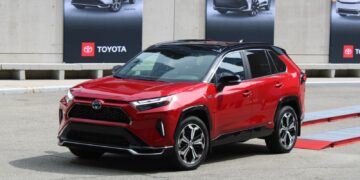
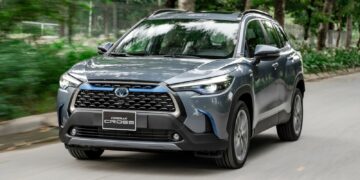








Toyota is approaching its next earnings report with an unusual combination of strong North American demand and mounting pressure in overseas markets. During the July–September 2026 quarter, Toyota and Lexus sold nearly 430,000 electrified vehicles in North America, an increase of more than 30%. Analysts expect the Japanese automaker’s operating profit to rebound 18%, potentially ending a five-quarter stretch without year-over-year earnings growth.
The anticipated recovery reflects more than rising hybrid sales. A weaker Japanese yen and a more favourable comparison with previous U.S. tariff expenses could help profitability, even as declining sales in China and the Middle East create new challenges. For Canadian consumers and the broader automotive industry, Toyota’s performance highlights a significant shift toward electrified vehicles and the growing importance of hybrids in an increasingly competitive global market.
A 30% Surge Signals a Major Change in North American Demand
An increase of more than 30% in a market as large as North America matters because it changes the composition of Toyota’s business, not simply the number of vehicles leaving dealerships. During July through September 2026, Toyota and Lexus sold almost 430,000 electrified vehicles across the region. At the same time, Toyota’s overall U.S. sales advanced by less than 1%. The contrast suggests that electrified models are taking a substantially larger role within a market that is otherwise growing slowly.
For buyers, the shift can look ordinary: a household replacing an aging SUV with a hybrid version that fits the same driveway and daily commute. For Toyota, thousands of decisions like that add up to a different sales mix. Analysts are watching because hybrids are generally more profitable for the company than some other vehicles, making their popularity potentially important to earnings. Still, a stronger mix does not automatically guarantee higher profit. Production costs, incentives, currency movements and trade expenses can all change the final result. The key development is that demand for electrification is rising even without a comparable surge in total U.S. vehicle sales.
Toyota’s Electrified Strategy Goes Far Beyond Fully Electric Cars
The term “electrified” can be misleading if it is treated as another word for fully electric. Toyota counts several technologies in this category: conventional hybrid electric vehicles, plug-in hybrids, battery-electric models and hydrogen fuel-cell vehicles. A conventional hybrid uses a gasoline engine alongside an electric motor and charges its smaller battery while driving. A plug-in hybrid can also draw power from an external charger, while a battery-electric model relies on electricity rather than gasoline for propulsion. These differences matter when interpreting headline sales growth.
Toyota’s strategy has been to offer these choices alongside one another instead of asking every buyer to adopt the same technology at once. As of September, Toyota and Lexus marketed 32 electrified vehicle options in U.S. dealerships. Earlier in the fiscal year, Toyota said hybrids accounted for the large majority of its global electrified sales and projected that hybrid sales would exceed five million units worldwide during the year ending March 2027. That explains why a surge in Toyota’s electrified sales should not be confused with a comparable increase in pure electric vehicle adoption. Much of the momentum comes from technology that requires no charging stop.
U.S. Sales Figures Reveal How Quickly Toyota’s Business Is Changing
Toyota’s official U.S. results help explain the regional trend. In the third quarter of 2026, Toyota Motor North America reported 633,223 U.S. vehicle sales, an increase of just 0.6% from a year earlier. Electrified models, however, reached 363,367 sales, up 28.5%. They represented 57.4% of the quarter’s U.S. volume. Those figures cover the U.S. market, not all North American countries, which is why they should not be treated as directly interchangeable with the region-wide figure of nearly 430,000.
The momentum was especially visible in September. Toyota reported 117,215 electrified vehicle sales in the United States for the month, up 37.8% year over year and equivalent to 58.2% of all vehicles it sold there. Both brands contributed: the Toyota division’s electrified sales rose 29.2% during the quarter, while Lexus electrified sales grew 23.1%. The numbers illustrate how the transition is reaching beyond one type of customer. A family shopping for a practical Toyota and a buyer considering a premium Lexus may have very different priorities, yet both are increasingly finding electrified alternatives within their preferred brands.
Canada’s Hybrid Sales Are Growing Even Faster Than the North American Average
Canada is providing an even more striking example of Toyota’s electrified momentum. On November 3, Toyota Canada reported that it had sold a record 17,735 electrified vehicles in October, a 70.2% increase from the same month in 2025. They accounted for 67.6% of all Toyota and Lexus sales in Canada. Overall monthly sales climbed 15.6% to 26,219 vehicles, showing that electrified models were growing far faster than the company’s combined business. These October figures come after the July-to-September period used in the North American earnings outlook, but they suggest the trend continued into the autumn.
The Canadian-built RAV4 Hybrid was an important part of that story, setting another monthly record with 6,195 sales. Toyota said it was the model’s seventh consecutive record month. The result has implications beyond showroom traffic because Toyota assembles the RAV4 Hybrid in Canada. Production demand touches workers, suppliers and communities connected to those plants. Other models also posted October records, including the Sienna hybrid and Lexus RX Hybrid, suggesting that buyers are responding across multiple vehicle categories. The Canadian numbers reinforce a simple point: electrification is no longer limited to a small group of early adopters, and locally manufactured hybrids are central to that shift.
Analysts Expect Toyota’s Operating Profit to Rebound 18%
The profit figure drawing attention is a forecast, not a result Toyota has already reported. According to a Reuters report published November 4, the median estimate from nine analysts surveyed by LSEG calls for operating profit of 992 billion yen in the July-to-September quarter. That would represent an 18% increase from a year earlier and Toyota’s first year-over-year quarterly operating profit gain in six quarters. Revenue is also forecast to rise 8% to 13.4 trillion yen, making the anticipated improvement significant on both the sales and earnings sides.
Operating profit measures earnings from business operations before certain other items and should not be confused with the final net profit attributable to shareholders. The distinction matters because currency movements, financing, taxes and other factors can affect the bottom line differently. Investors will also examine how much of any improvement comes from selling more profitable hybrids rather than temporary conditions. Toyota has scheduled its fiscal second-quarter results for November 5, 2026. Until that announcement, the 18% increase remains an expectation. Even if the company meets it, a single stronger quarter would not erase the challenges that contributed to the preceding stretch of weaker earnings.
A Weaker Yen and U.S. Tariff Comparisons Could Boost Earnings
A weaker yen is one reason analysts expect Toyota’s reported profit to improve. The company earns revenue in currencies such as U.S. dollars, and those overseas earnings can translate into more yen when Japan’s currency declines. That accounting benefit can be meaningful for a manufacturer with extensive operations and sales outside Japan. Reuters also identified a more favourable comparison with the tariff-related costs that damaged Toyota’s results in the same quarter a year earlier. Neither factor should be mistaken for evidence that underlying trade pressures have disappeared.
Tariffs remain especially relevant to a company whose North American operations involve factories, suppliers and vehicles moving across national borders. A change in the timing or size of trade-related expenses can influence reported quarterly performance even when customer demand is steady. Toyota’s previous financial update shows why investors remain cautious: operating income for April through June 2026 was approximately 1.063 trillion yen, down 102.6 billion yen from a year earlier. The company nevertheless raised its full-year operating income forecast to 3.4 trillion yen in August. For the upcoming results, analysts will be looking for evidence that a better vehicle sales mix is producing durable gains beyond currency and comparison effects.
Falling Sales in China and the Middle East Threaten Toyota’s Recovery
Strong demand in North America cannot completely offset every weakness elsewhere. During the July-to-September quarter, global Toyota and Lexus vehicle sales fell 4% to slightly more than 2.5 million units. China was a particularly difficult market, with sales down 22%, while Middle Eastern volumes declined by roughly one-third. The figures help explain why analysts are cautious about treating the anticipated profit rebound as a company-wide turnaround. A manufacturer can improve margins in one region while losing scale and competitive ground in another.
China presents an especially complex challenge because local automakers are competing aggressively as the market shifts toward electric vehicles. Toyota’s emphasis on conventional hybrids has worked well in North America, but the same product balance may not be equally effective everywhere. Signs of strain extend into the supplier network. Denso, a major Toyota supplier, reported that its operating profit in Asia declined 28% in the six months through September, even as regional revenue increased. The supplier also pointed to higher material and parts costs as a pressure on earnings. These developments underline the need to assess Toyota’s global profitability, not just the strongest market or most successful technology.
Why Hybrids Are Winning Over Drivers Concerned About Fuel Costs
For many drivers, the attraction of a conventional hybrid begins with a practical concern rather than enthusiasm for new technology: how to use less gasoline without arranging somewhere to plug in. Natural Resources Canada says conventional hybrids typically use 20% to 40% less fuel than comparable gasoline-only vehicles, depending on the model and driving conditions. They recharge through the vehicle’s own systems rather than an electrical outlet. That makes the technology accessible to households living in apartments, renters without dedicated parking and commuters who simply want their existing refuelling routine to stay familiar.
Toyota’s latest Canadian-built RAV4 illustrates why that proposition has gained attention. The company lists a manufacturer-estimated combined consumption rating of 5.5 litres per 100 kilometres for the 2026 RAV4 LE AWD, alongside standard all-wheel drive for Canadian versions. Actual fuel use can differ with weather, traffic, driving habits and vehicle loading, and buying decisions still depend on price, space and ownership costs. Yet the broader appeal is straightforward. A family can obtain the fuel-saving benefits of an electric motor without making home charging a requirement. That helps explain the continuing popularity of Toyota’s hybrid-first options even as fully electric vehicles receive considerable attention.
Toyota’s North American Factories Have More at Stake as Hybrid Demand Rises
The sales surge has consequences for manufacturing across North America. Toyota says its operations directly employ nearly 64,000 people in the region and include 14 manufacturing plants. In 2025, its North Carolina facility began assembling batteries for electrified vehicles. Canada also has a substantial stake: Toyota operates two manufacturing facilities there, building vehicles including the RAV4 Hybrid and electrified Lexus SUVs. The connection between showroom demand and manufacturing is important because a growing share of hybrid sales can support employment and supplier orders, provided plants are equipped to deliver the models customers actually want.
Toyota is also spending on the technologies that will shape future production. In October, it opened a 30,000-square-foot battery development and evaluation centre in Saline, Michigan, designed to support work from battery testing to recycling. Looking further ahead, Toyota has estimated that modernizing factories through automation could require roughly one trillion yen annually beginning in 2028 across the company, group businesses and major suppliers. That figure is an estimate rather than a confirmed spending commitment. The combination of battery development and possible factory upgrades shows how the shift toward electrification is becoming an industrial investment question, not merely a competition for retail sales.
Toyota’s Upcoming Earnings Will Test Whether the Hybrid Boom Can Sustain a Recovery
Toyota’s November 5 earnings release will provide the first firm test of analysts’ expectations. Investors will compare the reported operating profit with the 992-billion-yen consensus and examine whether revenue approaches the predicted 13.4 trillion yen. Equally important will be management’s discussion of regional profitability, currency effects, tariffs and the earnings contribution of hybrids. Toyota had already raised its fiscal-year operating income outlook to 3.4 trillion yen in August, but that remains below the roughly 3.77 trillion yen earned in the preceding fiscal year. One strong quarter therefore would not, by itself, establish a full-year recovery.
For Canadian consumers, the near-term question is whether strong hybrid demand continues to translate into attractive vehicle availability and competitive choices. For Canadian plants and suppliers, sustained demand for locally built models such as the RAV4 Hybrid would be encouraging, although production and trade conditions still matter. Toyota has projected global hybrid sales above five million units for the fiscal year ending March 2027, signalling confidence in the technology beyond North America. The coming financial update will show how much of that confidence is reaching the profit line. The bigger story is a company finding fresh strength in hybrids while still confronting major risks in other markets and the expensive transition toward future vehicle technology.