



















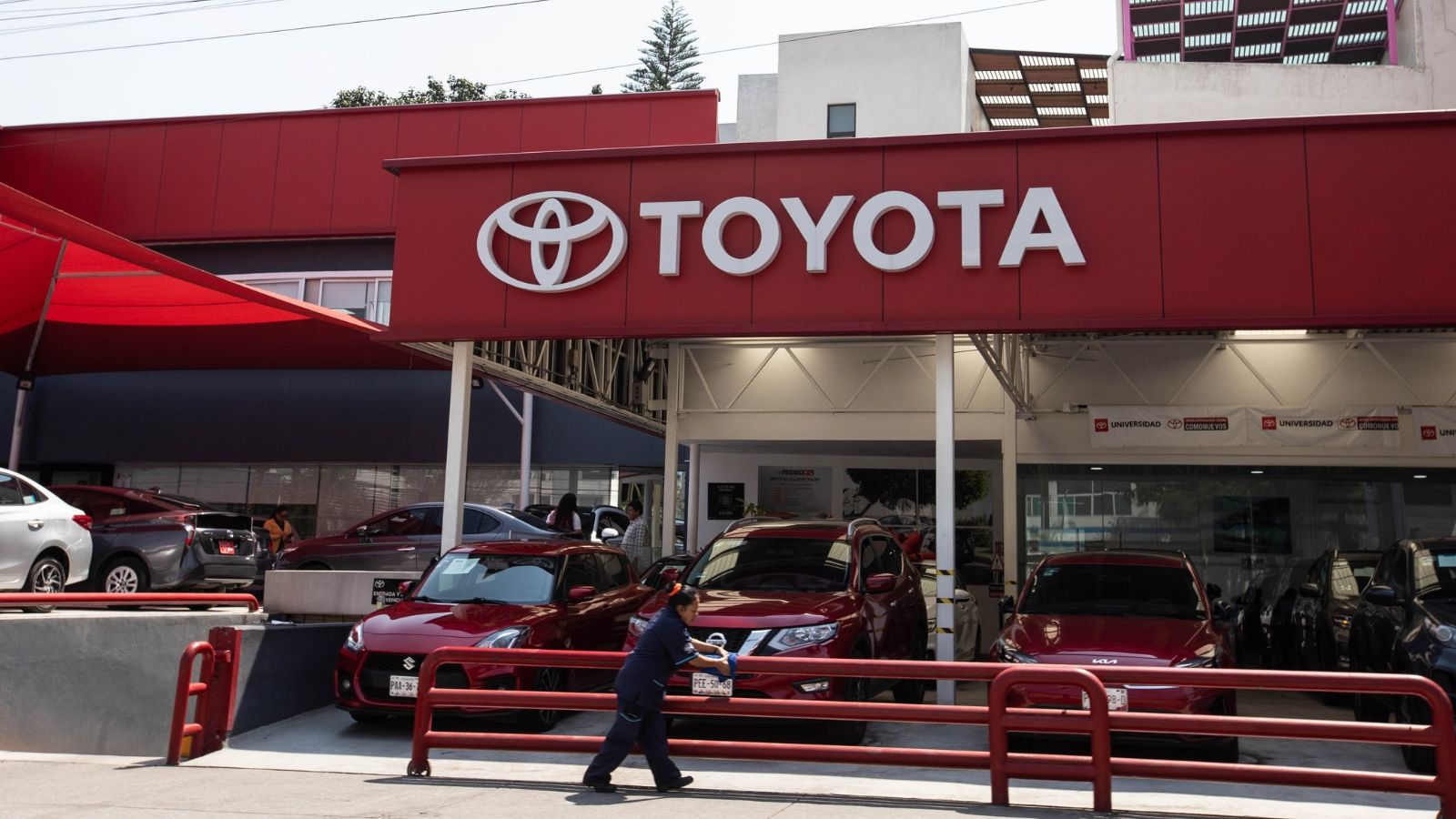
Toyota is facing two very different realities in the world’s largest automotive markets. In September 2026, the Japanese automaker recorded a 19.7% sales decline in China, extending its losing streak to eight consecutive months. Meanwhile, sales in the United States climbed 8.4%, supported by strong demand for hybrid vehicles and Toyota’s established lineup.
The contrasting results highlight a growing challenge for the world’s largest automaker. Chinese consumers are increasingly embracing electric vehicles as gasoline prices rise, while American buyers continue to favour Toyota’s combination of fuel efficiency, reliability, and vehicle choice. Despite stronger U.S. demand, Toyota’s worldwide sales and production declined for a third consecutive month, raising questions about how quickly the company can adapt to changing consumer preferences.
China’s Sales Decline Extends Into an Eighth Consecutive Month
China’s 19.7% sales decline in September 2026 was not an isolated disappointment. It marked the eighth consecutive month of falling Toyota and Lexus deliveries. The result followed a 22.8% drop in August, meaning the latest decline was smaller but offered little evidence of a sustained recovery. China remains a major market, so repeated monthly losses matter more than a single headline percentage.
For dealerships, a prolonged slowdown can mean a tougher conversation with shoppers who have more alternatives than ever. For Toyota, it raises questions about whether its traditional strengths translate into the same appeal in Chinese showrooms. The company built its global reputation on durability, efficient gasoline engines and hybrids. Those qualities have not disappeared, but the competitive landscape has changed quickly. Eight consecutive declines suggest the problem extends beyond the timing of purchases, even though one monthly report cannot establish precisely how much market share Toyota has lost.
Higher Gasoline Prices Are Changing What Chinese Buyers Want
Toyota identified higher gasoline prices as a factor weighing on demand for conventional cars and hybrids in China. A traditional Toyota hybrid burns gasoline, with help from an electric motor. With fuel costs elevated, the appeal of a car that requires regular trips to the pump can weaken relative to one capable of operating entirely on electricity. The issue is not that hybrids suddenly became inefficient; it is that buyers are reassessing the alternatives.
The market shows how strong that pressure has become. Data reported by the China Association of Automobile Manufacturers showed domestic sales of conventional fuel-powered passenger vehicles falling 47.3% from a year earlier in September. That figure covers the wider market, not Toyota alone, and it should not be confused with Toyota’s 19.7% decline. Still, it helps explain the environment. A household comparing vehicles may now put future fuel bills alongside purchase price, features and brand reputation.
Electric Vehicles Now Account for Two-Thirds of China’s Passenger Car Market
China’s electrification shift is visible in its September sales mix. New-energy vehicles accounted for about 67% of passenger vehicle retail sales, the China Passenger Car Association reported. That is two out of every three passenger vehicles purchased. Crucially, the category includes battery-electric vehicles and plug-in hybrids, not just cars powered exclusively by batteries. Conventional hybrids, such as many Toyota models, do not fall into the same classification.
The growing share also needs context: Chinese new-energy vehicle retail volumes were lower than a year earlier, even as they captured more of the market. Much of the increase in share reflects a sharper retreat in gasoline-only vehicles. For Toyota, that distinction is important. A company can offer efficient hybrids and still find itself competing in a market where buyers increasingly expect the option to plug in. The challenge is therefore about technology, pricing and the ownership experience, rather than fuel economy alone.
Chinese Automakers Are Making Competition More Difficult
Toyota’s pressure in China comes against a competitive field that is both crowded and fast-moving. In September, BYD led the country’s new-energy vehicle retail rankings with 246,816 sales, representing 22.8% of that segment. Geely followed with 119,682, while Leapmotor recorded 78,202, according to figures drawn from the China Passenger Car Association. The numbers describe the wider electric and plug-in market, rather than proving that any particular brand took customers directly from Toyota.
What they do demonstrate is the scale of the alternatives available to Chinese shoppers. Domestic manufacturers compete not only on propulsion but also on connected features, driver-assistance technology and rapid model updates. Even the local new-energy market has experienced declining year-over-year retail volumes, so competition is occurring within a difficult overall environment. Toyota therefore has to win attention in showrooms where prospective buyers can compare a familiar hybrid with several locally developed electric models at different price points.
Toyota Is Reshaping Its China Strategy Around Local Technology
Toyota is responding to China’s changes through localization. On October 8, Toyota, FAW and GAC signed a framework agreement to deepen cooperation between the FAW Toyota and GAC Toyota joint ventures. The companies said the alliance would cover areas such as research, procurement, production and sales, while accelerating work on electrification and intelligent technology. It is a meaningful operational proposal, although the agreement itself does not guarantee a sales recovery.
Toyota’s product strategy is shifting too. GAC Toyota launched the locally developed bZ7 electric sedan in March, incorporating Chinese technology partners for features such as its cockpit and driver-assistance systems. Separately, Toyota plans to begin producing Lexus battery-electric vehicles at a wholly owned Shanghai facility from 2027, initially targeting capacity of about 100,000 vehicles annually. These initiatives point toward a deeper commitment to China-specific development. Their real test will be whether shoppers respond consistently once new vehicles reach the market.
U.S. Sales Jump 8.4% as American Demand Recovers
The American picture was notably brighter. Toyota Motor North America reported 201,306 U.S. vehicle sales in September, an 8.4% increase from a year earlier. That total includes both Toyota and Lexus. The Toyota division grew 7.9%, while Lexus gained 11.4%, showing that the improvement was not limited to one side of the business. For an automaker managing weakness in China, the American numbers offered an important counterweight.
There is a useful qualification, however. September 2026 had 25 selling days versus 24 a year earlier, and Toyota’s increase was 4.0% when adjusted for daily selling rates. Across the full third quarter, U.S. sales rose only 0.6%. Neither detail erases September’s growth, but both help place it in perspective. A strong month can reflect genuine demand without signaling that every model is suddenly outperforming. Toyota’s U.S. results are encouraging precisely because they show resilience, not because they eliminate the wider global challenges.
Hybrid Vehicles Are Driving Toyota’s American Momentum
Electrified vehicles were central to Toyota’s American performance. In September, Toyota Motor North America sold 117,215 vehicles across its electrified range, up 37.8% from the previous year. Those vehicles represented 58.2% of its total U.S. sales. Toyota also said its namesake division reached a record 61% electrified sales mix, while Toyota and Lexus together offered 32 electrified options. The figures help explain why hybrid technology remains commercially important to the manufacturer.
But electrified does not mean fully electric. Toyota’s American category includes conventional hybrids, plug-in hybrids, battery-electric models and other electrified powertrains. That distinction matters when comparing the United States with China, where new-energy vehicle statistics use a different definition. In a U.S. showroom, a hybrid offers lower fuel consumption without requiring the owner to charge at home. For shoppers uneasy about charging access or willing to avoid a major change in daily routine, that combination can be especially persuasive.
The RAV4, Camry and Sienna Reveal a More Complicated Sales Picture
Looking below Toyota’s headline sales gain reveals a mixed result by model. The RAV4 recorded 34,192 U.S. sales in September, down 6.6% from a year earlier. Yet the RAV4 Hybrid’s sales more than doubled to 28,642, while the plug-in hybrid version reached 5,544, nearly tripling its year-earlier volume. The model’s sales mix is changing. Those changes show why an automaker’s growing electrified mix does not necessarily mean every nameplate is posting higher overall sales.
Other models reinforce that point. The hybrid Sienna minivan gained 25.3% in September, while Grand Highlander Hybrid sales climbed 46.3%. The Camry, which Toyota sells as a hybrid in the U.S., recorded 25,350 deliveries, up 3.4%. Results like these reflect buyers making different choices across family sizes, budgets and vehicle types. They also caution against describing America’s Toyota market as uniformly strong. The broader advance comes from a combination of products, not a single runaway bestseller.
Global Sales and Production Still Decline Despite U.S. Growth
The divergence between China and the United States was not enough to prevent a worldwide decline. Toyota and Lexus global sales fell 2.2% in September to 860,107 vehicles, while their worldwide production slipped 3.2% to 889,079. Both measures declined for a third consecutive month. The numbers underscore how difficult it can be for growth in one important market to offset weakness across several others.
Some reporting shows a different, larger set of totals. Toyota’s broader group figures, including subsidiary operations such as Daihatsu, put September sales at 921,847 vehicles, down 2.9%, and production at 989,168, down 4.5%. Their different inclusions often confuse otherwise straightforward comparisons. These are not contradictory results; they reflect different reporting scopes. Distinguishing Toyota-and-Lexus figures from group-wide totals is especially important when comparing headlines. Whichever measure is used, the direction was the same: the automaker’s worldwide business contracted, despite more favourable sales conditions in the United States.
Middle East Weakness Adds Pressure as Factory Output Shifts
China was not Toyota’s only weak spot in September. Sales in the Middle East fell 29.8% from a year earlier, adding substantially to the pressure on its global results. Japan moved in the opposite direction, with sales rising 1.8%. The contrast illustrates how regional economics can influence the same manufacturer’s performance in very different ways. A recovery in one market does not automatically translate into momentum elsewhere.
Production figures reveal another layer. Toyota’s output declined 18.6% in China and 2.9% in the United States, even though American vehicle sales increased. In Japan, production rose 5.8%. These figures describe where vehicles were built, not necessarily where every vehicle was eventually sold, so they should not be treated as a direct explanation of showroom availability. Still, the mismatch matters for manufacturing decisions. Toyota must manage regional demand and production networks while adjusting vehicle mixes in markets moving toward electrification at different speeds.
Toyota’s Next Challenge Is Balancing Hybrid Strength With China’s EV Shift
Toyota’s future depends on more than the latest sales table. In August, the company raised its operating income forecast for the financial year ending March 2027 to 3.4 trillion yen, up from an earlier projection of 3 trillion yen. Management cited factors including operational improvements and alternative logistics routes serving the Middle East. The stronger outlook shows why lower monthly deliveries do not automatically translate into a proportionate decline in expected earnings.
At the same time, Toyota plans to sell more than five million conventional hybrid electric vehicles in calendar 2026, as demand remains strong. China’s September results highlight the limits of relying on that strength everywhere. Localized electric models, a new Chinese joint-venture alliance and the planned Lexus facility in Shanghai could help Toyota respond, but their impact will take time to judge. The clearest test is whether future sales reports show stabilization in China without losing U.S. momentum.