

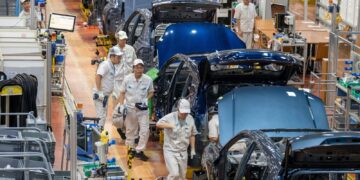
























Ottawa’s long-running dispute with Stellantis over its idled Brampton, Ontario, assembly plant is entering a more consequential phase. Industry Minister Mélanie Joly says the automaker could be required to repay hundreds of millions of dollars in government support if automotive production does not return to the facility, sharpening pressure on the company as it explores selling the plant to Canadian armoured-vehicle manufacturer Roshel.
The conflict reaches well beyond one factory. Brampton was supposed to be part of a multibillion-dollar transformation of Stellantis’s Canadian manufacturing operations, backed by federal and provincial funding. Instead, the plant has remained without vehicle production while the Jeep Compass program originally expected there was redirected to Illinois. With thousands of workers affected, government money at stake and contract negotiations with Unifor under strain, the factory has become a test of how aggressively Canada will enforce industrial-investment agreements.
Ottawa Is Making Clear That the Money Came With Conditions
The federal government’s message to Stellantis has become increasingly straightforward: financial assistance for Canadian manufacturing was not intended to continue regardless of what happened to production. On September 18, Industry Minister Mélanie Joly reiterated that Stellantis could face repayments worth hundreds of millions of dollars if automotive manufacturing does not resume at Brampton. Her position is that the plant needs a new vehicle mandate rather than simply remaining an unused automotive factory or permanently leaving Stellantis’s Canadian assembly footprint. Ottawa has previously said it is prepared to use legal remedies to protect taxpayer money.
That distinction matters because the dispute is not simply about politicians trying to persuade an automaker to change a business decision. Stellantis accepted public support through agreements connected to investment, employment and manufacturing activity in Canada. The federal government has already formally escalated the disagreement through a dispute-resolution process and a notice of default. Exactly how much Stellantis might ultimately have to return remains commercially sensitive, but the government has publicly maintained that substantial repayment could result if the company fails to satisfy its obligations. That makes the future of Brampton a financial issue for Stellantis as well as an industrial one.
More Than $220 Million in Federal Funding Had Already Been Disbursed
The scale of the original arrangement helps explain why Ottawa is unwilling to treat Brampton as an ordinary plant closure. In May 2022, the federal government announced up to $529 million through its Strategic Response Fund to support a broader $3.6-billion Stellantis investment covering Brampton and Windsor. Ontario committed up to another $513 million toward the wider investment. Brampton was expected to receive a flexible manufacturing architecture capable of producing electrified vehicles, while Stellantis promoted the plan at the time as one that would help secure the future of both Ontario assembly operations.
Federal records later showed that $222.4 million had been disbursed under the $529-million contribution agreement by March 31, 2025. Ottawa says those payments were made against eligible costs that had actually been incurred, rather than simply handing Stellantis the entire promised amount in advance. Once the Jeep production plan changed, future payments under that agreement were paused. That difference is important when discussing a potential clawback: Ottawa is dealing both with money already paid and with financial support that was authorized but had not yet flowed. Government officials have declined to publicly reveal all contractual remedies because portions of the Stellantis agreement contain commercially confidential terms.
The Jeep Compass Move Turned Brampton Into a Contract Dispute
Brampton stopped assembling vehicles at the end of 2023 as the factory prepared for a major retooling program. The plan was eventually expected to bring production of the next-generation Jeep Compass to Ontario, giving the plant a new purpose after the end of vehicles such as the Dodge Charger, Dodge Challenger and Chrysler 300. Retooling began, but Stellantis paused work in early 2025 while reassessing its North American plans amid rapidly changing market and trade conditions.
The decisive break came in October 2025. Stellantis announced that the Jeep Compass would instead be produced at its Belvidere Assembly Plant in Illinois as part of a much larger expansion of U.S. manufacturing. Ottawa responded by arguing that the move conflicted with commitments attached to Canadian government support. The federal government subsequently cut Stellantis’s annual quota for importing certain U.S.-assembled vehicles into Canada without counter-tariffs by 50 per cent. It later initiated formal dispute resolution and issued a notice of default. From the government’s perspective, Brampton had moved beyond a delayed product launch: a vehicle program connected to a publicly backed Canadian investment had effectively been relocated across the border.
Stellantis Says Returning Car Production No Longer Makes Economic Sense
Stellantis presents the situation differently. The automaker says it has considered multiple ways of returning manufacturing to Brampton, including new vehicle allocations, temporary production concepts and opportunities involving other companies. Stellantis Canada president Trevor Longley told employees that market and trade conditions had fundamentally changed the original business case. According to the company, none of the alternatives it examined produced a sustainable long-term case for continued Stellantis vehicle production at the facility.
That assessment has pushed the company toward Roshel, a Canadian manufacturer of armoured vehicles. Stellantis has signed a memorandum of understanding outlining a possible sale of the Brampton plant, although the transaction has not been finalized. Roshel says it wants to establish a defence-manufacturing centre at the property and has spoken about potentially creating more than 2,000 jobs while giving laid-off Stellantis workers first consideration. Ottawa says it did not arrange the pairing of the companies. The disagreement is therefore not simply about whether manufacturing could remain on the property; it is about whether replacing a mass-market auto assembly operation with a different form of manufacturing would satisfy Stellantis’s existing commitments to governments and workers.
For Brampton Workers, the Fight Has Already Lasted Nearly Three Years
Behind the dispute over contracts and subsidies are workers who have spent years waiting for the plant to restart. Unifor says roughly 2,200 members associated with Brampton Assembly remain on indefinite layoff. Many initially left the factory expecting a retooling period rather than the possible end of Stellantis vehicle production at the site. The plant had long been one of Brampton’s major industrial employers, and government and company announcements in 2022 presented the electrification investment as a way to secure manufacturing employment well into the future.
That history explains why the potential Roshel transaction has become a central issue in Stellantis’s 2026 labour negotiations. Unifor represents more than 9,000 Stellantis employees across Canada and says talks reached an impasse after 10 days of negotiations, with Brampton at the centre of the disagreement. The union has argued that defence manufacturing cannot simply be treated as an economic equivalent to high-volume automotive assembly and its surrounding supplier network. Stellantis, meanwhile, says a Roshel transaction could put the dormant property back into productive use. The existing collective agreement expires September 20, although Unifor has clarified that workers do not automatically enter a legal strike position on that date because Ontario’s conciliation process must first be completed.
The Brampton Fight Has Consequences Far Beyond One Assembly Line
Governments have reasons to worry about more than the jobs located inside the Brampton factory. Canada’s automotive industry depends on an interconnected network of assembly operations, parts producers, transportation companies, engineering firms and specialized suppliers. Federal figures show the automotive sector contributed about $16.8 billion to Canadian GDP in 2024, directly employed more than 125,000 people and supported more than 427,000 indirect jobs. Ottawa has also identified nearly 700 automotive parts manufacturers operating across the country.
Large assembly plants sit near the centre of that ecosystem because a single vehicle program can generate years of predictable orders for suppliers. When an assembly mandate disappears, the effect can therefore extend to companies that bought equipment, hired employees or expanded facilities in anticipation of supplying that vehicle. This helps explain why Ottawa’s response to Stellantis has included more than threats to recover old funding. The government has already linked tariff relief for automakers to Canadian production and investment performance. The Brampton confrontation may consequently influence how future Canadian industrial subsidies are structured, particularly when governments are trying to guarantee domestic production rather than merely attract investment announcements.
The Next Question Is Whether Stellantis Can Satisfy Ottawa Without Building Cars in Brampton
There is still substantial uncertainty around what happens next. Stellantis and Roshel have an agreement setting out a path toward a possible transaction, but a memorandum of understanding is not the same as a completed sale. Stellantis continues to argue that the Roshel proposal offers a credible path to restoring activity at the plant. Unifor wants automotive assembly preserved instead, while Ottawa continues to insist that Stellantis must meet the commitments connected to the public funding it accepted.
The most important unresolved issue is therefore contractual. Ottawa has not publicly released a definitive repayment figure, and government officials have said details concerning available remedies contain confidential commercial information. That makes it premature to say Stellantis definitively owes a particular amount. What can be said is that the federal government has already paused future payments, formally triggered dispute resolution, issued a notice of default and publicly raised the possibility of recovering hundreds of millions of dollars. For Brampton, the question is no longer merely when an idled factory will reopen. It is whether one of Canada’s most significant recent auto-sector investments can still deliver the automotive production, employment and industrial capacity that governments believed they were helping to secure.