


























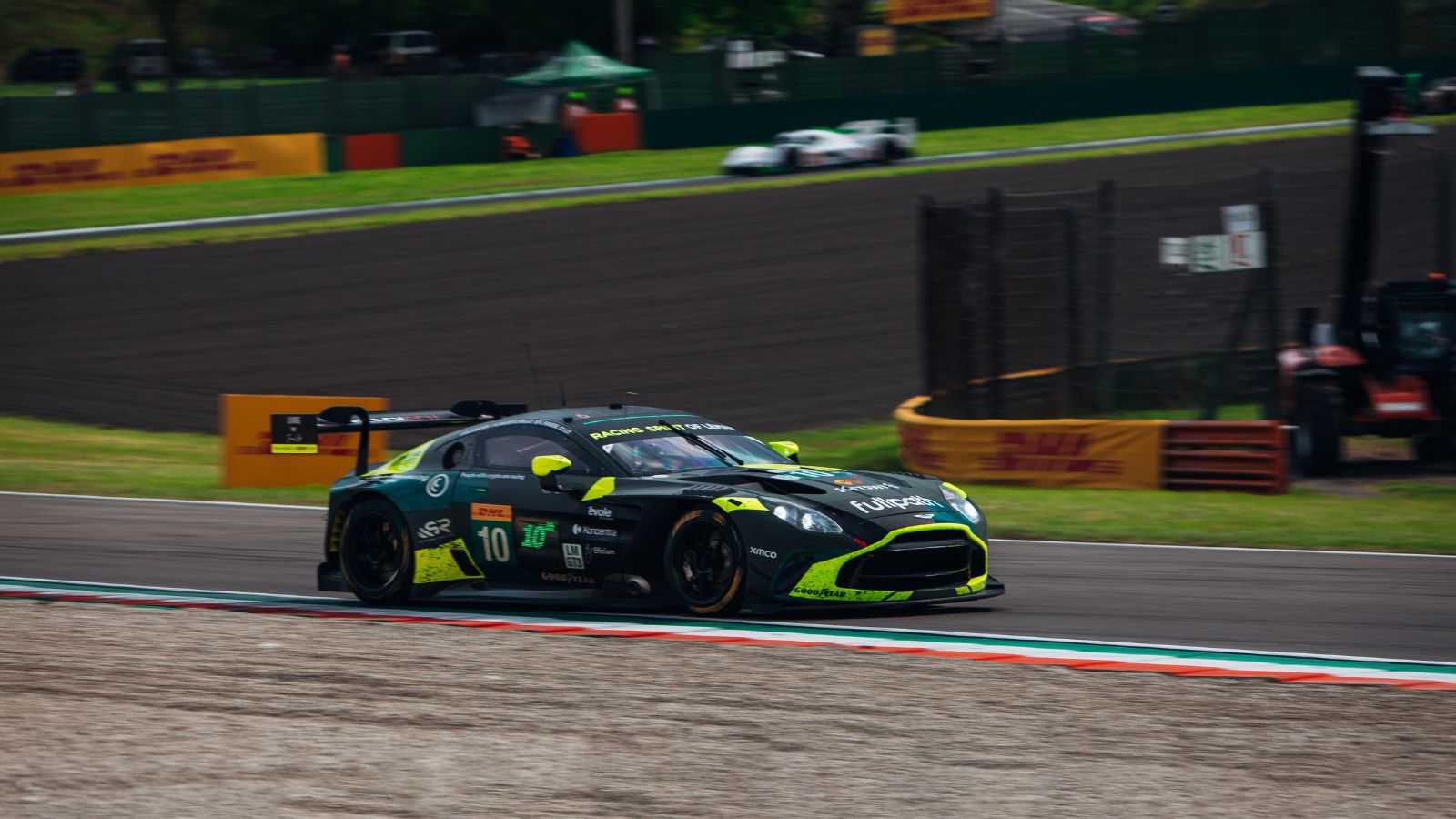
Zach Robichon’s breakthrough FIA World Endurance Championship victory arrived on a weekend when Aston Martin looked fast from the outset and finally converted that pace into a result. The Canadian shared the No. 27 Heart of Racing Aston Martin Vantage LMGT3 Evo with team principal Ian James and Mattia Drudi, winning the six-hour Lone Star Le Mans at Circuit of The Americas in Austin.
The result gave Robichon and Drudi their first WEC victories, delivered Heart of Racing its first LMGT3 win since the same Texas event in 2024, and ended a two-year drought in the category. It also came with the sister No. 23 Aston Martin finishing third, creating the marque’s first double LMGT3 podium in WEC competition. For Robichon, already an IMSA champion and Daytona class winner, Austin added a significant world-championship milestone to a career built around endurance racing.
Robichon Adds a WEC Victory to an Established Endurance Résumé
Robichon’s victory mattered beyond the simple fact that a Canadian stood on the top step. The Austin result was his first win in the FIA World Endurance Championship, one of international sports-car racing’s prominent series, and it came in a class built around Pro-Am combinations. He shared the No. 27 with Bronze-rated team principal Ian James and Italian professional Mattia Drudi, giving Heart of Racing a lineup blending experience, pace and the discipline required in a six-hour race.
The achievement also fit neatly into Robichon’s endurance-racing record. IMSA lists him as the 2021 GT Daytona champion, after a season in which he and Pfaff Motorsports collected multiple victories, and he was part of the GTD-winning crew at the 2022 Rolex 24 at Daytona. Austin therefore was not an isolated upset. It was a first WEC victory for a driver who had already demonstrated an ability to deliver in long-distance races.
Friday Pace Gave an Early Warning
The strongest clue that the No. 27 could contend came before qualifying. In Friday’s second free-practice session, Robichon set the fastest LMGT3 lap at 2 minutes, 5.609 seconds, moving to the top late in the 90-minute session. His margin over the quickest Iron Lynx Mercedes-AMG was 0.440 seconds, a meaningful cushion in a category where much of the field is often separated by fractions of a second.
The same session also underlined how comfortable Aston Martin looked at COTA. Harry Tincknell put the marque’s Valkyrie Hypercar quickest overall, meaning Aston Martin topped both WEC categories in FP2. Conditions were demanding, with air temperatures above 30 C and the track surface exceeding 40 C. Those numbers mattered later. The heat would become a defining physical challenge in the race, but on Friday it already showed that Robichon and the Vantage could produce speed when grip and tire management were especially difficult.
Aston Martin Locked Out the GT3 Front Row
Qualifying turned Aston Martin’s practice form into a front-row lockout. Eduardo “Dudu” Barrichello put the sister No. 23 Heart of Racing Vantage on LMGT3 pole with a 2:05.160 lap, while Robichon placed the No. 27 second, only 0.124 seconds behind. It was Aston Martin’s third consecutive LMGT3 Hyperpole success, following poles at Le Mans and São Paulo, and the first single-marque front-row lockout in the class since Austin a year earlier.
For the No. 27 crew, second was strategically valuable. Starting near the front reduced the need to take early risks in traffic and kept the car within reach of the leading group as strategies developed. It also confirmed that Robichon’s Friday speed was repeatable rather than a one-lap anomaly. Endurance races can punish teams that chase qualifying glory at the expense of race setup, but Heart of Racing arrived Sunday with both Vantages positioned to fight from the start.
Ford Turned the Opening Hours Into a Fight
Aston Martin did not control the race from the start. The Proton Competition Ford Mustang GT3 Evos surged into an early one-two, showing that the front-row qualifying result would not translate into an uncontested afternoon. Their challenge weakened as the race unfolded: the No. 77 Ford received a drive-through penalty for a Full Course Yellow infraction, while the No. 88 needed an extra stop after contact with the No. 34 Racing Team Turkey Corvette.
That opened the contest rather than settling it. The No. 91 Manthey DK Engineering Porsche, shared by James Cottingham, Timur Boguslavskiy and Ayhancan Güven, spent much of the middle phase in front. The No. 61 Iron Lynx Mercedes-AMG also remained a threat before penalties compromised its result. For Heart of Racing, the key was staying close enough to benefit when rivals stumbled, a classic endurance lesson: six hours reward speed, but also magnify costly procedural mistakes.
Robichon’s Middle Stints Put the No. 27 in Winning Position
Robichon’s most important contribution came when the race needed stability rather than a headline lap. FIA WEC credited him with a strong pair of stints before he handed the Aston Martin to Drudi. That sequence kept the No. 27 fighting the Manthey Porsche and gave Heart of Racing the track position needed for its later strategy. In endurance racing, middle stints can decide whether a closing driver receives a winning opportunity or an impossible recovery job.
The performance also showed why driver depth matters in LMGT3. The category requires crews to include at least one Bronze-rated driver and another Bronze or Silver-rated driver, creating lineups in which pace must be balanced across experience levels. Robichon’s job was not merely to be quick. He had to manage tires, handle traffic among faster Hypercars, avoid penalties and deliver the car cleanly. By the time Drudi took over, the winning opportunity was real.
A Porsche Penalty and an Undercut Changed the Race
The pivotal swing came through a mix of penalty and pit strategy. The No. 91 Porsche had led much of the race’s middle phase, but a five-second penalty for gaining an advantage off track weakened its control. Heart of Racing then used an undercut around the Robichon-to-Drudi driver change, getting the Aston Martin into clear air on fresh tires. Drudi explained that the clean track let him exploit the new rubber and create separation from the Porsche.
That sequence shows how endurance races can turn without a dramatic pass for the lead. A five-second sanction, a well-timed stop and a few fast laps on fresh tires can be more decisive than wheel-to-wheel contact. Safety-car periods further compressed the field, making each restart important. After the final intervention, Drudi had enough of a buffer to manage the margin. The No. 27’s advantage was built through execution rather than one spectacular moment.
Drudi Had to Finish Without Air Conditioning
The closing stint added a human element to an otherwise clinical result. Drudi’s cockpit air-conditioning stopped working, leaving him to finish in Texas heat while defending the lead. FIA WEC reported that the failure occurred after the first safety-car period, and Drudi later described the event as one of the toughest races of his life. With temperatures high all weekend, the problem turned a strategic lead into a physical test.
Despite that discomfort, Drudi produced the pace Heart of Racing needed. After the final safety car, he opened a gap of roughly five seconds over the No. 91 Porsche, helped by clean air and the traffic pattern at the restart. The Porsche ultimately finished second, while Drudi brought the No. 27 home first. For Robichon and James, watching from the pit lane, the final stint showed how endurance victories can depend on a teammate managing problems unseen on timing screens.
The Two-Year Drought Ended at the Same Circuit Where It Began
The victory ended a specific two-year drought: Heart of Racing and Aston Martin had not won in WEC’s LMGT3 category since the 2024 Lone Star Le Mans at the same circuit. That earlier Austin success was also Heart of Racing’s first WEC victory, with Ian James sharing the No. 27 with Alex Riberas and Daniel Mancinelli. James became the link between both Texas wins, while Robichon and Drudi became first-time WEC winners in 2026.
The gap between victories had been frustrating because the pace was often present. Before Austin, Aston Martin said the James-Robichon-Drudi trio had been competitive throughout the season but had only a second-place finish at Spa-Francorchamps to show for it. Drudi echoed that frustration afterward, saying small problems repeatedly prevented the crew from converting speed into wins. Austin changed the narrative: the No. 27 finally paired its performance with clean strategy and precise race-day execution overall too.
A Double Podium Strengthened Aston Martin’s Austin Record
Heart of Racing’s Austin weekend was bigger than one car. The sister No. 23 Aston Martin, driven by Gray Newell, Barrichello and Jonny Adam, finished third behind the No. 91 Porsche. That produced Aston Martin’s first double podium in the WEC LMGT3 era and gave the team its best-ever one-three class finish. For a two-car program, both crews reaching the podium suggests the underlying setup and operational performance worked across the garage.
COTA has long suited the Vantage. Before the 2026 race, Aston Martin counted 10 class victories from 13 podium appearances at the 3.426-mile circuit, including four weekends with double-class wins. The 2024 LMGT3 victory had already made Austin a landmark venue for the current-generation Vantage. Two years later, the No. 27 win and No. 23 podium reinforced that pattern. Some circuits align naturally with a car’s strengths, and COTA remains one of Aston Martin’s most productive WEC venues.
Austin Gives Robichon a New Career Milestone
For Robichon, the Austin win adds a world-championship result to a substantial North American endurance résumé. IMSA records show a 2019 Sprint Cup title, the 2021 GTD championship and a 2022 Rolex 24 class victory among his achievements. He joined Heart of Racing’s WEC lineup in 2025 and remained with James and Drudi for 2026 as the team expanded to two full-season Aston Martins. The Texas victory is a milestone in his career and the team project.
It also arrives with the 2026 WEC season unfinished. Austin was the fifth round, with Fuji next later in September and more races to come. Championship leaders endured a difficult day in Texas, while Heart of Racing finally converted speed into maximum reward. One victory cannot erase earlier missed opportunities, but it can change a team’s confidence. After Austin, Robichon and the No. 27 crew know their WEC pace can produce a win.