

























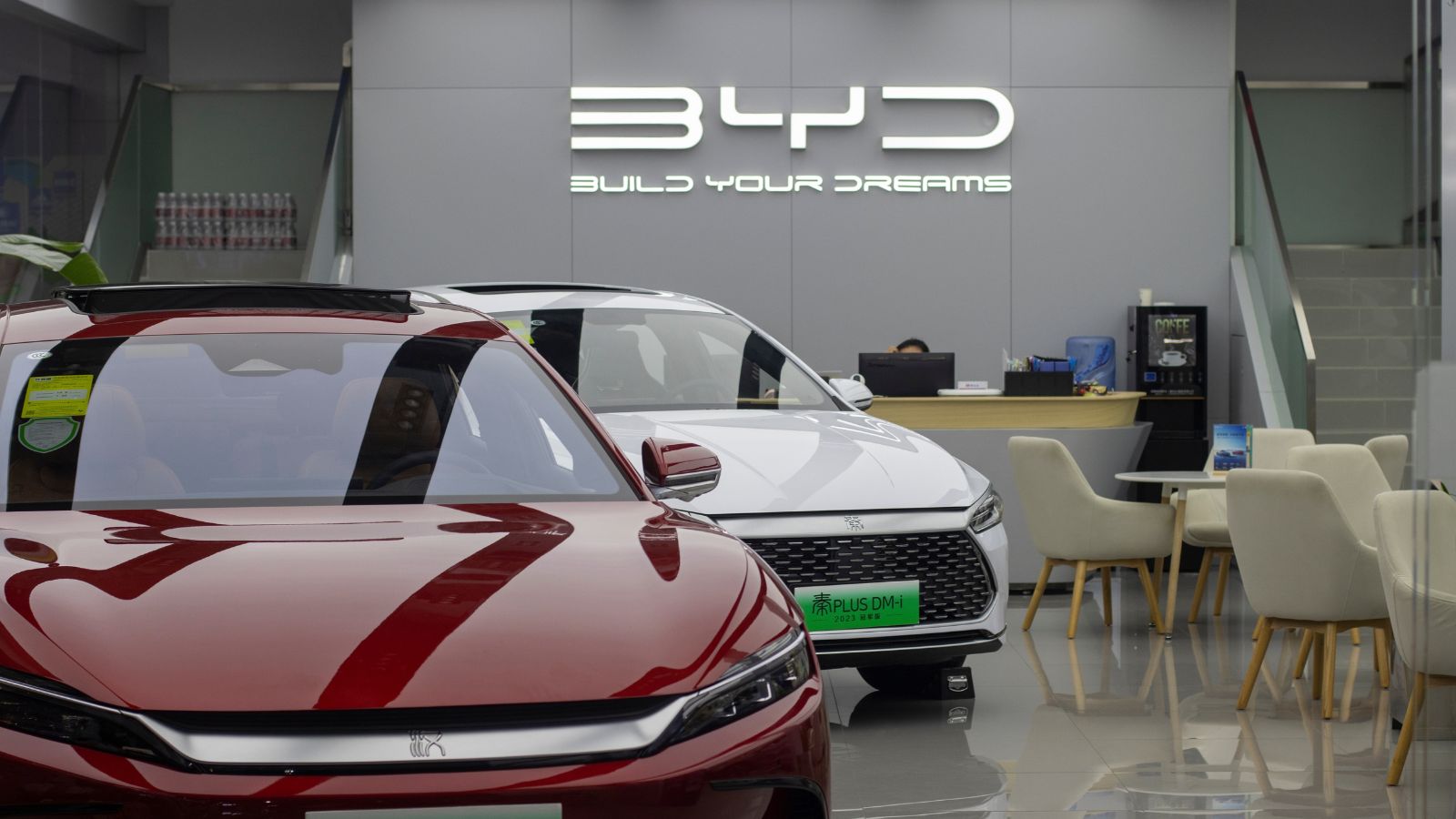
BYD has made one of its clearest public moves yet toward the Canadian passenger-vehicle market. Canada now appears on the Chinese automaker’s regional website network, where a dedicated Canadian page displays a prominent “Coming Soon” message and identifies BYD Canada Company Limited in Ontario. The page does not offer vehicles for sale, take deposits or provide a retail launch date, but its appearance adds another concrete piece to a months-long buildout that has included regulatory work, dealership planning and Canadian hiring.
The timing is particularly striking. Canada has reopened limited access to Chinese-built electric vehicles just as its automotive relationship with the United States is becoming more contentious, leaving BYD’s Canadian preparations sitting at the intersection of two major shifts in North American auto trade.
The Canadian Website Turns Months of Signals Into Something Consumers Can See
Until recently, much of the evidence surrounding BYD’s Canadian expansion came from regulatory filings, dealership discussions and hiring activity. The new Canadian web presence changes that. BYD’s own site now lists Canada in its American Region alongside established markets such as Mexico, Brazil and Chile, and the Canadian landing page carries the words “Coming Soon.” BYD’s Canadian terms of use, effective August 3, also explicitly identify a Canadian website operated by BYD Canada Company Limited. That makes the digital footprint considerably more substantial than an unofficial teaser or placeholder created by a third party.
There are still important limits to what the site confirms. BYD says the Canadian website does not currently allow purchases, leases, financing applications, reservations, pre-orders or deposits. It also does not provide Canadian prices or a firm sales date. That distinction matters because speculation about BYD’s Canadian lineup has repeatedly moved faster than the company’s own announcements. What is confirmed is a locally operated Canadian platform. What remains unconfirmed is exactly what Canadians will eventually be able to buy through it.
BYD Has Been Building a Canadian Corporate Footprint Behind the Scenes
The website did not appear in isolation. Canadian federal records already show that BYD has been laying administrative foundations in the country. An Investment Canada Act notification published in March identified BYD Canada Company Limited operations connected with Markham, the Greater Toronto Area and Greater Vancouver. The listed business activity includes selling and potentially manufacturing new-energy products, primarily motor vehicles and parts. BYD also registered federal lobbying activity involving departments including Finance, Global Affairs, Innovation, Natural Resources and Transport Canada.
Recruitment provides another window into how the operation is taking shape. Reporting on BYD’s current Canadian vacancies identified management positions spanning sales, marketing, dealer-network development, operations planning, infrastructure, legal affairs, human resources, product management and information technology. Several positions were connected with Toronto or the Greater Toronto Area, while others were based around Vancouver. A company can explore a market with consultants, but hiring people responsible for sales networks, products, operations and legal compliance suggests a deeper level of preparation. BYD still has substantial work to complete, yet the staffing pattern increasingly resembles an organization preparing to sell vehicles rather than simply studying whether it should.
Dealership Planning and Vehicle Compliance Work Are Already Underway
The strongest evidence of a future retail launch may be happening away from the website. Reuters reported in June that an automotive retail adviser working with BYD expected the company to open six Canadian dealerships, while earlier discussions had pointed to a broader ambition of roughly 20 outlets during the first year of operations. Greater Toronto has been described as the initial focus, with other large markets such as Vancouver, Montreal and Calgary considered as the network expands. The precise number and timing of stores can still change before retail operations begin.
There is also movement on the regulatory side. Reuters found Transport Canada records showing BYD had started compliance procedures involving two passenger vehicles manufactured in China. More importantly, BYD executive vice-president Stella Li told Reuters in June that the company was still deciding which models to introduce and that sales would likely begin in 2027. That statement is especially useful because it separates genuine company planning from widely circulated claims about specific models and prices that BYD never officially confirmed. The “Coming Soon” page strengthens the launch case, but it does not supersede that caution.
Canada’s New Chinese-EV Quota Removed a Major Barrier
BYD’s Canadian preparations became significantly more viable after Ottawa rewrote the economics of importing Chinese-built EVs. Canada introduced a country-specific annual quota beginning March 1, 2026, allowing an initial 49,000 qualifying vehicles from China to enter at the regular 6.1% most-favoured-nation tariff. That replaced the 100% surtax Canada had imposed in 2024. The first six-month allocation covers 24,500 vehicles through August 31, with another 24,500 available during the second half of the quota year, plus unused capacity carried forward.
The quota remains deliberately small relative to Canada’s overall new-vehicle market. Federal regulatory documents estimated the initial 49,000 vehicles at less than 3% of annual Canadian new-vehicle sales. Even so, the policy dramatically changes the commercial calculation for companies such as BYD. A vehicle facing a 6.1% import tariff has a very different chance of being competitively priced than the same vehicle facing a 100% surtax. Ottawa also intends to increase the quota by 6.5% annually, while progressively reserving more space for vehicles with import values of C$35,000 or less. That creates a controlled but expandable entry point.
Canada Could Matter to Chinese Automakers Far Beyond Its Sales Volume
Canada is not an enormous automotive market by global standards. Reuters reported approximately 1.9 million vehicles were sold in Canada in 2025, compared with more than 16 million in the United States. On volume alone, that makes Canada a far smaller prize than the American market. Yet the similarities between Canadian and U.S. consumers, dealerships and regulatory requirements make the country strategically interesting. Automotive executives and analysts interviewed by Reuters described Canada as an unusually useful North American market for Chinese manufacturers developing distribution networks and learning how their products perform with local buyers.
That does not mean BYD has described Canada as merely a rehearsal for entering the United States. Stella Li explicitly pushed back against that interpretation when Reuters raised it. BYD had contemplated U.S. passenger-vehicle sales before Washington erected much stronger barriers against Chinese automotive technology and imports, and the company already operates commercial-vehicle activities in the United States. Canada therefore has value in its own right, even while geography makes the American question impossible to ignore. Dealer groups, suppliers and service networks frequently operate on both sides of the border, creating relationships that could become strategically important if U.S. policy ever changes.
The U.S.-Canada Auto Fight Makes BYD’s Timing More Politically Significant
BYD’s Canadian website has appeared during an extraordinary deterioration in Canada-U.S. automotive relations. The United States currently applies a 25% tariff to Canadian autos and trucks, although approved U.S. content in CUSMA-compliant vehicles can be excluded from the tariff calculation. President Donald Trump has now threatened to raise tariffs on Canadian automobiles, trucks and automotive parts to 50% beginning January 1, 2027 after the latest bilateral negotiations broke down. Ottawa, meanwhile, has pledged dollar-for-dollar retaliation against a new round of American tariffs.
There is no evidence that BYD launched its Canadian page because of the latest U.S. dispute, and the distinction is important. BYD’s preparations predate the most recent breakdown by months. But the simultaneous developments illustrate how quickly the old North American automotive order is changing. Canada historically built its passenger-vehicle industry around extraordinarily deep integration with the United States. At the same time that those ties are under unprecedented political pressure, Ottawa is giving Chinese EV manufacturers controlled access that Washington largely refuses to provide. BYD is arriving at a moment when Canada’s automotive relationships are becoming more diversified and more complicated at once.
Canadian EV Demand Is Large Enough to Matter but Harder to Read Than It Was
A Canadian launch would not automatically translate into booming sales. Statistics Canada recorded 169,972 zero-emission vehicle sales in 2025, down 35.7% from the previous year. ZEVs accounted for approximately 8.7% of new motor vehicles sold, compared with 13.8% in 2024. Federal and provincial incentive changes contributed to the decline, although sales strengthened again toward the end of 2025. The Canada Energy Regulator noted that December’s ZEV share reached 12.5%, roughly restoring the market to levels seen in early 2024.
Vehicle preferences present another challenge. Trucks — a Statistics Canada category that includes SUVs, pickups, vans and several other vehicle types — represented 88% of new-vehicle sales in Canada during 2025. That helps explain why simply importing inexpensive compact EVs would not necessarily be enough to build a major Canadian business. BYD sells everything from small hatchbacks to sedans, crossovers, SUVs and plug-in hybrids in international markets, but its Canadian mix remains undecided. Price will matter, yet so will range, winter performance, charging, insurance, service availability and the type of vehicle Canadian households actually want to put in their driveways.
The Next Confirmation Will Have to Come From the Showroom, Not the Homepage
The “Coming Soon” label makes BYD’s intentions harder to dismiss, but several milestones still separate a website from a functioning national automotive business. Transport Canada certification has to be completed for individual models. Dealers need facilities, technicians, parts inventories and service systems. Canadian warranties and financing programs must be established. Pricing has to account for currency movements, transportation costs and quota availability. Most importantly, BYD still needs to tell consumers which vehicles it intends to sell and when retail deliveries will begin.
The company has the scale to move quickly once those pieces are in place. BYD says it sold more than 4.6 million new-energy vehicles worldwide in 2025 and operates across more than 120 countries and regions. By mid-2026 its cumulative NEV sales had passed 16 million, underscoring how different a prospective BYD launch would be from the arrival of a small startup. For Canada, the important development is therefore not simply that another automotive website has appeared. It is that one of the world’s largest electrified-vehicle manufacturers is steadily replacing speculation about Canada with tangible infrastructure.