















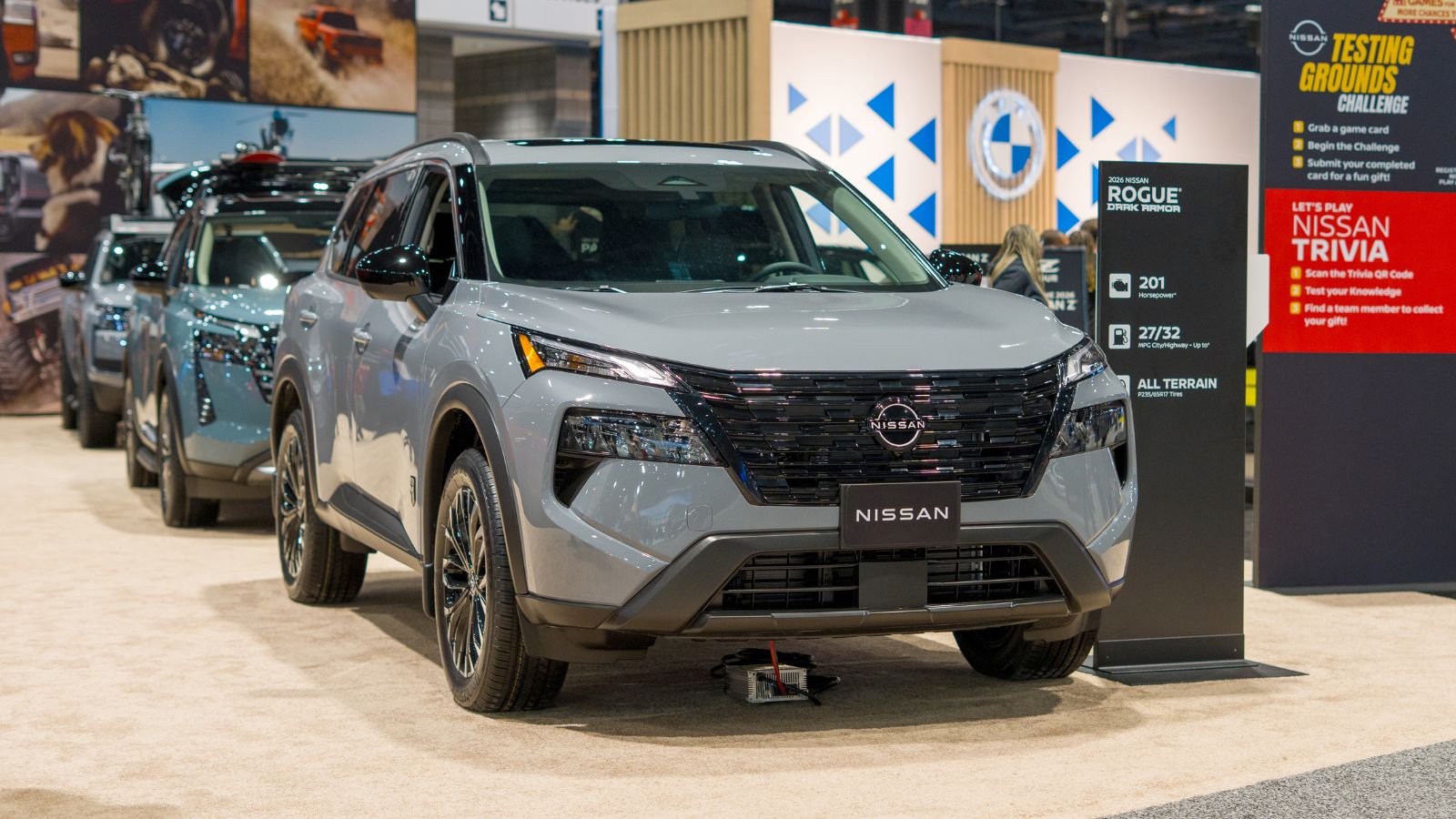
North America’s SUV market is entering a new era, and three very different vehicles are competing for one of the automotive industry’s most prestigious honours. The 2027 Nissan Rogue Hybrid e-POWER has been named a finalist for North American Utility Vehicle of the Year, facing two all-electric challengers: the Kia EV3 and Rivian R2.
Announced at the Los Angeles Auto Show on November 19, 2026, the finalists highlight an increasingly competitive market where fuel efficiency, electric technology, affordability, and everyday practicality are reshaping consumer expectations.
With an independent panel of automotive journalists evaluating the contenders, the competition represents more than a battle between three SUVs. It offers a glimpse into how automakers are responding to changing priorities across Canada and the United States.
Three Very Different SUVs Make the Final Cut
The race is unusual because the three finalists do not represent three versions of the same vehicle. Nissan has entered a gasoline-fuelled hybrid that is propelled by electric motors, while Kia and Rivian are competing with SUVs powered entirely by batteries. That contrast puts different ideas of convenience, efficiency, and value in front of the same judges. A driver with easy access to home charging may approach the decision very differently from someone who spends long days on highways or parks on the street.
The North American Car, Truck and Utility Vehicle of the Year organization announced its finalists at the Los Angeles Auto Show on November 19. The utility category is one of four award categories for 2027, alongside car, truck, and a new automotive technology honour. A jury of 45 automotive journalists evaluated the Kia EV3, Nissan Rogue Hybrid e-POWER, and Rivian R2 as contenders. All three have advanced beyond the broader candidate field, but no winner has been chosen. The final verdict will arrive in Detroit in January.
Nissan’s e-POWER Technology Offers an Alternative to Traditional Hybrids
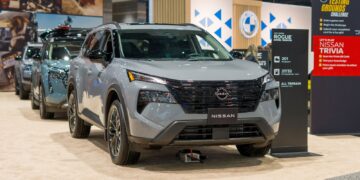
The Rogue Hybrid’s strongest distinction is hidden beneath its bodywork. Nissan’s third-generation e-POWER system uses a 1.5-litre turbocharged gasoline engine to generate electricity rather than turn the wheels mechanically. Two electric motors provide propulsion, giving the SUV the immediate response associated with an electric vehicle. A small 1.67-kWh lithium-ion battery supports the system, and the combined output is rated at 225 horsepower. Every Canadian Rogue Hybrid also receives dual-motor all-wheel drive as standard equipment.
That arrangement makes the Rogue an alternative for motorists interested in electric driving characteristics but unwilling or unable to depend on charging stations. Refuelling takes place at an ordinary gas pump, so there is no home charger to install or public charging stop to plan. Importantly, however, the Rogue remains a gasoline-burning hybrid, not a zero-emission electric vehicle. Nissan says nearly two million vehicles with earlier generations of e-POWER have been sold worldwide since 2016, providing a substantial history behind the technology now arriving in North America.
Rogue Hybrid Promises 6.2 L/100 km Fuel Economy With Family-Friendly Features
Fuel economy is central to Nissan’s argument. Natural Resources Canada estimates the 2027 Rogue Hybrid SR at 5.9 litres per 100 kilometres in the city, 6.6 on the highway, and 6.2 combined. The U.S. Environmental Protection Agency’s corresponding combined estimate is 38 miles per gallon. Those are test-cycle ratings rather than guaranteed results, but they show how Nissan is trying to make ordinary commuting less expensive without asking owners to change how they refuel.
The SUV also makes its case through practical touches that matter after the test drive ends. Rear doors open almost 90 degrees, making it easier to manoeuvre a child seat into place, and Nissan lists up to 880.7 litres of cargo volume behind the second row. A 12.3-inch touchscreen with wireless Apple CarPlay and Android Auto is standard; higher trims offer a 14.3-inch display. For a family juggling school pickups, grocery bags, and winter travel, those details could weigh as heavily as quick acceleration in the judges’ assessment.
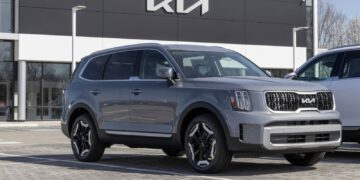
Kia EV3 Challenges Nissan With a Lower Starting Price
Kia’s response is not to make electrification invisible, but to make it easier to afford. The 2027 EV3 Light FWD entered the Canadian market with a starting manufacturer’s suggested retail price of CA$36,995. Kia also listed an all-in figure of CA$39,744 for that trim, before applicable sales taxes. At its August launch announcement, the automaker described the EV3 as Canada’s lowest-priced new electric vehicle, excluding incentives. That positioning gives the small crossover a clear argument in an award category where value matters alongside engineering.
The entry model is front-wheel drive, and buyers pay more for bigger batteries, additional features, or all-wheel drive. Those distinctions matter when comparing it with Nissan’s standard-AWD Rogue Hybrid, which occupies a different size and equipment position. Kia also arrives with previous international recognition: the EV3 won the 2025 World Car of the Year award, chosen by journalists from 30 countries. That earlier victory does not determine North America’s separate competition, but it shows why the EV3 is more than an inexpensive newcomer.
Kia EV3 Offers Up to 517 Kilometres of Estimated Electric Range
The EV3’s range figures are designed to address one of the biggest questions about an affordable electric SUV: can it handle life beyond short city trips? Kia offers a 58.3-kWh battery and a larger 81.4-kWh pack. For Canadian buyers, Kia estimates up to 356 kilometres from the standard-range version and up to 517 kilometres with the long-range front-wheel-drive configuration. The longer-range all-wheel-drive version is estimated at up to 451 kilometres. These figures vary by model and represent estimates, not promises under every weather or driving condition.
Kia says its EV3 can charge from 10 to 80 percent in approximately 31 minutes when conditions and a suitable high-power DC fast charger allow. The vehicle also carries a North American Charging Standard port, widening compatibility with charging infrastructure, and available vehicle-to-load functionality can power items such as a laptop or campsite lighting. A commuter who plugs in at home may rarely think about public chargers; a family travelling across provinces must pay much closer attention to charging stops, temperature, and route planning.
Rivian R2 Enters the Competition With 656 Horsepower
The Rivian R2 brings a different kind of ambition to the final round. Its Performance version combines two electric motors with all-wheel drive, producing a manufacturer-rated 656 horsepower and 609 pound-feet of torque. Rivian quotes acceleration from zero to 60 mph in as little as 3.6 seconds and an EPA-estimated driving range of up to 330 miles, depending on configuration. In the United States, that Performance model starts at US$57,990, putting it well above Kia’s entry-level price. Less expensive R2 variants are scheduled to arrive later.
Rivian is not entering the North American contest without momentum. On November 11, MotorTrend named the R2 its 2027 SUV of the Year after considering 32 contenders. That is a separate award, with different judges and criteria, so it should not be confused with the undecided NACTOY title. MotorTrend praised the R2’s on-road dynamics, off-road ability, and interior, while also noting limitations in road-trip range. The combination makes Rivian a formidable finalist, but not an automatic winner.
Rivian’s Adventure Features Add Another Dimension to the Battle
Beyond acceleration, Rivian wants the R2 to feel useful on a camping trip and a weekday school run. The five-seat SUV offers 245 millimetres of ground clearance, a 40/20/40-split folding rear seat, and storage in both the rear cargo area and front trunk. Its rear window can lower independently, a distinctive feature for transporting longer items or letting fresh air into the cabin. Higher trims add features such as semi-active suspension, adaptive lighting, and heated seating.
Technology is another part of the appeal. Rivian promotes software updates, smartphone-based vehicle controls, and its Autonomy+ driver-assistance package, although such systems still require responsible driver supervision and have operating limits. The company is also a finalist in NACTOY’s separate technology award for its Adaptive Drive Beam lighting system. Canadian buyers face one important distinction: Rivian’s Canadian website lists the R2 as coming in 2027, even though deliveries have already begun in the United States. Its strength as an award contender does not mean Canadians can take delivery immediately.
Canadian Pricing and Availability Could Influence Buyers
For Canadian shoppers, the contest comes with an important pricing wrinkle. Kia’s EV3 Light FWD starts at CA$36,995 before applicable fees and taxes. Nissan advertises the Rogue Hybrid SV AWD from CA$39,998, but that less expensive trim is expected in early 2027; the SR AWD that began arriving first carries a CA$47,998 MSRP. The vehicles differ in size, equipment, and drivetrain, so those starting figures are not direct comparisons of identically equipped SUVs. Rivian’s advertised U.S. R2 prices should not be mistaken for confirmed Canadian retail prices.
Living with each vehicle could matter even more than the window sticker. A household with a driveway and reliable home charging might find an electric SUV convenient for most daily journeys. For another family, ready access to gasoline stations could make Nissan’s approach less disruptive. Canadian winters add another consideration: in a cold-weather test of other electric models, the Canadian Automobile Association found real-world range 14 to 39 percent below official ratings. Those results are not specific predictions for the EV3 or R2, but they underline why individual driving conditions matter.
How the Judges Will Choose North America’s Top SUV
Winning this award requires more than producing the biggest horsepower number or posting the lowest sticker price. NACTOY describes a judging process that considers innovation, design, safety, performance, technology, driver satisfaction, user experience, and value. Its 2027 jurors represent automotive media in Canada, the United States, and Mexico, bringing different roads, climates, and consumer priorities to the evaluation. The three utility finalists will undergo further assessment before the final ballots are cast.
Past winners illustrate why the contest is difficult to predict. Hyundai’s Palisade captured the 2026 Utility Vehicle of the Year title, following the electric Volkswagen ID. Buzz in 2025 and Kia EV9 in 2024. Those selections span different sizes and purposes rather than repeating a single winning formula. For the Rogue, smooth hybrid operation may carry weight; for the EV3, affordability and efficient packaging could prove persuasive; for the R2, performance and versatility stand out. What matters is how convincingly each contender delivers on its intended purpose, not which powertrain is newest.
January 2027 Will Decide the Winner
The 2027 North American Utility Vehicle of the Year winner is scheduled to be announced on January 14, 2027, during the Detroit Auto Show. Until then, the Kia EV3, Nissan Rogue Hybrid e-POWER, and Rivian R2 remain finalists, with no announced ranking that establishes a leader. The judges’ decision will recognize one vehicle, but the range of choices in the final three already tells a larger story about how quickly the SUV category is changing.
Nissan is betting that drivers will welcome electric-motor acceleration without plugging in. Kia is making the case that battery-powered transportation can be priced within reach of more households. Rivian is trying to combine the capabilities of an adventure-oriented SUV with the speed and technology of an EV. In Canada, their different availability dates, pricing structures, and energy requirements make that contrast especially meaningful. The eventual winner will earn a major industry distinction, but the final result will not erase the very different reasons a family might choose one of these SUVs over another.