
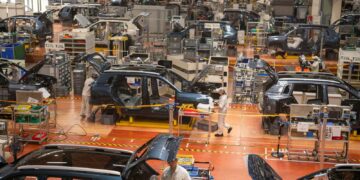























A new robotics target at General Motors is raising an old question across the auto industry: when factories become more efficient, what happens to the people who keep them running? According to a November 17 Reuters report citing people familiar with the plans, GM is aiming to increase the use of robots and other automation across its North American factories by 20% by 2028.
The company says automation can improve safety, quality and efficiency, but the reported goal arrives during a difficult period for Canadian auto workers. GM’s Ontario operations are navigating layoffs, changing vehicle programs and new investment commitments. The immediate concern is not that one robot replaces one employee. It is how the next wave of factory technology could reshape jobs, skills and investment decisions on both sides of the border.
The 20% Target Is Significant, but Its Meaning Is Not Yet Clear
Reuters reported the 20% goal on November 17, attributing it to two people familiar with GM’s plans. The target covers North American factories, not Canada alone. That distinction matters because GM operates a manufacturing network across the United States, Canada and Mexico, and technology introduced at one plant need not appear in the same form at another. The report did not establish a plant-by-plant rollout or identify which Canadian sites might receive additional systems.
There is another important limitation: the public reporting does not define the baseline for the 20% increase. It is not clear whether the target refers to the number of robots, the extent of automated processes or another internal measurement. GM did not publicly confirm that numerical target in the report, although it defended automation as a way to support manufacturing teams. A 20% increase in automation therefore cannot responsibly be translated into a 20% reduction in jobs. For Canadian workers, the unanswered questions are about where, when and how GM intends to make the changes.
Mobile Robots Could Change the Work Between Assembly Stations
The newest equipment being discussed is not necessarily a towering robot arm building an entire vehicle. According to Reuters, GM is developing and assembling robots at its Kokomo, Indiana, facility, with particular attention to autonomous mobile robots that move parts through factories. GM is also continuing to purchase equipment from outside suppliers. In practical terms, this could mean more machines transporting components between workstations instead of people or manually operated vehicles doing every trip.
Material handling matters because a vehicle plant depends on a constant flow of parts arriving in the right order. A delayed component can interrupt work far beyond the spot where a shortage begins. Mobile robots could make those movements more predictable, but they also change the tasks assigned to employees who deliver materials, manage inventory and respond to problems. The Kokomo initiative has been reported for GM’s broader manufacturing system; it is not confirmation that these exact robots are scheduled for Oshawa, Ingersoll or St. Catharines. That distinction prevents a technological plan from being mistaken for a Canadian staffing announcement.
GM Is Building a Larger Robotics Team Around Human Work
GM’s robotics ambitions extend beyond purchasing machines. In October 2025, the company said more than 100 roboticists, artificial-intelligence engineers and hardware specialists were working on advanced systems at its Autonomous Robotics Center in Warren, Michigan, and a sister operation in California. The effort draws on production data and aims to develop collaborative robots capable of assisting with manufacturing work. GM said such systems were being deployed in its U.S. assembly plants, without announcing an equivalent rollout for Canadian facilities.
The company’s robotics strategy also recognizes that a factory cannot simply be handed over to software. In a February 2026 industry podcast, GM robotics leader Mikell Taylor described the challenge of matching human strengths with machine capabilities while maintaining safety and quality. She also emphasized the difficulty of adding new robotics without disrupting existing production lines. For an experienced production worker, the change could involve supervising equipment, handling exceptions or learning a new system rather than performing the same repetitive task all shift. Whether that transition preserves employment depends on how the technology is introduced and how workers are trained.
Rising Production Costs Are Pushing GM Toward Efficiency
The timing of GM’s reported target is not accidental. Following the United Auto Workers’ 2023 agreement with the Detroit automakers, GM estimated that the contract would add roughly US$575 in labour costs per vehicle. That figure concerns its American labour agreement; it should not be presented as the cost of GM’s Canadian workforce. Still, it helps explain why executives are examining ways to reduce the hours required to produce each vehicle as global competition increases.
There are other expenses to manage. In its October 2026 earnings presentation, GM forecast US$1 billion to US$1.5 billion in additional costs associated with moving production to the United States, supply-chain investment and higher software spending during 2026. It also projected commodity, logistics and memory-chip cost pressures of approximately US$2 billion. Robotics may help factories absorb some pressures, but no public evidence shows how much of those expenses GM expects its automation target to offset. For workers in Ontario, the deeper concern is whether cost-cutting decisions will favour adding technology to Canadian facilities or directing more production elsewhere.
Parts Suppliers May Feel the Pressure Before Assembly Workers Do
GM’s reported plans reach beyond the company’s own factory gates. Reuters says parts suppliers bidding on new business are being asked to provide automation plans, with GM assessing those efforts through a scorecard that can influence contract decisions. That could reward suppliers able to demonstrate efficient, modern production. It could also create an expensive challenge for smaller businesses that must invest in new equipment while competing on price and delivery times.
Canada has a substantial stake in that process. Federal industry figures identify nearly 700 automotive parts manufacturers employing more than 67,500 people in 2025. Statistics Canada also reported that employment in motor vehicle parts manufacturing declined by 9.3% between December 2024 and December 2025. Those figures describe existing industry pressures, not layoffs caused by GM’s newly reported robotics target. Nevertheless, a supplier facing weaker demand, trade disruption and new automation expectations may have less room to manoeuvre. For communities outside major assembly plants, the important question is whether suppliers can finance modernization without losing contracts or cutting their workforces.
More Than 4,600 Union Members Have a Direct Stake in GM Canada
Canadian auto workers are not watching these developments from the sidelines. Unifor represents more than 4,600 members across GM facilities in Oshawa, Ingersoll, St. Catharines and Woodstock. When bargaining began in August 2026, the union said approximately 30% of its GM members in Canada were on layoff. That was a snapshot at the opening of negotiations, not a verified count of workers off the job in November. It nevertheless shows why new talk of automation may provoke concern even without an announced reduction in staffing.
The labour outlook is not uniformly negative. Members ratified new three-year agreements in late August that include annual 3% wage increases and commitments for future products and investments. Unifor reported that full-rate production wages will reach $50.20 an hour during the contracts. Yet pay improvements do not answer every question about future staffing. A worker with decades of experience may welcome improved equipment and safer conditions while still wondering whether retraining, job classifications and seniority protections will keep pace when a familiar task becomes automated.
Oshawa’s Truck Transition Shows How Quickly Plans Can Change
At Oshawa Assembly, workers have already experienced a major adjustment unrelated to the newly reported automation goal. GM returned the plant to two shifts in February 2026 and said approximately 500 employees would be laid off as a temporary third shift ended. The automaker linked that move to production needs, while Unifor raised concerns about the impact of U.S. trade policies. The reasons remain contested; the shift reduction should not be attributed to robots without evidence.
Another transition is underway. GM confirmed that Chevrolet Silverado 1500 production at Oshawa would end in November 2026, while saying it expected employment levels to remain unchanged through a greater focus on heavy-duty pickups. Under its August agreement with Unifor, GM committed an additional C$144 million to bring next-generation GMC Sierra heavy-duty production to Oshawa alongside the Silverado HD. The investment strengthens the plant’s product prospects, but workers will judge the transition by actual shifts and assignments. New technology could become part of that evolution, although GM has not published a Canadian automation timetable.
CAMI’s Empty Production Lines Make Job Security the Immediate Issue
For employees at CAMI Assembly in Ingersoll, the most urgent question is not how many robots might arrive. It is when vehicles will be built there again. GM suspended production of its BrightDrop electric delivery vans in May 2025 and confirmed in October of that year that the program would end. The company pointed to slower-than-expected commercial electric-van demand and a changing U.S. regulatory environment. The decision left the plant without an announced replacement vehicle.
The August 2026 Unifor agreement offers some protection but not a production restart. GM agreed to extend income-maintenance support for eligible laid-off CAMI members until May 2028 and to consider opportunities for the site. The plant received first consideration for potential Canadian Armed Forces defence work only if such work is awarded to GM. That conditional commitment is not an awarded contract or a confirmed assembly program. CAMI illustrates the limits of treating automation as the sole explanation for insecurity: product demand, government policy and allocation decisions can affect jobs long before a new robot reaches the factory floor.
St. Catharines Has New Investment—and a Changing Skills Mix
The outlook is different at the St. Catharines Propulsion Plant. As part of the 2026 labour agreement, GM announced C$215 million for a next-generation transmission program, with work anticipated to begin in late 2029. The company has also committed C$691 million toward production of its sixth-generation V8 engine. Together, those projects represent more than C$900 million in planned investment at St. Catharines, giving employees a more concrete view of future products than workers at the idled CAMI facility currently have.
Investment, however, does not automatically settle the employment question. New engines and transmissions can require different equipment, quality checks and maintenance expertise. As GM introduces more advanced manufacturing systems, employees may need additional training in sensors, industrial controls, machine troubleshooting and safe collaboration with robots. Those are plausible demands of automated production, not a published list of new St. Catharines job requirements. The meaningful test will be whether employees receive opportunities to develop those skills and whether new production programs sustain stable work as technologies change.
The Labour Debate Will Not End at the U.S. Border
In the United States, automation is already emerging as a flashpoint ahead of the United Auto Workers’ next contract negotiations, with agreements scheduled to expire in spring 2028. Reuters reported that the UAW, which represents about 50,000 GM factory workers, criticized the automaker’s automation push as a threat to jobs. GM counters that technology can improve quality, efficiency and safety. These are competing claims about how productivity gains should be achieved and shared, not proof that a particular number of workers will be displaced.
Canadian GM employees bargain through Unifor, not the UAW, and they ratified their own three-year agreements in August 2026. The negotiating calendars and contract protections are different, even when manufacturing decisions cross the border. A factory improvement that saves hours can help secure a product mandate, but it can also reduce demand for particular tasks. Workers and unions will be watching whether GM offers transparent staffing plans, retraining commitments and meaningful consultation before systems are installed, rather than explaining the consequences after decisions are made.
The Real Test Is Whether Automation Creates a Future for Workers
Robotics is already expanding across Canada. The International Federation of Robotics reported that nearly 4,000 industrial robots were installed nationwide in 2025, an increase of 5% from the previous year. But those figures cover industries across Canada and cannot establish what GM alone intends to install. A January 2026 Statistics Canada study also warned that exposure to automation does not automatically mean job loss: some tasks may be performed by machines while employees move into monitoring, maintenance or other responsibilities.
Canada is trying to prepare for that transition. In August 2026, Ottawa launched an Advanced Manufacturing Workforce Alliance to bring employers, unions and training organizations together around skills gaps in industries affected by robotics and artificial intelligence. Those efforts will matter only if opportunities reach workers whose duties actually change. Before 2028, the most revealing details from GM will be its definition of the 20% target, the plants receiving new systems, the work being redesigned and the provisions for employees affected. The machines may be increasingly sophisticated, but the measure of success will also be human.