




















• About
  • Contact
AutoIgloo
  • News & Trends
    Tesla Gives U.S. Model Y Buyers 43 KM More Range, While Canadian Version Stays at 463 KM

    Tesla Gives U.S. Model Y Buyers 43 KM More Range, While Canadian Version Stays at 463 KM

    Winnipeg Gas Prices Fall to Eight-Month Low of $1.38 as Canadian Drivers See Relief at the Pumps

    Winnipeg Gas Prices Fall to Eight-Month Low of $1.38 as Canadian Drivers See Relief at the Pumps

    Carney Says Washington Is Asking Less in Renewed Trade Talks, but Canadian Auto Tariff Relief Remains Unannounced

    Only 33.3% of Canadians Would Accept a U.S. Trade Deal That Keeps Tariffs, New Nanos Poll Finds

    Canada’s Vehicle and Parts Imports Fall 9.1% After a 9.3% Drop as U.S. Factory Disruptions Hit Supply

    Ottawa Proposes Luxury-Tax Relief for $150,000 Electric Cars While Gas Vehicles Keep $100,000 Threshold

    Toyota Tundra vs Ford F-150: Which Full-Size Truck Would You Trust Longer?

    Toyota Recalls 6,835 Tundra Trucks in Canada After Faulty Engine Parts Raise Risk of Sudden Power Loss

    17 Vehicles That Are Quietly Getting Crushed by Insurance Costs in Canada

    Honda Is Dropping Gas-Only CR-Vs in Canada as Its Bestselling SUV Moves Entirely to Hybrid Power

  • Car Reviews
    Mitsubishi Outlander Review: Is It Still the Underrated Family SUV?

    Mitsubishi Outlander Review: Is It Still the Underrated Family SUV?

    19 Cars With Windshields That Crack Constantly on Canadian Highways

    Subaru Forester vs Toyota RAV4: Which SUV Is Better for Canadian Winters?

    20 Cars Canadians Should Avoid If They Hate Expensive Windshield Replacements

    Hyundai Tucson vs Kia Sportage: Which Compact SUV Is the Better Everyday Buy?

    BYD, CATL and Xiaomi Are in the Mix for Xi’s Washington Trip as Canada and U.S. Split on Chinese EV Access

    Toyota RAV4 Plug-In Hybrid vs Regular Hybrid: Which One Should Canadians Buy?

    17 Vehicles That Are Quietly Getting Crushed by Insurance Costs in Canada

    Honda CR-V Hybrid Review: The Family SUV That Plays It Safe

    2026 Toyota RAV4 vs Honda CR-V: Which SUV Makes More Sense for Canadians?

    2026 Toyota RAV4 vs Honda CR-V: Which SUV Makes More Sense for Canadians?

  • Buying Guides
    Mitsubishi Outlander Review: Is It Still the Underrated Family SUV?

    Mitsubishi Outlander Review: Is It Still the Underrated Family SUV?

    16 Used SUVs That Suddenly Don’t Look Like Smart Buys in Canada

    Nissan Rogue vs Honda CR-V: Which SUV Feels Better After the Test Drive?

    19 Cars With Windshields That Crack Constantly on Canadian Highways

    Subaru Forester vs Toyota RAV4: Which SUV Is Better for Canadian Winters?

    Mazda CX-5 vs Mazda CX-50: Which One Feels More Premium for the Money?

    Mazda CX-5 vs Mazda CX-50: Which One Feels More Premium for the Money?

    17 Vehicles That Are Quietly Getting Crushed by Insurance Costs in Canada

    Honda CR-V Hybrid Review: The Family SUV That Plays It Safe

    18 Cars With Parts Prices So Wild They’re Becoming Hard to Own in Canada

    Is the New Toyota RAV4 Still the Safest Bet in Canada?

  • Comparisons
    19 Cars With Windshields That Crack Constantly on Canadian Highways

    Subaru Forester vs Toyota RAV4: Which SUV Is Better for Canadian Winters?

    21 Vehicles With the Best Real-World Fuel Economy in Canada (Not Just the Sticker)

    Toyota Corolla Cross vs Honda HR-V: Which Small SUV Is Less Compromised?

    20 Cars Canadians Should Avoid If They Hate Expensive Windshield Replacements

    Hyundai Tucson vs Kia Sportage: Which Compact SUV Is the Better Everyday Buy?

    BYD, CATL and Xiaomi Are in the Mix for Xi’s Washington Trip as Canada and U.S. Split on Chinese EV Access

    Toyota RAV4 Plug-In Hybrid vs Regular Hybrid: Which One Should Canadians Buy?

    Honda Asked Suppliers for 30% Parts Cost Cuts as $9.4-Billion Savings Drive Hits Global Supply Chain

    Why Some Buyers Are Choosing Older Hondas Over Newer SUVs

    25 EV Charging Mistakes Canadians Make in March (That Wreck Range)

    Why Some Canadians Are Choosing Hybrids Over Full EVs Again

  • EVs & Hybrids
    BYD, CATL and Xiaomi Are in the Mix for Xi’s Washington Trip as Canada and U.S. Split on Chinese EV Access

    Toyota RAV4 Plug-In Hybrid vs Regular Hybrid: Which One Should Canadians Buy?

    Geely Auto’s Core Profit Jumps 46% as Chinese EV Expansion Accelerates — With Canada Now Opening to Geely-Owned Lotus

    Geely Confirms Canadian Vehicle Sales for 2027 as Chinese Automakers Challenge Established Brands

    18 Cars That Will Feel Dated Fast as New Chinese EVs Arrive

    12 EVs Now Price Below $41,000 in Canada—Fiat 500e Falls Under $30,000 With Rebate

    The Used EV Question Canadians Should Ask Before Buying One

    The Used EV Question Canadians Should Ask Before Buying One

    Why Some EV Owners Are Getting Sticker Shock From Home Charging Setups

    Why Some EV Owners Are Getting Sticker Shock From Home Charging Setups

    20 Signs Your Car Battery Is About to Leave You Stranded

    Canadian Auto Jobs Become a Central Fault Line as Ottawa Reveals Why It Rejected U.S. Vehicle Terms

  • More
    • Pricing & Deals
    • Winter Driving
    • Ownership & Maintenance
No Result
View All Result
AutoIgloo
No Result
View All Result

Home » News & Trends

Winnipeg Gas Prices Fall to Eight-Month Low of $1.38 as Canadian Drivers See Relief at the Pumps

Nate Brewer by Nate Brewer
November 16, 2026
Reading Time: 7 mins read
A A
Image Credit: Shutterstock

Image Credit: Shutterstock

465
SHARES
1.5k
VIEWS
Share on FacebookShare on Twitter

After months of high fuel bills, Winnipeg drivers are finally seeing a number at the pumps that looks familiar for a better reason. Regular gasoline averaged $1.38 a litre on November 15, according to GasBuddy figures reported by CityNews, marking the city’s lowest level in eight months.

The drop comes as crude oil prices retreat and national gasoline averages move lower, offering breathing room for motorists managing commutes, groceries and everyday bills. Yet a cheaper fill-up is only part of the story. Local station prices still differ, diesel remains considerably more expensive, and international energy markets can reverse direction quickly. For now, the relief is real—but so is the uncertainty about how long it will last.

Eight Months Without Prices This Low

For Winnipeg motorists, the number attracting attention is 138 cents per litre. CityNews reported on November 15 that GasBuddy put the average price of regular gasoline at that level, its lowest in eight months. Prices had not been seen around that mark since March. It is a meaningful change for drivers who watched fuel costs climb through much of the year, especially those whose commutes leave little room to reduce how often they fill up.

The November figure also stands out against official monthly data. Statistics Canada recorded Winnipeg’s average regular-gas price at 171.5 cents per litre in September, or 33.5 cents higher than the newly reported reading. Those figures come from different reporting periods and methods, so the comparison is illustrative rather than a precise day-to-day decline. Still, it shows why the recent drop is attracting attention. The city’s average is not a promise that every pump is charging exactly $1.38.

What the Drop Means for a Tank of Gas

A few cents off a litre can look insignificant on a roadside sign, but the difference becomes more noticeable when an entire tank is involved. At $1.38 per litre, a 50-litre purchase costs $69. At Winnipeg’s September monthly average of $1.715, the same amount would have cost $85.75. That is an illustrative saving of $16.75 per fill-up, using the latest reported price against the earlier official monthly benchmark.

For a driver buying 60 litres, the equivalent totals are $82.80 and $102.90, a difference of $20.10. Four 50-litre fill-ups at that price difference would represent $67 over a month, although actual spending depends on mileage, vehicle efficiency and when fuel is purchased. Such savings will not solve a household’s financial pressures, but they are substantial enough to affect routine decisions. For commuters and families making several school, shopping and work trips each week, fewer dollars spent at the pump can mean a little more flexibility elsewhere.

Canada’s Average Is Falling Alongside Winnipeg’s

Winnipeg is not experiencing this change in isolation. CAA’s national fuel-price tracker placed the Canadian average at 148.6 cents per litre around November 15, compared with 175.1 cents one month earlier. That represents a fall of 26.5 cents per litre in roughly a month. A week earlier, the tracker had shown 158.4 cents, indicating that much of the relief was recent rather than a distant memory of cheaper summer fuel.

Winnipeg’s reported 138-cent average was 10.6 cents below that national figure. But the broader comparison requires perspective: CAA’s national average remained above its year-earlier reading of 133.6 cents per litre. In other words, prices have retreated sharply from recent highs without necessarily returning to what drivers paid last November. National averages also hide sizeable differences among provinces, cities and individual stations. Location, transportation costs, taxes and competition all influence the final number displayed beside the roadway. That uneven history matters to household budgets.

Cheaper Crude Oil Helps Explain the Sudden Relief

The shift begins well beyond Manitoba. Brent crude, a widely watched international oil benchmark, settled at US$95.84 a barrel on November 13, according to Reuters. CityNews contrasted roughly that level with prices around US$116 in late October. A decline of about US$20 a barrel in a matter of weeks changes the underlying economics of producing gasoline, creating room for wholesale prices and, eventually, retail prices to move lower.

Reuters also reported that oil markets had been weighing signs of a growing global supply surplus, even while conflict and shipping risks in the Middle East persisted. Those competing forces help explain why recent price changes have been unusually sharp. Crude oil is not the whole pump price: gasoline must still be refined, transported and sold, and taxes are added along the way. A lower barrel price can ease pressure, but it does not mechanically produce an identical reduction at every Canadian station on the same day.

Why Gas Stations Do Not Change Prices Together

There is a reason drivers can see different prices on opposite sides of a major road. Natural Resources Canada breaks gasoline costs into crude oil, refining, retailing and taxes, with transportation and marketing expenses embedded in the business margins. CAA also points to local competition, sales volumes and station location. Even when crude oil is cheaper, retailers are not all buying replacement fuel at the same moment or operating with the same costs.

The U.S. Energy Information Administration notes that retail gasoline prices can lag changes in spot-market prices. That delay matters during a fast-moving decline: one station may cut its price quickly to attract customers, while another changes its sign only after its supply costs move. Refinery maintenance, unexpected supply disruptions or a shift in demand can complicate the picture further. This makes the citywide average a useful snapshot rather than a price guarantee. What drivers actually pay depends on the station, the fuel grade and the day they arrive.

Manitoba’s Fuel Taxes Still Affect the Final Bill

Lower gasoline prices do not mean the tax portion of a fill-up has disappeared. Manitoba’s provincial fuel tax on regular gasoline and clear diesel is 12.5 cents per litre, a rate that took effect on January 1, 2025 after the province’s temporary gas-tax holiday ended. That amount is built into the posted price. On a 50-litre purchase, the provincial levy alone represents $6.25, regardless of whether the retail price is high or low.

Federal goods and services tax also applies to gasoline sales in Manitoba at five per cent, while the province’s general retail sales tax does not apply to ordinary taxable motor fuel. These rules help explain why pump prices do not track crude oil dollar for dollar. They also show why it is important to distinguish a market-driven decline from a new government tax cut. Winnipeg’s November relief was reported alongside falling crude prices, not as the result of an announced change in Manitoba’s provincial fuel-tax rate.

Shopping Around Can Still Make a Difference

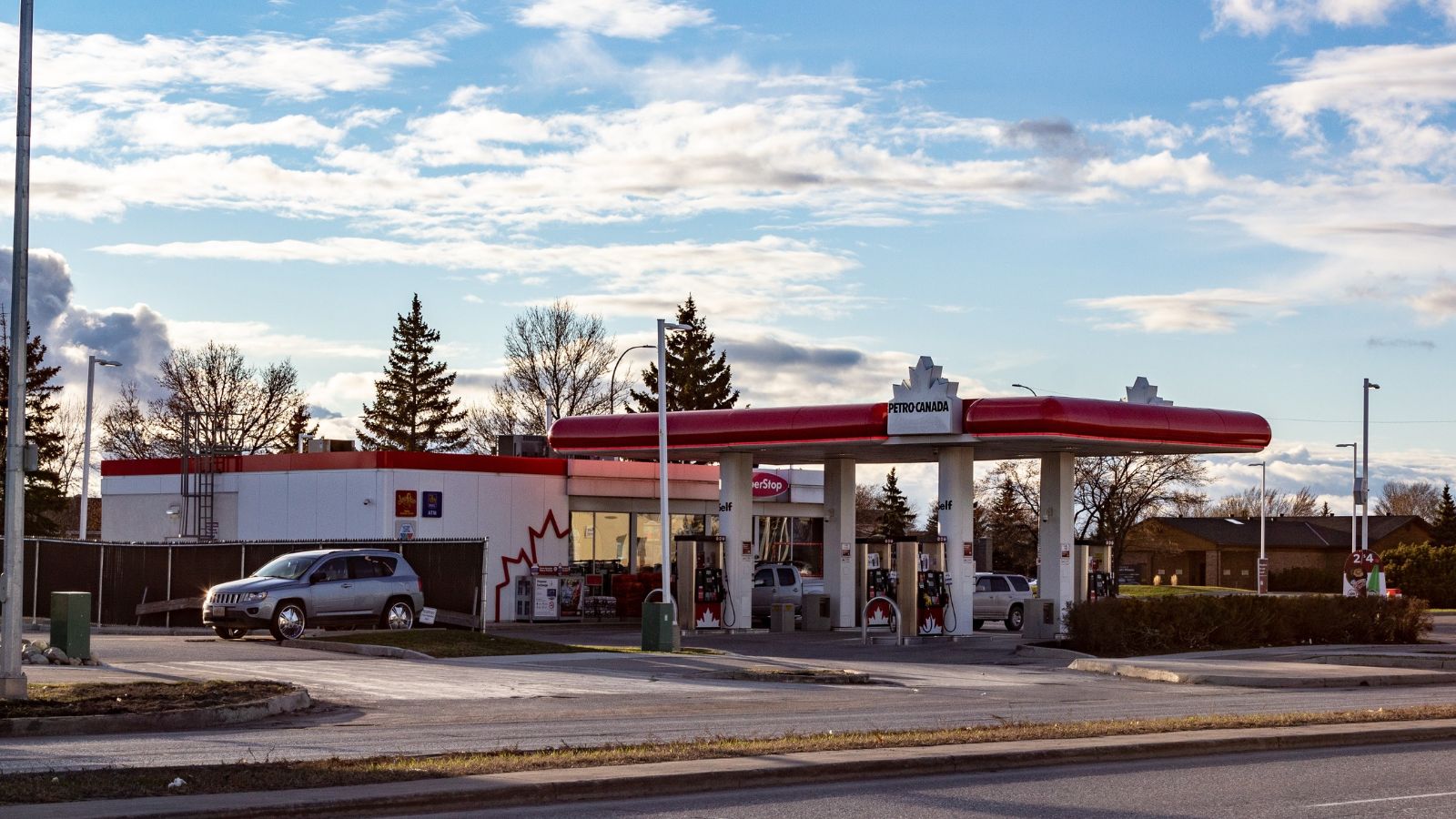
An average of $1.38 does not mean every Winnipeg station posted the same price. Community-reported pump data collected on November 15 showed regular gasoline at 133 cents per litre at a Canadian Tire gas bar on Portage Avenue and 138 cents at a Petro-Canada location on the same corridor. That five-cent spread would equal $2.50 on a 50-litre purchase. Other reported stations showed wider differences, underlining the value of comparing nearby options rather than assuming one citywide price applies everywhere.

There is an important limitation to those figures: crowdsourced reports are observations from particular times, not guaranteed live quotes. A station may change its sign before someone reaches it, and promotional pricing or report timing can distort comparisons. The useful habit is to check when a price was last reported, compare stations already along a planned route and confirm the number on the pump. Driving a long distance solely to save a few cents can quickly consume the savings.

Diesel and Premium Fuel Tell a Different Story

The $1.38 headline refers to regular gasoline, not every grade of fuel. A Winnipeg station report from November 15 listed regular at 133 cents per litre, premium at 167 cents and diesel at 232 cents. Those are prices from one location, not citywide averages, but they illustrate how much the bill can differ depending on the vehicle. A driver filling a diesel pickup may therefore see a very different total from a commuter buying regular for a compact car.

Official monthly figures reinforce the distinction. Statistics Canada’s September data put Winnipeg diesel at 242.2 cents per litre, compared with 171.5 cents for regular gasoline. Refining economics, supply requirements and demand patterns vary by product, so one fuel’s decline need not match another’s. That distinction matters for delivery businesses, tradespeople and other operators whose vehicles use diesel. A welcome improvement in regular gasoline prices does not automatically translate into equally affordable fuel for every motorist or commercial fleet.

A Welcome Reversal After Months of Inflation Pressure

The price drop arrives against a difficult backdrop. Statistics Canada reported that gasoline prices were 27.8 per cent higher nationally in September 2026 than a year earlier, contributing to annual consumer-price inflation of 3.1 per cent. Transportation prices were up 8.4 per cent over the same period. Those figures describe September, not the new November readings, but they help explain why cheaper gasoline now feels particularly significant for households trying to plan around unpredictable expenses.

The strain was visible in broader spending data as well. Statistics Canada said households purchased less gasoline and food in the second quarter of 2026, likely in response to higher prices. That does not mean every family changed driving habits, yet it suggests fuel costs had begun shaping decisions beyond the pump. A few lower-priced fill-ups can free money for groceries, rent or seasonal expenses. Nevertheless, cheaper gasoline is only one component of living costs, and it cannot reverse previous price increases across the economy.

Students, Families and Gig Workers Feel It First

Behind the averages are everyday budgets that cannot easily be postponed. In CityNews interviews published November 15, Winnipeg student Wynelle Dueck described the pressure of paying for tuition, gasoline and groceries. She said filling her tank had previously cost more than $100 and welcomed the lower prices. Her experience gives the figures a practical meaning: transportation is not optional when classes, work shifts and other responsibilities are spread across a city.

Part-time Uber Eats delivery worker Mohammed Jasim told the outlet that cheaper fuel meant more of his earnings could be retained after driving expenses. Another resident, Dexter Suban, described the decline as welcome relief for his family and others facing financial pressure. These are individual experiences rather than a scientific sample of local sentiment, but they show why fuel prices draw so much attention. For people paid by the trip, driving between commitments or balancing student expenses, even a modest change in operating costs can matter.

The Next Price Move Is Far From Certain

For now, the eight-month low offers welcome breathing room, not a forecast that gasoline will keep getting cheaper. Natural Resources Canada identifies global crude prices, local supply, competition, inventories and seasonal demand as important influences. The switch to less expensive winter-blend gasoline can also ease prices, although seasonal patterns are not strong enough to cancel a major disruption in oil markets. A refinery problem or renewed supply concerns could change the direction quickly.

Recent events underline that uncertainty. Reuters described falling oil prices alongside persistent risks affecting Middle Eastern production and shipping, a reminder that markets can move in both directions within days. Drivers making a budget should therefore treat $1.38 as a dated Winnipeg average rather than a guaranteed rate for the weeks ahead. Checking reliable trackers and the price actually displayed at a station remains more useful than assuming a decline will last. The most important result for residents is immediate: filling up has become less expensive, even if the next chapter remains unwritten.


Recommended.

Chinese EV Price Pressure Gets a New Benchmark as Voyah Opens $63,420 Luxury MPV Orders

Chinese EV Price Pressure Gets a New Benchmark as Voyah Opens $63,420 Luxury MPV Orders

September 5, 2026
Cars That Are About to Become the New “Budget Luxury” in Canada

Cars That Are About to Become the New “Budget Luxury” in Canada

March 25, 2026

Trending.

15 “Hidden Fees” Canadians Keep Paying at Dealerships in 2026

15 “Hidden Fees” Canadians Keep Paying at Dealerships in 2026

March 30, 2026
PBO Warns U.S. Tariff War Threatens Up to 185,000 Canadian Jobs, With Auto Manufacturing Among Hardest Hit

PBO Warns U.S. Tariff War Threatens Up to 185,000 Canadian Jobs, With Auto Manufacturing Among Hardest Hit

October 21, 2026
22 Ways Canadians Accidentally Void Their Vehicle Warranty

B.C. Drivers Vote Today on the Future of ICBC Insurance as Parties Clash Over Private Competition and No-Fault Coverage

October 24, 2026
10 Reasons the Canadian Car Market Feels Different Heading Into Summer

Canadian Auto Sales Rise 3.4% for a Fourth Straight Month—but 2026 Still Trails Last Year

October 3, 2026
21 Vehicles Insurance Companies Are Quietly Flagging as “High Risk” in Canada (2026 Update)

21 Vehicles That Are Getting Flagged for Higher Theft Risk in Canada (2026)

March 26, 2026
  • About
  • Contact
  • Privacy Policy
  • Disclaimer
  • Editorial Policies
  • Terms and Conditions
A Revir Media Group Website

2026 Autoigloo - © All rights reserved

No Result
View All Result
  • News & Trends
  • Car Reviews
  • Buying Guides
  • Comparisons
  • EVs & Hybrids
  • More
    • Pricing & Deals
    • Winter Driving
    • Ownership & Maintenance

2026 Autoigloo - © All rights reserved

This website uses cookies. By continuing to use this website you are giving consent to cookies being used. Visit our Privacy and Cookie Policy.