





















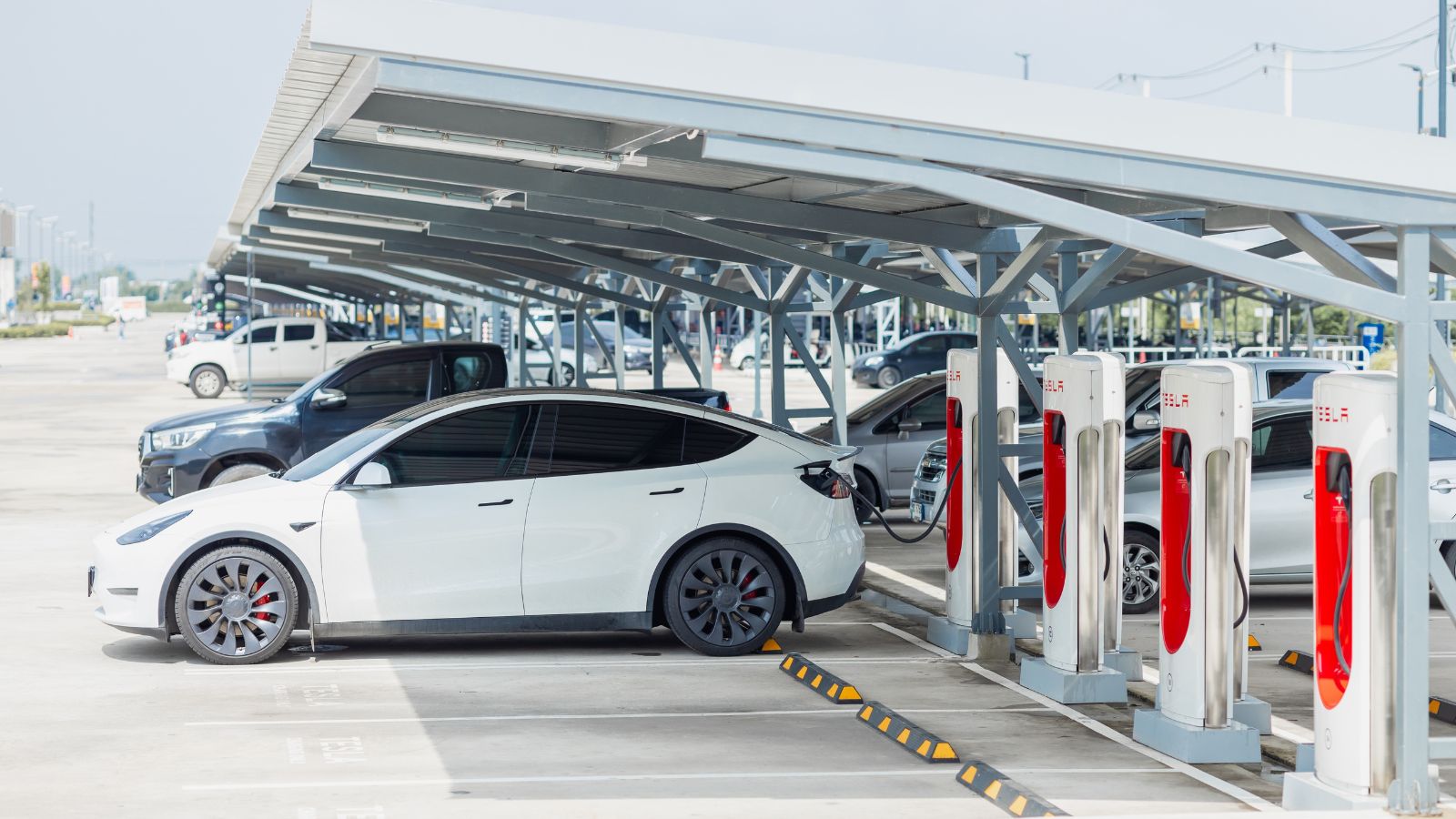
Tesla is widening its role in Canada’s charging market by letting businesses buy the same high-powered charging technology that has largely been associated with its own network. The company has brought both Supercharger for Business and Semi Charging for Business to Canada, opening the door for retailers, fleet operators, property owners and other organizations to install Tesla-operated charging technology on their own sites.
The offering stretches from V4 Supercharger posts rated at up to 500 kW for passenger vehicles to Megachargers capable of delivering as much as 1.2 megawatts to heavy trucks. The move arrives as electric-vehicle sales regain momentum in Canada and as businesses face a growing question: who will build all the charging capacity needed as electric cars and commercial trucks become more common?
Canadian Businesses Can Now Own Tesla Superchargers
Until relatively recently, seeing a Tesla Supercharger generally meant looking at infrastructure deployed as part of Tesla’s own charging network. Supercharger for Business changes that relationship. Canadian companies can now purchase Tesla’s fast-charging equipment for their properties while gaining access to much of the software and operational system Tesla uses for its own locations. For passenger-vehicle installations, Tesla requires businesses to purchase at least four charging posts.
The model potentially brings a different group of investors into Canada’s charging buildout. A shopping centre, hotel, fuel retailer, fleet depot or highway business no longer necessarily has to wait for Tesla to select its property for a company-owned charging station. The business can become the infrastructure owner itself. Tesla says hosts can monitor utilization, adjust charging prices and track financial performance through its portal, while Tesla remains responsible for equipment servicing. Canadian pricing is not publicly posted on the program page, with prospective buyers instead directed to request a quote.
The 500-kW Rating Comes With an Important Technical Detail
The headline number is substantial: Tesla’s V4 Supercharger post is rated to deliver as much as 500 kW to a passenger vehicle. That is twice the 250-kW peak normally associated with Tesla’s widely deployed V3 equipment and gives the new hardware considerably more headroom for vehicles designed around higher-voltage battery systems. Tesla says the V4 platform supports vehicle architectures ranging from 400 volts to 1,000 volts, while each post is equipped with a three-metre cable.
That does not mean eight cars at an eight-stall location can necessarily draw 500 kW simultaneously. Tesla’s V4 cabinet has a maximum DC output of 1.2 MW that can be shared between as many as eight posts. Tesla argues that real-world charging curves make this arrangement practical, saying an eight-post installation typically needs less than one megawatt of supply to give cars their maximum requested power 99% of the time. The distinction matters: 500 kW is the maximum capability of an individual post, not a promise of four megawatts flowing into an eight-stall site.
Tesla Is Selling an Operating System, Not Just a Charger
The business proposition includes considerably more than steel cabinets, cables and charging posts. Tesla says buyers can employ their preferred installer, while a Tesla design engineer assists with the project. Tesla also provides engineering and commissioning support, reviews project drawings and pre-commissioning documentation, and handles commissioning through its service organization. Once the chargers are operational, the business controls pricing while Tesla manages key pieces of the network and service experience.
Tesla also promises a 97% uptime guarantee for Supercharger for Business sites as part of a package that includes network operations, preventative maintenance and driver support. Owners can white-label the stations or apply their own branding rather than presenting them simply as Tesla-owned chargers. This arrangement shifts some of the capital burden for network expansion to property and business owners while keeping the software and maintenance relationship tied to Tesla. It is similar to a franchise-like infrastructure model, although the property owner retains responsibility for the site itself and owns the charging equipment rather than operating a conventional Tesla retail franchise.
The New Chargers Are Intended to Reach Far Beyond Tesla Drivers
Tesla describes the business Superchargers as compatible with all supported electric vehicles, reflecting the broader opening of its charging ecosystem. The V4 hardware supports communication standards including ISO 15118-2 and is designed around multiple connector standards globally. In Canada, practical Supercharger access currently centres on vehicles equipped with the North American Charging Standard, or CCS1 vehicles using an approved NACS DC adapter where supported.
That dramatically expands the potential customer base for a Canadian business installing the equipment. Automakers including Ford, General Motors, Hyundai, Kia, Mercedes-Benz, Rivian, Volvo, Toyota, Volkswagen and others have gained access to compatible portions of Tesla’s North American network. Tesla’s V4 design also uses a longer cable to address a persistent problem at older sites: different manufacturers put charging ports in different places. Optional payment terminals provide another route for payment at equipped locations, while Tesla’s app continues to handle charging for many users. For a business owner, the important point is that the hardware is no longer useful only to a narrow Tesla-driving clientele.
Tesla Is Entering the Business Market as Canadian EV Demand Rebounds
The Canadian timing is notable because electric-vehicle demand has strengthened again after a difficult 2025. Statistics Canada reported 22,716 new zero-emission vehicles sold in August 2026, an increase of 55.1% from August 2025. ZEVs represented 13% of all new motor vehicles sold that month, compared with 8.8% a year earlier. Second-quarter registration data showed a similar recovery, with 58,811 new ZEV registrations, up 26.7% year over year.
Charging infrastructure is expanding at the same time. Industry data provider Paren counted 9,615 publicly accessible DC fast-charging ports across Canada at the end of the third quarter of 2026, spread across 2,740 stations. Tesla remained the largest individual network with 3,091 ports, or 32.1% of the national fast-charging total tracked by Paren. The company added 88 Canadian ports during the quarter. Selling chargers directly to businesses gives Tesla another path to expand its footprint without requiring every new location to be financed and owned entirely by Tesla itself.
Power Sharing Could Matter as Much as the 500-kW Peak
Installing high-power chargers is rarely as simple as buying the equipment and connecting it to an existing electrical panel. Utility capacity, transformers, switchgear, trenching, permits and construction can turn charging projects into major infrastructure investments. Natural Resources Canada has warned that increasing EV charging demand will require substantial generation, transmission and distribution investment, with some high-power projects facing long lead times when major grid upgrades are necessary.
That makes Tesla’s power-sharing architecture commercially significant. Rather than sizing an eight-post passenger-vehicle site for an implausible four-megawatt simultaneous peak, the V4 cabinet distributes as much as 1.2 MW among its connected stalls according to demand. Tesla is also increasingly shipping charging equipment in pre-assembled configurations and says its approach can reduce installation costs by more than 15% in some deployments. The economics still depend heavily on the site, utility connection and construction requirements, but reducing unnecessary peak capacity could make projects easier to build in locations where bringing several additional megawatts onto the property would otherwise become prohibitively expensive.
The Biggest Jump in Power Is Reserved for Heavy Trucks
Passenger-car charging is only half of Tesla’s Canadian announcement. Through Semi Charging for Business, companies can also order Tesla’s heavy-duty charging equipment, including the Megacharger. Each Megacharger post is rated at up to 1.2 MW. Tesla says that level of charging can restore as much as 60% of a Semi’s range in approximately 30 minutes, bringing electric-truck charging closer to the break periods that already exist in commercial transportation schedules.
Tesla’s Canadian specifications list the long-range Semi at an estimated 750 kilometres of range, while the standard-range version is rated around 500 kilometres. Both carry an estimated energy-consumption figure of 1.1 kWh per kilometre under Tesla’s specified test conditions. Actual charging, however, will not sit at 1.2 MW for an entire session. Tesla cautions that power depends on factors including battery state of charge, battery temperature and whether another truck is using the same Megacharger system. In other words, the megawatt figure describes peak capability, while route planners and fleet operators still have to account for real charging curves.
Tesla Is Also Offering a Much Slower Charger — for Good Reason
Not every truck needs megawatt charging. Tesla’s second commercial-truck option is the Basecharger, a roughly 120-kW DC product designed for depots and extended stops. Tesla says it can recover a substantial portion of a Semi’s range over roughly four hours. Compared with a 1.2-MW Megacharger, that can sound underpowered, but overnight and depot charging often has completely different economics from charging a truck midway through a revenue-generating route.
Canadian government research reinforces that distinction. Natural Resources Canada expects more than 80% of the charging ports ultimately required for medium- and heavy-duty electric vehicles to be overnight chargers. Its modelling describes depot charging as generally cheaper and less operationally restrictive because vehicles can remain connected for long periods and charging can be shifted to periods when electricity demand and costs are lower. Tesla’s two-product approach consequently mirrors how commercial fleets actually operate: high-cost, extremely high-power equipment for rapid turnarounds and lower-power equipment where trucks already spend several hours parked.
MCS Is Becoming the Common Language of Megawatt Truck Charging
Tesla lists MCS 3.2 as the charging standard for its Megacharger and Basecharger hardware. The wider Megawatt Charging System is important because the commercial-truck industry does not want every manufacturer building an incompatible megawatt plug. CharIN began developing MCS specifically for large electric vehicles, and international standardization took a major step forward in September 2026 when IEC 61851-23-3 was published, completing what CharIN describes as the core MCS standards framework.
There is an important caveat. Standards compatibility does not automatically mean Tesla’s existing Megacharger network is already open to every MCS-equipped truck. Tesla’s current support documentation explicitly says its Megacharger sites support Tesla Semi trucks and do not presently accept trucks from other manufacturers. That may evolve as MCS implementation and interoperability testing mature, but buyers should distinguish between an industry-standard connector architecture and immediate network access. The significance of MCS is that the technical foundation for broader interoperability now exists; commercial and software access still has to follow.
British Columbia Is Already Showing What the Model Could Look Like
One of the first practical Canadian examples is emerging in British Columbia. R.R. Plett Trucking is preparing Tesla Megacharger installations in Langley and Kamloops ahead of 12 Tesla Semis the company expects in June 2027. The carrier already operates eight Volvo VNR Electric tractors on routes linked to the Port of Vancouver. Chief operating officer Trevor Plett has said megawatt charging could reduce charging time from roughly three hours to about 30 minutes, making double-shift operation more practical.
The Canadian launch also fits a broader Tesla strategy that is already moving beyond pilot scale. In its third-quarter 2026 update, Tesla said Supercharger for Business had grown to more than 600 customer-owned stalls. The company also reported adding more than 2,100 net new Supercharging stalls during the quarter and deploying its first pre-assembled Megacharger. Canada therefore joins the program as Tesla is turning its charging technology into a product other companies can own, rather than simply infrastructure Tesla builds for itself. If businesses embrace that model, Tesla’s next major Canadian charging expansion may increasingly be financed by the businesses whose parking lots, depots and customers use it.