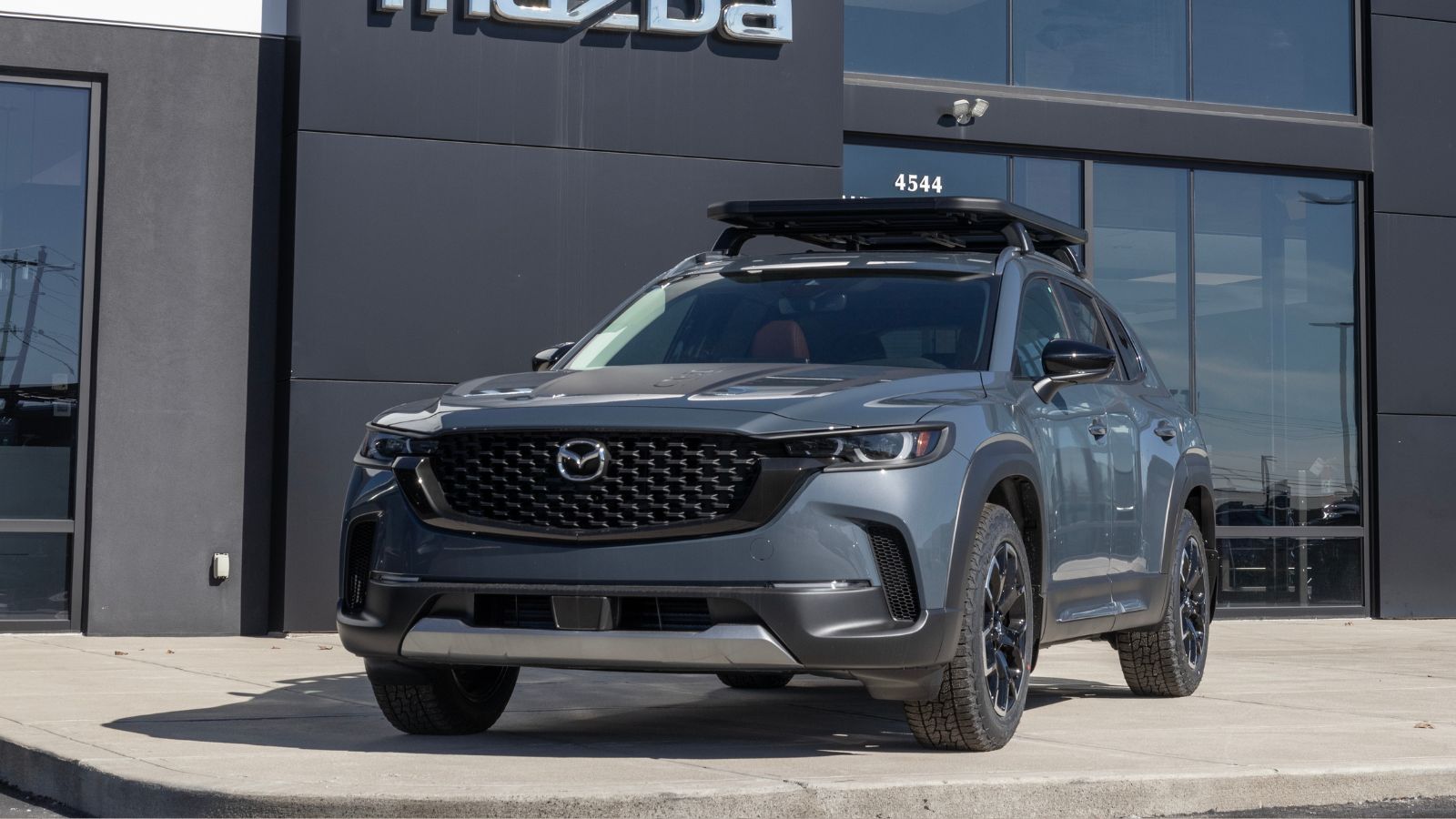
A popular Mazda SUV has virtually disappeared from Canadian sales charts, highlighting how North America’s escalating trade tensions are changing the vehicles available to consumers.
Mazda Canada recorded just 168 CX-50 sales during the first six months of 2026, compared with 6,258 during the same period last year. The difference of 6,090 vehicles represents one of the company’s most significant model-level declines, following its decision to suspend Canadian-bound production of the Alabama-built crossover.
The disruption has continued into the third quarter, even as some of Mazda’s other SUVs deliver encouraging results. New industry analysis published October 13 illustrates how the loss of one model can distort an automaker’s entire sales performance.
For Canadian dealerships and consumers, the situation demonstrates how quickly changing trade policies can reshape familiar automotive lineups.
Mazda’s CX-50 Sales Collapse by More Than 97% in Six Months
Mazda Canada’s first-half sales results reveal the scale of the CX-50’s disappearance. Between January and June 2025, the company sold 6,258 examples of the compact crossover. During the same six months of 2026, that figure collapsed to just 168 vehicles, representing a 97.3% decline. The difference of 6,090 vehicles is especially striking because the CX-50 had become an established part of Mazda’s Canadian SUV lineup. Instead of attracting thousands of new customers, the model contributed almost nothing to the company’s sales volume during the opening half of the year.
The decline weighed heavily on Mazda’s overall performance. Total Canadian sales fell from 39,781 vehicles in the first half of 2025 to 34,349 in 2026, a 13.7% reduction. However, the 6,090-unit CX-50 shortfall was larger than Mazda’s entire company-wide decline of 5,432 vehicles. That means sales of its remaining models collectively improved, partially offsetting the missing crossover. The figures reveal an important distinction: Mazda’s overall downturn was not simply the result of Canadians losing interest in its vehicles.
Production for Canada Was Suspended at Mazda’s Alabama Factory
The origins of the disruption can be traced to April 23, 2025, when Mazda North American Operations announced that production of the CX-50 for Canada would be temporarily suspended beginning May 12. The decision affected vehicles destined for Canadian dealerships, not the entire assembly operation. Mazda confirmed that the Huntsville, Alabama, facility would continue producing the CX-50 for the American market, with increased U.S.-bound output maintaining overall production volumes. The announcement illustrated how trade conditions could divide what had previously functioned as a closely connected North American vehicle market.
The factory itself is a joint operation between Mazda and Toyota, established to produce vehicles for North American customers. CX-50 manufacturing began there in January 2022, making the crossover an important part of Mazda’s American production strategy. In its suspension announcement, Mazda said it would continue monitoring government negotiations, market conditions and policy developments before determining its response. Although the suspension was initially described as temporary, the model’s subsequent sales collapse suggests Canadian supply never recovered meaningfully. The distinction matters: production continued in Alabama, while the stream of new CX-50s intended for Canada effectively dried up.
Canada’s 25% Auto Tariffs Create a Complicated Trade Barrier
The suspension came shortly after Canada introduced retaliatory tariffs on vehicles imported from the United States. Beginning April 9, 2025, Ottawa imposed a 25% surtax on American vehicles that do not comply with the Canada-United States-Mexico Agreement. For qualifying vehicles, the surtax applies to the portion of their value not originating in Canada or Mexico. These rules were introduced in response to American tariffs on Canadian automotive exports. They created additional financial uncertainty for manufacturers accustomed to moving completed vehicles across the border as part of routine North American operations.
However, the tariff system is more complicated than a flat 25% charge on every American-built vehicle. Canada established a remission framework allowing eligible automakers to import specified quantities of qualifying vehicles without the counter-tariffs, subject to Canadian production and investment commitments. The framework was extended into 2027. Mazda has not publicly disclosed a model-specific tariff calculation for the CX-50, so its precise potential import cost cannot be established from the available announcements. What is clear is that the changing trade environment coincided with Mazda’s decision to redirect Canadian-bound production toward the American market.
September Figures Reveal an Even Larger 7,471-Vehicle Shortfall
The situation has deteriorated beyond the original first-half figures. Mazda Canada’s September 2026 sales release shows just 168 CX-50 deliveries through the first nine months of the year, compared with 7,639 during the equivalent period in 2025. That represents 7,471 fewer vehicles, or a 97.8% decline. The monthly figures are equally revealing. Mazda recorded no Canadian CX-50 sales in July, August or September 2026, whereas those three months collectively generated 1,381 deliveries in 2025. The company has also recorded zero monthly CX-50 sales since May 2026.
Those missing vehicles have had an enormous effect on Mazda’s latest national results. Through September, the company sold 56,148 vehicles in Canada, down from 64,017 a year earlier. The overall decline was 12.3%, equivalent to 7,869 vehicles. Remarkably, the CX-50 shortfall represented approximately 95% of that net reduction. This does not establish that every missing customer would otherwise have purchased a CX-50, but it demonstrates how strongly the model’s disappearance has influenced the company’s reported performance. Other Mazda vehicles have helped compensate for the losses, although not enough to restore the brand’s previous sales volume.
Mazda’s CX-5 Becomes an Increasingly Important Canadian Sales Anchor
As the CX-50 fades from Canada’s sales charts, the CX-5 has assumed even greater importance. Mazda sold 21,807 CX-5 vehicles through September 2026, compared with 20,863 during the same period in 2025. The 4.5% increase confirms that the compact SUV remains the company’s strongest-selling vehicle in Canada. During the first half of the year, CX-5 sales were up 9.6%, providing an important counterweight to the sharp decline elsewhere in Mazda’s crossover lineup. For households seeking practical transportation, the CX-5 continues to offer a familiar alternative within the brand.
Mazda has also invested in keeping the vehicle competitive. The redesigned 2026 CX-5 received the Insurance Institute for Highway Safety’s TOP SAFETY PICK+ designation in July, contributing to a strong year of safety awards for the manufacturer. However, the model has not maintained uninterrupted growth. September deliveries fell 28.9% year over year to 2,498 units, demonstrating that even Mazda’s strongest Canadian nameplate is exposed to changing market conditions. The CX-5’s broader performance remains encouraging, but the figures cannot establish how many former CX-50 buyers chose it instead.
CX-70 and CX-90 Sales Provide Relief but Cannot Replace the Missing CX-50
Mazda’s larger SUVs have delivered some of the brand’s strongest Canadian results during 2026. The three-row CX-90 reached 7,227 sales through September, up 11.6% from 6,474 a year earlier. September alone brought 888 sales, representing a 12% increase. The two-row CX-70 also enjoyed a strong September, establishing a monthly record with 510 deliveries, up 25%. Its third-quarter volume increased 10.4%. However, the CX-70’s nine-month total remained slightly below its 2025 performance, with 4,044 vehicles sold compared with 4,060 the previous year.
Mazda has also attempted to attract more customers through its plug-in hybrid lineup. In June 2026, the company reduced the starting price of the CX-70 PHEV to $48,999 and the CX-90 PHEV to $49,999, making specified versions eligible for federal electric-vehicle incentives of up to $2,500. These models provide additional choices, particularly for buyers considering electrified transportation. Nevertheless, they occupy a different position from the smaller CX-50, whose 2025 Canadian lineup began at $39,950. Their improved performance therefore cannot automatically replace the volume or customer demand associated with the missing compact crossover.
Mazda’s Other Vehicles Reveal a More Complicated Sales Picture
The CX-50’s disappearance has overshadowed some more encouraging developments elsewhere in Mazda’s Canadian lineup. Through September, the smaller CX-30 recorded 12,875 deliveries, up 2% from the same period in 2025. That modest increase suggests the brand continues to attract buyers seeking smaller utility vehicles. By contrast, the Mazda3 experienced a substantial decline, with nine-month sales falling 20.5% to 9,054 vehicles. The MX-5 sports car was one of the smaller bright spots, recording 973 deliveries, up 1.8%. These contrasting results show that Mazda’s difficulties cannot be reduced to one uniform trend.
The wider Canadian automotive market also provides important context. According to DesRosiers Automotive Consultants, approximately 950,000 new light vehicles were sold nationwide during the first half of 2026, down 2.6% from roughly 976,000 a year earlier. Mazda’s 13.7% first-half decline was considerably steeper. Yet excluding the CX-50, the company’s remaining models collectively recorded approximately 2% growth. This comparison suggests Mazda’s underlying performance was much healthier than the headline number initially indicated. It also reinforces the importance of examining individual models when assessing whether an automaker is losing customers or struggling to supply its established lineup.
American CX-50 Sales Are Rising While Canadian Deliveries Disappear
Perhaps the clearest indication of how differently the two markets are performing comes from Mazda’s American sales figures. In the United States, the CX-50 achieved its strongest September sales performance on record during 2026. Mazda delivered 9,147 vehicles that month, an increase of 3.1% compared with September 2025. Across the first nine months of the year, American CX-50 sales reached 95,351 units, up 19.7% from 79,628 a year earlier. These figures include gasoline and hybrid variants, demonstrating that the model continues to generate substantial volume south of the border.
The contrast is striking. While American dealers recorded a monthly CX-50 sales record, their Canadian counterparts reported zero September deliveries. Mazda’s wider American business also enjoyed a strong month, with total September sales increasing 31.9% to 34,519 vehicles. Canada moved in the opposite direction, with overall Mazda deliveries falling 19.3% to 6,454. Different production allocations help explain why the two markets are experiencing such divergent CX-50 results. The numbers do not prove that every Canadian sale was transferred directly to an American customer, but they show that the vehicle’s manufacturing program remains commercially active despite its near-disappearance from Canada.
Canadian Dealers and CX-50 Owners Face a Different Reality
The CX-50’s disappearance matters because it was a proven Canadian seller before the trade disruption. Mazda recorded 10,759 CX-50 deliveries in 2024, an 88.4% increase over 2023. The crossover appealed to buyers seeking standard all-wheel drive, outdoor-oriented styling and a practical five-passenger cabin. The 2025 lineup started at $39,950, while the newly introduced hybrid version began at $42,950. These options gave Mazda a distinctive presence in the competitive compact SUV market. Today, Mazda Canada’s vehicle listings identify both the conventional CX-50 and its hybrid counterpart as sold out, although some website views still reference limited hybrid inventory.
For consumers hoping to purchase a CX-50, individual dealership inventories and the pre-owned market may offer alternatives, but availability cannot be assumed. Existing owners face a different set of considerations. Mazda’s Canadian warranty program includes three-year unlimited-mileage new-vehicle coverage and five-year unlimited-mileage powertrain protection, subject to applicable conditions. The manufacturer also maintains a network of 163 Canadian retail locations. A production suspension does not automatically cancel existing warranty obligations or maintenance support. Nevertheless, customers should confirm parts availability, service requirements and coverage directly with their dealership, particularly when considering a previously owned vehicle.
Mazda’s Canadian Recovery Depends on More Than Strong SUV Demand
The unanswered question is whether the CX-50 will eventually return to normal Canadian availability. Mazda’s original April 2025 announcement described the production suspension as temporary, but the company has not announced a confirmed restart date for Canadian-bound vehicles. More than a year later, its official sales reports show virtually no CX-50 activity. Meanwhile, the model continues to sell strongly in the United States, suggesting the immediate problem is not the vehicle’s overall commercial viability. Trade costs, production allocation and the financial attractiveness of exporting American-built SUVs to Canada remain central considerations.
Canada’s auto tariff framework is scheduled to remain in place through at least the current relief period ending April 8, 2027, although future government decisions could change the rules. Any meaningful CX-50 comeback would depend on Mazda’s production strategy and the commercial conditions for supplying Canadian dealerships. In the meantime, the company must rely on the CX-5, CX-30, CX-70 and CX-90 to compete for customers. The broader lesson extends beyond one automaker. North American vehicle production is deeply interconnected, and changes at the border can quickly influence showroom availability. Mazda’s missing CX-50 sales demonstrate the consequences when a successful vehicle becomes caught between trade policy and manufacturing decisions.