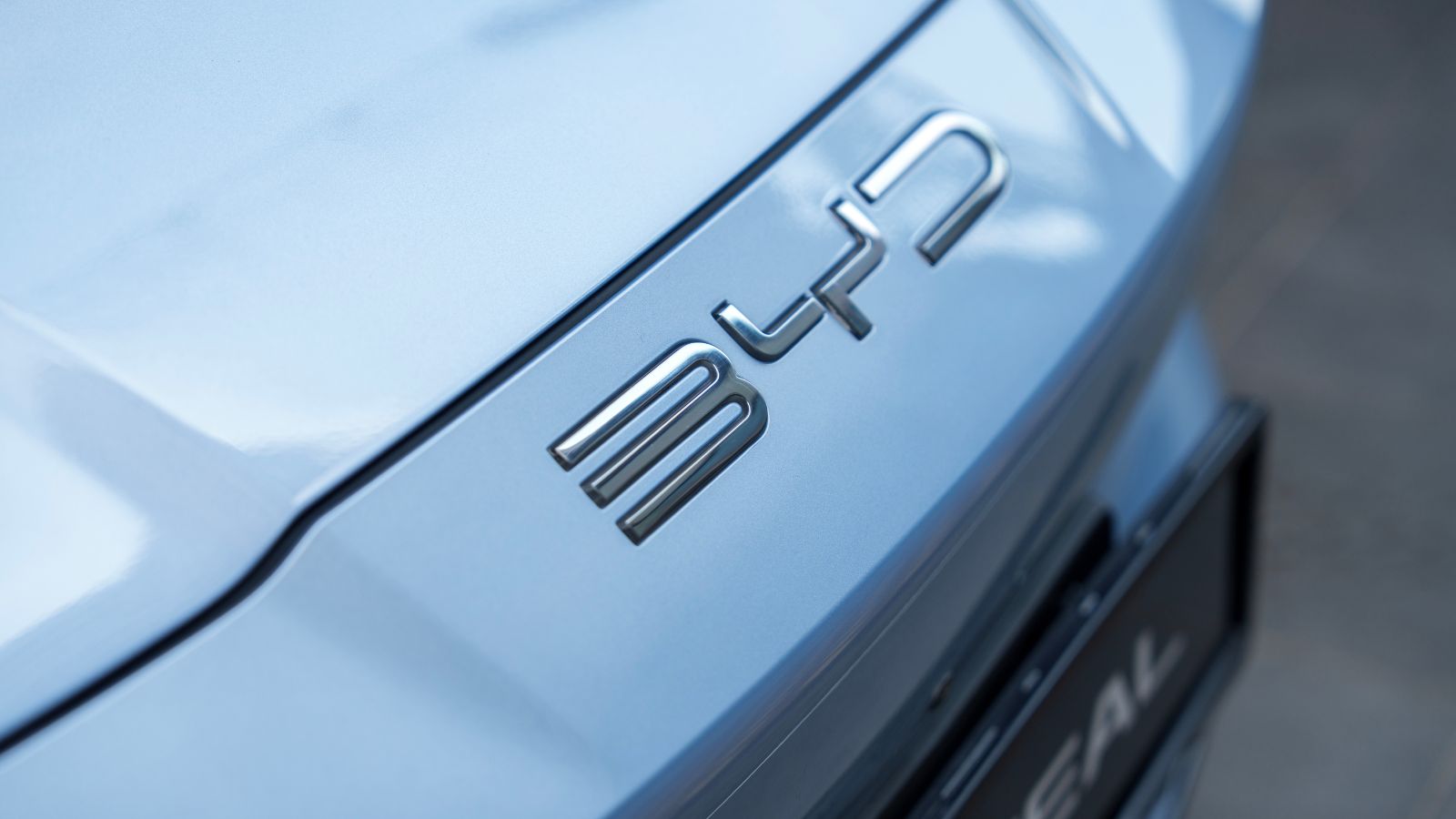
An electric sedan promising more than 1,000 kilometres of driving range on a single charge has become the latest demonstration of China’s rapidly advancing automotive technology. On October 13, 2026, BYD officially launched the Da Han EV, also known as the Great Han, introducing a full-size luxury vehicle with powerful electric motors, rapid-charging technology and a starting price below its earlier pre-sale estimate.
The unveiling comes as Canada prepares for greater competition from Chinese automakers following significant changes to its electric-vehicle import rules. BYD has already taken steps toward entering the Canadian passenger-vehicle market, but the company has not confirmed whether the new Da Han will be offered there.
For Canadian consumers, the launch raises important questions about driving range, affordability and how quickly the electric-vehicle market could change.
BYD Officially Launches Its New Flagship Electric Sedan in China
BYD introduced the Da Han EV on October 13, 2026, expanding its Dynasty lineup with a large, premium electric sedan positioned above the existing Han. The vehicle is available in three configurations, beginning with the rear-wheel-drive LiDAR Premium version priced at 235,900 yuan. A more extensively equipped rear-wheel-drive LiDAR Flagship model costs 249,900 yuan, while the all-wheel-drive LiDAR Flagship starts at 275,900 yuan. The launch moves the vehicle beyond an early product announcement into the Chinese retail market, giving customers specific prices and configurations to consider.
The timing is significant because BYD had already opened pre-sales at the Chengdu Auto Show on August 21. At that point, prices ranged from 249,900 to 299,900 yuan. The final prices announced in October are between 14,000 and 24,000 yuan lower, depending on the version. That reduction makes the new flagship more competitively positioned without removing its premium ambitions. However, the published prices apply to China. BYD has not announced Canadian pricing, specifications or an order date for the Da Han.
The 1,008-Kilometre Range Comes With an Important Qualification
The headline figure belongs to the two rear-wheel-drive versions of the Da Han EV, both of which carry an official range rating of 1,008 kilometres. The more powerful all-wheel-drive model is rated for 880 kilometres. All three configurations use a 102.3-kWh battery pack. These figures are impressive for a large luxury sedan, particularly one designed to combine substantial passenger space with strong acceleration. However, the distances are measured under China’s China Light-Duty Vehicle Test Cycle, commonly known as CLTC, rather than Canada’s official vehicle-rating procedure.
That distinction matters for buyers comparing electric vehicles across international markets. Natural Resources Canada publishes vehicle efficiency information using standardized testing procedures that account for several driving conditions, including higher speeds, air-conditioning use and cold temperatures. Real-world driving can produce different results. In a 2025 study, the Canadian Automobile Association found that electric vehicles tested in sub-zero temperatures travelled 14% to 39% less than their published Canadian ratings. The Da Han was not included in that study, so its Canadian winter performance cannot be calculated from those results. Until independent testing is available, the 1,008-kilometre figure should be understood as a Chinese laboratory rating, not a promise of comparable Canadian highway range.
Second-Generation Blade Battery Promises Nine-Minute Ultra-Fast Charging
One of the Da Han EV’s most significant technologies is its second-generation Blade Battery, a lithium iron phosphate battery system introduced by BYD earlier in 2026. The company says the vehicle can recharge from 10% to 97% in approximately nine minutes when connected to compatible Flash Charging equipment. BYD’s charging technology is designed to deliver up to 1,500 kilowatts through a single connector, substantially exceeding the power available from many conventional public fast chargers. In a separate extreme-temperature demonstration, BYD reported that its latest battery technology could recharge from 20% to 97% in 12 minutes at minus 30 degrees Celsius.
Those results could make electric vehicles considerably more convenient for long-distance travel, but the charging equipment is essential to the claim. A nine-minute charging session should not be interpreted as something the Da Han could achieve at any public charging station. BYD announced plans to deploy 20,000 Flash Charging locations across China by the end of 2026, with international expansion also planned. No Canadian Flash Charging network has been confirmed for the sedan. Actual charging performance would depend on available equipment, battery temperature, charging conditions and the vehicle’s compatibility with local infrastructure.
The Da Han Combines Full-Size Sedan Dimensions With Luxury Interior Features
Measuring 5,256 millimetres in length, 1,999 millimetres in width and 1,510 millimetres in height, the Da Han is considerably larger than the compact electric vehicles frequently associated with affordable Chinese brands. Its 3,130-millimetre wheelbase allows BYD to dedicate substantial space to its five-passenger cabin. The exterior follows the company’s established Dynasty design language, with narrow lighting elements, an aerodynamically optimized front end and a claimed drag coefficient of 0.197. Those proportions make it a vehicle aimed at customers seeking executive-sedan comfort rather than simply economical transportation.
Inside, BYD has emphasized features normally associated with premium automotive models. Equipment includes Nappa leather upholstery, two front seats with zero-gravity positioning, a 31-speaker Devialet sound system and multiple digital displays. The central touchscreen measures 17.3 inches, while a head-up display projects information into the driver’s field of vision. Rear passengers can benefit from adjustable seating, available leg supports, a folding display and a small table. The vehicle also features a 130-litre front storage compartment. These amenities demonstrate BYD’s ambition to compete on comfort and technology, although no Canadian equipment package has been announced.
Rear-Wheel Steering and Up to 764 Horsepower Add Performance Appeal
BYD is offering the Da Han with two distinct electric powertrain configurations. The rear-wheel-drive versions use a single electric motor producing 370 kilowatts, or approximately 496 horsepower, allowing the sedan to accelerate from zero to 100 kilometres per hour in a claimed 4.9 seconds. The all-wheel-drive model adds a 200-kilowatt front motor, raising combined output to 570 kilowatts, equivalent to approximately 764 horsepower. According to the manufacturer’s performance figures, this version can complete the same acceleration test in just 3.3 seconds. The additional power comes with a reduction in rated driving range, from 1,008 to 880 kilometres under CLTC testing.
Despite its considerable dimensions, the Da Han has been engineered to handle tighter spaces more easily than its length might suggest. Standard rear-wheel steering helps achieve a minimum turning radius of 4.95 metres. BYD also includes its DiSus-A dual-chamber air suspension, which can adjust the vehicle’s ride characteristics and uses road-preview technology to anticipate changing surfaces. These systems are intended to combine high-speed comfort with low-speed manoeuvrability. Their practical effectiveness, however, will depend on real-world conditions and independent driving assessments.
LiDAR and Advanced Driving Assistance Become Standard Across the Lineup
The Da Han’s technology package extends beyond its battery and electric motors. All three configurations include BYD’s LiDAR-equipped God’s Eye B driver-assistance hardware and God’s Eye 5.0 capabilities. The system is designed to help drivers navigate selected urban roads and highways, while also supporting intelligent parking functions. By providing this technology across the lineup, BYD is making advanced driver assistance a standard feature rather than reserving the hardware for its most expensive version. That approach gives the entry-level model a notably comprehensive equipment package for its advertised Chinese price.
However, sophisticated sensors and software should not be confused with fully autonomous driving. Systems that provide partial driving automation still require appropriate driver supervision and cannot independently handle every road condition. The Insurance Institute for Highway Safety emphasizes that Level 2 automation does not replace the driver. Another question concerns how these systems would operate outside China. Road markings, traffic rules, digital maps and regulatory requirements can differ between markets. Even if BYD eventually selected the Da Han for Canada, the availability and capabilities of its driver-assistance functions would need to be confirmed for Canadian roads.
The Launch Arrives as BYD’s Existing Han Sales Fall Sharply
The Da Han is entering the Chinese market at a difficult moment for BYD’s existing Han sedan family. According to sales data compiled by CnEVPost, the Han lineup recorded just 2,529 deliveries in September 2026, representing a 70.9% decline from the same month in 2025. Between January and September, cumulative deliveries reached 44,324 vehicles, down approximately 68.9% year over year. Those figures demonstrate how quickly competition can reshape China’s electric-vehicle market. Even an established manufacturer with substantial technological resources cannot assume that customers will continue purchasing familiar models when newer alternatives appear.
Against that backdrop, the Da Han represents an attempt to refresh BYD’s premium offering with greater driving range, faster charging and more sophisticated comfort features. The vehicle also carries considerable symbolic importance. On September 29, BYD announced that the 10 millionth vehicle produced within its Dynasty lineup was a Da Han sedan. That milestone reflects the success of a vehicle family that began with the Qin model in 2013. However, cumulative production achievements and current consumer demand are different measures of success. The new flagship must still establish its own sales momentum in a highly competitive domestic market.
Canada’s New Import Quota Creates Opportunities for Chinese EV Manufacturers
Canada’s electric-vehicle trade environment changed significantly on March 1, 2026, when a new arrangement allowing limited imports of Chinese-origin electric vehicles took effect. Under the framework, up to 49,000 qualifying vehicles can enter Canada during the first quota year at a most-favoured-nation tariff of 6.1%. The arrangement replaced the additional 100% surtax that had previously applied to Chinese-built electric vehicles. Ottawa has also committed to expanding the annual quota by 6.5% in subsequent years. For manufacturers such as BYD, the policy substantially changes the economics of entering Canada’s market, although it does not automatically authorize every Chinese model for sale.
The quota operates through a regulated permit system. The first annual period runs from March 1, 2026, through February 28, 2027, with 24,500 vehicles initially available in each half-year period. Unused allocations from the first period can be carried into the second. Importers must obtain shipment-specific permits, and the current system operates on a first-come, first-served basis. Ottawa also intends to reserve a growing portion of future quotas for vehicles meeting a lower import-value threshold. These measures create possibilities for increased competition, but import eligibility, vehicle certification and actual retail availability remain separate requirements.
BYD Is Preparing for Canada, but the Da Han Is Not a Confirmed Model
BYD has taken concrete steps toward entering Canada’s passenger-vehicle market. A Reuters investigation published in June 2026 reported that the manufacturer had begun compliance procedures for two passenger vehicles, based on Transport Canada records. One vehicle was associated with production in Shenzhen and another with Xi’an, although the identities of the models were not established in that reporting. A dealership advisory firm also told Reuters that it was scouting locations as part of plans for six initial Canadian dealerships. BYD executive vice-president Stella Li said at the time that the company was still deciding which models to introduce and suggested retail sales would likely begin in 2027.
BYD has also established an official Canadian website operated by BYD Canada Company Limited. However, its terms of use, updated August 3, 2026, explicitly state that the website does not currently support vehicle purchases, reservations, financing applications or deposits. The terms also caution that internationally displayed vehicles and features may never be offered in Canada. That distinction is especially important for the newly launched Da Han. There is no verified Canadian price, confirmed local specification, announced showroom arrival or Canadian order process for the model. Reports about BYD’s wider expansion should therefore not be interpreted as proof that its 1,008-kilometre flagship sedan has been selected for the Canadian market.
Canadian Buyers Still Face Questions About Pricing, Safety and Federal Incentives
Before the Da Han could appear in a Canadian showroom, it would need to meet Canada’s motor-vehicle safety requirements and comply with applicable import procedures. Transport Canada requires vehicles manufactured for the Canadian market or imported for sale to meet Canadian Motor Vehicle Safety Standards. A successful launch would also require locally supported software, compatible charging equipment, warranty arrangements, replacement parts and trained service technicians. There is a meaningful potential market: Statistics Canada recorded 58,811 new zero-emission vehicle registrations in the second quarter of 2026, up 26.7% from a year earlier. These vehicles accounted for 10.7% of all new registrations.
Affordability presents another complication. Canada’s Electric Vehicle Affordability Program offers up to C$5,000 for eligible battery-electric vehicles in 2026, but eligibility is restricted to vehicles assembled in Canada or countries with which Canada has a free-trade agreement. A Chinese-assembled Da Han would therefore not qualify under the current rules, even if BYD eventually introduced it to Canada. Import duties, transportation costs and dealership pricing would also affect its final cost. For now, the Da Han demonstrates what BYD can offer Chinese consumers: exceptional claimed range, powerful performance and advanced charging technology. Whether Canadians will eventually have the opportunity to buy it remains an unanswered question.