


























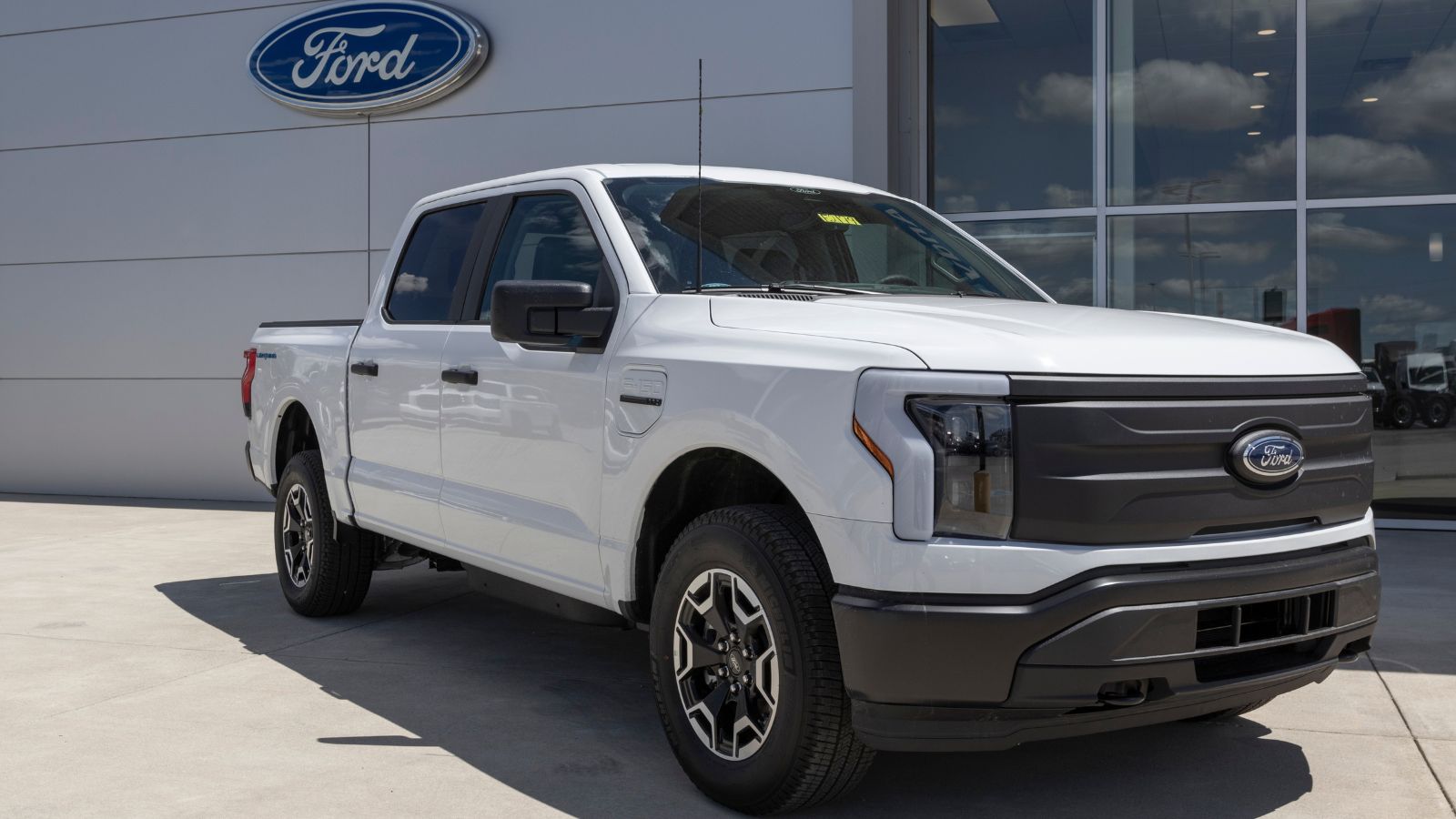
Ford’s F-150 assembly lines are moving again, but restarting a factory cannot recover every truck that was lost during a critical final week of the quarter. CEO Jim Farley says the supplier problem that interrupted production has been resolved and Ford is “back up and running,” yet the disruption will still reduce the automaker’s third-quarter wholesale shipments.
The timing is particularly frustrating for Ford. The company entered 2026 already trying to rebuild F-Series production after fires at aluminum supplier Novelis disrupted its truck operations beginning in late 2025. Ford says that older problem has now been overcome, making the latest shortage a separate setback rather than a continuation of the aluminum crisis. For a company heavily dependent on profitable pickups, even a relatively short interruption can leave a noticeable mark on quarterly results.
A Nearly Weeklong F-150 Halt Hit at the Worst Possible Time
The most serious interruption occurred at Ford’s Dearborn Truck Plant in Michigan, one of the company’s major F-150 manufacturing operations. Production crews were cancelled beginning Thursday, September 24, with the shutdown expected to run through Tuesday, September 29, according to an internal memo reported by Reuters. That placed essentially the entire disruption in the closing days of the third quarter, leaving little opportunity to make up the lost trucks before September 30.
Dearborn was not the only operation affected. Ford’s Kansas City Assembly Plant, another major F-150 production site, cancelled some shifts because of the same supply problem. Meanwhile, the company increased truck output at its Kentucky Truck Plant in an attempt to compensate. Ford did not publicly identify the supplier at the centre of the disruption, and the precise component involved was not initially disclosed. That matters because it prevents the interruption from being confidently attributed to aluminum, semiconductors, electronics or another specific category of part. What Ford did confirm is simpler: insufficient parts temporarily prevented normal F-150 production.
Restarting the Lines Cannot Put the Lost Trucks Back Into Q3
Farley confirmed on September 30 that the supplier problem had been fixed and production had restarted. Operationally, that is the encouraging part of the story. Financially, however, the calendar creates a problem. Trucks that were not completed and shipped while the factories were down cannot simply be counted as third-quarter wholesales because the assembly line begins running again after the lost production window has already passed.
That distinction between production and wholesale shipments is important. Ford can potentially build additional F-150s later, refill dealer pipelines and catch up with customer orders, but those vehicles will fall into a later reporting period. Farley specifically acknowledged that the disruption was affecting Ford’s third-quarter wholesale numbers even while expressing optimism about the resolution. For dealers, the impact may appear as fewer incoming trucks or delayed replenishment of particular configurations. For Ford, it means a short-term reduction in some of its most commercially important shipments even though the underlying manufacturing problem has already been addressed.
This Was Not Another Novelis Aluminum Shutdown
The latest disruption inevitably brought back memories of Ford’s much larger aluminum problem, but the two events are separate. Novelis operates a major aluminum facility in Oswego, New York, where a significant fire occurred on September 16, 2025. A second major fire followed on November 20 while restoration work was underway. Both incidents affected the hot-mill area, creating serious supply complications for customers including Ford.
Novelis eventually restarted the Oswego hot mill in early June 2026 and began ramping production. Ford had also temporarily sourced aluminum elsewhere while working to reduce the effect on vehicle assembly. By September 30, Farley said Ford was fully recovered from the effects of those fires. Reuters reported that the latest F-150 supplier problem was unrelated to Novelis. That distinction changes how the new disruption should be viewed. Ford is no longer dealing with the same months-long shutdown of a crucial aluminum source. Instead, the late-September interruption appears to have been a shorter component-supply problem that was serious enough to stop assembly but resolved relatively quickly.
Every Lost F-Series Truck Matters More Than a Typical Vehicle
Few vehicles matter to an automaker as much as the F-Series matters to Ford. The company reported 357,801 F-Series sales during the first half of 2026, more than 80,000 ahead of the Chevrolet Silverado and enough to retain its position as America’s best-selling truck. Ford has said the nameplate is on pace for a 50th consecutive year as the country’s best-selling truck. That scale makes production interruptions unusually consequential.
The problem is that 2026 volume has already been running behind the previous year. Through August, F-Series sales were about 11% below their year-earlier level, according to Reuters. The company has repeatedly described its gasoline-powered trucks and large SUVs as important profit generators, while its financial results demonstrate the value of favourable product mix and pricing. Losing production at Dearborn therefore does more than reduce the number of vehicles leaving one factory. It interrupts one of Ford’s strongest revenue and earnings engines. A week of missing small cars would be inconvenient; a week involving the F-150 can be financially far more visible.
Ford Had Already Added Capacity to Catch Up on Missing Trucks
The timing is also awkward because Ford spent much of 2026 doing the opposite of cutting F-Series production. Following the Novelis disruption, the company added a third crew at Dearborn Truck Plant and increased assembly-line speed at Kentucky Truck Plant. Ford had previously announced plans to increase F-150 and Super Duty production by more than 50,000 trucks in 2026 as it worked to recover lost volume and respond to demand.
Those actions illustrate just how aggressively Ford was trying to rebuild its truck pipeline. Employees were shifted into Dearborn, additional staffing was planned, and Kentucky was configured to produce more Super Duty pickups. Ford also told shareholders that alternative aluminum supplies had been secured while Novelis recovered. By the first half of 2026, the company was still telling investors and customers that supply should improve more significantly during the second half. The latest component problem does not erase that recovery effort, but it removes some production during precisely the period when Ford had been counting on higher output to replace trucks it could not build earlier.
The Shortage Arrived While Ford Was Already Under Sales Pressure
The F-150 interruption did not happen against the backdrop of a booming year for Ford’s overall U.S. volume. Through August, the automaker’s vehicle sales were down roughly 10% from the same period of 2025. F-Series volume was down approximately 11%. Some of that weakness reflected supply limitations and changes elsewhere in Ford’s lineup rather than simply falling demand for pickups, but the result was still fewer Ford vehicles moving through the market.
Cox Automotive had also forecast that Ford’s U.S. sales through the first three quarters would decline 8.8%, taking its estimated market share to about 12.5%. Cox expected Asian manufacturers to gain ground, with Hyundai Motor Group forecast to finish the third quarter ahead of Ford in U.S. volume. Those figures were forecasts rather than final reported results, but they illustrate the competitive environment surrounding the production stoppage. Ford could afford neither prolonged F-150 shortages nor another extended supply-chain crisis. Keeping its highest-volume and most profitable vehicle families moving becomes particularly important when competitors are gaining share elsewhere in the market.
The Financial Stakes Go Well Beyond One Week of Factory Output
Ford entered the third quarter with considerably stronger financial expectations than it had at the beginning of 2026. The company reported $48.3 billion in second-quarter revenue and $2.5 billion in adjusted earnings before interest and taxes, up about $400 million from the same period a year earlier. Ford subsequently raised its full-year adjusted EBIT forecast to between $10 billion and $11 billion.
Its traditional Ford Blue vehicle business produced $1.135 billion of second-quarter EBIT, compared with $661 million a year earlier. Ford attributed part of that improvement to favourable product mix and higher pricing—exactly the areas where strong pickup and SUV sales are valuable. That explains why investors pay close attention whenever F-150 output stops. The late-September shortage does not automatically imply that Ford’s annual guidance must change, and Ford did not announce a new full-year forecast alongside Farley’s comments. Still, missed high-margin truck production leaves less room for operational mistakes elsewhere. For Ford, protecting F-Series volume remains central to protecting earnings.
The Bigger Test Is Whether Fourth-Quarter Production Stays on Track
The immediate message from Ford is considerably more reassuring than it was during the Novelis crisis. Farley said the supplier problem had been addressed, production was running again and the company had ways to manage the issue. Reporting from The Wall Street Journal and Quartz indicated that Ford expects production heading into the fourth quarter to remain on schedule. If that holds, the disruption may ultimately be remembered as a third-quarter shipment problem rather than the beginning of another lengthy supply squeeze.
The challenge now is execution. Ford must move quickly enough to restore dealer shipments, continue rebuilding F-Series availability and avoid additional supplier interruptions while maintaining the higher production rates it planned for 2026. The company has already shown how vulnerable a modern assembly network can become when one important supplier goes offline. The newest shortage was shorter and apparently easier to resolve, but it delivered the same basic lesson. For Ford, getting the F-150 assembly line restarted is only the first step. Keeping it running without interruption through the fourth quarter is what determines how quickly the lost ground can be recovered.