




















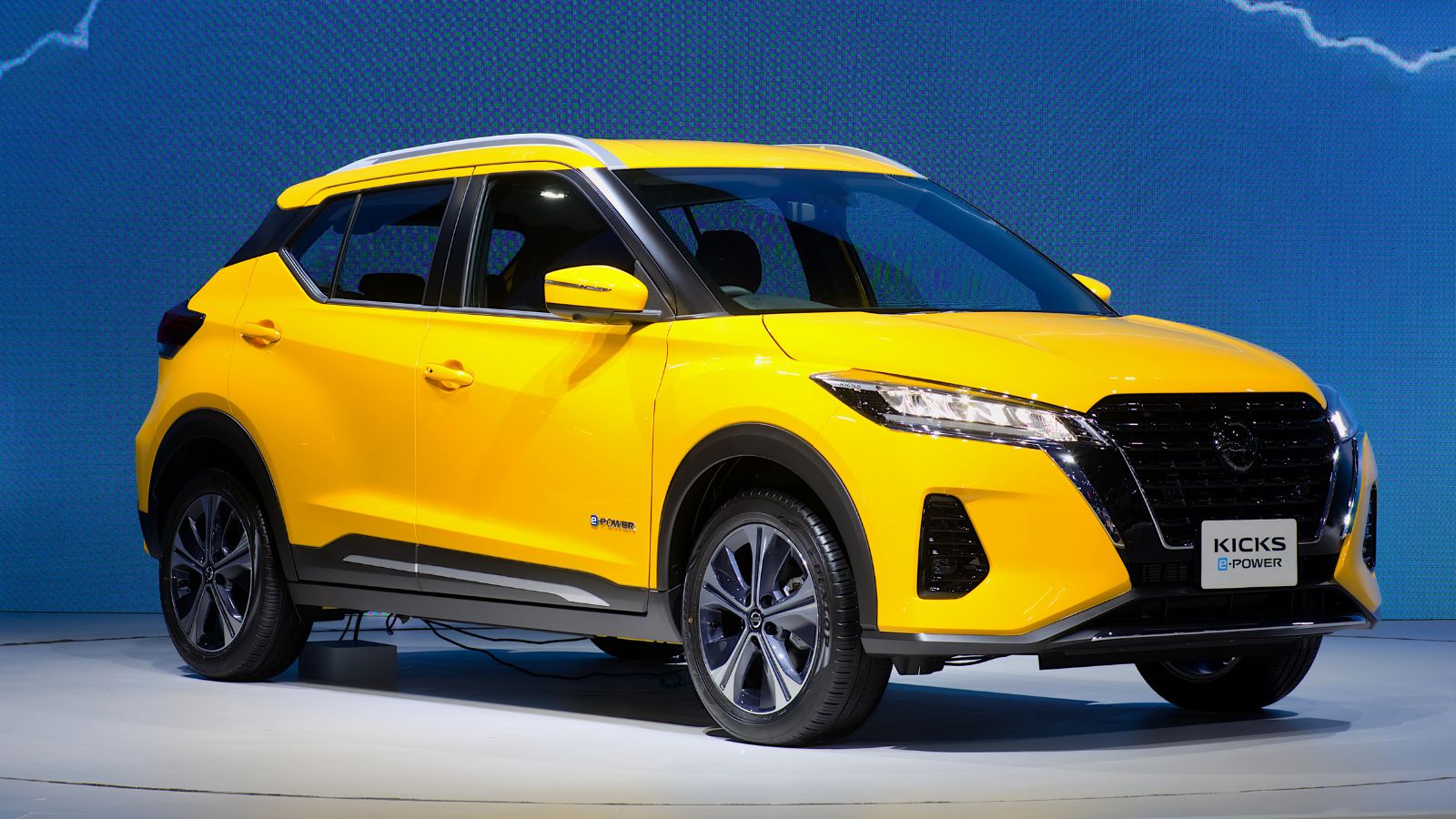
Nissan’s electrification strategy in North America is suddenly moving beyond full EVs. Nissan Americas Chairman Christian Meunier says the company plans to bring the smaller Kicks e-POWER hybrid to Canada and the United States “as soon as possible,” giving Canadian buyers their clearest indication yet that the technology will move beyond the upcoming Rogue Hybrid.
The timing matters. Nissan is preparing to put its third-generation e-POWER system into U.S. showrooms with the 2027 Rogue Hybrid beginning in November, while Canadian Rogue Hybrid deliveries are expected in late fall. With conventional hybrid registrations rising sharply in Canada, the Kicks could eventually give Nissan an electrified option in a smaller and more affordable crossover segment. What remains missing, however, is a firm Canadian launch date, price or final specification for the Kicks e-POWER.
Nissan Has Put Canada on the Kicks e-POWER Road Map
The biggest development is not simply that Nissan is considering another hybrid. Meunier told reporters in Japan that Nissan plans to bring the Kicks e-POWER to both Canada and the United States “as soon as possible.” That wording goes further than the cautious language Nissan Canada was using only days earlier. On September 17, the company’s Canadian communications team said it was continually exploring opportunities to expand its portfolio and evaluating technologies that could match the needs of Canadian customers.
The newer statement still falls short of an on-sale announcement. Nissan has not attached a model year, production start, Canadian arrival window or reservation date to the Kicks e-POWER. Still, putting Canada alongside the United States in an explicit product plan is significant. Nissan is no longer merely discussing whether the technology might make sense here. The question has shifted toward when the smaller e-POWER crossover can be incorporated into the North American rollout and what version Canadian dealers will ultimately receive.
Rogue Will Give North America Its First Big e-POWER Test
Before the Kicks arrives, Nissan will find out how North American shoppers respond to e-POWER through the Rogue. Nissan’s U.S. consumer site lists the 2027 Rogue Hybrid as expected in November 2026, initially with limited quantities of the SR with Technology Package. Additional trims are scheduled to follow in January 2027. Nissan says the SR AWD is expected to return 40 mpg in city driving, an important figure in a segment where fuel economy has become an increasingly prominent selling point.
The Rogue also gives Nissan a much larger customer base on which to introduce an unfamiliar hybrid layout. Rather than asking buyers to understand e-POWER first through a niche vehicle, Nissan is putting the technology into one of its core crossovers. Meunier said Nissan wants hybrids to account for 30% to 40% of U.S. C-segment midsize vehicle sales “very quickly.” That is an ambitious target, making the Rogue launch more than another trim addition. It is effectively the opening test for Nissan’s broader North American hybrid strategy.
Canadian Rogue Buyers Will Not Be Far Behind
Canada is also scheduled to receive the 2027 Rogue Hybrid before the end of 2026. Nissan Canada currently describes its arrival as “late Fall 2026,” placing the Canadian rollout close to the initial U.S. launch rather than months or years behind it. The Canadian model is advertised with an estimated city consumption figure of up to 5.9 L/100 km, and every trim is expected to use a dual-motor all-wheel-drive configuration.
That Canadian launch could make the Rogue an important bridge to the eventual Kicks e-POWER. Dealers will have an opportunity to explain a hybrid system that behaves differently from many familiar gasoline-electric vehicles, while buyers will get direct exposure to the technology before it spreads farther down Nissan’s lineup. Nissan Canada says the Rogue uses the third generation of e-POWER and combines electric-motor propulsion with conventional gasoline refuelling. If the system gains traction through winter driving, commuting and family use, Nissan will have a much stronger foundation for introducing a smaller e-POWER crossover.
e-POWER Works Differently From Many Familiar Hybrids
The name can create confusion because e-POWER is neither a battery-electric vehicle nor a plug-in hybrid. In Nissan’s system, the wheels are driven directly by electric motors. The gasoline engine is used to generate electricity for the battery and motors instead of being mechanically connected to the wheels through a conventional transmission. Drivers still stop at a gas station, and Nissan says there is no charging plug to connect at home or on the road.
That layout is designed to reproduce some of the characteristics people associate with an EV without requiring them to change their refuelling routine. Electric motors can provide immediate torque when the vehicle pulls away, while regenerative braking captures energy that can be stored in the battery. Nissan says the gasoline engine tends to operate less frequently in lower-speed city and suburban conditions, then runs more often during sustained highway driving or heavier loads. In practical terms, e-POWER attempts to put an electric driving experience between the traditional hybrid and full-electric worlds.
Third-Generation e-POWER Was Developed With North America in Mind
The Rogue is particularly important because Nissan says its third-generation e-POWER system has been tuned for North American driving environments. The system uses two electric motors to propel the vehicle, and Nissan describes the gasoline engine as being connected to a generator rather than a transmission. That distinction allows the company to calibrate engine operation around electricity generation instead of making engine speed directly mirror what the wheels are doing.
North American conditions also create demands that are different from those in some of the urban markets where e-POWER first became established. Long highway journeys, colder winters, sustained higher speeds and widespread demand for all-wheel drive all influence how a hybrid system has to perform. Nissan has made dual-motor AWD standard across the Canadian Rogue Hybrid range. None of that confirms the Canadian Kicks will receive precisely the same hardware or all-wheel-drive arrangement, but the Rogue demonstrates that Nissan has already completed much of the engineering work needed to adapt its newest e-POWER technology for this continent.
A Hybrid Kicks Would Change Nissan’s Entry-Level Crossover Offering
The current Canadian Kicks is a conventional gasoline vehicle. For the 2026 model year, Nissan Canada lists a starting MSRP of CA$27,198 before applicable selling-price additions and offers S, SV and SR grades. Its naturally aspirated 2.0-litre four-cylinder produces 141 horsepower and 140 lb-ft of torque, with front-wheel drive or available all-wheel drive depending on configuration. Natural Resources Canada estimates cited by Nissan put combined consumption at 7.4 L/100 km for front-wheel-drive versions and 7.8 L/100 km for AWD models.
An e-POWER version would therefore represent more than a minor engine option. Electric motors would become responsible for driving the wheels, fundamentally changing how the Kicks accelerates and delivers power. For a shopper using a small crossover primarily for commuting, school runs or stop-and-go urban traffic, that could make the Kicks feel considerably different without creating a need for home charging. Nissan has not released Canadian e-POWER fuel-consumption, horsepower, pricing or drivetrain figures, so direct comparisons with the existing Kicks would still be premature.
Canada’s Hybrid Market Is Expanding at the Right Time
Nissan’s timing coincides with a noticeable change in Canadian vehicle registrations. Statistics Canada reported that registrations of conventional hybrid-electric vehicles increased 39.5% year over year during the second quarter of 2026. That was the largest percentage increase among the fuel types identified in the agency’s quarterly release, narrowly ahead of the 37.4% increase for battery-electric vehicles. Overall, Canadians registered 547,673 new motor vehicles during the quarter, the highest second-quarter level since 2019.
Those figures do not guarantee success for any individual Nissan model, but they show that hybrids are gaining buyers quickly. The distinction is especially relevant for e-POWER because the system does not need to be plugged in. Statistics Canada separately classifies battery-electric and plug-in hybrid vehicles as zero-emission vehicles, while conventional hybrids sit in their own category. For households interested in reducing fuel use but unwilling or unable to depend on charging infrastructure, vehicles that retain gasoline refuelling while adding electrified propulsion represent a different path into electrification.
Kicks e-POWER Is Becoming a Global Product
Canada would not be an isolated experiment for the electrified Kicks. Nissan announced in September that the Kicks e-POWER is also coming to Europe using third-generation e-POWER technology. The automaker plans to invest £170 million to manufacture the crossover at its Sunderland plant in the United Kingdom, where it will be built alongside other Nissan models. The European announcement follows the Kicks’ expansion into other international markets and makes e-POWER increasingly central to the model’s global identity.
That broader rollout matters because Nissan has substantial experience with the powertrain itself. Meunier said the company has already sold more than two million e-POWER vehicles globally, even though the technology has not previously been offered in the United States. Nissan has been selling earlier generations of the system internationally since 2016. North America is therefore receiving a mature concept rather than serving as the initial proving ground. What is new is Nissan’s attempt to adapt that concept for vehicles, driving patterns and customer expectations on this side of the Atlantic.
Nissan’s Hybrid Expansion Is Tied to a Bigger North American Strategy
The Kicks and Rogue announcements come as Nissan is also reconsidering where its North American vehicles are built. Meunier said the company is targeting 80% localization of U.S. manufacturing by the end of 2030, compared with roughly 65% currently and about 40% before new U.S. tariffs were imposed in early 2025. Nissan is also considering U.S. production of the Rogue e-POWER as early as 2028.
That does not mean a Canadian Kicks e-POWER has a confirmed North American production site. Nissan has not announced where the version planned for Canada would be assembled, and the company should not be assumed to use the same sourcing strategy in every market. What the broader plan shows is that electrification, manufacturing and trade policy are increasingly connected. Automakers launching hybrids across Canada and the United States now have to consider not only consumer demand and fuel economy, but also tariff exposure, component sourcing and the cost of moving vehicles across increasingly complicated international supply chains.
“As Soon as Possible” Still Leaves Several Important Questions
For Canadian consumers, the latest statement is encouraging but deliberately incomplete. Nissan has not announced the Kicks e-POWER’s Canadian model year, price, official fuel-economy rating, horsepower, trim structure, production location or dealer-arrival date. It has also not confirmed whether Canada will receive exactly the same third-generation configuration announced for Europe or how all-wheel drive would fit into the Canadian range. Until those details arrive, comparisons with established hybrid subcompact crossovers remain speculative.
The wording is nevertheless a notable change from where Nissan Canada stood earlier in September. The company had previously said it was evaluating future opportunities without confirming the Kicks e-POWER for the country. Meunier’s subsequent statement places Canada directly in Nissan’s intended rollout. In the meantime, the 2027 Rogue Hybrid will provide the first indication of how Canadians respond to e-POWER in everyday use. If Nissan can translate that technology into a smaller Kicks at a competitive price, its Canadian hybrid lineup could look considerably different in a relatively short period.