
























The latest oil shock is beginning to reshape the economics of the global auto market. Disrupted Middle Eastern supplies, volatile crude prices and unusually expensive refined fuels are making gasoline and diesel vehicles more costly to operate just as electric models become more affordable in a growing number of markets.
The shift is far from uniform. Electric-vehicle demand remains weak in the United States, while Europe, emerging Asian economies and parts of Latin America are showing considerably stronger momentum. That divergence creates another problem: if high fuel prices accelerate electrification faster than expected, the pressure may simply migrate from oil markets to lithium, copper, batteries, grids and the mines needed to supply them.
The Oil Crisis Is Changing the EV Calculation
The latest energy shock has given consumers a reason to think about electric vehicles that has little to do with climate targets. Gulf oil flows have remained heavily disrupted by the Middle East conflict, while diesel, gasoline and jet-fuel markets have struggled with depleted inventories and refinery constraints. The International Energy Agency estimated that oil movements through the Strait of Hormuz averaged just 7.6 million barrels per day in August, about 13.1 million barrels per day below pre-war levels.
That matters enormously for transportation because road vehicles consume close to half of the world’s oil. A household comparing vehicles may still care about sticker price, driving range and charging access, but a sustained increase in fuel costs changes the monthly calculation. The IEA estimates that higher oil prices earlier in 2026 increased the running-cost advantage of battery-electric cars by roughly 20% to 45% in many countries when home charging is available. The longer elevated fuel costs persist, the harder that economic signal becomes for car buyers to ignore.
Europe and Emerging Markets Are Carrying the Growth
Headline global EV numbers can make the market look much weaker than it actually is. Benchmark Mineral Intelligence reported 13.4 million electric-vehicle sales worldwide through August 2026, only 4% higher than a year earlier. Beneath that modest increase, however, the regional split is dramatic. European EV sales were up 29% year-to-date, with August alone running 36% above the same month in 2025.
Official European industry figures tell a similar story. Battery-electric cars captured 20.7% of European Union registrations during the first half of 2026, compared with 15.6% one year earlier. Growth is spreading beyond the traditional EV strongholds as well. The IEA found that second-quarter electric-car sales reached records in 50 countries. In Australia, Brazil, India, South Korea and Vietnam, sales roughly doubled between March and June compared with the same period in 2025. For increasingly fuel-sensitive households, electrification is becoming less of a niche technology decision and more of a practical hedge against another trip to an expensive petrol station.
The United States Is Moving in the Opposite Direction
North America is currently the major exception to the acceleration. Benchmark reported that regional EV sales were down 21% through August, with the weakness driven predominantly by the United States. August sales were 33% below their year-earlier level, although that comparison was unusually difficult because American consumers had rushed to complete purchases during the same period of 2025 before federal EV incentives expired.
The result is an increasingly unusual global auto market. Europe is expanding, emerging markets are absorbing cheaper electric models, and Chinese manufacturers are pushing aggressively overseas, while the American market has lost much of its previous momentum. That does not mean U.S. electrification has ended; month-to-month sales showed some improvement during the summer. But it does mean an oil shock that strengthens EV economics can produce very different results depending on vehicle prices, incentives, charging availability and existing market structure. A worldwide technology transition is no longer moving at anything close to a single speed.
Chinese EV Exports Are Amplifying the Fuel-Price Effect
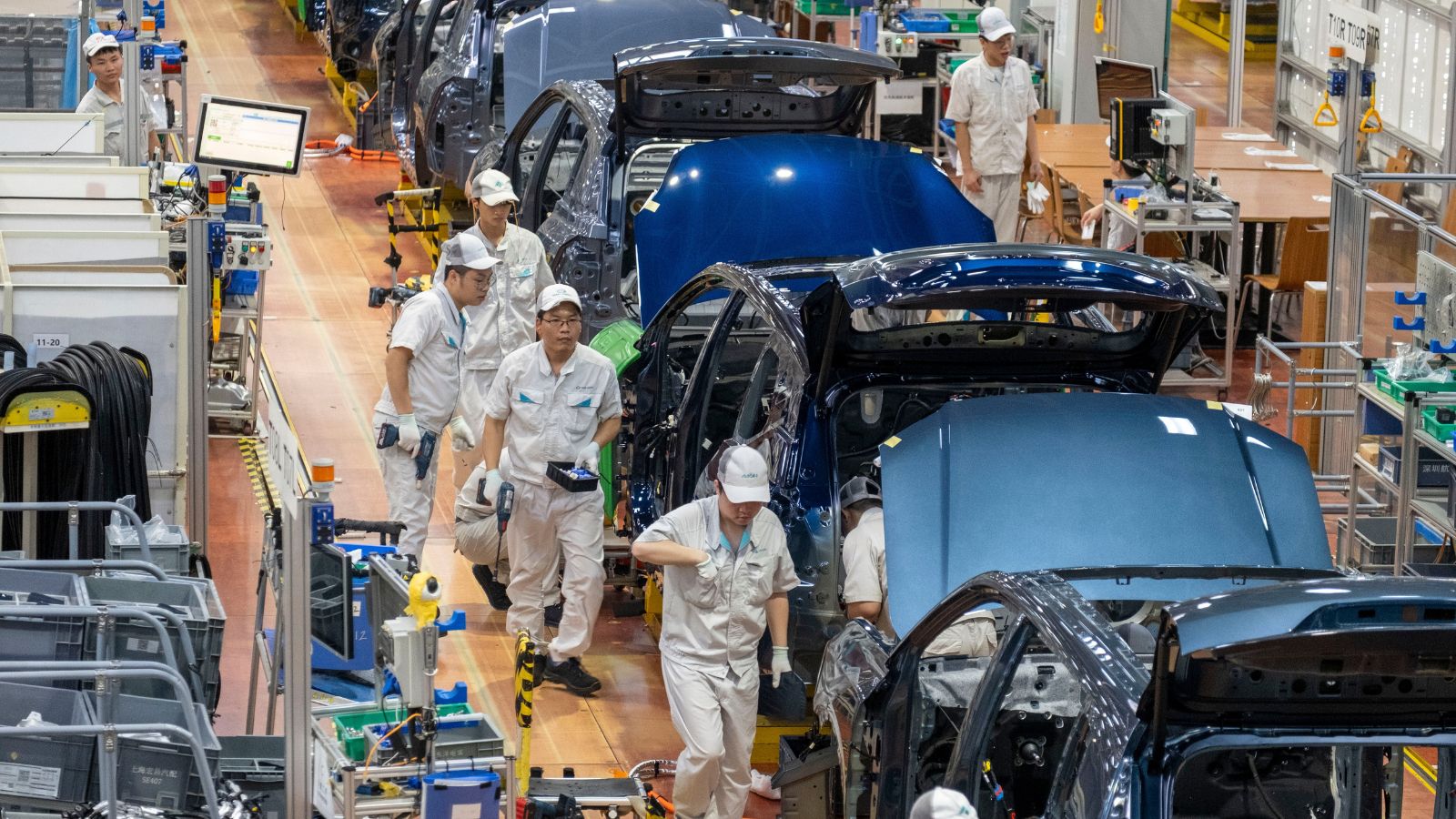
High gasoline prices would matter less if electric alternatives remained significantly more expensive. China’s enormous EV manufacturing base is helping change that equation. The IEA estimates Chinese electric-car exports more than doubled during the first half of 2026, rising more than 120% from the previous year. By August, Benchmark said Chinese new-energy-vehicle exports had reached roughly 518,000 units for the month, more than 150% higher than a year earlier.
Those cars are increasingly heading toward markets outside the United States. In 2025, Chinese imports supplied 55% of electric-car sales in countries outside Europe and the U.S., according to the IEA. Southeast Asia, Latin America and the Middle East have become especially important destinations. The combination can be powerful: expensive imported oil increases the cost of conventional driving just as large-scale Chinese production puts more competitively priced EVs into showrooms. For an urban household in Brazil, Thailand or another fuel-importing market, that can turn an EV from an environmental premium product into a straightforward household-cost decision.
Fuel Savings Are Becoming Harder to Dismiss
Purchase price remains one of the biggest barriers to electric-car adoption, but running costs can change the picture substantially once fuel prices rise. Using April 2026 energy prices and assuming home charging, the IEA calculated that the annual operating-cost advantage of an EV over a gasoline vehicle increased substantially across most of the countries it examined. In the United States, estimated annual savings rose from roughly $900 to about $1,300. In the European Union, the fuel-cost advantage was about 35% larger than it had been in 2025.
The impact can be greater for taxis, delivery operators and company fleets because their vehicles travel many more kilometres every year. That creates a feedback mechanism that previous EV adoption forecasts may not fully capture. Higher oil prices raise the cost of driving; more attractive operating economics encourage electric purchases; larger sales volumes can then lower manufacturing costs and expand charging networks. The effect is unlikely to happen overnight, because vehicle orders and deliveries take time, but persistent energy insecurity could make the transition noticeably faster.
Lithium Demand Could Tighten Again After Years of Oversupply
The lithium market is in an awkward position. Producers spent much of the last few years dealing with excessive supply and sharply lower prices, yet underlying battery demand has continued to expand. The IEA says global battery demand grew by more than 35% in 2025 to above 1.5 terawatt-hours, while lithium demand increased by roughly 25% annually on average during the previous two years. Battery storage systems are adding another major source of consumption alongside electric vehicles.
Prices remain volatile rather than uniformly bullish. Mid-September data from InfoLink showed battery-grade lithium carbonate in China falling to an average of about RMB130,000 per metric ton, while spodumene concentrate averaged roughly $1,850 per ton. That near-term softness does not eliminate the longer-term challenge. Wood Mackenzie’s accelerated “electric shock” scenario estimates that faster EV adoption could raise lithium requirements by about 14% above its baseline by 2040. A market that currently appears reasonably supplied could therefore tighten surprisingly quickly if vehicle demand, grid batteries and energy-storage projects all accelerate together.
Copper May Be the More Difficult Bottleneck
Copper presents an even more complicated problem because electric vehicles are competing with power grids, renewable projects, conventional construction and rapidly expanding data-centre infrastructure for the same metal. The IEA’s 2026 critical-minerals outlook projects that announced mining projects could still leave copper supply roughly 25% short of requirements by 2035 under its stated-policies scenario. Copper is also expected to post the largest absolute increase in mineral demand through 2040.
The market is already sensitive to disruptions. Copper prices moved into record territory in early September amid tight mine supply, inventory shifts and uncertainty around U.S. trade measures. Wood Mackenzie estimates that under a much faster EV-adoption scenario, annual additions to copper mine capacity would have to rise from a long-term average of roughly 850,000 tonnes to about 960,000 tonnes through 2040. The difference does not look enormous on paper. In mining, however, adding even a few hundred thousand tonnes consistently means finding deposits, securing permits, financing multibillion-dollar projects and waiting years for new production.
The Next Energy Security Problem Could Be About Metals, Not Oil
Electric vehicles reduce exposure to gasoline and diesel, but they do not make resource dependence disappear. They shift part of it toward electricity systems, battery materials and industrial supply chains. The IEA says processing remains highly concentrated: excluding rare earths, the leading refining country accounted for an average 72% of refined supply across major critical minerals in 2025. China also produced about 70% of the world’s electric cars and more than 80% of battery cells that year.
That is why the oil shock carries consequences far beyond auto dealerships. Wood Mackenzie estimates that supporting an EV fleet 50% larger than its baseline by 2040 could require around $45 billion of additional greenfield metals investment over the next decade, including roughly $25 billion for copper supply. The infrastructure challenge extends to charging stations and power grids as well. The emerging lesson is uncomfortable but important: replacing oil dependence requires investment before the next shortage arrives. If EV adoption accelerates while mining, refining and electricity infrastructure lag behind, today’s fuel shock could eventually be replaced by a very different materials shock.