





















Genesis has turned its biggest electric-vehicle ambitions into a production flagship. Unveiled in San Francisco, the new GV90 is a full-size electric luxury SUV designed to move the Korean brand into territory occupied by vehicles such as the Cadillac Escalade IQ. It brings serious numbers to that fight: 657 horsepower, a 123.5-kWh battery and an estimated 310 miles of range for the seven-seat version.
Yet the GV90 is not trying to win purely through battery size or maximum driving range. Genesis is pairing its electric hardware with unusual luxury features, including available coach-style doors, swivelling front seats, a heated wood floor and an expansive digital cabin. Its claimed 10-to-80-percent charging time of 22 minutes may be especially important as large luxury EVs become increasingly capable—and increasingly difficult to distinguish.
Genesis Finally Has a Full-Size Flagship SUV
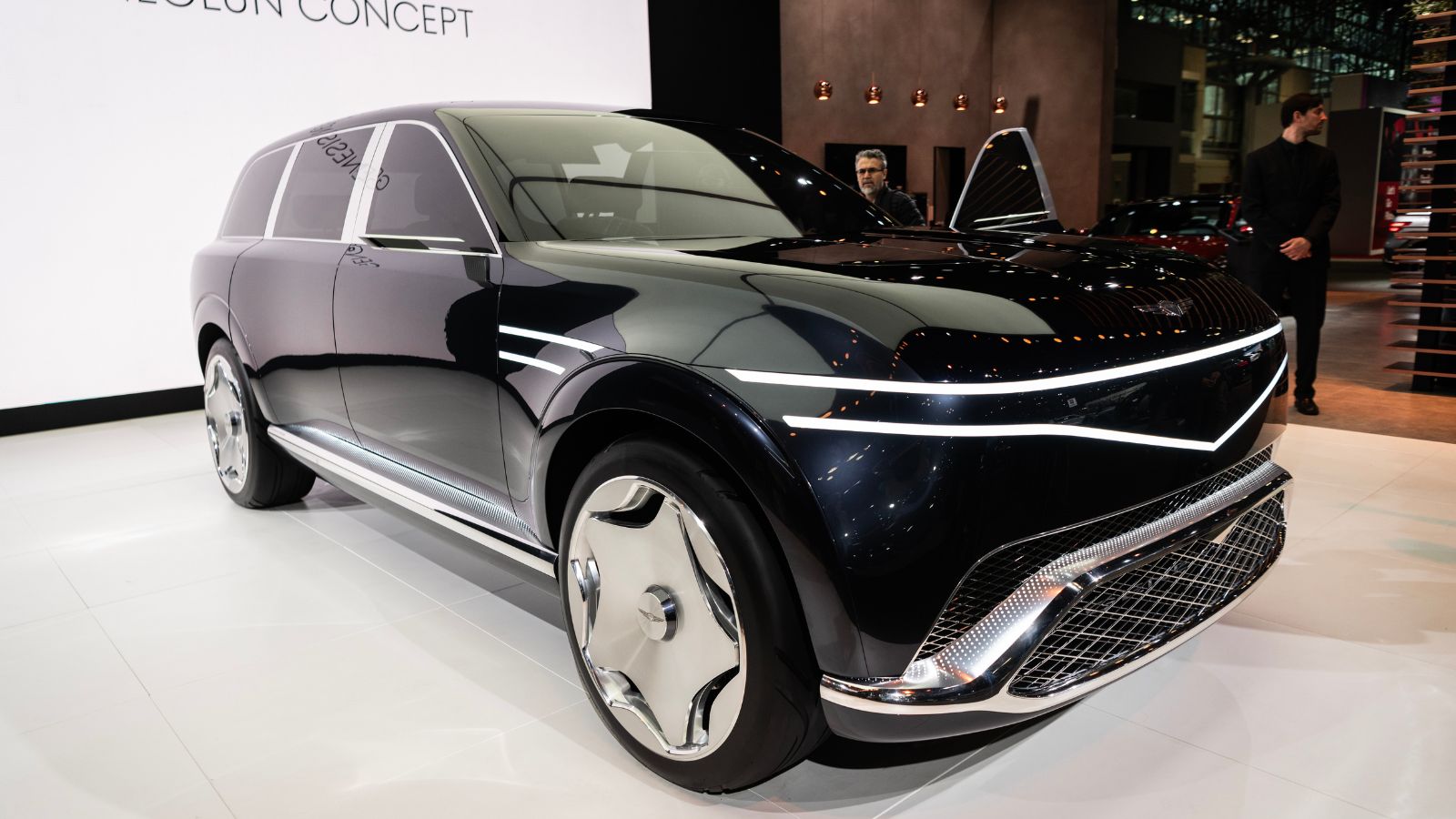
The GV90 represents a significant step beyond the existing GV80. Genesis describes it as its first full-size flagship SUV, and the production vehicle closely follows the Neolun concept introduced in 2024. The company formally unveiled the GV90 at San Francisco’s Palace of Fine Arts on August 19, 2026. At 208.1 inches long with a 127.8-inch wheelbase, it has the dimensions expected of a large three-row luxury vehicle without stretching quite as far as some American rivals.
Genesis is dividing the range into two distinct personalities. The regular GV90 uses conventional doors and offers the more familiar luxury-SUV experience, while the GV90 Neolun is intended to push considerably further upmarket. That strategy allows Genesis to chase traditional premium SUV buyers while also creating an attention-grabbing halo model. For a luxury marque that only became a standalone brand roughly a decade ago, the GV90 is meant to demonstrate how far its ambitions have expanded.
Its 657 Horsepower Gives Genesis Serious Performance Credentials
Two electric motors provide the GV90 with a combined maximum output of 657 horsepower and 590 lb-ft of torque. Genesis lists 322 horsepower from the front motor and 335 horsepower from the rear. That makes the GV90 the most powerful Hyundai Motor Group EV announced with this particular flagship system and gives a vehicle focused heavily on passenger comfort enough muscle to compete in a segment where enormous power figures have become almost routine.
The chassis technology suggests Genesis does not want that output to feel unwieldy. Electronic limited-slip differentials are fitted at both ends, helping distribute power according to available grip. Multi-chamber air suspension can alter spring characteristics and ride height, while electronically controlled dampers adjust their response. Rear-wheel steering can turn the rear wheels by as much as five degrees. Around town, that should help a large SUV negotiate tighter spaces; at higher speeds, Genesis says the system is intended to improve stability.
The 22-Minute Charging Claim Is One of the Bigger Headlines
A 123.5-kWh high-voltage battery sits underneath the GV90, making it the largest battery Genesis says Hyundai Motor Group has installed in an EV so far. For the seven-passenger model, the company is targeting approximately 310 miles—about 499 kilometres—of range based on its internal research and development testing. That figure should not be treated as a final EPA rating, but it places the GV90 comfortably beyond the psychological 300-mile threshold many luxury-EV shoppers consider important.
Charging could be an equally important part of the story. Genesis says a sufficiently powerful 350-kW DC fast charger can take the battery from 10 to 80 percent in 22 minutes. That is an impressive claim for such a large battery, although real charging sessions will depend on battery temperature, charger output and other conditions. Genesis has some credibility here: earlier Hyundai Motor Group EVs have performed strongly in independent fast-charging tests, including previous Genesis models.
The Escalade IQ Still Has the Bigger Numbers in Several Areas
Calling the GV90 an Escalade IQ rival does not mean the two vehicles are identical on paper. Cadillac currently rates the 2026 Escalade IQ at 750 horsepower and 785 lb-ft of torque when Velocity Max is engaged. Its 205-kWh battery is dramatically larger than the Genesis pack, and Cadillac estimates 465 miles of driving range. The Escalade IQ can also accept up to 350 kW at a public DC charger, with Cadillac claiming as much as 117 miles of additional range in roughly 10 minutes.
The Cadillac is physically larger as well. It measures 224.3 inches long, compared with the GV90’s 208.1 inches, and rides on a 136.2-inch wheelbase versus 127.8 inches for the Genesis. That difference helps explain why the Cadillac can package such an enormous battery and substantial passenger space. Genesis therefore appears to be challenging the Escalade IQ less through outright size and range than through faster-looking charging numbers, distinctive design and an unusually elaborate rear-seat experience.
The Neolun’s Coach Doors Turn a Concept-Car Idea Into Reality
Perhaps the GV90’s most dramatic feature is not located under the floor at all. The GV90 Neolun uses opposing front and rear doors without a conventional fixed B-pillar between them. Genesis calls the setup the Neolun Arch Gate. Unlike a simple rear-hinged door, the rear door uses a newly developed mechanism that first moves it outward before rotating open, allowing the front and rear doors to operate independently while creating an unusually broad opening when both are extended.
Removing a traditional pillar naturally creates structural challenges, so Genesis has devoted considerable engineering attention to the surrounding body. The company says high-strength dual steel beams help replace the structural role normally played by the B-pillar. A concealed reinforced structure around the passenger compartment uses integrated high-strength steel tubes and structural foam. The Neolun is therefore intended to deliver the theatrical arrival associated with ultra-luxury automobiles without turning its dramatic doorway into merely a show-car feature.
Rear Passengers Get Some of the GV90’s Wildest Luxury Features
The four-seat GV90 Neolun Executive Suite makes clear where Genesis believes modern flagship luxury is heading. When the vehicle is parked, its front seats can rotate a full 180 degrees, creating a face-to-face seating arrangement. The second row can be separated from the cargo area by a comfort partition, while privacy blinds and an available roof with individually controllable transparency zones can make the rear compartment feel much more secluded than a conventional family SUV.
Then there is the floor. Genesis uses real wood veneer with a radiant heating system inspired by traditional Korean ondol underfloor heating. A refrigerator, integrated tables and semi-aniline leather seating add to the executive-lounge atmosphere. These details matter because raw horsepower is becoming relatively easy for expensive electric vehicles to deliver. Creating a memorable luxury experience is harder. Genesis is effectively betting that some customers will remember a heated wooden floor and disappearing B-pillar longer than another increment in acceleration.
The Dashboard Is Just as Unconventional as the Rear Cabin
Technology dominates the front of the GV90, but Genesis has taken several unusual approaches to how that technology appears. A 23.6-inch OLED display handles instrumentation, navigation and entertainment during normal use. When the vehicle is parked, part of the screen rises by 90 millimetres, creating what Genesis describes as a 24.6-inch cinematic display. Instead of relying solely on a conventional instrument panel directly in front of the driver, the GV90 also projects key information through a large 25-inch head-up display.
Genesis has even eliminated the traditional start button. Opening the vehicle begins a choreographed process involving the powered doors, column-mounted shifter and rotating Crystal Sphere controller, while pressing the brake prepares the vehicle to drive. The Pleos Connect infotainment environment runs on Android Automotive and supports downloadable applications, while Genesis is integrating a generative-AI assistant called Gleo AI. A 25-speaker Bang & Olufsen Premier 3D audio system with Dolby Atmos further reinforces the flagship positioning.
Pricing Could Decide How Dangerous the GV90 Is to Cadillac
One of the most important GV90 specifications remains missing: its North American price. Genesis had not announced U.S. pricing alongside the August 19 reveal, saying details would come closer to sales. That leaves considerable room for speculation because the Escalade IQ already occupies a very expensive part of the market. Cadillac lists the 2026 Escalade IQ from US$127,405, with higher trims moving substantially beyond that amount.
Genesis has historically used generous equipment and aggressive positioning to establish itself against older luxury marques, but the Neolun’s complicated doors, enormous battery, advanced suspension and executive-cabin hardware give the company plenty of reasons to charge flagship money. The brand is also arriving with a growing North American footprint: Genesis says it has more than 190 independent U.S. retailers and more than 30 Canadian agency distributors. In Canada specifically, Genesis recorded 805 sales in July 2026, its strongest July yet. The GV90 now gives that expanding network a genuine halo SUV to sell.