

























A security feature designed to let police officers leave a Chevrolet Silverado running without making it easy to steal is getting a software correction from Generae Pursuit Vehicles can, under specific circumstances, be shifted out of Park without the key fob inside while the truck is operating in Protected Idle mode.
That matters because Protected Idle exists specifically for situations in which an officer needs to step away while keeping the engine, climate control and electrical equipment operating. GM has responded with Service Update N252519860, which calls for new body-control-module software. Eligible vehicles can receive the programming remotely, while others can be updated through a GM dealer. The campaign illustrates how a seemingly small software issue can undermine a feature built around a very practical law-enforcement need.
The Problem Undercut the Point of Protected Idle
GM’s July 28, 2026 service update describes the problem in straightforward terms: certain affected vehicles may be able to shift out of Park without a key fob inside while Protected Idle is operating. The campaign covers selected Silverado 1500 vehicles from the 2023 through 2026 model years, with dealers instructed to use GM’s vehicle-history system to determine whether an individual VIN is included. Recent reporting on the campaign identifies the affected application as the Silverado Police Pursuit Vehicle, or PPV, which is equipped with the police-specific idle-protection feature.
The security implication is easy to understand. An officer might leave a running truck to handle a collision scene, assist another officer or work outside the vehicle while onboard equipment remains powered. Protected Idle is supposed to make that possible without leaving a driveable truck behind. If the transmission can instead be moved out of Park without the authorized fob inside, an important layer of protection disappears. GM’s campaign therefore targets the electronic controls governing the feature rather than the engine or transmission hardware itself.
Protected Idle Was Designed for Exactly This Situation
Protected Idle is not simply a convenience that allows a Silverado to warm up on a cold morning. Chevrolet developed it as a police-specific security feature. When the Silverado PPV entered service, police-industry coverage described the system as allowing the engine, heating or air conditioning and installed equipment to remain operational while preventing someone without authorization from climbing into the unattended truck and driving away. Officers can activate the feature as they leave the vehicle, making it particularly useful during calls that require frequent movement between the cab and the scene.
That arrangement reflects an unusual reality of emergency vehicles. A civilian driver normally switches off and locks a vehicle after parking. Police vehicles may instead be expected to remain operational while their driver is several metres away, with radios, computers, warning equipment and climate systems still needed. Chevrolet incorporated remote keyless entry and push-button starting into the Silverado PPV while offering Protected Idle as an additional security layer. The new service action matters precisely because the affected condition compromises that carefully designed separation between keeping a truck running and allowing it to be driven.
The Silverado PPV Has Been on Patrol Since the 2023 Model Year
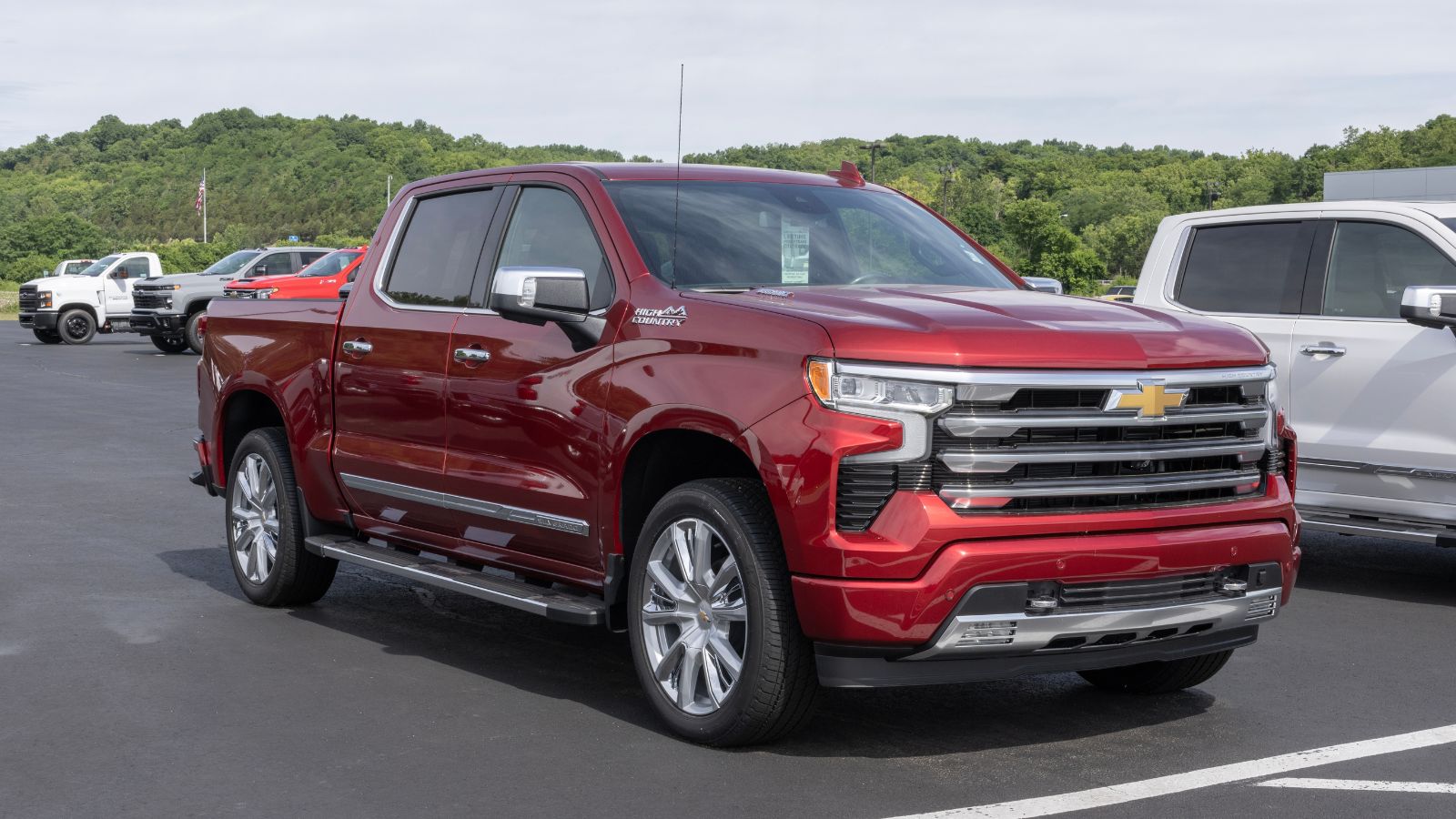
Chevrolet announced the Silverado PPV in March 2022 as its first pursuit-rated Silverado, with availability beginning later that year in both the United States and Canada for the 2023 model year. The truck was conceived as something more versatile than a conventional patrol car: a crew-cab, short-bed, four-wheel-drive pickup capable of pursuit work while also hauling equipment, towing trailers and operating on rough terrain. That combination helped give police agencies another option alongside Chevrolet’s long-running Tahoe PPV.
Underneath the police equipment is substantial truck hardware. Chevrolet launched the PPV with a 5.3-litre V8 producing 355 horsepower, a 10-speed automatic transmission and large front Brembo brakes using 16-inch rotors. Its maximum advertised towing capacity was 9,300 pounds. GM’s current police-fleet lineup continues to list the 2026 Silverado 1500 PPV, including the heavy-duty Brembo braking hardware and an available two-inch factory suspension lift that retains its pursuit rating. The service campaign consequently reaches across virtually the entire lifespan of the Silverado PPV so far, from its introductory model year through the current 2026 version.
GM Can Fix It Without Replacing Any Hardware
The repair is unusually straightforward for a problem with potentially serious security consequences. GM’s bulletin states that no replacement parts are required. Instead, technicians reprogram the Body Control Module, or BCM, with updated software. That module participates in the operation of numerous electronically controlled vehicle functions, making revised programming enough to correct the Protected Idle behaviour identified by the company.
Some fleet operators may not even need to schedule a workshop visit. GM says vehicles whose owners have accepted the applicable connected-vehicle terms can be offered the software wirelessly through an over-the-air update. A dealer can perform the same programming for vehicles that do not receive it remotely. The bulletin lists 0.5 hour of labour for BCM reprogramming and 0.2 hour when a technician verifies that the required software or calibration level is already present. This is a useful example of how modern fleet-vehicle fixes increasingly resemble computer maintenance: the physical truck may be mechanically sound, yet a new software calibration can materially change how one of its security systems behaves.
Police Vehicles Have Good Reasons to Stay Running
The feature at the centre of the campaign exists because idling can be a significant part of police work. U.S. Department of Energy material on idle reduction has documented how patrol vehicles can spend long periods stationary while officers handle incidents, complete paperwork or wait for calls. One study cited by the department found a police cruiser idled during roughly 60% of normal operation and consumed about 21% of its fuel while stationary. Those figures come from an older study and should not be treated as representative of every modern police fleet, but they illustrate why idle management has received so much attention.
Chevrolet designed the Silverado PPV around those electrical demands. The original specification included a 220-amp alternator and two 120-volt power outlets intended to support equipment away from the station. Similar requirements explain why police fleets have experimented with systems that reduce engine idling without cutting power to lights, radios and computers. In a Burlington, Vermont pilot highlighted by the U.S. Department of Energy, an idle-management system reduced operating hours and was estimated to save hundreds of gallons of fuel per vehicle annually. Protected Idle approaches the problem from the security side: when idling remains necessary, the running vehicle still needs to stay under the officer’s control.
The Campaign Should Not Be Mistaken for Evidence of a Theft Wave
The wording around this issue deserves care. GM’s service bulletin says the affected vehicles may shift out of Park without the key fob while Protected Idle is active. The document does not identify a series of stolen Silverado PPVs, nor does it list crashes, injuries or confirmed thefts resulting from the condition. Calling the trucks vulnerable to being driven away accurately describes the potential consequence of the malfunction; claiming that police departments have already experienced widespread thefts would go beyond the information GM has released.
There is another important distinction. Service Update N252519860 is a manufacturer service campaign rather than a conventional federal safety recall. NHTSA maintains manufacturer communications and technical service bulletins alongside recall information, but the categories are not interchangeable. Federal safety recalls involve defects or noncompliance determined to have motor-vehicle-safety implications and carry specific notification and remedy requirements. Manufacturer communications can also address product improvements, malfunctions or other deviations that are not classified as safety recalls. In this case, GM’s campaign documentation identifies the action as a service update and provides a targeted software remedy for affected VINs.
Dealers Have Stricter Instructions for Trucks Still in Inventory
GM’s instructions draw a notable distinction between affected Silverados already operating in fleets and vehicles still controlled by dealers. Dealers are told to check GM’s Investigate Vehicle History system before beginning work because the campaign applies only to designated VINs with an open status. If an eligible truck successfully receives the correction over the air, its status can close electronically, helping prevent unnecessary duplicate programming when it subsequently reaches a service department.
Affected dealer inventory faces tighter restrictions. GM says applicable new, used, certified pre-owned, courtesy, shuttle and other dealer-controlled vehicles must be repaired before being sold or released. The bulletin says they should not be delivered, dealer-traded, auctioned or used for demonstration before completion of the remedy. For customer vehicles already in service, however, GM says the service update is generally intended to be completed when the truck returns for regular service rather than requiring every operator to make a dedicated visit. The bulletin remains active until July 31, 2028, giving dealers a defined window to complete the campaign on eligible vehicles they encounter.
A Small Software Fault Stands Out on a Heavily Engineered Police Truck
The Protected Idle issue is notable partly because of how extensively the Silverado PPV was engineered for police use. Beyond its V8 and heavy-duty brakes, Chevrolet equipped the truck with features intended to simplify emergency-service upfitting, including auxiliary wiring circuits, available spot lamps, dedicated upfitter switches and a Surveillance Mode circuit that can support specialized lighting control. Its bed, four-wheel drive and towing ability were designed to let a department use one vehicle for jobs ranging from ordinary patrol to transporting specialized equipment.
Performance testing also showed that the PPV was developed as more than a Silverado wearing emergency lights. Police Magazine’s coverage of Michigan State Police evaluations reported that the tested Silverado PPVs reached a governed 112 mph, while estimated 60-to-zero-mph stopping distances were about 140 feet for the tested variants. Those numbers help put the present campaign in perspective. Police vehicles are subjected to demanding standards for acceleration, braking, electrical capacity and durability, yet increasingly important capabilities also depend on software. GM’s Protected Idle correction is relatively simple, but it demonstrates that a few lines of vehicle-control logic can be just as operationally significant as a set of pursuit-rated brakes.