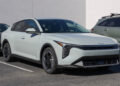



























Toronto renters are getting a new transportation option without having to visit a dealership, arrange a private parking space or install a charger. Kite Mobility and Tricon Living have begun rolling out shared electric vehicles directly inside rental communities, starting with Maple House and Birch House in the Canary District on August 18, 2026.
The partnership is expected to expand to eight Toronto rental communities between August and October, ultimately providing 15 EVs and 32 e-bikes. The idea is straightforward: make occasional access to a vehicle part of residential life while reducing some of the expenses and infrastructure associated with private car ownership. In a city where housing, parking and transportation all compete for household budgets, the experiment could show whether the next desirable apartment amenity is less about owning more and more about having convenient access when it is actually needed.
Shared Cars Are Moving Into the Apartment Amenity Mix
The first stage gives residents of Maple House and Birch House access to electric vehicles located directly where they live. Maple House will also offer shared e-bikes. Another six Tricon Living communities are scheduled to receive the service between August and October, bringing the total planned fleet across the eight properties to 15 EVs and 32 e-bikes. Instead of functioning like a conventional rental counter located elsewhere in the city, the vehicles become part of the residential environment.
That difference may sound small, but convenience is central to the concept. An urban renter who normally walks, cycles or takes transit may still occasionally need a vehicle for a large grocery run, an appointment across town or a weekend trip. Having one available at the building can fill that gap without requiring a permanent car in the garage. Kite and Tricon are effectively testing whether transportation access can sit alongside gyms, lounges and co-working spaces as a modern apartment amenity.
Canary Landing Is the Starting Point
The rollout begins at Canary Landing, where Maple House and Birch House already sit within a neighbourhood designed around several transportation choices. Tricon describes Maple House as walkable and bikeable, with transit connections and access to major roads for longer trips. Birch House is similarly close to TTC streetcar service, the Distillery Loop, bicycle routes and pedestrian-friendly streets. That makes the area a logical place to test a shared-car model intended to supplement other ways of travelling rather than replace them.
Maple House also provides a useful sense of the scale involved. Tricon has previously identified the building as containing 770 rental apartments, with 30% designated as affordable units. It forms part of the larger 12-acre Canary Landing development, planned for roughly 2,500 purpose-built rental homes. In a community that size, even a relatively small shared fleet could serve many residents if vehicles turn over efficiently throughout the day rather than remaining parked for most of their useful lives.
The Bigger Target Is the Cost of Owning a Car
The financial argument behind shared mobility is not simply that an electric vehicle uses electricity instead of gasoline. Private ownership bundles together a much wider collection of expenses. CAA’s vehicle-cost tools emphasize that the sticker price is only one element of the equation, alongside continuing operating and ownership costs. Insurance, maintenance, depreciation and financing can matter just as much as the energy required to move the vehicle.
For someone who drives every day or travels long distances, ownership may still make practical or financial sense. The calculation can look very different for an urban household that uses a car only occasionally. Recent academic work comparing car-sharing with private ownership found that the economic break-even point can fall somewhere around 5,000 to 10,000 kilometres of annual travel, although circumstances and pricing structures vary. The Toronto program is aimed squarely at that occasional-use problem: providing access to a vehicle without requiring residents to carry every fixed cost of keeping one permanently.
Insurance, Charging and Maintenance Are Rolled Into Access
One of the more significant features of the Tricon-Kite arrangement is what residents are not expected to handle individually. The companies say access to the shared EVs incorporates charging, insurance and maintenance. Those responsibilities normally remain with the owner of a private vehicle regardless of how often the car actually leaves its parking space. Folding them into a shared service changes transportation from an owned asset into something closer to an on-demand utility.
That could be particularly meaningful for renters interested in electric driving but reluctant to purchase an EV without dependable residential charging. Toronto itself identifies access to home and workplace charging as an important part of the transition to electric transportation. A shared vehicle stationed with its charging infrastructure largely sidesteps that individual problem. The building and mobility operator handle the system while residents use the vehicle when necessary. It does not eliminate every transportation expense, but it changes which costs and logistical responsibilities fall directly on the person making the trip.
Parking Costs Give Developers Another Reason to Share
The economics extend beyond residents. Underground parking can be remarkably expensive to construct in dense urban developments. The Atmospheric Fund, which invested in Kite Mobility in 2025, has estimated that underground parking in multi-family residential buildings adds an average of about $100,000 in capital costs for each stall. TAF says Kite’s model can displace demand for as many as 10 parking spaces for every shared electric vehicle, depending on how the service is used.
For developers, that turns car-sharing into more than a transportation perk. If fewer households feel compelled to own cars, future buildings may require fewer expensive spaces devoted to storing vehicles. Toronto has already moved away from traditional minimum-parking requirements for many new developments, giving builders greater flexibility in deciding how much parking a project needs. In that environment, a vehicle that can serve multiple households offers a different equation: invest in shared mobility and charging instead of automatically constructing a separate private parking space for every potential driver.
Shared EVs Fill the Space Between Transit and Ownership
Toronto residents already have an extensive mix of ways to travel, and the Canary District illustrates how shared vehicles can fit between them. Maple House and Birch House have nearby streetcar connections, cycling routes and walkable destinations. A shared EV does not need to compete with those options on every trip. Its value may be greatest on journeys that are awkward by transit, involve carrying bulky purchases, include several destinations or extend beyond the areas where walking and cycling are practical.
Research into car-sharing has repeatedly found that the relationship between shared vehicles and personal ownership can be significant. Studies have documented households selling vehicles or postponing purchases after obtaining reliable car-sharing access, although outcomes differ by city and program design. Electric car-sharing adds another dimension because the shared fleet can also reduce tailpipe emissions. The Toronto rollout therefore represents a hybrid mobility model: transit and active transportation can handle routine urban trips, while a conveniently located shared vehicle remains available when a car genuinely offers the better tool.
The Program Fits Toronto’s Transportation Goals
The timing also puts the partnership alongside an ambitious municipal push toward lower-emission transportation. Toronto’s TransformTO targets call for 30% of registered vehicles in the city to be electric by 2030. The strategy also aims for 75% of school and work trips shorter than five kilometres to be made by walking, cycling or transit. Those goals show why simply replacing every gasoline vehicle with an individually owned electric one is not the city’s only transportation objective.
Transportation accounted for 35% of Toronto’s community-wide greenhouse gas emissions in 2022, according to the city, while passenger cars and trucks represented 23% of total emissions. Electric vehicles can reduce tailpipe emissions, but fewer privately owned cars can potentially address parking and space pressures as well. Toronto recorded 2,810 public EV charging ports at 801 locations at the end of 2024, yet the city has also acknowledged the importance of charging for people without access at home or work. Building-based shared EVs approach that problem from another direction by pairing the vehicle and charger from the outset.
Eight Communities Will Show Whether the Model Can Scale
The most important phase may come after the initial Canary Landing launch. Six additional Tricon Living communities are scheduled to enter the program between August and October 2026. Kite and Tricon have not framed the service as something limited exclusively to building residents either; the mobility hubs are also intended to be accessible to members of the public. That could increase utilization and make each vehicle useful to a wider neighbourhood rather than leaving it idle when residents are not driving.
The eight-community expansion will provide a larger real-world test of whether “mobility as an amenity” can become a standard feature of purpose-built rental housing. Kite has already attracted investment from The Atmospheric Fund and Mitsui, with both organizations pointing to reduced private-car dependence and parking requirements as reasons the model has potential. The real measure, however, will be everyday behaviour: whether convenient vehicles close to home persuade enough Toronto households that access can replace ownership for at least some of their transportation needs.