

























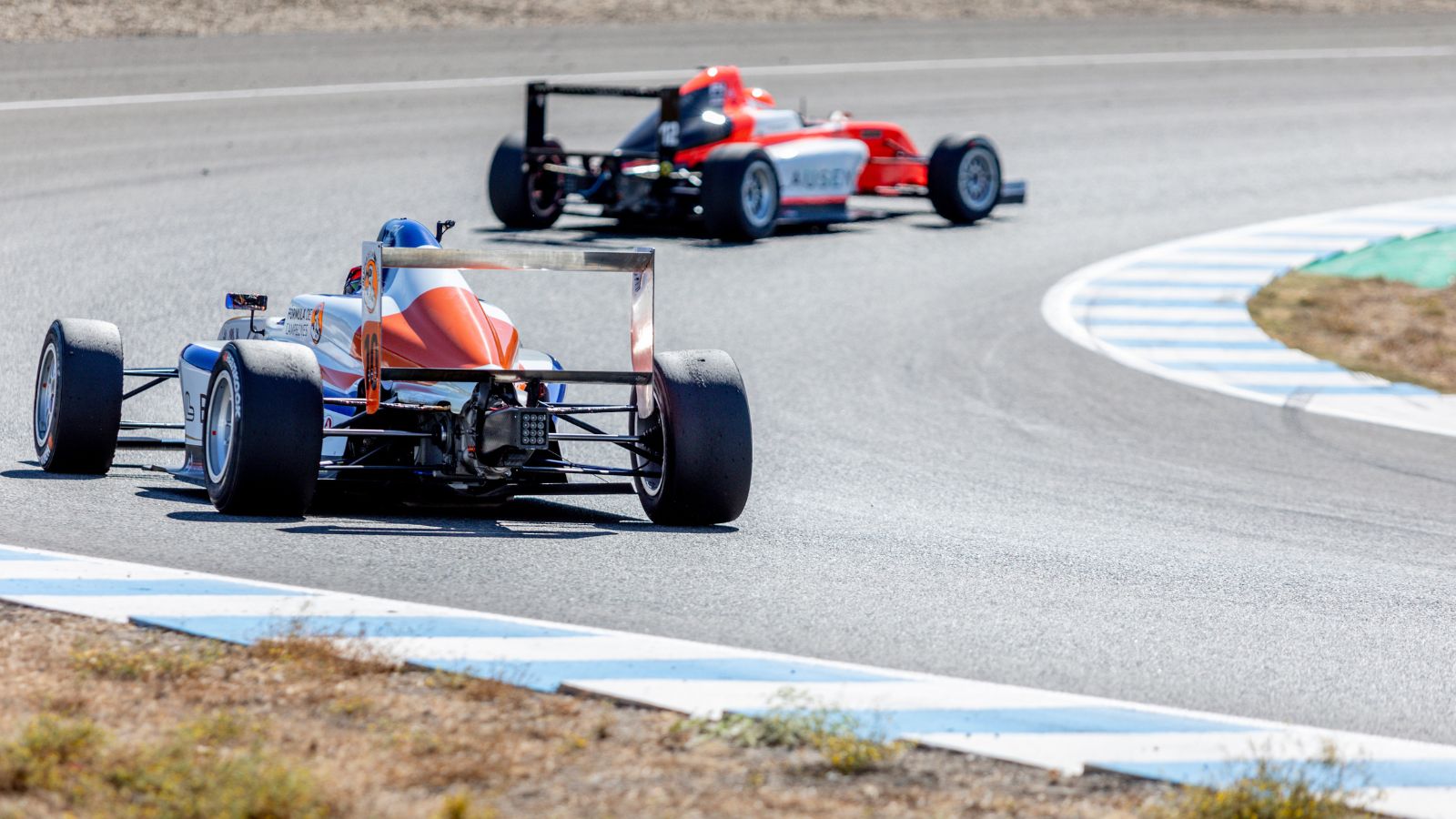
Markham’s first weekend as the new Canadian home of IndyCar racing produced a milestone that reached far beyond Ontario. Andres Cardenas, the 18-year-old racer from Lima, became the first Peruvian driver to win a USF Pro Championships event, taking Sunday’s USF Pro 2000 race by only 0.6487 seconds over Jack Jeffers.
The breakthrough had been building. Cardenas had already shown front-running speed throughout his rookie campaign and finished third on Markham’s streets a day earlier. On Sunday, he turned that pace into a landmark result, passing Jeffers on lap 10 and defending the lead through late caution periods and a final three-lap run to the checkered flag. It was a maiden series victory, a piece of Peruvian motorsport history and an immediate signature moment for Markham’s brand-new street circuit.
Markham’s New Circuit Gets an Instant Piece of History
The setting made Cardenas’s victory particularly memorable. USF Pro 2000 arrived in Markham as part of the first Ontario Honda Dealers Indy weekend at the city’s new temporary street course, replacing the longtime Exhibition Place venue in Toronto on the Canadian open-wheel calendar. The Markham Centre layout measures 3.52 kilometres, or 2.19 miles, and contains 12 turns. Designed by Tony Cotman of NZR Consulting, it runs through the city’s downtown district between major transportation and development corridors. The circuit was built to continue an Ontario Indy-car tradition stretching back to 1986 while giving the event a completely new physical identity.
That meant every meaningful benchmark established during the weekend carried historical weight. Drivers were not merely searching for tenths of a second; they were establishing the first reference points on a circuit nobody in the field had raced before. Jack Jeffers won Saturday’s opening USF Pro 2000 contest, but Sunday belonged to Cardenas. By becoming the second winner of the weekend and simultaneously the first Peruvian winner in USF Pro Championships competition, he ensured that one of the earliest chapters in Markham’s racing history would carry Peru’s flag.
A Breakthrough That Had Been Building All Season
Cardenas’s maiden victory was not an isolated upset. The JHDD powered by ECR driver had repeatedly shown the speed required to race near the front during his first USF Pro 2000 campaign. The series described him as a regular frontrunner and two-time polesitter before his Markham breakthrough. Earlier in the season, he had qualified on pole at Indianapolis Motor Speedway, while results at tracks including Road America and Mid-Ohio provided further evidence that the teenager could match the championship’s established contenders over a lap and in race conditions.
Saturday in Markham offered another indication that a first victory was close. With qualifying cancelled, the starting order was established by championship position. Cardenas lined up fifth, passed Frankie Mossman for third during the opening stages and stayed among the leaders through a race affected by caution periods. He ultimately finished behind Jeffers and G3 Argyros. It was valuable preparation. Cardenas later explained that his team changed the car’s setup overnight and that he was able to apply lessons learned during the first race. Less than 24 hours after standing on Markham’s third-place podium, he returned and climbed two steps higher.
Jeffers Led Early, but Cardenas Never Let Him Escape
Sunday’s race began with Jeffers in the strongest possible position. Because the scheduled qualifying session had been cancelled, the Race Two grid was determined using each driver’s fastest lap from Saturday’s contest. Jeffers had recorded the quickest lap late in Race One, earning another Continental Tire Pole Award and giving himself track position on a circuit where passing had already proved challenging. He controlled the opening laps, but Cardenas remained close enough to prevent the championship leader from settling into a comfortable rhythm.
The pressure became increasingly visible. Jeffers locked his tires heavily under braking for the Turn Five hairpin on lap eight while trying to keep Cardenas behind. Two laps later, the Peruvian finally found the opening he needed. Cardenas attacked at the end of the long, flowing straight approaching Turn Six and completed the pass for the lead on lap 10. It was the decisive move of the race. Rather than inheriting the victory through strategy, penalties or somebody else’s mechanical problem, Cardenas took first place directly from the driver who had won the previous afternoon and who was leading the championship.
The Race Kept Resetting, and So Did the Pressure
Taking the lead was only part of Cardenas’s challenge. Street racing frequently rewards concentration as much as outright speed, and Sunday’s contest repeatedly forced the leader to rebuild his advantage. The first interruption came early when Cardenas’s teammate JT Hoskins entered the escape road at Turn Seven, prompting a brief full-course caution. Later, Brady Golan hit the tire barrier at Turn 10, bringing another stoppage to the flow of the race. Almost immediately after the subsequent restart, G3 Argyros crashed heavily at Turn Two while running near the front.
Argyros was taken to the infield care centre and released shortly afterward, but the incident created another tense reset for Cardenas. Instead of managing a settled gap to Jeffers, he faced one final restart with only three laps remaining. The advantage accumulated before the caution effectively disappeared, placing the two leaders together again for a short sprint. This time Jeffers was the pursuer. Cardenas had to defend without compromising his exits, make no significant braking errors and keep the championship leader behind on a circuit with concrete walls waiting for even a small miscalculation. He did exactly that.
Just 0.6487 Seconds Separated Victory From Second Place
After 25 laps, the official margin between Cardenas and Jeffers was 0.6487 seconds. Rounded to the hundredth, the gap was only 0.65 seconds — barely enough time for a racing car traveling at speed to cover a meaningful stretch of pavement. The number captures how little room Cardenas had for error during the closing laps. A slightly slower exit from a corner, a minor lock-up or a missed apex could have erased most of the advantage before the next braking zone.
The victory carried another performance marker as well. Cardenas established a new race-lap record for the freshly created Markham circuit and received the GhostLap Fastest Race Lap of the Weekend Award. That combination mattered because it reinforced the character of the result. The win was not simply a product of staying clear of trouble while others made mistakes; the No. 6 JHDD powered by ECR car possessed front-running pace. Jeffers finished second for his seventh podium of the season, while Thomas Schrage inherited third after Argyros’s crash and secured the first USF Pro 2000 podium for TJ Speed Motorsports.
Peru’s First USF Pro Championships Winner Already Had an International Résumé
Although Cardenas is still a high school student, his racing background was international long before his arrival in USF Pro 2000. Born on May 15, 2008, and listed by the championship as being from Lima, he spent several years progressing through karting and European single-seater competition. His early record includes three Peruvian national karting championships and a gold medal representing Team Peru in the Karting Junior Sprint Cup at the 2022 FIA Motorsport Games.
His move into formula cars produced more milestones. Cardenas won in the Spanish Formula 4 Championship during his 2023 rookie season, finished runner-up in the 2024 Formula Winter Series with two victories and earned an FIA Motorsport Games silver medal in Formula 4 that same year. In 2025, he competed in Eurocup-3, finishing seventh overall and winning the final race at Circuit de Barcelona-Catalunya from pole position. He also topped USF Pro 2000 running during the USF Fall Combine test at Indianapolis Motor Speedway. Those results made the move to North America a logical next stage rather than a speculative jump, and Markham provided his first victory after making that transition.
The Trip to Canada Nearly Did Not Happen at All
One of the most striking details surrounding the victory happened away from the circuit. According to USF Pro 2000, Cardenas’s visa allowing him to enter Canada was granted only one day before he was due to make the trip north. His participation had therefore remained uncertain unusually late into race week. Cardenas acknowledged after Saturday’s podium that he had not expected to be able to compete in Markham because of the visa situation and expressed gratitude simply for being present.
The issue also had direct competitive significance because championship leader Leonardo Escorpioni was unable to compete in Markham due to immigration issues of his own. Cardenas, by contrast, received the required clearance just in time and turned that opportunity into 48 hours that dramatically strengthened his season: third place on Saturday, victory on Sunday, a fastest lap award and his country’s first USF Pro Championships win. Had the paperwork arrived slightly later, none of those achievements would have existed. The contrast offered an unusually clear reminder that international junior racing involves more than driving talent, engineering and budgets. Travel documentation can determine whether a contender even reaches the starting grid.
JHDD Powered by ECR Scores an Important Breakthrough
The result also carried significance for Cardenas’s team. Jay Howard Driver Development competes under the JHDD powered by ECR banner as part of a broader partnership with Ed Carpenter Racing. Announced ahead of the 2026 season, the arrangement connected JHDD’s programs in USF Juniors, USF2000 and USF Pro 2000 with ECR and its higher-level American open-wheel operation, creating a more direct developmental pathway toward INDY NXT and ultimately the NTT IndyCar Series.
Cardenas delivered the partnership a high-profile victory during one of the championship’s biggest weekends. Team owner Jay Howard received his first PFC Award of the season as the winning entrant, while Cardenas’s No. 6 car carried backing associated with Java House, Splenda and Ed Carpenter Racing. The timing was useful symbolically as well as competitively. USF Pro 2000 exists primarily to prepare young drivers for the next stage of the American open-wheel ladder, meaning wins under pressure on unfamiliar street circuits are particularly valuable demonstrations of development. Cardenas handled traffic, restarts, braking pressure and a championship-leading opponent to secure the result — precisely the kinds of demands young drivers will encounter if they continue progressing toward IndyCar.
Cardenas Leaves Markham Fourth in a Championship With Major Stakes
The victory substantially improved Cardenas’s championship position. After 14 of the scheduled 18 rounds, the provisional standings placed Jeffers first with 309 points, Leonardo Escorpioni second with 276 and G3 Argyros third with 268. Cardenas moved to 246 points in fourth, ahead of Frankie Mossman on 226 and Thomas Schrage on 216. Four races remained, keeping significant points available even as Jeffers left Ontario with a 33-point advantage over Escorpioni.
There is more at stake than a trophy. The 2026 USF Pro Championships program uses scholarships to move successful drivers through its development system, and the USF Pro 2000 champion is competing for a package valued at almost $600,000 toward advancement to INDY NXT in 2027. That makes every point especially consequential for young drivers attempting to finance the next stage of their careers. Cardenas remains 63 points behind Jeffers after Markham, so the championship picture is challenging, but the win changes the tone of his season. He is no longer simply a quick rookie searching for a breakthrough. He has proven that he can convert speed into victory when the opportunity arrives.
Milwaukee Presents a Completely Different Test
There will be little time for Cardenas to linger on the Markham milestone. USF Pro 2000’s next event is scheduled for the historic Milwaukee Mile on August 28-29, where the championship returns to oval racing in support of the NTT IndyCar Series. The change in environment could hardly be greater. Markham demanded repeated heavy braking, careful positioning against concrete barriers and patience through slow corners. Milwaukee will place greater emphasis on sustained speed, car balance in traffic and the confidence required to race wheel-to-wheel around an oval.
That contrast is part of the purpose of USF Pro 2000. The championship asks developing drivers to perform on street circuits, permanent road courses and ovals before they reach INDY NXT. Cardenas’s stated career ambition is eventually to race in IndyCar and win the Indianapolis 500, making experience across those disciplines essential. Whatever happens over the final four rounds, Markham has already given his 2026 campaign a defining moment. He arrived in Canada unsure until the last moment whether he could cross the border. He left as a race winner, a lap-record holder and the first Peruvian ever to stand atop a USF Pro Championships podium.