
























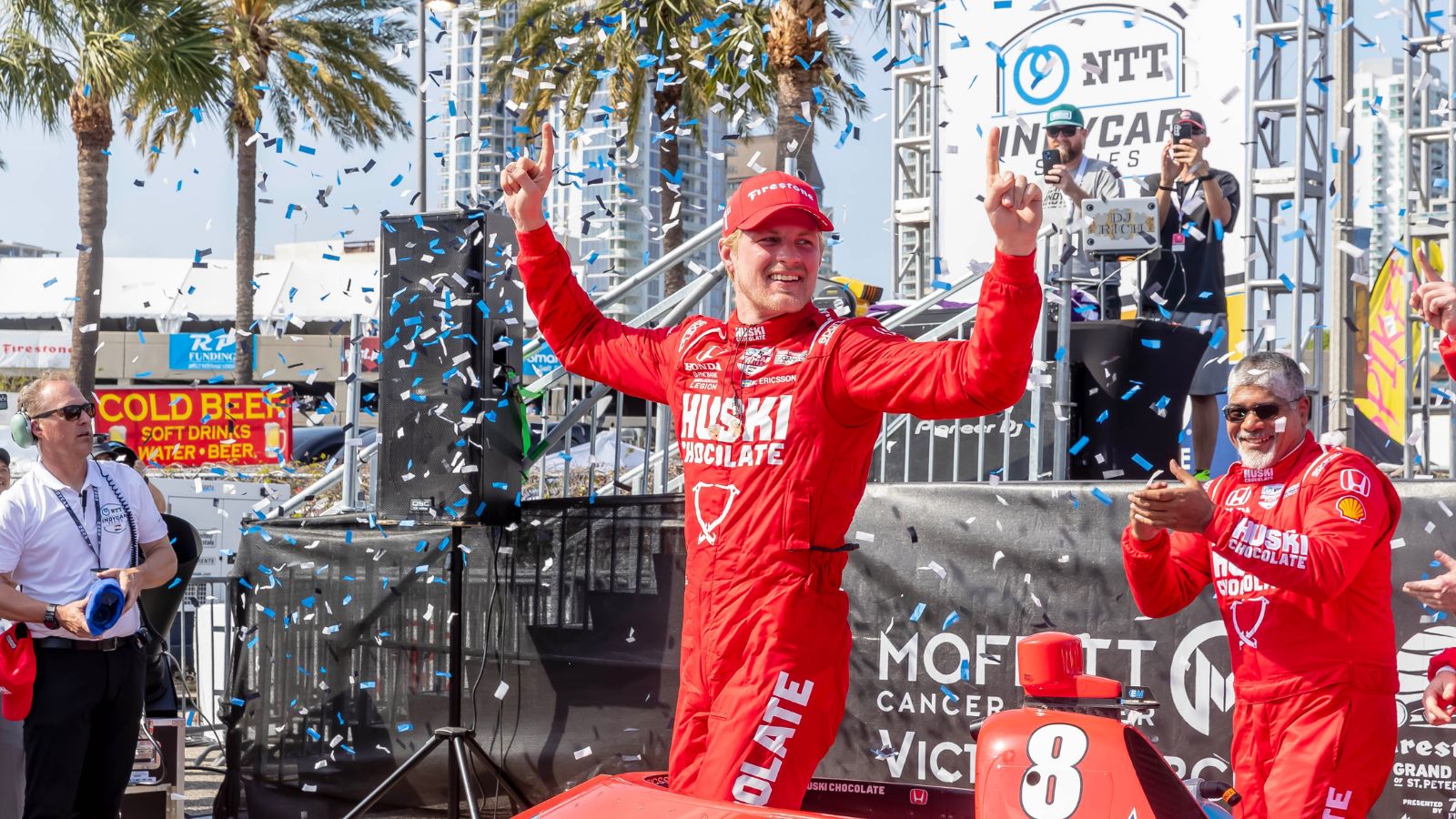
Marcus Ericsson arrived at Markham with plenty of evidence that another IndyCar victory was possible, but no guarantee that the breakthrough would finally come. By Sunday afternoon, the Swedish driver had turned the inaugural Ontario Honda Dealers Indy at Markham into one of the defining drives of his career.
Ericsson charged through the closing stages of the 90-lap race, overtook Romain Grosjean for the lead with four laps remaining and delivered Andretti Global its biggest result of the weekend. The victory ended a 63-race drought stretching back to St. Petersburg in 2023, gave Ericsson his fifth IndyCar win and placed his name permanently beside the first championship race held on Markham’s new downtown street circuit.
A 63-Race Drought Finally Ends
For Ericsson, the significance of the afternoon stretched well beyond becoming Markham’s first IndyCar winner. His previous victory had come at the 2023 season opener in St. Petersburg, leaving him without a win for 63 consecutive races despite remaining a regular presence near the front. He qualified fourth in Markham after reaching the Firestone Fast Six and entered Sunday with a car that had been competitive almost from the moment IndyCar finally took to the new circuit. The result became his fifth career series victory and his first as an Andretti Global driver.
There was a visible emotional release once the race was finished. Ericsson’s voice cracked during his post-race interview after the celebrations, a reaction that reflected how long the drought had lasted. The 2022 Indianapolis 500 winner had already demonstrated an unusual affinity for street racing, with victories in Nashville, Detroit and St. Petersburg among his previous successes. Markham added another temporary circuit to that list. More importantly, this one came after an afternoon in which Ericsson repeatedly had to create his own opportunities rather than simply inherit them through strategy or late-race chaos.
Andretti’s Late Gamble Changed the Race
The decisive strategic decision came deep into a race that had already produced six caution periods. Rather than matching rivals who stopped earlier and attempted to conserve fuel and tires to the finish, Ericsson and Andretti kept the No. 28 Honda on track. After a restart around lap 63, he drove at qualifying-style speed while building a gap to Grosjean. By the time Ericsson finally made his last stop around lap 69, the advantage he had accumulated was large enough to put him back into the fight despite dropping into traffic.
That created an unusual closing scenario. Grosjean, Alex Palou and others ahead had track position, but Ericsson had fresher tires and far fewer fuel-saving concerns. He began cutting through them as the remaining laps disappeared. Will Power was passed during the closing sequence, followed by Palou at the Turn 5 hairpin on lap 84. Ericsson then erased the remaining gap to Grosjean and moved into the lead on lap 86. Four laps later, he took the checkered flag 7.5305 seconds clear, a remarkably comfortable margin considering how late the winning move had come.
Grosjean Comes Painfully Close Again
Ericsson’s breakthrough meant another agonizing near-miss for Romain Grosjean. The Dale Coyne Racing driver led 28 of the 90 laps and appeared to have positioned himself for a memorable first IndyCar victory after making his final stop on lap 53. That strategy effectively asked him to stretch his fuel and tires for roughly 37 laps. For much of the final stint, it looked possible. Grosjean controlled the pace while rivals behind managed their own fuel situations, and even Palou initially seemed more likely than Ericsson to pose the final threat.
Then the speed difference became impossible to ignore. Ericsson was able to attack with fresher equipment while Grosjean had little strategic flexibility left. Second place was still Dale Coyne Racing’s best result of the season and Grosjean’s first top-five finish of 2026, but it represented his sixth runner-up result in IndyCar and seventh podium in 78 series starts. His most recent race victory in any major single-seater championship remains a GP2 win in Hungary in 2011. Grosjean acknowledged afterward that the result hurt, even as he emphasized how much progress the performance represented for the team.
Foster’s Dream Weekend Ends Against the Wall
Before Ericsson emerged as the central figure, Louis Foster looked capable of becoming Markham’s first winner. The Rahal Letterman Lanigan Racing driver had produced a 1-minute, 13.2383-second lap in qualifying, establishing the new circuit record and earning the second IndyCar pole of his career. He then led the first 32 laps Sunday and opened a lead of nearly three seconds. On a circuit no IndyCar driver had previously raced, Foster appeared remarkably comfortable while controlling the opening stage.
His race changed when a caution arrived shortly after other leading drivers had made pit stops. Foster’s longer opening strategy shuffled him back to 12th, forcing him to recover positions instead of protecting a lead. He immediately began doing so, gaining eight places and closing on Ericsson by lap 43. Attempting an aggressive move approaching Turn 3, Foster clipped the inside wall and was thrown heavily into the outside barrier. The impact ended his afternoon instantly, although he was not injured. A weekend that had included the fastest practice pace, a track-record pole and more than 30 laps led therefore ended without a finish anywhere near what his speed had suggested was possible.
Andretti Nearly Turned Markham Into a Team Showcase
For significant portions of the race, Andretti Global appeared capable of placing all three cars near the front. Ericsson had started fourth, while Kyle Kirkwood worked forward after beginning deep in the field and Will Power recovered from a difficult qualifying session. Following one mid-race restart, Ericsson, Power and Kirkwood occupied positions immediately behind Grosjean. It was exactly the kind of collective pace the organization wanted to display at a circuit where every team had started the weekend without previous race data.
The afternoon ultimately split in dramatically different directions. Kirkwood, who had charged into contention, clipped the inside wall approaching Turn 3 on lap 54 and was launched into the outside barrier in an accident strikingly similar to Foster’s earlier crash. He finished 21st. Power, by contrast, kept climbing and eventually reached third place, giving Andretti two drivers on the podium. Ericsson and Power even made contact while racing for position during the closing stages, illustrating how little room existed for team diplomacy when a victory was available. Ericsson ultimately won, Power finished third and the speed of all three cars became one of the clearest messages from the weekend.
Palou Turns Trouble Into Another Championship Gain
Alex Palou’s weekend began with an unusually costly qualifying mistake. The four-time champion hit the wall during the Top 12 portion of qualifying, ending a streak of 30 consecutive races in which he had started inside the top 10. He qualified 12th and eventually started 11th, placing him in unfamiliar territory on a circuit where passing could carry substantial risk. Yet by the closing stages Sunday, Palou had once again navigated his way into the fight near the front.
Palou briefly ran second after passing Scott McLaughlin, but his need to conserve fuel prevented him from matching Ericsson’s late pace. He ultimately finished fourth behind Ericsson, Grosjean and Power. From a championship perspective, however, the result was highly productive. Kyle Kirkwood entered Markham 110 points behind Palou but crashed and finished 21st. David Malukas also encountered trouble late and finished 17th. With four races remaining, Palou’s advantage over Kirkwood grew to 133 points, with Malukas 137 behind. Even on a weekend containing mistakes and contact, the championship leader left Ontario in a stronger position than when he arrived.
Markham’s New Circuit Delivered Immediate Drama
The Streets of Markham gave drivers little time to become comfortable. The temporary layout measures 2.19 miles, or 3.52 kilometres, across 12 turns and includes a distinctive double-sided pit lane. Sunday’s race covered 90 laps and 197.1 miles. Ericsson later described a surface with substantial grip on the racing line but much less grip when cars moved offline, exactly the combination that can make overtaking tempting while sharply increasing the consequences of getting a braking zone wrong.
Those characteristics were visible throughout the race. Turn 5’s hairpin repeatedly became a passing and contact zone, while Turn 3 punished both Foster and Kirkwood with race-ending crashes. Six caution periods meant 25 of the 90 laps were completed behind the pace car. Mick Schumacher also crashed early, while incidents involving Scott Dixon, Christian Rasmussen, Nolan Siegel, Josef Newgarden and others repeatedly reshaped the running order. The interruptions complicated fuel calculations and created restart opportunities, but they also made Ericsson’s final gamble particularly risky: another yellow after he elected to stay out could have erased the advantage Andretti was trying to build.
A Troubled Friday Gave Way to a Memorable Sunday
The weekend’s successful conclusion had looked considerably less certain two days earlier. IndyCar cancelled Friday’s scheduled track activity after the promoter had not completed the circuit build in time. Fans who arrived expecting to see cars encountered an unfinished race venue and continuing construction work instead. Reports from the scene pointed to incomplete barriers and fencing as crews continued preparing the temporary facility. For an inaugural event carrying major expectations from Markham, the delay created an uncomfortable opening impression.
IndyCar responded by compressing the competitive program into Saturday. Andretti reported that drivers completed two practice sessions before qualifying later that day, turning what had originally been a multi-day learning process into an intense single-day exercise. The rapid turnaround made Ericsson’s performance more notable because teams possessed almost no real-world information about the circuit before Saturday morning. By Sunday, the conversation had shifted from construction delays to aggressive strategy, crashes and a late winning charge. That did not erase the logistical problems, but completing the headline race on schedule allowed Markham’s first IndyCar weekend to finish with the competition itself at the centre of attention.
Markham Takes Over a Four-Decade Ontario Racing Tradition
The Ontario IndyCar event arrived in Markham carrying a history far older than the new circuit. Indy-style racing had been staged around Toronto’s Exhibition Place beginning in 1986, with 39 races held across roughly four decades before the event moved northeast. The new Markham venue was announced in September 2025 through a multi-year agreement involving promoter Green Savoree Toronto, the City of Markham and IndyCar. Rather than abandoning the Greater Toronto Area, organizers effectively transplanted one of Canada’s best-known annual motorsport events into a rapidly developing urban centre.
Promoters projected more than 140,000 attendees across the inaugural three-day Markham weekend and tens of millions of dollars in economic activity tied to tourism, hospitality and event services. The circuit was constructed in Markham Centre between major transportation corridors and transit infrastructure, giving organizers a substantially different setting from Exhibition Place. For local officials, the race was positioned as both a sporting event and a regional showcase. Ericsson’s victory now gives that new era its first defining competitive memory: a former Indianapolis 500 winner chasing down the leader in the final minutes on streets that had never previously hosted an IndyCar race.
The Win Validates Ericsson’s 2026 Rebound
The timing of Ericsson’s victory also mattered for his longer-term future with Andretti. Just 10 days before the Markham race, the team confirmed that the 35-year-old Swede would remain with the organization for the 2027 season, giving him a fourth year with Andretti. The extension followed a significant improvement from a difficult 2025 campaign. Earlier in 2026, Ericsson earned his first IndyCar pole on the streets of Arlington and finished second at World Wide Technology Raceway, while repeatedly showing stronger qualifying speed than the final results sometimes indicated.
Markham converted that underlying pace into something much harder to dismiss. Ericsson qualified on the second row, survived a chaotic race, accepted the risk of staying out while others stopped and then made the passes necessary to complete the strategy. He described the victory afterward as the product of preparation and speed rather than surprise, particularly because Andretti had arrived at a new venue without historical setup information. For Ericsson, that may be the most important takeaway from ending the drought. Sixty-three races separated his St. Petersburg and Markham victories, but the final four laps in Ontario offered strong evidence that his next opportunity does not necessarily need to take nearly as long.