

























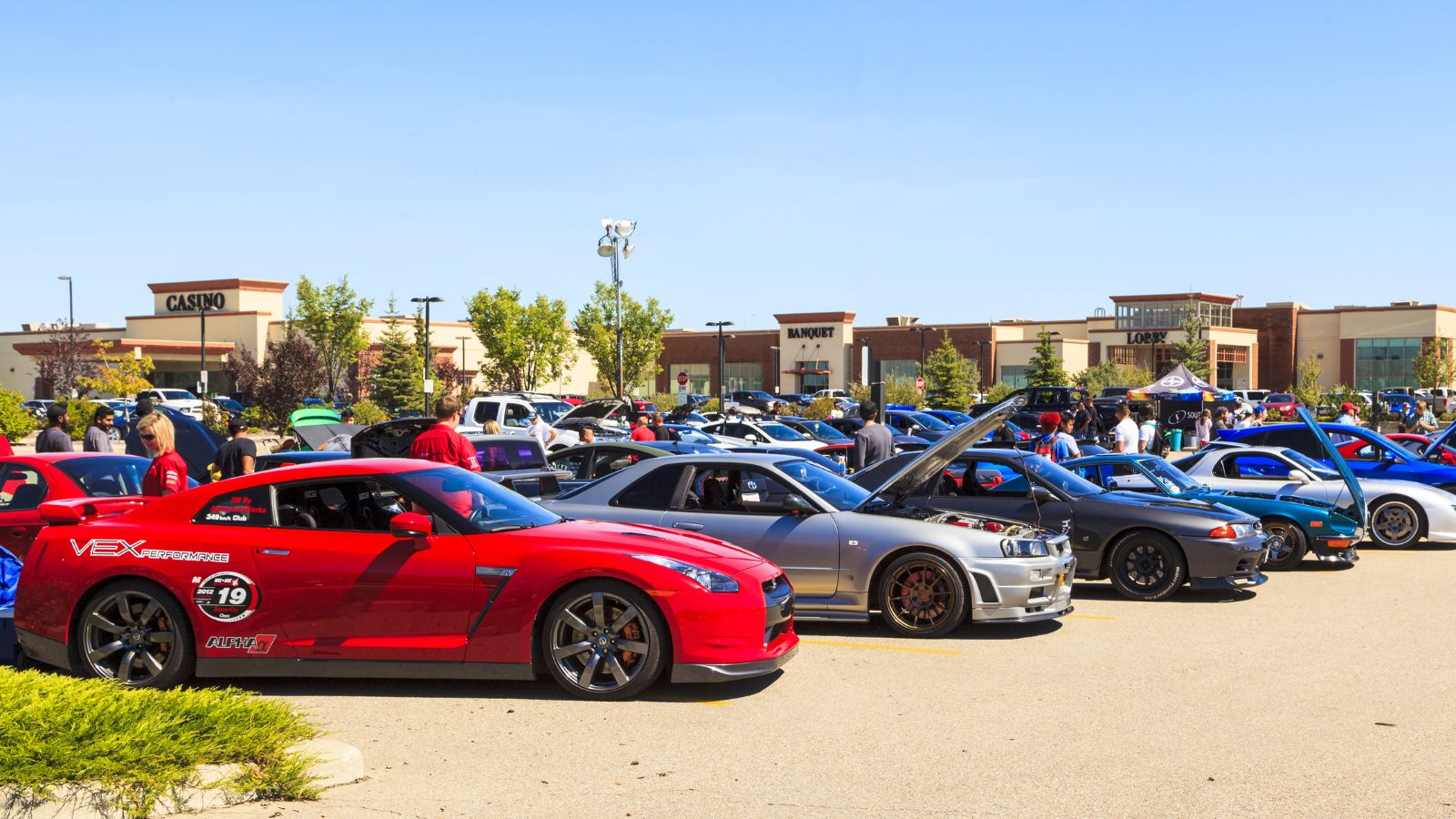
Downtown Saskatoon is trading ordinary Sunday traffic for rows of polished classics, custom builds, trucks and motorcycles as the Rock 102 Show & Shine returns for its 44th year. The downtown car show opened at 10 a.m. on August 16, filling 14 city blocks between First and Fourth avenues and 20th and 23rd streets.
Organizers describe it as one of Western Canada’s largest outdoor car shows, and the scale helps explain why. Roughly 600 to 1,000 vehicles were expected to participate, alongside more than 50 vendors and a crowd projected at between 20,000 and 40,000 people. With free admission, decades of history and vehicles ranging from carefully preserved originals to heavily modified customs, the event has become as much a Saskatoon summer gathering as a display of automotive craftsmanship.
Downtown Becomes the Show Floor
For six hours Sunday, a substantial piece of central Saskatoon stops functioning like a normal street grid. The Show & Shine footprint stretches across 14 downtown blocks, from First Avenue to Fourth Avenue and between 20th and 23rd streets. Instead of regular traffic occupying those streets, hundreds of display vehicles are positioned throughout an area large enough to turn an ordinary walk through downtown into a lengthy tour of automotive history and customization.
The transformation started well before spectators arrived. Road closures took effect at 4 a.m., registered car clubs began loading in at 6:30 a.m., and vendors followed at 7 a.m. By the official 10 a.m. opening, the downtown core had effectively become an open-air exhibition space. That size separates Show & Shine from a typical parking-lot gathering. Visitors are moving through multiple streets and intersections rather than circling a single venue, while Saskatoon’s downtown buildings provide the backdrop.
Scale Could Reach 1,000 Vehicles
The word “hundreds” leaves considerable room when describing Show & Shine. Ahead of Sunday’s event, Rawlco Radio director of promotions Heather Bonynge said organizers were anticipating somewhere between 600 and 1,000 vehicles downtown. Those entries include classic and custom cars as well as trucks and motorcycles, creating the possibility that the final field could approach four figures if participation lands near the upper end of expectations.
Past editions show that such numbers are realistic rather than promotional exaggeration. Global News reported more than 900 vehicles lining the same 14-block footprint when the downtown show returned in 2022 after its pandemic-era interruption. The current format also leaves room for individual owners beyond organized clubs. Non-registered participants were allowed to arrive between 8 and 9:30 a.m. Sunday, with available space assigned on a first-come, first-served basis. That creates some unpredictability in the final count — and helps make each year’s collection different.
Tens of Thousands Expected Downtown
Cars may occupy the streets, but people create the larger spectacle. Organizers entered Sunday expecting between 20,000 and 40,000 visitors, putting pedestrian traffic on a scale normally associated with major festivals rather than a conventional vehicle meet. More than 30,000 people attended both the 2024 and 2025 editions, according to CKOM’s reporting, giving the 2026 estimate a strong recent benchmark.
Those crowds alter the character of the downtown core for a day. Families, longtime collectors, photographers and casual visitors share the streets with owners who may have spent years restoring the machines parked beside them. The event is also designed for spectators to circulate rather than simply watch from a fixed seat. In 2025, more than 30,000 people moved through the same 14-block area while hundreds of vehicles and over 50 vendors were on display. That combination explains why organizers and police prepare for Show & Shine as a major public event, not simply a gathering of enthusiasts.
Variety Extends Far Beyond Classic Cars
A show with potentially close to 1,000 vehicles cannot be reduced to one era or one type of collector. The official description specifically includes classic and custom cars, trucks and motorcycles, while previous organizers have highlighted everything from British cars and Volkswagens to performance machines, themed vehicles and older North American models. That breadth allows someone interested in factory preservation to walk the same streets as someone more interested in modified engines, modern suspensions or customized bodywork.
The mix also makes the event accessible to people without encyclopedic knowledge of collector cars. A rare restoration may draw enthusiasts who recognize every factory detail, while a dramatically modified truck can attract children who simply like the way it looks. Shane Arthur of Saskatoon’s Draggins Car Club offered a good example of that range this year: he planned to bring both a 1937 Chevrolet and a 1968 Chevrolet C10, while his wife was bringing a restored 1977 Corvette. One club can therefore span several distinct periods of automotive design.
Every Car Comes With a Story
The most memorable part of a large car show is often not the specification sheet taped inside a windshield. It is the explanation from the person standing beside the vehicle. At the 2025 Show & Shine, Lloydminster Auto Club member Dave Deeg displayed a 1969 Chevrolet Chevelle he had owned for 45 years. Deeg said the car underwent a complete restoration, including bodywork he performed himself, while modern suspension and transmission upgrades made it easier to drive.
Another participant, Grant Pippen, brought a 1967 Chevelle that he had known for much of his life before eventually becoming its owner. Pippen told CKOM that speaking with younger visitors was one of his favourite parts of the event because many had never experienced older vehicles firsthand. That intergenerational exchange helps explain why a row of parked cars can hold attention for hours. A vehicle may represent engineering history to one visitor, a childhood memory to another and years of hands-on work to the person who brought it downtown.
A Tradition Dating Back to 1982
Show & Shine is not a new event that suddenly discovered a large audience. Its roots go back to 1982, and the 2026 downtown gathering marks its 44th year. Discover Saskatoon describes the weekend as a pillar of the city’s summer calendar, while the event itself says it attracts participants and visitors from around Saskatchewan. Four decades of repetition have given it something that cannot be created through advertising alone: generations of people who associate August in Saskatoon with cruising and collector cars.
That history also creates family traditions. Rock 102 host Whitney Graves described in 2025 how her father had taken her to the show as a child and how she now brings her own children. Stories like that help explain the staying power of an event centred on machines built decades ago. The cars change owners, restorations evolve and younger generations arrive, but the basic experience remains recognizable — enthusiasts bringing cherished vehicles into the city centre and spending the day talking about them with strangers.
Free Admission Keeps the Crowd Broad
One of the simplest details about Show & Shine is also central to its scale: spectators do not pay admission. The downtown event is free from 10 a.m. to 4 p.m., removing the ticket barrier that can turn a family outing into a significant expense. Vehicle participation is also free, although commercial vendors and certain promotional activities require organizer approval and are subject to vendor rates.
The open format makes the event easy to experience casually. Someone does not need to commit to a ticketed venue or stay for the full six hours; the streets themselves form the show space. Organizers also explicitly welcome families, and dogs are permitted within outdoor portions of the footprint as long as they remain leashed and owners clean up after them. That combination broadens the audience beyond serious collectors. A person may arrive because of a particular muscle car, while another comes downtown for food, games or a family walk and ends up spending an hour looking beneath open hoods.
More Than 50 Vendors Fill the Footprint
Vehicles dominate the visual scene, but the 2026 event also includes more than 50 vendors. The official lineup ranges from automotive businesses and community organizations to food operators, service companies and recreational groups. That means the streets are not simply rows of cars separated by empty intersections; the event has the food, displays and activities associated with a much broader summer festival.
The number matters when considering how long visitors can reasonably spend downtown. A person who walks all 14 blocks, stops to speak with owners and visits vendor booths can easily turn Show & Shine into a substantial afternoon outing. Food options on the organizer’s list include barbecue, mini doughnuts, shaved ice, poutine, coffee and other offerings. Community and sports organizations are represented alongside automotive companies. Organizers had already described the expected mix as more than 50 vendor booths, food trucks and games, giving non-enthusiasts reasons to linger even after they have found their favourite car.
The Weekend Builds Toward Sunday
Although the downtown takeover is the largest visible component, Show & Shine is structured as an entire weekend of automotive activity. Events began Friday evening with the Show N Shine Kickoff at Sutherland Automotive Speedway. On Saturday, Rock 102 held its Drive & Shine from 9 a.m. to 3 p.m., allowing participants to visit designated businesses and locations around Saskatoon rather than gathering in one fixed exhibition area.
The Drive & Shine format included 16 participating locations and 16 prizes, with one potential winner selected at each location. No purchase was necessary. Sunday’s downtown show then serves as the finale, bringing the scattered automotive community into one concentrated footprint. That progression helps explain why police and organizers refer more broadly to “Cruise Weekend.” The activity is not limited to six hours behind barricades. Cars are moving throughout Saskatoon across several days, culminating in the moment when hundreds of them are parked side by side downtown for the public to inspect at walking speed.
Rock the River Adds Another Layer
Automotive culture is sharing the weekend with another major Saskatoon attraction. Rock the River runs from August 14 through 16, giving visitors the option of moving from daytime car activities into live music. For 2026, the classic-rock festival shifted to Rotary Park and scheduled performances throughout the weekend, including Collective Soul on Saturday and Colin James among Sunday’s performers.
The overlap is deliberate in atmosphere even though the downtown car show remains a separate, free event. Classic cars and classic rock appeal to some of the same sense of nostalgia, and the weekend schedule allows enthusiasts to participate in both. Sunday’s Show & Shine ends at 4 p.m., while Rock the River’s Sunday performances begin during the afternoon and continue into the evening. Organizers have also promoted shuttle arrangements connected with the music festival. The result is a weekend in which the vehicles may be the biggest feature downtown, but they are part of a wider concentration of entertainment drawing people into central Saskatoon.
Road Closures Start Long Before Opening
Turning 14 city blocks into a pedestrian-heavy vehicle display requires removing ordinary traffic before most people are awake. Road closures began at 4 a.m. Sunday and remain in place until 6 p.m., two hours after the official car show ends. The restricted zone covers the same broad area as the display: First through Fourth avenues and streets between 20th and 23rd.
Organizers warned downtown residents, customers and businesses not to leave vehicles inside the closure area overnight. Cars remaining there after restrictions began could be towed outside the footprint, although owners are not charged for that relocation. Anyone trying to locate a moved vehicle can seek assistance at the Rock 102 information point at Third Avenue and 21st Street. The extended closure also provides time for dismantling the event. Vehicle and vendor load-out is scheduled from 4 to 6 p.m., meaning the city cannot simply reopen the streets the moment spectators begin heading home.
Police Prepare for Heavy Cruise Traffic
Show & Shine brings unusual traffic conditions beyond the closed downtown streets. Saskatoon Police Service issued a public advisory ahead of the weekend, noting that vehicle and pedestrian volumes historically increase along 8th Street during the evening. Police asked motorists to be patient and cautious and said officers would maintain a visible presence downtown, on 8th Street and in nearby parking lots.
The service also made its enforcement approach clear: traffic laws, municipal bylaws and regulations would be enforced with what police described as a zero-tolerance approach. Additional road restrictions could be introduced when required to maintain safer traffic flow. The warning reflects the difference between the organized daytime show and the wider cruising culture around it. Inside the downtown footprint, vehicles are parked and gates control movement. Outside it, enthusiasts and spectators continue circulating across Saskatoon. Police therefore prepare not only for a large pedestrian event but also for heavier vehicle activity after the formal exhibition begins winding down.
Loading Hundreds of Vehicles Takes Precision
Visitors arriving at 10 a.m. see finished rows of vehicles, but getting them there is a carefully timed operation. Pre-registered car clubs were assigned a 6:30 to 8 a.m. load-in period, while vendors could enter from 7 to 9:30. Independent vehicles that were not part of registered clubs were admitted from 8 to 9:30 on a first-come, first-served basis. At 9:30, the gates closed to vehicle entry and exit.
Once positioned, participating vehicles are required to remain in place until the show finishes at 4 p.m. Organizers even instruct drivers to try another entrance if a gate has a lineup of four or more vehicles, an indication of the logistical challenge created by moving hundreds of collector cars into a compact downtown grid in only a few hours. Participants receive maps and “Do Not Touch” signs on entry. The choreography is largely invisible once the event opens, but it is essential to making 14 blocks feel organized rather than congested.
Why the Show Still Matters to Saskatoon
The strongest measure of Show & Shine’s place in Saskatoon may be its ability to attract large crowds repeatedly rather than simply producing one exceptional year. CKOM reported more than 30,000 visitors in both 2024 and 2025. Downtown Saskatoon separately estimated more than 60,000 people moving through the district during the 2024 weekend, illustrating just how substantial overall foot traffic can become depending on the measurement used.
Yet crowd size tells only part of the story. This year, Draggins Car Club member Shane Arthur planned to arrive with a 1937 Chevrolet and a favourite 1968 C10 equipped with a newly installed LS engine, while his wife was bringing the 1977 Corvette she spent a couple of years restoring. That is the small-scale human reality behind a show advertised in blocks and thousands. For owners, it is a chance to share years of work. For spectators, it is access to machines normally scattered across private garages. For Saskatoon, it is a 44-year tradition temporarily reshaping the heart of the city.