


























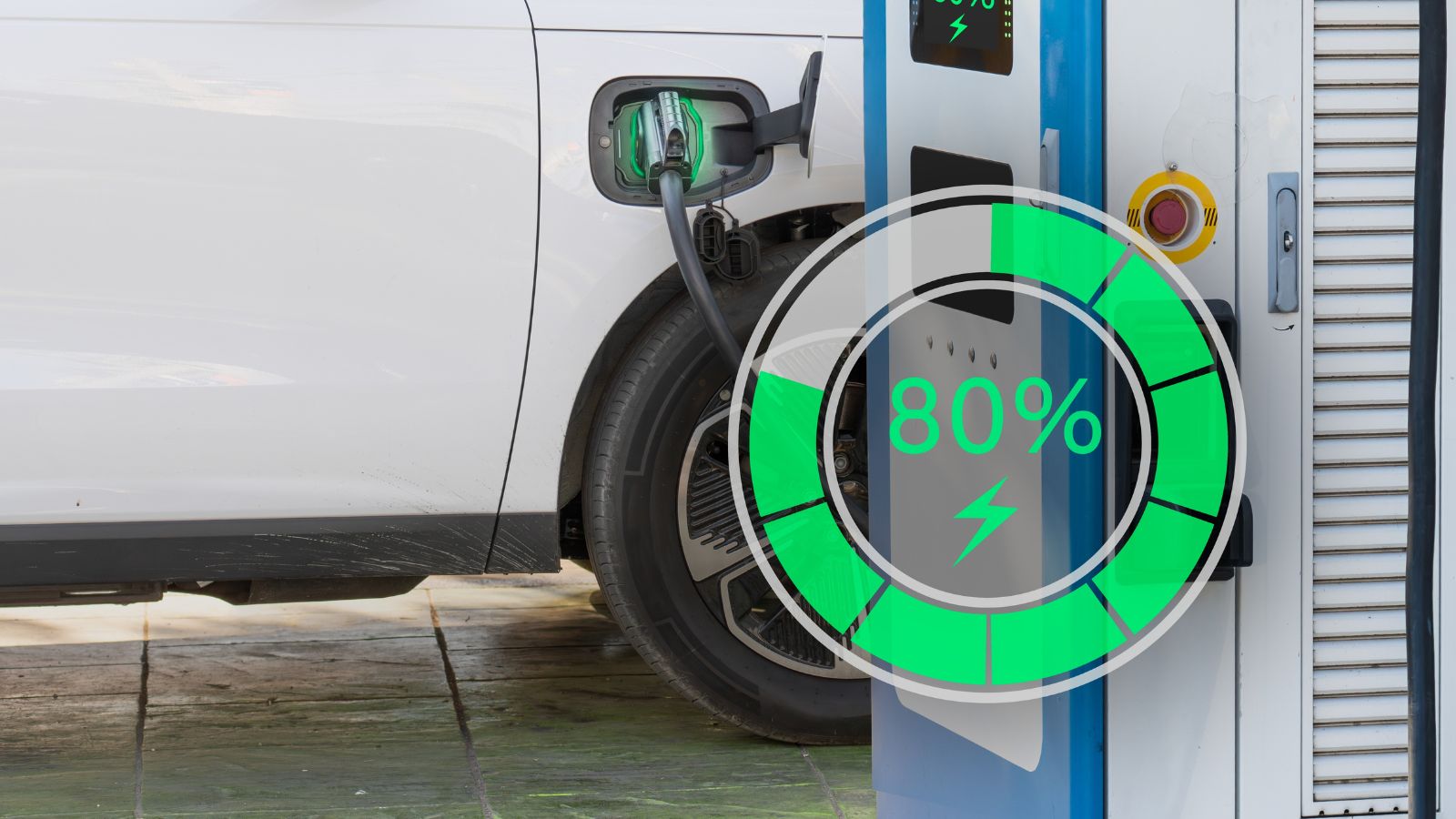
Canada’s EV charging story is starting to change tone. For years, “gas-station-fast” charging sounded more like a lab demonstration than a near-term reality. Now megawatt-level charging is moving from concept to deployment, and Canada is no longer standing entirely on the sidelines. Quebec’s Electric Circuit is preparing a megawatt-class charger for commercial vehicles, while faster 400-kW public sites are already appearing elsewhere in the country.
That shift matters because it says something bigger than raw speed. It signals a new phase in which charging is becoming more specialized, more powerful and more closely tied to real-world travel patterns. These five sections look at the promise behind five-minute charging, why Canada’s first megawatt step is aimed at trucks, what technical barriers still stand in the way, and why this development still matters for everyday EV adoption.
The Five-Minute Promise Is No Longer Just a Talking Point
The phrase “five-minute charging” used to sound like classic auto-industry exaggeration. Lately, it has become more concrete. BYD has publicly unveiled a megawatt-capable charging platform that it says can add roughly 400 kilometres of range in five minutes on compatible vehicles. It has also said the same system can move from 10% to 70% state of charge in about five minutes and reach 97% in around nine. Those numbers are attention-grabbing not simply because they are fast, but because they narrow the psychological gap between plugging in and filling a gas tank. For EV skeptics, that matters almost as much as the underlying engineering.
Still, the headline speed does not mean every electric vehicle is about to recharge that quickly. Ultra-fast charging at this level depends on a tightly matched system: battery chemistry, thermal management, high-voltage architecture, charging hardware and software all have to be designed for it. In practice, that means the five-minute benchmark is real in a limited sense, not universal in a mass-market sense. It is best understood as proof of direction. The industry has shown what is possible under the right conditions. The harder question now is how quickly that capability spreads beyond a small group of compatible vehicles and purpose-built charging sites.
Canada’s First Megawatt Step Is Happening In Quebec
Canada’s most important near-term megawatt development is not a flashy coast-to-coast rollout. It is a specific site with a specific purpose. Electric Circuit, Hydro-Québec’s charging network, has said it plans to install a 1.2- to 1.4-megawatt charger at the Service Area de la Porte du Nord on Highway 15 in the Laurentians by summer 2026. The project is aimed at medium- and heavy-duty electric trucks, not family crossovers. That distinction matters because it immediately grounds the story in reality. Canada is getting closer to megawatt charging, but the first serious use case is freight and commercial transport, where downtime carries a direct business cost.
The location itself also tells a useful story. Electric Circuit has already built out the rest stop with a cluster of fast chargers for light-duty vehicles, including a 400-kW unit. In other words, this is not a random moonshot. It is a staged escalation at a site that already functions as a high-power charging hub. That kind of measured rollout feels very Canadian: test a high-demand corridor, collect performance data, solve operational problems, then scale. It may not create the same buzz as a splashy consumer launch, but it is often how important infrastructure actually arrives.
Trucks Are Going First For A Reason
Megawatt charging is being built around heavy-duty vehicles because that is where the technical and economic case is strongest. The Megawatt Charging System, or MCS, was developed specifically for high-power charging in commercial applications, and industry materials describe it as a standard capable of reaching power levels well beyond what today’s passenger-car fast chargers deliver. That makes sense. Large battery packs in trucks take much longer to recharge, and logistics operations are highly sensitive to delay. A truck sitting still is not just inconvenient; it disrupts routes, delivery timing and asset utilization. Ultra-fast charging has a clearer financial payoff in freight than it does in a suburban grocery run.
Canada’s fleet mix also helps explain the order of deployment. Transport Canada’s dashboard shows thousands of medium- and heavy-duty battery-electric vehicles already operating on Canadian roads, even though the segment is still small relative to passenger EVs. At the same time, Electric Circuit has said one of its practical headaches is finding trucks equipped with MCS connectors to test the new equipment. That detail captures the moment perfectly. The charging hardware is advancing, but vehicle availability is still catching up. So the first phase of Canada’s megawatt story is not mass adoption. It is controlled experimentation in a part of the market where the upside is obvious and the operational lessons will be valuable.
A Bigger Plug Does Not Solve The Hardest Problem
It is easy to imagine ultra-fast charging as a simple hardware race, but the real challenge is broader. Canada’s public charging network is still expanding at a meaningful pace, with nearly 39,654 public charging ports at 14,743 locations as of late March 2026, and DC fast charging growing faster than Level 2. That is progress. But megawatt charging is a different class of infrastructure. It raises tougher questions about available grid capacity, site design, power electronics, cooling, redundancy and utility coordination. The industry is learning that the charging pedestal visible to drivers is only the front end of a much more complicated energy project.
That is why seemingly dry developments matter. Ontario utilities have started publishing interactive grid-capacity maps to help charging providers understand where electrical load is available before they sink time and money into site design. Toronto Hydro has also launched a pilot aimed at giving local charging providers direct access to 480-volt power to simplify connections. Those are not headline-grabbing breakthroughs, but they show where the bottlenecks really live. The future of five-minute charging will not be decided only by better connectors or stronger batteries. It will depend on whether utilities, site hosts, regulators and charging companies can make very high-power projects faster and easier to build.
What This Means For Canadian Drivers Right Now
For ordinary Canadian drivers, the immediate takeaway is not that every EV stop is about to become a five-minute stop. It is that the country’s charging ladder is getting taller. Canada already has public sites offering 400-kW charging, including deployments from On The Run, BC Hydro and Mercedes-Benz in British Columbia. BC Hydro has said its new 400-kW units can add about 100 kilometres of range to the average EV in roughly three minutes, while Mercedes’ first Canadian hubs were designed to support both CCS-1 and NACS. Those projects matter because they normalize higher-power charging long before megawatt charging becomes routine for passenger vehicles.
The broader backdrop is equally important. The federal government says it has invested more than $1.2 billion since 2016 to support EV chargers and hydrogen refuelling stations, and Transport Canada’s dashboard shows nearly one million light-duty zero-emission vehicles already operating in Canada as of October 2025. Put those pieces together and the picture becomes clearer. Canada is not yet at the point where a driver can expect a universal five-minute refill anywhere on the map. But it is moving from basic charger expansion into a more ambitious phase: better corridor coverage, higher power, more connector flexibility and, now, the first real megawatt-class deployment. That is a meaningful shift from aspiration to infrastructure.