





















Solid-state batteries have spent years being presented as the technology that could finally combine longer range, faster charging and improved safety in electric vehicles. Li Auto is now putting a more sober timetable around that promise. The Chinese automaker says limited vehicle deployment could begin within the next one or two years, but truly mature, dependable mass production is still roughly five years away.
That distinction matters. A battery can work in prototypes or small batches long before it is ready for millions of vehicles, warranty obligations and everyday fast charging. Li Auto’s latest comments place the company alongside other major automakers targeting late-decade commercialization while acknowledging that cost, lifespan and charging performance still have to improve together.
A Five-Year Gap Separates Pilot Cars From Mature Production
Li Auto’s latest timeline draws a clear line between getting solid-state batteries into a small number of vehicles and making them dependable enough for mainstream production. According to a September 22 report from Cailian, Li Auto expects its solid-state technology to be capable of limited vehicle installation in 2027 or 2028. Liu Zhimin, the company’s senior director of power batteries, said Li Auto already has several solid-state projects under development and has carried out prototype validation in eyewear products. That work shows the technology is progressing beyond basic laboratory research, but it does not mean automotive-scale manufacturing has been solved.
Liu said mature vehicle production with a consistent user experience will likely require about another five years, which points to around 2031 if the estimate holds. He identified three intertwined hurdles: service life, charging performance and cost. Those priorities matter because automakers cannot optimize one specification in isolation. A cell with impressive energy density but weak cycle life is difficult to warranty, while exceptionally fast charging is less useful if the materials and manufacturing process make the pack prohibitively expensive. Li Auto’s message is therefore less about delaying solid-state batteries than defining what “ready” means once a technology has to work reliably in ordinary family vehicles for many years.
The Hard Part Is Making Every Cell Behave Consistently
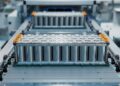
The appeal of solid-state batteries is straightforward. Replacing a conventional liquid electrolyte with a solid ion-conducting material can potentially improve safety while opening the door to higher-energy battery designs. The engineering challenge is that solid materials do not automatically make the electrochemistry simple. Peer-reviewed research has repeatedly identified the interfaces between electrodes and solid electrolytes as a major bottleneck. Poor physical contact can increase resistance, while charging and discharging can create cracks, voids or unwanted chemical reactions. Lithium dendrites can also remain a concern in solid-state designs and may eventually cause failure or short circuits if they are not controlled.
Those problems become more difficult once development moves from carefully prepared laboratory cells to large-format automotive cells being produced by the thousands. Manufacturing requires tight control over material purity, layer thickness, pressure, temperature and assembly speed. Recent research reviews continue to identify processing complexity, interface stability, long-term performance and scalable manufacturing as unresolved areas. That helps explain why Li Auto is talking about lifespan and charging alongside cost. An EV battery must tolerate summer heat, freezing winters, highway fast charging and years of repeated cycling while delivering predictable performance from one pack to another. A laboratory prototype can demonstrate that a chemistry is possible. A high-volume automotive factory has to demonstrate that the same result can be reproduced consistently, affordably and safely.
Other Automakers Are Targeting the Same Late-Decade Window
Li Auto is not alone in placing meaningful solid-state deployment near the end of this decade. Toyota has said it is working toward commercializing all-solid-state batteries in 2027 or 2028 with partner Idemitsu, with full-scale production expected to come later. Nissan has adopted a similarly staged approach. It began operating an all-solid-state battery pilot line in January 2025 and says it aims to launch an EV using internally developed all-solid-state batteries by fiscal 2028. In both cases, the wording is important. An initial vehicle launch, pilot plant or small production batch is a significant engineering milestone, but it is not equivalent to producing batteries economically for several high-volume vehicle lines.
The International Energy Agency has drawn much the same distinction. Its recent battery analysis notes that solid-state cells are already being produced, yet integration into EV packs and industrial-scale manufacturing remain difficult. Manufacturing capacity for solid-state batteries that is installed, under construction or has reached a final investment decision represents only about 1% of total battery capacity covered by the IEA’s assessment, with roughly 80% of those solid-state projects located in China. Early products are also expected to carry higher costs, making premium vehicles more natural early adopters. The IEA expects solid-state technology to remain concentrated largely in higher-end applications into the first half of the 2030s. Against that backdrop, Li Auto’s five-year estimate fits a broader industry pattern: limited deployment can arrive several years before mature mass production.
Li Auto Is Not Waiting for Solid State to Improve Its EVs
The company’s caution on solid-state batteries does not mean its existing battery program is standing still. Li Auto has been expanding development of its own 5C fast-charging battery technology while moving internally developed packs into more vehicles. The Li i8, for example, launched with 90.1-kWh and 97.8-kWh ternary-lithium 5C battery options. Li Auto says the larger pack supports a 720-kilometre CLTC-rated range, while its charging system can add 500 kilometres of claimed driving range in 10 minutes. In the company’s battery lifespan testing, health remained above 80% after 1,500 full charge-discharge cycles under supercharging conditions. Those figures are manufacturer test claims, but they illustrate how high the performance benchmark has become for any replacement chemistry.
Li Auto is also building the infrastructure needed to make those batteries useful outside a laboratory. By June 30, 2026, the company reported 4,097 supercharging stations equipped with 22,593 charging stalls across China. Executives have said Li Auto began exploring solid-state technology in 2019 and invested tens of millions of yuan in preliminary research around 2020, including work with universities and industry partners. That history is significant because it shows solid state is not a technology the company has only recently discovered. Li Auto has been studying it while simultaneously improving commercially mature lithium-ion technology. For customers, the transition is therefore more likely to be evolutionary than an abrupt overnight replacement of liquid-electrolyte batteries.
Conventional Lithium-Ion Has Five More Years to Get Better
The five-year horizon also gives current lithium-ion technologies more time to improve, which raises the bar solid-state batteries will eventually have to clear. The IEA’s Global EV Outlook 2026 says lithium iron phosphate, or LFP, battery packs were more than 40% cheaper on average than nickel-manganese-cobalt alternatives per kilowatt-hour in 2025. Regional manufacturing economics are improving quickly as well. The IEA found that average battery pack prices in China during 2025 were about 30% lower than in North America and 35% lower than in Europe. A solid-state battery commercialized around 2028 or 2029 will therefore not be competing against a frozen version of today’s lithium-ion technology. It will face several additional years of improvements in chemistry, fast charging, cell design, factory efficiency and pack integration.
Existing manufacturing scale is another formidable advantage. The IEA has estimated that roughly 95% of battery manufacturing capacity that was installed, under construction or at final investment decision in its assessment remained focused on conventional lithium-ion technology, compared with about 1% for solid-state batteries and 4% for sodium-ion. At the same time, global battery demand is projected to more than triple between 2024 and 2030 under stated policies, giving established technologies enormous production volumes through which manufacturers can continue cutting costs and refining performance. That is why Li Auto’s five-year estimate should not be interpreted as a countdown to an automatic solid-state takeover. The technology still carries considerable promise, but true mass-market success will depend on whether it can deliver durability, fast charging, manufacturability and competitive cost at the same time.