
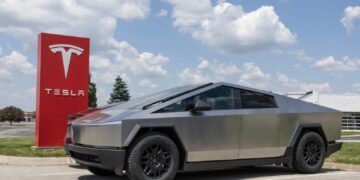














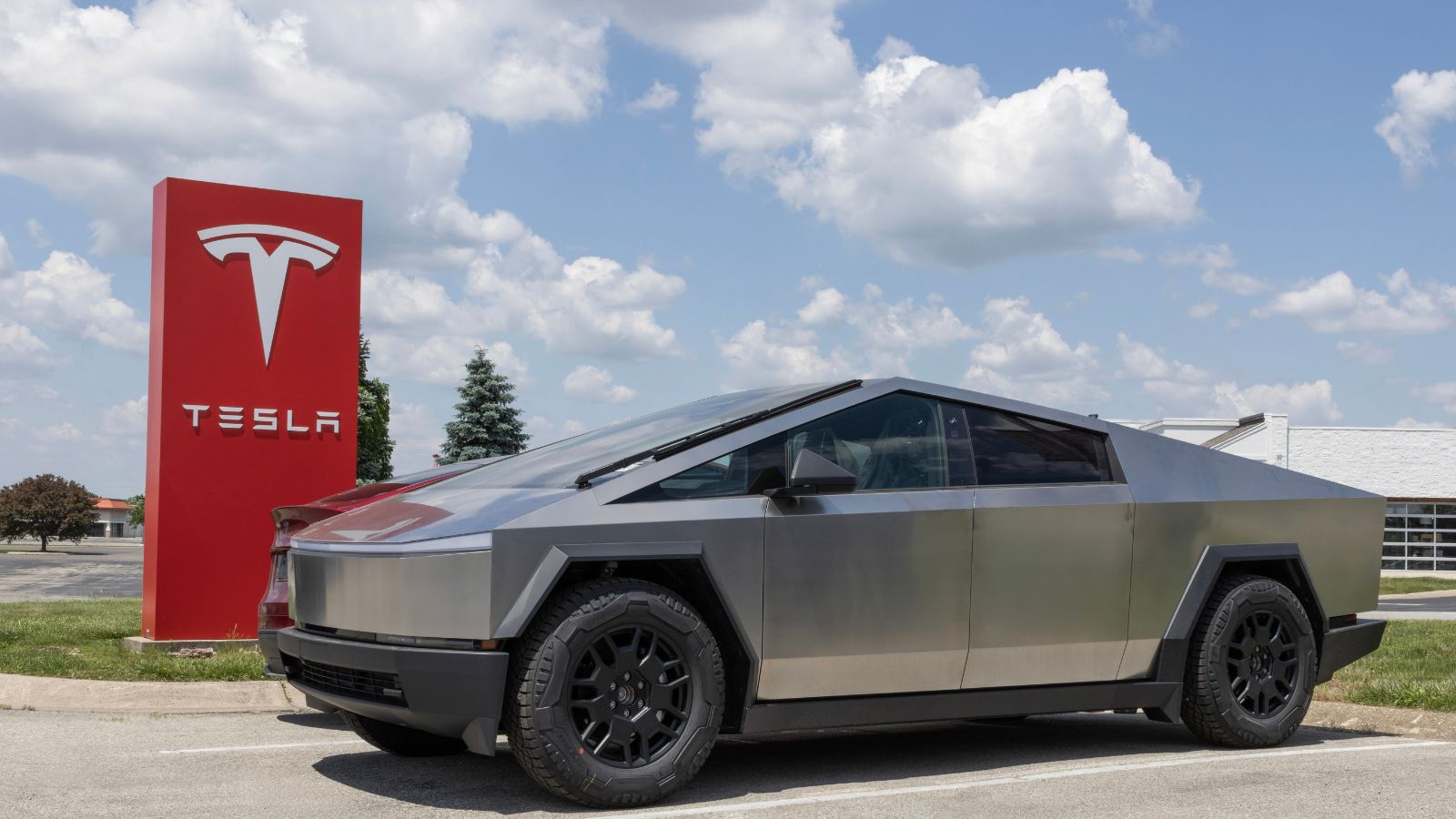
Few vehicles attract as much attention in a parking lot as Tesla’s Cybertruck. Yet one of the most practical changes to its 2027 model is intended to make those parking lots easier to navigate.
Tesla says new Cybertrucks can turn in a smaller space, and lead engineer Wes Morrill attributes the improvement to a modified steering rack with greater travel. He also claims the electric pickup can now turn more tightly than a Model Y—a striking comparison for a truck nearly 19 feet long.
The improvement combines new-model-year hardware with an eligible software release; it is not a confirmed upgrade for every Cybertruck already on the road. Tesla has not released a new official turning-circle measurement.
Tesla Demonstrates a Noticeably Tighter Turning Circle
Tesla revealed the change on November 21, 2026, through its official Cybertruck account, using an overhead video to compare the truck’s turning path before and after the improvement. The newer path forms a smaller circle, delivering a simple message that even drivers unfamiliar with steering geometry can understand. A vehicle that needs less room to reverse direction could be easier to manage in a crowded parking lot, a narrow driveway or a tight entrance.
The announcement was deliberately visual, but the footage has limits. Tesla did not provide a measured curb-to-curb figure, disclose the test conditions or publish a detailed engineering breakdown alongside the clip. The video supports the company’s claim that the new configuration turns more sharply; it does not establish the precise improvement in feet or metres. For a vehicle as unconventional as the Cybertruck, the distinction matters. The most useful result will ultimately be whether owners notice fewer awkward, multi-point manoeuvres in everyday driving.
Redesigned Steering Hardware Makes the Improvement Possible
The key detail came from Cybertruck lead engineer Wes Morrill, who said Tesla modified the steering rack for the 2027 model year to allow more travel. In practical terms, additional steering travel can permit a greater wheel angle, helping a vehicle follow a tighter path at low speed. That makes this more than an adjustment to the image shown on a touchscreen. The underlying hardware has changed, even though owners experience the improvement through the vehicle’s software-controlled steering system.
Morrill went further, saying the modified arrangement gives the pickup a better turning radius than a Model Y. His statement is important because it identifies a physical reason for the improvement rather than simply announcing a new setting. However, Tesla has not specified which steering component was revised in detail, how much additional travel it gained or whether both axles contribute differently than before. Without those figures, the mechanical explanation should remain narrow: the 2027 truck has a revised steering rack, and Tesla says that revision enables tighter turns.
The 2027 Cybertruck Now Claims to Out-Turn the Model Y
Tesla’s published Cybertruck owner’s manual lists an approximately 43.5-foot (13.25-metre) curb-to-curb turning circle. The current Model Y manual gives 39.8 feet (12.1 metres) for its five-seat and Performance versions, and 41 feet (12.5 metres) for the six-seat version. Those figures help explain why Morrill’s comparison drew attention. According to Tesla’s engineer, a full-size electric pickup can now turn more tightly than a crossover built for everyday family use, despite the considerable difference in their dimensions.
There is an important distinction between a turning circle and a turning radius. The manual’s 43.5-foot measurement describes the complete curb-to-curb circle, not the distance from its centre to the edge. Tesla has not updated that specification to reflect the 2027 hardware, so it would be misleading to treat the old number as the new one. Morrill also did not identify a particular Model Y configuration in his comparison. Until a revised specification or comparable independent test appears, the claim remains a company-reported performance improvement rather than a fully quantified measurement.
Four-Wheel Steering Gives the Large Pickup an Advantage
The Cybertruck’s ability to manoeuvre in surprisingly limited space begins with a feature most conventional pickups lack: steering at the rear wheels as well as the front. During a low-speed turn, the rear wheels angle in the opposite direction from the front wheels. That effectively helps the truck pivot through a smaller arc, reducing the room needed for manoeuvres such as turning around at the end of a street. Tesla lists the vehicle’s steering system as four-wheel directional steer-by-wire in its owner’s manual.
Rear-wheel steering was already part of the Cybertruck before the 2027 revision, so the announcement should not be confused with the addition of an entirely new system. Instead, the revised rack appears to expand what the existing architecture can achieve. The distinction is meaningful for drivers accustomed to long pickups, where large turning circles can make ordinary errands feel cumbersome. It also helps explain why the engineering update matters more at parking-lot speeds than on an open highway. Tesla has not detailed whether the latest modification changes the amount of rear-wheel movement, front-wheel movement or both.
Steer-by-Wire Technology Plays a Central Role
Unlike traditional steering arrangements, the Cybertruck uses steer-by-wire technology rather than a direct mechanical connection between the steering wheel and the road wheels. Sensors interpret the driver’s input and send electronic commands to steering actuators. Tesla says the design allows responsive steering with less effort at the wheel, while its manual describes redundant sensors and actuators intended to manage certain faults. This electronic architecture gives engineers flexibility in how steering input translates into wheel movement, although physical hardware still limits how far the wheels can turn.
That distinction helps explain the 2027 change. Software can alter commands within the steering system’s available range, but it cannot automatically create more mechanical travel in an earlier steering rack. The experience also has trade-offs: Consumer Reports praised the Cybertruck’s agility in road testing while noting that its very quick, non-linear steering response at lower speeds could feel unpredictable. The new announcement concerns a tighter turning path, not a verified overhaul of steering feel, emergency behaviour or high-speed handling. Those characteristics would require separate testing before drawing stronger conclusions.
Tesla Limits the Upgrade to 2027 Models With Newer Software
Tesla has attached two specific eligibility conditions to the tighter-turning feature. Its Cybertruck account says the vehicle must be a model-year 2027 example and run software version 2026.44 or newer. That means the rollout is not simply a software package that every Cybertruck will receive on equal terms. The eligible software activates or supports the capability, but the revised steering hardware supplies the additional travel identified by Morrill. A version number on its own is therefore insufficient to establish that a particular truck can use the new steering range.
For owners, the difference between the build year and the date a vehicle is purchased matters. A Cybertruck bought in 2027 is not necessarily a model-year 2027 truck, just as an earlier purchase could potentially have a later model-year designation. Buyers should confirm the actual vehicle specification and installed software rather than assuming eligibility from a sales date. Tesla has announced the feature’s rollout, but it has not published a detailed vehicle-identification guide or a precise turning-circle number for the updated configuration. That makes confirmation especially important when comparing otherwise similar trucks.
Earlier Cybertruck Owners May Miss Out on the Improvement
Owners of earlier Cybertrucks have a straightforward question: will the same software version give their trucks the tighter turn? Based on Tesla’s stated eligibility, the answer for this particular feature is no. The company explicitly restricted it to model-year 2027 vehicles, and Morrill identified the extra steering-rack travel as a hardware change. Older Cybertrucks still have the four-wheel steering that made the pickup relatively agile from its launch, but installing newer software does not establish that an older rack has gained additional mechanical movement.
The distinction is particularly relevant to used-vehicle buyers and existing owners who have become accustomed to Tesla improving cars remotely. Tesla has not announced a retrofit programme or described a way to reproduce the 2027 steering range on earlier trucks. That does not prove a future physical retrofit will never be possible; it means no such option has been confirmed. Drivers should therefore separate normal software maintenance from promises about this model-specific capability. A vehicle can receive other updates without becoming mechanically identical to the newest production version.
Tesla Previously Improved Cybertruck Turning Performance in 2024
This is not the first time Tesla has tried to make the Cybertruck easier to turn. In 2024, the company’s software release notes described an improvement of 1.6 feet to the truck’s turning circle. The change was achieved by increasing the turning angles available at both the front and rear wheels. It was an early demonstration of how electronically controlled steering could unlock more manoeuvrability from components already installed in customers’ vehicles, without requiring a completely new steering arrangement.
The 2027 revision represents a different kind of refinement. Instead of merely commanding the existing components to use more of their available range, Tesla says it has changed the rack itself to permit additional travel. Together, the two developments illustrate an important distinction in modern vehicle engineering: some gains come from updating software, while others depend on altered parts. They also offer context for Morrill’s Model Y comparison. Tesla has been working on the Cybertruck’s low-speed manoeuvrability for years, although it has not supplied a precise measurement that would let owners calculate the cumulative change across every model year.
Tighter Turning Could Make Parking and Daily Driving Easier
The practical attraction becomes clearer when the Cybertruck’s dimensions are considered. Tesla lists the pickup at about 223.7 inches long, or 5.68 metres, and approximately 95 inches wide with its mirrors extended. Those proportions do not disappear simply because the wheels can steer more sharply. But a smaller turning circle can make the difference between completing a U-turn in one movement and having to stop, reverse and try again. For drivers using shopping-centre parking areas, residential streets or tight worksite entrances, that could be genuinely useful.
There are still limits to what the improvement can accomplish. A curb-to-curb turning-circle figure describes the path of the wheels under a defined manoeuvre; it does not guarantee the truck’s body or mirrors will clear nearby walls, posts or parked vehicles. Rear corners can also sweep through space during a tight turn. The safest interpretation is therefore practical rather than miraculous: the updated steering may reduce the room needed for certain low-speed manoeuvres, but drivers must still judge their surroundings. Independent testing would be needed to show how much easier those everyday situations actually become.
Steering Upgrade Arrives as Cybertruck Faces an Uncertain Production Future
The timing makes the update unusually interesting. Earlier in November, Tesla CEO Elon Musk said the company intended to wind down Cybertruck production at its Texas factory to make room for more Cybercab manufacturing. On November 11, he said the schedule had been extended through the end of summer 2027 so Tesla could work through more of its order backlog. Those statements describe a future production plan, not an already completed shutdown, and the timetable could still change.
Against that backdrop, introducing revised steering hardware shows that Tesla is continuing to refine the pickup even as its longer-term production outlook is being reconsidered. For prospective buyers, the engineering achievement and the business questions are separate considerations. The essential points are clear: Tesla has announced a smaller turning circle for eligible 2027 Cybertrucks, its lead engineer credits a modified rack, and the company claims the resulting turn is tighter than a Model Y’s. What remains missing is an official new measurement and independent confirmation of the difference on the road. Until then, the improvement is promising but not yet fully quantified.