






















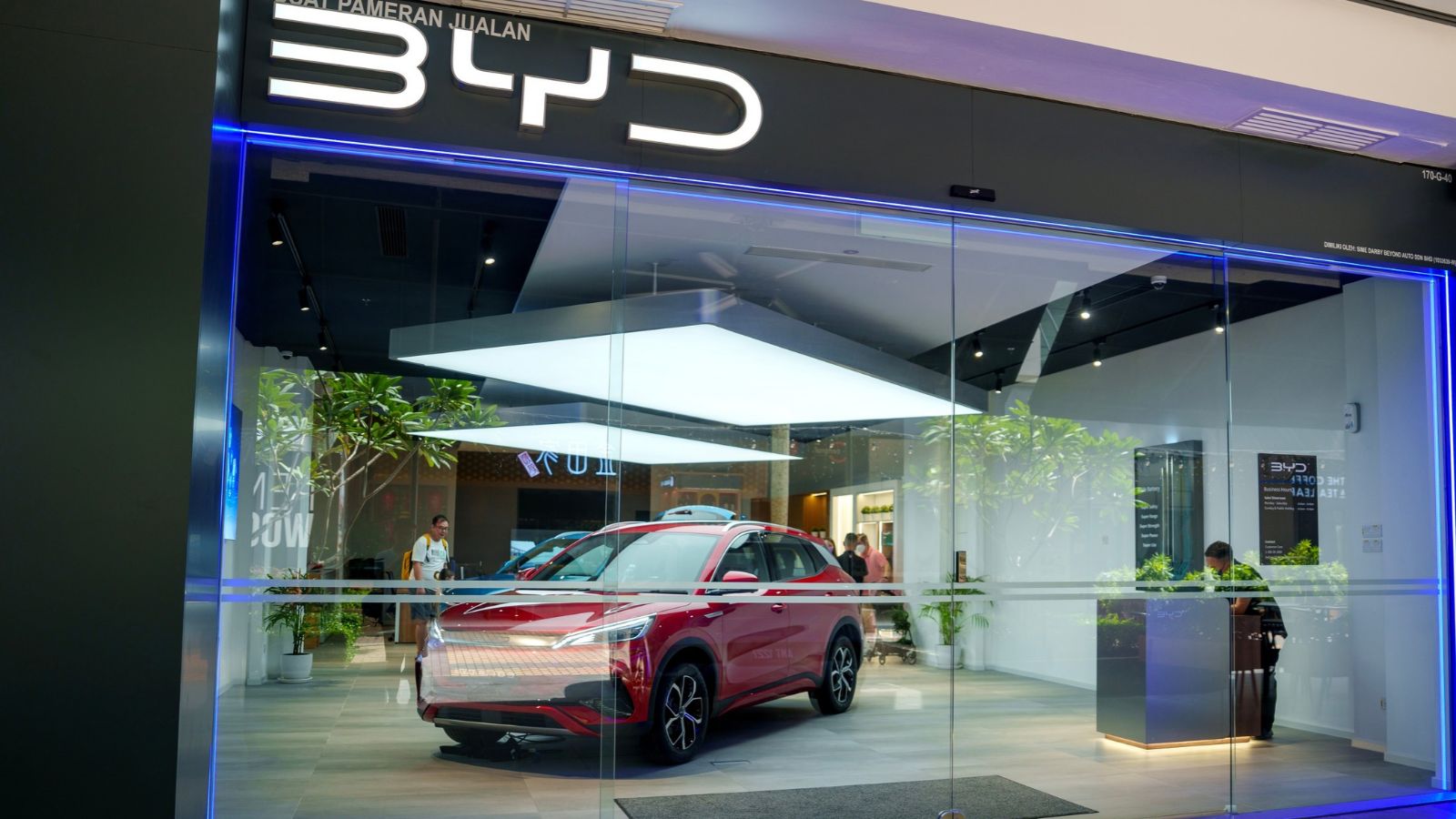
BYD’s international expansion is gathering momentum, but its anticipated arrival in Canadian showrooms remains a work in progress. The Chinese automotive giant reported 170,194 overseas vehicle shipments in October 2026, an increase of 102.8% from a year earlier. The surge helped support overall sales despite mounting competitive pressure in China’s domestic market.
For Canadian consumers, the figures highlight a growing contrast between BYD’s global ambitions and its unfinished local rollout. The company has publicly indicated plans to enter Canada, with reports outlining a potential dealership network. However, specific showroom openings, Canadian vehicle prices, and retail availability remain unconfirmed. As Ottawa opens the door to more Chinese-built electric vehicles, BYD’s latest results raise an important question: how quickly can international sales momentum translate into an established Canadian retail presence?
Overseas Shipments More Than Double in a Year
BYD’s October export figures illustrate how quickly its international business has expanded. The company shipped 170,194 new-energy vehicles overseas, compared with 83,904 during October 2025. That represents an increase of approximately 86,300 vehicles in just 12 months. Overseas shipments accounted for roughly 34.7% of BYD’s total October sales, compared with approximately 19% a year earlier. These figures are particularly significant because they show international markets becoming a much larger contributor to the company’s overall business, rather than simply providing additional sales beyond China.
However, the latest performance also requires some perspective. October shipments were lower than September’s 180,700 vehicles and August’s 189,466, meaning exports declined for a second consecutive month despite the impressive annual increase. That distinction matters when evaluating whether growth is accelerating or beginning to stabilize. BYD’s export statistics also do not identify individual destinations, so the 170,194 figure should not be interpreted as evidence of vehicle deliveries to Canada. It demonstrates international demand, not a confirmed Canadian launch.
China’s Competitive Market Is Creating Pressure at Home
BYD’s global expansion comes against a challenging backdrop in its domestic market. The automaker sold 490,168 new-energy vehicles worldwide in October, approximately 11% more than during the same month in 2025. It was BYD’s sixth consecutive month of year-over-year sales growth, although the rate of expansion slowed from September’s roughly 17% increase. The headline performance suggests continued momentum, but the underlying figures reveal how much international markets contributed to keeping the company’s overall sales moving higher.
After subtracting exports, BYD’s October domestic sales totalled approximately 319,974 vehicles, down 10.6% from a year earlier. China’s automotive industry has faced intense competition, aggressive pricing, and pressure on manufacturers to keep introducing newer technology. For a company operating at BYD’s scale, international markets can help absorb production and reduce reliance on Chinese consumers. Yet overseas expansion brings its own expenses, including shipping, distribution, regulatory compliance, and establishing local sales networks. Strong export growth does not automatically guarantee stronger profitability, particularly when manufacturers are competing heavily on price.
Battery-Electric Vehicles Are Outperforming Plug-In Hybrids
Another important development in BYD’s October results is the changing balance between fully electric vehicles and plug-in hybrids. The company sold 305,743 battery-electric passenger vehicles during the month, an increase of approximately 37.4% from October 2025. It was the first time BYD surpassed 300,000 battery-electric passenger vehicle sales in a single month, marking its third consecutive monthly record in that category. Fully electric models represented approximately 63.3% of the company’s passenger vehicle sales, compared with about 51% a year earlier. That shift suggests battery-electric vehicles are playing an increasingly important role in BYD’s growth.
Plug-in hybrids moved in the opposite direction. BYD sold 177,382 plug-in hybrid passenger vehicles in October, a year-over-year decrease of approximately 17.2%. Although these vehicles remain an important part of its product portfolio, their weaker performance highlights the challenge of managing demand across different technologies. For Canadian consumers, the distinction is relevant because fully electric vehicles and plug-in hybrids address different driving requirements. Some households prioritize eliminating gasoline purchases, while others value the flexibility of having a combustion engine for longer trips. BYD’s international product diversity could eventually give Canadian buyers more choices, but its domestic Canadian lineup has not been announced.
International Markets Are Becoming Central to BYD’s Growth
BYD’s October performance was not an isolated monthly achievement. Between January and October 2026, the company exported approximately 1.51 million new-energy vehicles, representing year-over-year growth of nearly 94%. That volume accounted for about 42% of the company’s 3.62 million worldwide vehicle sales during the ten-month period. The comparison demonstrates how dramatically BYD’s business has shifted toward international markets. It also helps explain why the manufacturer continues investing in distribution networks, new markets, and overseas production capabilities even while competition remains intense at home.
The importance of those overseas sales becomes clearer when examining BYD’s broader performance. Despite strong October results, worldwide vehicle sales for the first ten months of 2026 remained approximately 2.2% below the comparable period in 2025. International growth has therefore helped offset weakness elsewhere rather than delivering an uninterrupted expansion across every part of the business. For established automakers, entering another country involves more than finding customers willing to buy vehicles. It requires financing relationships, reliable logistics, local regulatory knowledge, and long-term support for owners. BYD’s export figures show that it can move vehicles across borders at scale, but they cannot establish how effectively a future Canadian dealership network would operate.
BYD’s International Strategy Goes Beyond Exporting Vehicles
BYD is also investing in manufacturing outside China, suggesting that its international strategy extends well beyond shipping finished vehicles to foreign dealerships. Brazil provides a particularly revealing example. The company opened its Camaçari automotive plant in Bahia in October 2025 and has been expanding operations as demand increases. In October 2026, Reuters reported that BYD was seeking permits to double the facility’s annual production capacity to 600,000 vehicles. The expansion involves additional manufacturing infrastructure, including stamping, welding, and painting facilities, as the company works toward increasing its use of locally sourced components.
The Brazilian investment demonstrates how entering a market can evolve into a much larger industrial commitment. BYD executives have described plans to source more than half of the components used in Brazilian production locally as the company moves into 2027. Local manufacturing can help an automaker navigate trade requirements, develop supplier relationships, and support regional expansion. Canada presents a different situation. Although BYD has explored Canadian opportunities, no comparable Canadian passenger-vehicle factory investment has been formally announced. Its Brazilian experience shows what a substantial international operation can eventually look like, but it would be premature to assume that Canada’s market will receive the same scale of investment.
Canadian Dealership Plans Have Progressed, but No Opening Is Confirmed
BYD’s Canadian retail ambitions have attracted considerable attention, particularly because dealership discussions have become more concrete. Dealer Solutions Mergers & Acquisitions, an automotive retail consultancy based in Markham, Ontario, has worked on identifying potential Canadian locations. Its chief executive, Farid Ahmad, described a target of approximately 20 dealerships during BYD’s first year of Canadian operations, with the Greater Toronto Area considered an initial priority. Vancouver, Montreal, and Calgary were also identified as prospective markets. Reuters subsequently reported in June that the company was exploring an initial group of six dealerships, citing the consultancy.
However, these figures represent reported plans rather than an officially announced network of operating showrooms. Reuters also interviewed BYD executive vice-president Stella Li, who indicated in June that the company was still deciding which models to introduce and that sales would likely begin in 2027. Confusion intensified when separate online reports falsely attributed a confirmed 2026 launch, specific models, and a C$25,000 starting price to Li. Those claims originated from an impersonator account and were later corrected. The distinction is essential: there is credible evidence of Canadian market preparation, but no verified Canadian dealership opening date, address, or finalized passenger-vehicle launch schedule.
BYD Has Established a Canadian Web Presence Without Opening Sales
One tangible indication of BYD’s Canadian preparations is its official Canadian website, which operates under BYD Canada Company Limited. The company’s published terms identify a business address at 60 Travail Road in Markham, Ontario, and provide information in English and French. These details demonstrate that BYD has established a formal Canadian web presence rather than relying entirely on international promotional material. However, the website primarily presents information about the company’s global operations, technologies, and vehicles. It does not provide a confirmed Canadian passenger-vehicle catalogue with local prices and dealer availability.
The company’s legal terms make an important distinction between its online presence and the ability to purchase a car. They state that the website does not currently support vehicle purchases, leases, financing applications, reservations, pre-orders, or deposits. BYD also indicates that its vehicles will be sold through approved, independently operated dealers rather than through transactions completed directly on the website. For prospective buyers, that matters because a Canadian website does not establish that a vehicle can be ordered or delivered. Until BYD identifies authorized retailers and publishes Canadian sales terms, potential customers have no company-confirmed passenger-vehicle purchase process to rely upon.
Canada’s Revised Trade Rules Create an Opening, Not a Guarantee
Canada’s evolving trade relationship with China has created a potential pathway for manufacturers such as BYD. Beginning March 1, 2026, Ottawa replaced its previous 100% surtax on Chinese-made electric vehicles with a tariff-rate quota system. Under the arrangement, up to 49,000 eligible Chinese-built electric vehicles can enter Canada annually at the regular 6.1% most-favoured-nation tariff rate. The federal government described that volume as less than 3% of Canada’s annual new-vehicle market. The change significantly reduces a major trade barrier, making Canadian sales more commercially plausible for Chinese manufacturers.
However, the quota is not a guaranteed allocation for BYD or any other individual brand. Importers must obtain the necessary shipment-specific permits, and access to the quota is administered on a first-come, first-served basis. Vehicles also remain subject to applicable Canadian safety and regulatory requirements. As a result, the revised tariff rules should be viewed as an opportunity rather than confirmation of an imminent launch. A manufacturer still needs a compliant product, a viable distribution network, and a competitive retail price before Canadian consumers can purchase its vehicles.
Vehicle Certification and Dealer Support Still Matter
Before BYD can establish a meaningful Canadian passenger-vehicle presence, it must navigate the country’s vehicle certification and distribution requirements. Reuters reported in June that records showed BYD had begun import-related regulatory preparations involving two passenger vehicles produced at facilities in Shenzhen and Xi’an. The development was a meaningful indication of market planning, but preliminary regulatory activity should not be confused with confirmation that specific models are approved for Canadian retail sale. Vehicles sold in Canada must comply with applicable Canadian Motor Vehicle Safety Standards, while dealers must meet the licensing or registration obligations established by their respective provinces.
The practical requirements extend beyond government paperwork. Canadian buyers expect replacement parts, trained service technicians, warranty assistance, financing options, and dependable access to repairs. In Ontario, for example, motor vehicle dealers and salespeople must be registered with the Ontario Motor Vehicle Industry Council. These obligations are particularly important for a brand entering a market where consumers may have little previous experience with its passenger vehicles. A competitively priced electric car can attract interest, but the ability to obtain a replacement windshield, resolve a battery-related problem, or receive timely warranty service can determine whether customers remain satisfied long after leaving the showroom.
Canada’s EV Market Offers Opportunity, but Buyers Need Concrete Answers
Canada’s electric-vehicle market continues to offer opportunities despite changing incentives and uneven regional demand. Statistics Canada recorded 58,811 new zero-emission vehicle registrations during the second quarter of 2026, an increase of 26.7% from the corresponding period in 2025. Zero-emission vehicles represented 10.7% of all new vehicle registrations during that quarter. Those figures demonstrate that a substantial consumer market exists for manufacturers capable of offering competitive vehicles. Nevertheless, pricing comparisons require care. Canada’s 2026 federal Electric Vehicle Affordability Program offers incentives of up to C$5,000 for eligible battery-electric vehicles, but eligibility depends partly on where the vehicle was manufactured. Chinese-built vehicles do not qualify under the program’s manufacturing-country requirements.
For BYD, international shipment records provide evidence of production and export capabilities, but Canadian success will ultimately depend on details that have yet to be finalized publicly. Buyers need confirmed models, Canadian specifications, transparent pricing, dealership locations, warranty coverage, and reliable service arrangements. They also need an official timeline rather than speculation circulating through automotive websites or social media. Until those announcements arrive, BYD’s 170,194 overseas shipments remain a significant indicator of its global expansion—not proof that Canadian showrooms are ready to open. The opportunity is increasingly visible, but the country’s prospective customers are still waiting for the practical details that turn international ambitions into vehicles available for purchase.