











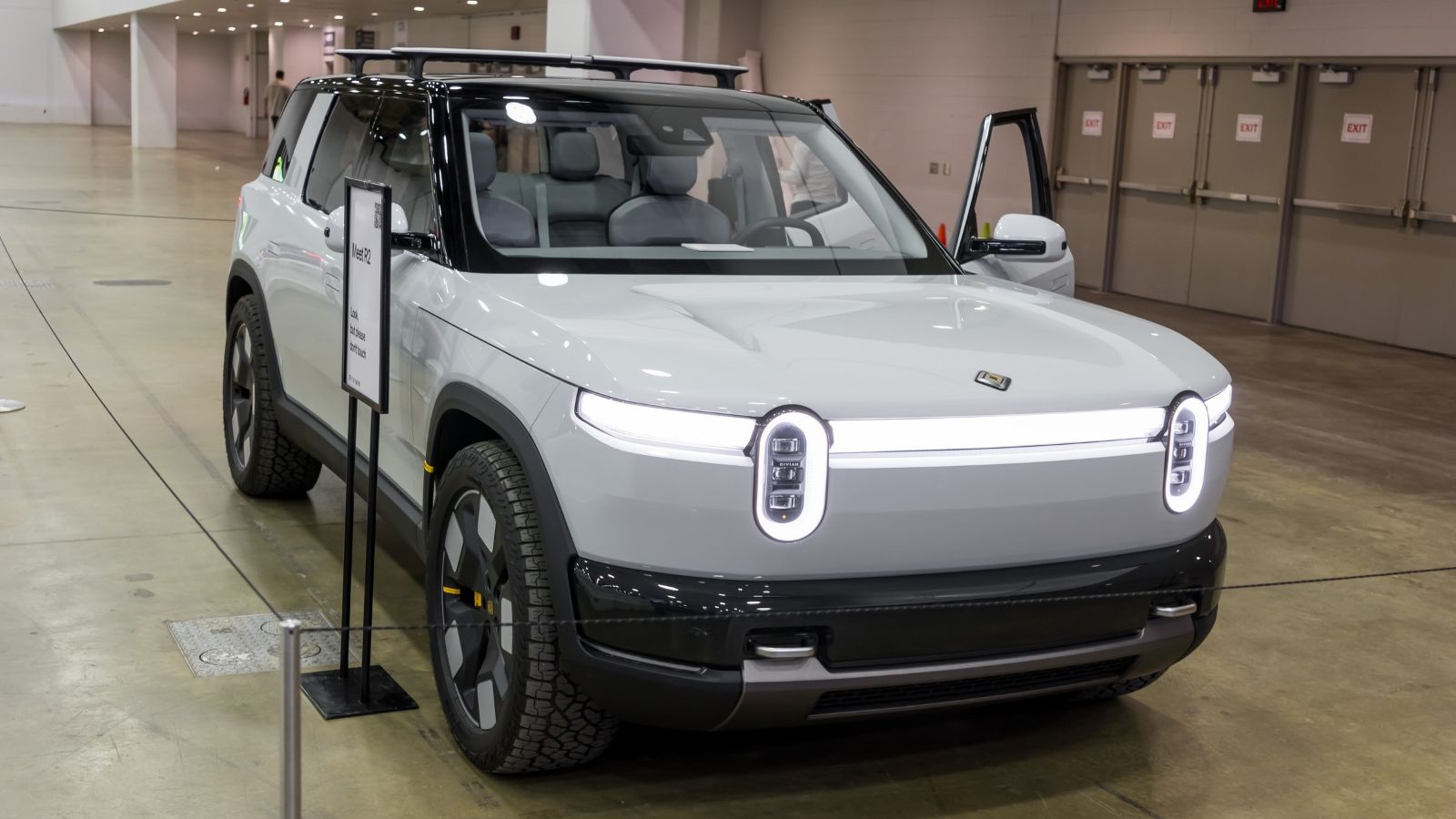
Rivian has reached a major milestone with its newest electric SUV, but the company’s financial challenges are far from over. In the third quarter of 2026, the R2 became Rivian’s best-selling vehicle by volume, helping the American automaker achieve record deliveries of 19,248 vehicles. Revenue climbed 38% to US$2.155 billion, yet Rivian still reported a US$913 million quarterly net loss attributable to common stockholders, highlighting the enormous cost of expanding an electric vehicle business.
For Canadian buyers, the excitement comes with a longer wait. The R2 is already gaining traction in the United States, while its Canadian arrival remains scheduled for 2027. The contrasting sales and financial results raise an important question about whether Rivian’s more accessible electric SUV can finally transform strong customer interest into sustainable profitability.
R2 Became Rivian’s Bestseller Almost Immediately
When Rivian began delivering the R2 to customers in June 2026, the midsize SUV was expected to widen the company’s appeal. Its first full sales quarter delivered an unusually quick result. Between July and September, the R2 outsold Rivian’s established R1 consumer vehicles and electric delivery vans, making it the company’s best-selling vehicle by volume. Rivian has not disclosed an exact R2 delivery count, so the 19,248 vehicles delivered company-wide should not be mistaken for R2 sales alone. What is clear is that the new model rapidly became central to Rivian’s business.
Other demand signals were encouraging. Chief executive RJ Scaringe said conversions from reservations for the R2 Launch Edition remained above expectations. Rivian also conducted more than 103,000 demonstration drives during the quarter across its R1 and R2 vehicles, up from more than 57,000 in the previous quarter. Those figures suggest growing opportunities to turn curiosity into purchases, although demonstration drives are not the same as orders. Early customers may be particularly enthusiastic about Rivian’s brand. The more demanding test will come when the company must persuade families and commuters who are comparing the R2 against familiar alternatives.
Record Production Put the Illinois Factory to Work
The R2’s arrival was visible in the numbers coming out of Rivian’s factory in Normal, Illinois. The company built 19,751 vehicles during the third quarter, up from 12,613 in the second quarter. Deliveries climbed from 12,194 to 19,248 over the same period, an increase of roughly 58%. Compared with the third quarter of 2025, deliveries rose 46%. These are totals across Rivian’s vehicles, not a separate R2 production report, but they show how dramatically the company’s manufacturing and distribution pace changed as the new SUV entered full-quarter sales.
Rivian also started a second R2 production shift at Normal, a significant step for a factory that must share its resources across consumer vehicles and commercial vans. Increasing output can help spread equipment, staffing and other fixed costs across more vehicles, although those benefits do not appear automatically. New shifts require training, dependable parts deliveries and consistent quality control. For a buyer waiting on an R2, a production record is more than a corporate milestone: it can eventually mean more vehicles to choose from and a shorter queue. Rivian still has to demonstrate that the faster pace can be maintained without sacrificing efficiency.
The $913 Million Loss Was Smaller, Not Small
The headline loss looks alarming beside Rivian’s sales success, but the comparison with a year earlier provides some perspective. Rivian reported a third-quarter 2026 net loss attributable to common stockholders of US$913 million, down from US$1.173 billion in the comparable 2025 quarter. That represents a US$260 million improvement, even though the company remains deeply unprofitable. Its consolidated net loss was US$907 million; the slightly higher headline figure reflects the amount attributable to common stockholders. Keeping that accounting distinction clear matters when comparing different reports on the same results.
Several other figures point in the same direction without suggesting the problem has been solved. Rivian’s adjusted earnings before interest, taxes, depreciation and amortization, or EBITDA, showed a US$435 million loss, versus US$602 million a year earlier. The company also generated US$176 million in consolidated gross profit, but that figure comes before substantial operating expenses. Research and development alone cost US$485 million in the quarter, while selling, general and administrative expenses reached US$572 million. Put simply, producing and selling vehicles at a better gross margin does not yet cover the broader costs of developing technology, running the business and building for future demand.
The R2 Ramp Is Still Costing Rivian Money
Rivian’s automotive business generated US$1.55 billion in third-quarter revenue, a 36% year-over-year increase, yet the segment still recorded a US$80 million gross loss. That was an improvement from its US$130 million automotive gross loss a year earlier, but worse than the US$36 million gross loss reported in the immediately preceding quarter. The contrast captures a familiar problem with new vehicle programs: a factory can deliver more cars while incurring substantial expenses to get those cars built efficiently. Rivian attributed approximately US$120 million in incremental quarterly costs to the R2 production ramp compared with more normalized manufacturing conditions.
Management described those extra costs as including underused capacity in a two-shift operation and expenses such as expedited freight. At the same time, executives emphasized that the R2 is less expensive to manufacture than Rivian’s larger vehicles, making it important to the company’s efforts to lower overall production costs. Rivian also booked US$81 million in automotive regulatory-credit revenue and benefited from a tariff-refund receivable. Those items improved the reported result but should not be confused with recurring profit from vehicle sales. The central challenge is reducing ordinary production costs enough that a growing R2 customer base strengthens margins without relying heavily on credits or refunds.
Volkswagen and Software Are Helping Carry the Business
An important part of Rivian’s improving financial picture comes from outside its vehicle assembly lines. Its software and services segment produced US$605 million in third-quarter revenue, up 45% from a year earlier, and US$256 million in gross profit. That equates to a 42% gross margin, contrasting sharply with the automotive segment’s continuing gross loss. The division includes vehicle software development, electrical architecture work, maintenance services and paid features such as Autonomy+. It is therefore more varied than a simple subscription business, and it gives Rivian a second source of revenue while its manufacturing operations mature.
Volkswagen is especially important to that story. Rivian said US$354 million, or 59% of the segment’s quarterly revenue, was attributable to its joint venture with the German automaker. The relationship centres on vehicle technology that can be used beyond Rivian’s own products. As a result, the company’s consolidated gross profit reached US$176 million despite the loss in automotive operations. The arrangement demonstrates that Rivian can generate value from its engineering expertise, but it also creates a concentration worth watching: a substantial share of the software division currently depends on one major partner. Strong technology revenue helps finance growth; it does not erase the need to improve vehicle profitability.
Cash Burn Remains a Serious Pressure Point
For a growing automaker, the cash leaving the business can be as revealing as the reported accounting loss. Rivian recorded negative free cash flow of US$1.124 billion in the third quarter, compared with a US$421 million outflow a year earlier. Its operations used US$758 million in cash, and capital spending accounted for another US$366 million. Rivian said the operating cash outflow was influenced by working-capital changes, including inventory purchases connected to the R2 launch. Building vehicles and stocking parts before customer deliveries can tie up considerable money, even in a period when sales are climbing.
Rivian ended September with US$5.502 billion in cash, cash equivalents and short-term investments. Including borrowing capacity and an additional US$1 billion Volkswagen-related loan funded after quarter-end, the company calculated pro forma available liquidity at US$7.095 billion. Management has also discussed further potential funding from partners and a U.S. government loan, but those amounts depend on conditions and are not the same as cash already in the bank. That distinction matters because Rivian is simultaneously expanding production, developing technology and preparing future facilities. The R2’s success must ultimately translate into healthier cash generation, not just more impressive delivery reports.
A Broader Lineup Is Central to the R2 Strategy
Rivian designed the R2 as a more accessible alternative to its larger R1 vehicles, although its initial U.S. offering still sits well above the price of an entry-level car. The R2 Performance currently starts at US$57,990 before applicable fees and taxes. A US$53,990 Premium version is scheduled for late 2026, while Rivian advertises a Standard version starting at US$44,990 for late 2027. These are U.S. prices, not Canadian figures, and the least expensive advertised version is not yet available. That rollout helps explain why the R2 can already be a bestseller while its broader affordability ambitions remain a work in progress.
The practical differences matter as much as the sticker price. Rivian describes the R2 as a five-seat midsize SUV, compared with the three-row, seven-seat R1S. That configuration gives it a more natural role as an everyday family vehicle, particularly for households that do not need a larger luxury SUV. The company is also counting on the R2’s familiar Rivian styling and adventure-focused features to distinguish it from conventional crossovers. Yet early demand for a higher-priced launch model cannot guarantee equal enthusiasm for later trims. Rivian must deliver competitive equipment, reliable production and a convincing ownership experience across the lineup if the R2 is to reach buyers beyond its existing fan base.
Canadian Buyers Have a 2027 Timeline, Not a Delivery Date
The strong U.S. sales result does not mean the R2 is about to arrive in Canadian driveways. Rivian’s Canadian website continues to describe the vehicle as coming in 2027, a change from the earlier 2026 expectation. In July, reports based on emails sent to Canadian reservation holders said the first order invitations were expected in the first half of 2027. That is useful guidance for people who put their names down early, but an invitation to configure an SUV is not the same as a guaranteed delivery appointment. Rivian has not provided an exact Canadian delivery date that prospective owners can rely on.
Pricing is another unresolved piece. Rivian previously displayed a starting figure of C$66,500 for the Canadian market, then removed it as the timeline shifted. Its current Canadian R2 page accepts reservations with a refundable C$150 deposit but does not publish a final Canadian vehicle price. That makes a straightforward conversion from U.S. pricing misleading: exchange rates, equipment choices, freight charges and trade-related costs can all affect what buyers eventually pay. For Canadian households comparing a new electric SUV with an existing vehicle, the wait involves more than patience. A firm order window, a real Canadian price and a dependable handover schedule are essential before a purchase decision becomes concrete.
Range, Charging and Winter Use Will Shape Canadian Demand
The R2 has several specifications that should interest Canadian SUV shoppers once sales begin. Rivian’s Canadian site lists estimated range figures of 531 kilometres for the Premium and Performance configurations and 442 kilometres for the base Standard version, with equipment affecting the final result. It also lists 245 millimetres of ground clearance and towing capacity of up to 2,000 kilograms when appropriately equipped. These figures suggest a vehicle intended for commuting, family trips and occasional outdoor use rather than simply providing brisk electric acceleration. However, final specifications and driving range can vary by trim, weather and conditions.
Charging access is equally important. Rivian says every R2 has a North American Charging Standard port and can use more than 21,000 Tesla Superchargers across the United States and Canada. It advertises a 10% to 80% fast-charge time of under 30 minutes under suitable conditions. Canadian winters introduce another practical question. In a 2025 Canadian Automobile Association test of other electric models, vehicles travelled 14% to 39% less than their published range in sub-zero temperatures. The R2 was not part of that study, so those losses cannot be assigned to it. For buyers in colder regions, real R2 winter testing, local charging coverage and service access will matter alongside the brochure figures.
Rivian’s Next Test Is Turning Growth Into Profit
Rivian responded to the strong quarter by lifting the lower end of its 2026 delivery forecast. It now expects 67,000 to 70,000 deliveries for the year, compared with its previous estimate of 65,000 to 70,000. Management expects the R2 to account for a majority of deliveries in the fourth quarter. It also narrowed its projected full-year adjusted EBITDA loss to between US$1.75 billion and US$1.85 billion, while reducing capital-expenditure guidance to US$1.4 billion to US$1.5 billion. These are improved forecasts, but they still describe a business committing significant resources to expansion.
One near-term target deserves particular attention: Rivian expects to finish 2026 operating at a positive automotive gross-profit rate. Company executives clarified that this does not mean they expect the entire fourth quarter to show positive automotive gross profit. The distinction is important because profitability at a year-end production rate is only an early step toward sustaining positive results over a full reporting period. For Canadians, the implications stretch into 2027. If Rivian can keep increasing R2 output while reducing costs, its delayed launch could benefit from a more established product. If margins, production or pricing disappoint, demand alone will not settle the questions surrounding its next chapter.