






















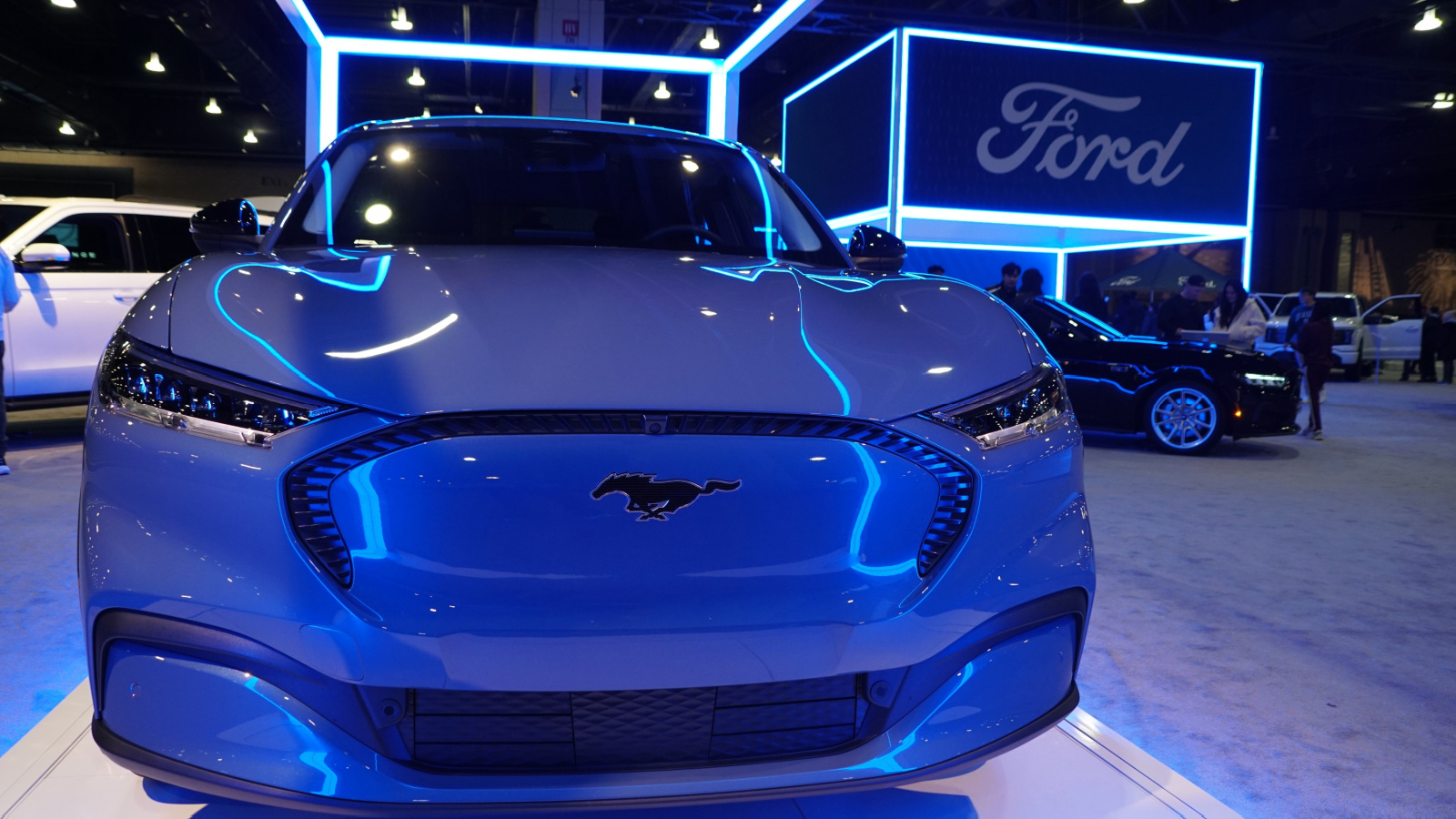
Ford’s Mustang Mach-E is heading into 2027 with a meaningful battery rethink: the smaller 73-kWh pack is being removed, while Select and Premium models move to the larger 88-kWh battery as standard. Canada is also being teased with a new Trail Package aimed at buyers who spend time beyond smooth pavement.
The headline numbers, however, need important context. The 515-km estimate is a genuine Ford Canada figure for a 2026 Premium extended-range rear-wheel-drive configuration, and $48,995 appears in 2026 Canadian trim data, but Ford has not yet published official 2027 Canadian range or pricing. As of October 23, Ford Canada still lists the 2026 Mach-E from $46,590. The hardware update is real; the final Canadian 2027 price-and-range picture is still taking shape.
The 73-kWh Battery Is Going Away for 2027
The biggest mechanical change is also the easiest to understand. For the 2027 Mustang Mach-E, Ford is eliminating the 73-kWh standard-range battery that has served as the lower-cost option in Select and Premium models. Those trims move to an 88-kWh usable-capacity pack as standard, while GT and Rally versions continue with a larger 91-kWh battery. In practical terms, Ford is simplifying the lineup around batteries that previously sat higher in the range. That means a shopper should no longer have to choose a base Mach-E and then accept a smaller pack simply to keep the initial price down.
The shift matters in Canada because battery size is closely tied to how comfortable an EV feels outside major cities, especially when weather, highway speeds and cabin heating can reduce real-world range. Ford has not yet released official Canadian 2027 range ratings, so it would be premature to attach a new kilometre figure to every version. Still, removing the 73-kWh option changes the starting point. Rather than treating extended range as an upgrade on the mainstream trims, Ford is making the larger pack part of the basic 2027 proposition, which should make the Select and Premium easier to explain on a showroom floor.
The 515-KM Number Is Real — But It Belongs to 2026
Ford Canada does publish a 515-kilometre estimated range for the Mustang Mach-E, but that number currently belongs to the 2026 Premium with the 88-kWh extended-range battery and rear-wheel drive. The same official specification page lists 406 km for a standard-range rear-wheel-drive model and 380 km for standard-range eAWD. With the extended-range battery and eAWD, the estimate is 483 km. Those differences show why a single headline range number can hide a great deal of configuration detail: adding a second drive motor can improve traction and performance while also changing energy consumption.
For buyers, 515 km remains a useful benchmark because it shows what Ford’s existing 88-kWh hardware can already deliver under Canada-approved testing. It should not, however, be presented as Ford’s confirmed rating for the 2027 model year. Ford has not released those Canadian figures yet, and changes in wheels, tires, calibration, drivetrain or equipment can affect certification results even when battery capacity stays the same. The sensible takeaway is that the outgoing 2026 lineup demonstrates the potential of the larger battery, while the exact 2027 range must wait for Ford’s official Canadian specification sheet.
The $48,995 Figure Needs Model-Year Context
The price story is similarly easy to misread. Ford Canada previously listed a 2026 Mustang Mach-E Select eAWD with the 73-kWh standard-range battery at an MSRP of $48,995. That figure is therefore a legitimate Canadian Mach-E price, but it is not a confirmed starting price for the new 2027 lineup. Ford’s current Canadian showroom now lists the 2026 Mustang Mach-E from $46,590, reflecting a newer pricing structure than the earlier comparison page. In other words, $48,995 and 515 km are both real Canadian numbers, but they describe different configurations and should not be combined into one promised 2027 specification.
That distinction becomes especially important when model-year changeovers overlap with inventory clearances, incentives and revised manufacturer pricing. A shopper may see one number in an older comparison tool, another on a current build page and a third on a dealer vehicle already in stock. For 2027, the cleanest fact is that Canadian MSRP has not yet been published. Ford has opened the next chapter by announcing the larger standard battery and promoting the Trail Package in Canada, but the company still needs to provide the local price sheet before anyone can say exactly what the least-expensive 2027 Mach-E will cost.
Standard Extended Range Changes the Value Equation
Making the 88-kWh pack standard on Select and Premium changes more than a specification line. In the 2026 lineup, the smaller 73-kWh battery helped create a lower entry point, while the larger pack was tied to configurations aimed at drivers willing to pay more for additional range. For 2027, Ford is collapsing that distinction. A buyer considering an entry-level Mach-E should be getting the larger battery without first climbing to a separate extended-range configuration, at least based on the product structure Ford has announced for the new model year.
That can make comparisons with rival electric crossovers simpler because battery capacity and usable driving range are among the first figures shoppers tend to weigh. It also reduces the chance of a buyer discovering after purchase that the least-expensive version carries a materially smaller pack than the one highlighted in advertising. There is a trade-off, however: larger batteries cost money and add weight, so the real value depends on Ford’s eventual Canadian MSRP and equipment packaging. The company’s U.S. announcement points to a cheaper entry into an extended-range Mach-E than before, but Canadian pricing cannot be inferred directly from U.S. dollars, taxes, destination charges or market-specific incentives.
The Trail Package Gives the Mach-E a New Personality
Ford is also broadening what a Mach-E is supposed to do. The new 2027 Trail Package is based on the Select eAWD and is intended for gravel roads, dirt tracks, trailheads and other light off-pavement use rather than serious rock crawling. Ford Canada is already promoting the package with rugged styling, all-season tires and 400-watt Pro Power Onboard. More detailed launch information says the suspension is raised by 10 millimetres at the front and 15 millimetres at the rear, while the package borrows the Rally model’s steering rack, 19-inch wheels and Michelin CrossClimate 2 tires.
That combination gives the Mach-E a more outdoors-oriented role without turning it into a battery-electric Bronco. The 400-watt power supply is modest compared with the high-output onboard systems found in some electric pickups, but it is enough for small campsite accessories, lights or portable gear. The package also illustrates how Ford is trying to stretch one EV platform across different lifestyles: Select remains the mainstream starting point, GT and Rally focus on speed and performance, and Trail introduces a softer adventure theme. Ford has announced a US$2,295 Trail Package price in the United States, but Canadian package pricing has not yet been released.
A Redesigned Front Motor Targets Lower Costs
One of the more consequential 2027 changes is largely invisible from the driver’s seat. Ford has developed a redesigned front electric motor for all-wheel-drive Mach-E models that is intended to match the performance of the previous unit while costing less to produce. That kind of change rarely earns the attention of a new colour or a lifted suspension package, but it speaks directly to one of the toughest problems facing established automakers: making EVs less expensive without simply stripping away equipment or shrinking the battery.
If the new motor delivers the same job with fewer manufacturing costs, Ford gains room to improve margins, hold pricing or redirect money toward other features. It is also a reminder that EV cost reduction is increasingly happening inside components customers may never see. Battery chemistry gets most of the attention, yet motors, inverters, wiring, software and assembly processes all shape the final sticker price. For Canadian buyers, the important caveat is that lower production cost does not automatically guarantee a lower MSRP. Exchange rates, logistics, tariffs, equipment levels and incentive rules can all influence local pricing, so the redesigned motor is best viewed as an efficiency move until Ford publishes the Canadian 2027 price list.
BlueCruise 1.5 Pushes the Tech Story Forward
The 2027 update also leans more heavily on software. Ford says BlueCruise 1.5 will be standard on GT and Rally in the announced U.S. packaging and available on Select, Premium and the Select-based Trail. Version 1.5 adds Automatic Lane Change, allowing an equipped vehicle to initiate certain lane changes without the driver touching the turn signal when the system determines conditions are suitable. Earlier BlueCruise features already combine adaptive cruise control and lane centering for hands-free operation on mapped divided highways, making long highway drives the kind of environment where the technology is most noticeable.
The word “hands-free” still needs a clear boundary. Ford describes BlueCruise as a driver-assistance system, not full self-driving technology. A driver-facing camera monitors attention, and the person behind the wheel must keep eyes on the road and be prepared to resume control. That matters in a vehicle whose marketing can make the technology sound almost effortless. Ford already offers BlueCruise hardware and service choices on current Mach-E models, but Canadian 2027 subscription terms and trim packaging should be checked once the local configurator goes live. The meaningful upgrade is convenience, not a transfer of responsibility from the driver to the car.
Charging Still Matters as Much as the Bigger Battery
A larger standard battery solves only part of the ownership equation. The current Canadian 2026 specification sheet shows that the 73-kWh rear-wheel-drive model takes about 7.8 hours to charge from zero to 100 per cent on a 48-amp, 240-volt charger, while the eAWD version is listed at 7.7 hours. Ford lists 9.9 hours for the 91-kWh GT and Rally under the same type of home-charging setup. Those figures are useful context, but Ford has not yet published equivalent Canadian charging times for the 2027 Select and Premium with their now-standard 88-kWh packs.
Public charging access is just as important on road trips. Ford Canada sells a NACS fast-charging adapter for 2024–2026 Mach-E models, reflecting the broader shift toward access to NACS-equipped infrastructure alongside other public charging options. For a household that plugs in overnight, a bigger battery can feel almost invisible during the workweek because the car starts each morning replenished. On a long winter drive, charging speed, charger availability and battery temperature can matter as much as the laboratory range figure. That is why the eventual 2027 Canadian charging specifications deserve the same attention as the headline kilometre estimate.
Canadian Incentives Could Move the Effective Price by Thousands
Sticker price is only part of the Canadian affordability story. Under the federal Electric Vehicle Affordability Program, eligible battery-electric vehicles can receive an incentive of up to $5,000 in 2026. That amount falls to $4,000 in 2027, and the government says the applicable amount depends on when the dealer submits the eligibility assessment, not the vehicle’s model year or delivery date. For vehicles not made in Canada, the program generally requires a final transaction value of $50,000 or less and production in Canada or a country with a free-trade agreement with Canada.
That timing creates an unusual comparison for Mach-E shoppers. A discounted 2026 vehicle purchased while the higher federal incentive is available could end up costing materially less out of pocket than a newer 2027 version, even if the latter has a larger standard battery. Ford Canada is already advertising examples that incorporate the $5,000 federal incentive on qualifying 2026 Mach-E transactions. Provincial programs can add another layer where available; Ford’s Quebec information, for example, points to a combined federal and provincial amount of up to $7,000 on eligible configurations under current rules. The best deal may therefore depend as much on purchase date and transaction value as on model-year specifications.
Canadian Shoppers Still Need the Final 2027 Numbers
The most important missing information is now straightforward: Canada still needs official 2027 Mustang Mach-E pricing, certified range figures and full trim-by-trim packaging. Ford Canada is openly advertising the 2027 Trail Package and inviting shoppers to get updates, yet its build-and-price showroom currently continues to list the 2026 Mach-E, starting at $46,590. Canadian automotive coverage published alongside the 2027 announcement likewise notes that Ford’s Canadian site has not yet been fully updated with the new model-year data. That makes any claim of a confirmed $48,995 Canadian 2027 starting price premature.
What is already clear is the direction Ford is taking. The small 73-kWh battery is disappearing, the 88-kWh pack becomes the mainstream choice, GT and Rally retain 91 kWh, a Trail variant adds light-duty adventure hardware, and Ford is working on lower-cost drivetrain components and newer driver-assistance software. For someone shopping today, the decision becomes a familiar model-year dilemma: a 2026 Mach-E has known Canadian prices, ranges and potentially stronger 2026 incentives, while the 2027 promises better standard battery hardware but still carries unanswered local pricing questions. Until Ford posts the Canadian configurator, those two propositions should be compared rather than blended together.