























Canada’s commercial electric-vehicle shift is beginning to look less like a collection of demonstrations and more like an actual truck business. RIZON, an all-electric medium-duty brand launched in North America, expanded its Canadian sales footprint through a partnership with commercial-truck dealer Globocam, adding three locations across Quebec and Ontario. The move coincided with the arrival of RIZON’s first substantial shipment of Class 4 and Class 5 trucks for Canadian customers. It also put the brand closer to fleets in two of the country’s biggest transportation markets. The expansion was not, however, RIZON’s first Canadian dealer presence: six locations were already operating in British Columbia. What Quebec and Ontario represented was the next stage of a broader attempt to make electric work trucks easier to buy, service, charge and deploy.
The Quebec-Ontario Move Was an Expansion, Not the Starting Point
RIZON formally announced its Canadian entry in April 2024, with preorders scheduled to begin that June. By October, the company said its first shipment of 12 trucks from a 22-vehicle order had reached British Columbia, with the remaining 10 expected the following month. Nineteen of those vehicles were slated for customers in British Columbia and Quebec after being fitted with bodies such as dry boxes, service bodies and landscape dumps. Three were intended for demonstrations. Customers identified by the company included municipalities, rental and leasing businesses, and freight and logistics operators.
At the same time, RIZON announced its partnership with Globocam, a major commercial-truck dealer in Quebec. The agreement added three dealer locations across Quebec and Ontario to six existing locations in British Columbia. That distinction matters because the expansion was not simply a symbolic Canadian launch. Vehicles were arriving, upfitters were preparing them for work, and local sales and service points were being established near potential fleet customers. The strategy reflected the commercial-truck market’s practical reality: a fleet may be interested in an electric vehicle, but interest means little without nearby parts, technicians, charging advice and after-sales support.
RIZON’s Corporate Identity Is More Global Than the Headline Suggests
RIZON first appeared publicly at the Advanced Clean Transportation Expo in Anaheim, California, in May 2023. Daimler Truck introduced it as a new brand aimed at the U.S. Class 4 and Class 5 commercial-vehicle market, initially using Velocity Vehicle Group to build sales and service coverage. Its first U.S. vehicles subsequently received federal and California regulatory approvals, and deliveries began in California. That U.S. debut is why RIZON is often discussed as an American-market electric-truck brand, even though describing it simply as an independent U.S. manufacturer misses an important part of the story.
Its corporate structure has since changed. As of April 2026, Mitsubishi Fuso and Hino Motors operate under the new ARCHION holding company, and RIZON is now part of that structure. RIZON’s current corporate information says its trucks are engineered and manufactured by Mitsubishi Fuso under ARCHION and assembled in Japan. Daimler Truck and Toyota each planned to retain roughly 25% stakes in ARCHION following the integration. For Canadian fleet buyers, the significance is less about corporate geography than industrial backing: RIZON entered the market with the manufacturing, engineering and commercial-truck experience of established global companies rather than as a small EV startup attempting to build everything from scratch.
Quebec and Ontario Offer a Large Pool of Potential Electric-Truck Customers
The decision to build sales coverage in Quebec and Ontario looks increasingly logical when measured against Canadian adoption data. Transport Canada’s electric-vehicle dashboard showed that zero-emission models accounted for 6.5% of new medium- and heavy-duty vehicle sales in Quebec in the first quarter of 2026, compared with 3.1% in Ontario and 2.7% nationally. Those percentages are still modest, but they illustrate how commercial electrification has moved beyond isolated pilot programs, particularly in Quebec.
The former federal Incentives for Medium- and Heavy-Duty Zero-Emission Vehicles program tells a similar story. Through February of its 2025-26 fiscal year, Transport Canada recorded 2,630 incentive claims from Quebec, 1,159 from Ontario and 1,091 from British Columbia, versus 211 from the rest of the country combined. Statistics Canada also reported that the number of registered battery-electric medium-duty vehicles nationwide jumped from 994 in 2024 to 4,368 in 2025. Not every vehicle in those figures competes directly with RIZON, but the trend matters. Class 4 and Class 5 trucks occupy precisely the urban and regional part of the market where predictable routes and return-to-base operations can make battery-electric propulsion easier to integrate.
These Trucks Are Designed Around Shorter, Repeatable Commercial Routes
RIZON’s Canadian lineup spans four variants: the e16M, e16L, e18M and e18L. Gross vehicle weight ratings run from 15,995 pounds to 18,850 pounds, placing the trucks in Classes 4 and 5. The smaller M versions use two battery packs and carry a published range of up to 177 kilometres, while the three-pack L versions are rated at up to 257 kilometres. Those figures were established under the manufacturer’s specified testing conditions with a 50% payload, meaning actual range will vary with temperature, payload, traffic, accessory use, battery condition and driving style.
That range profile helps explain the jobs RIZON is pursuing. The company lists dry vans, flatbeds, landscape dumps, refuse applications and refrigerated bodies among potential configurations. An electric power take-off can supply equipment such as hydraulic pumps or refrigeration-related components without relying on a conventional engine-driven system. These are not trucks intended to replace a diesel tractor running hundreds of kilometres down a highway every shift. They are aimed instead at work that often begins and ends at the same depot: urban deliveries, landscaping, construction support, municipal service, rental fleets and other vocational jobs. For those duty cycles, knowing that a vehicle can return to the same charger each night can be more valuable than maximizing theoretical highway range.
A Commercial-EV Dealer Has to Do More Than Hand Over the Keys
Traditional vehicle retail is only one part of the job when a business buys its first battery-electric truck. A fleet may need to calculate daily energy requirements, determine where chargers can be installed, coordinate with an electrical utility, train drivers and technicians, arrange specialized upfitting and decide whether a particular route is even suitable for electrification. RIZON’s current dealer-support materials specifically describe assistance with infrastructure planning, route evaluation, fleet-management integration, charging strategy and driver or service training.
That support addresses barriers identified independently by Transport Canada. A federal evaluation of medium- and heavy-duty EV incentives found that adoption had been slower than originally anticipated and highlighted both high vehicle costs and the expense and complexity of charging infrastructure. Permitting and approval processes can lengthen projects as well. RIZON continued strengthening its network after the original Globocam announcement: in February 2025, Premier Truck Group in Mississauga became a dealer serving Greater Toronto and Southern Ontario, with support that included charging-infrastructure guidance and financing. For a fleet manager, that local expertise can determine whether a truck spends its day earning revenue or becomes an expensive vehicle waiting for an unfinished charging project.
Canadian Winters Make Battery Management a Business Issue
Cold weather is not a minor specification-sheet detail for an electric commercial vehicle in Quebec or Ontario. Lithium-ion batteries deliver less available energy when temperatures fall, while cabin heat and other systems also consume electricity that could otherwise be used for propulsion. Transport Canada’s recent evaluation of federal EV programs noted that colder temperatures slow the chemical reactions inside lithium-ion batteries and reduce available driving range. The report cited a Natural Resources Canada survey in which 59% of respondents believed EVs performed poorly in cold weather and 56% worried that an EV could not travel far enough on one charge.
RIZON addresses that operating environment with battery preconditioning that can warm the battery toward its preferred operating temperature while the truck remains connected to grid power. Canadian-specification vehicles have also been promoted with heated seats, a heated steering wheel and a heated windshield. None of those features makes winter-related efficiency losses disappear, and fleet operators still need to plan routes with seasonal range changes in mind. Preconditioning is useful because energy for warming the truck can be drawn before departure rather than entirely from the battery after the route begins. For a predictable 100- or 150-kilometre urban shift, that kind of planning can make the difference between a workable electric route and one that consistently pushes too close to the battery’s limits.
Depot Charging Gives RIZON Fleets Two Different Paths
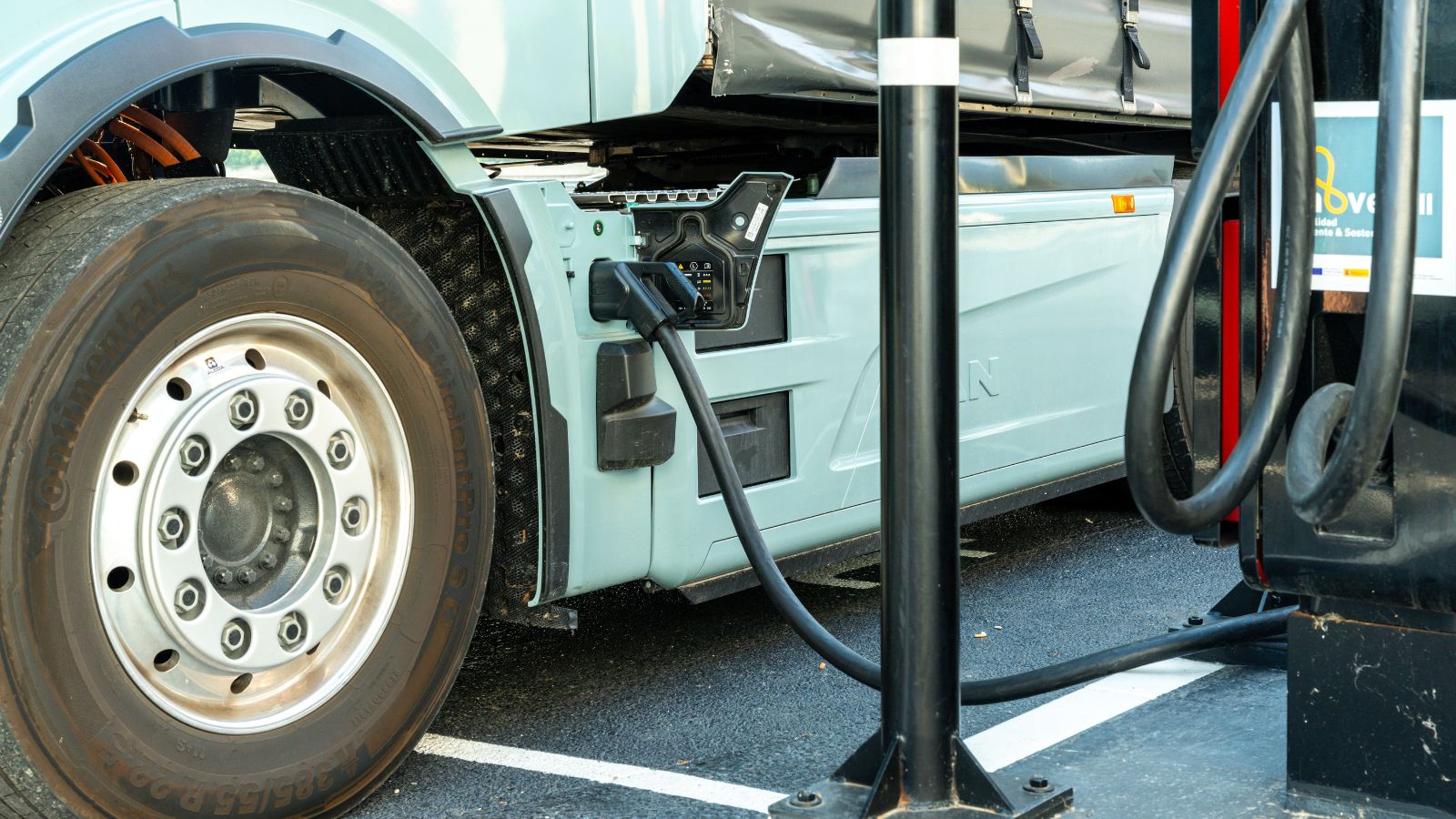
The trucks support both J1772 Level 2 AC charging and CCS1 DC fast charging. That combination gives operators flexibility to choose between slower charging during long periods of inactivity and faster charging when turnaround time becomes more important. A landscaping company whose trucks sit for most of the night may have a very different infrastructure requirement from a rental fleet trying to send the same vehicle out on two shifts. The ability to evaluate route length, payload and available dwell time before installing chargers is therefore central to the business case.
Canada is gradually building more infrastructure specifically relevant to larger commercial EVs, although the network remains far from mature. Transport Canada’s dashboard reported 339 medium- and heavy-duty electric-vehicle chargers opened under the federal infrastructure initiatives it tracks, with another 257 planned as of early 2026. Commercial fleets also rely heavily on private depot charging that is not equivalent to the public charging network used by passenger cars. This is another reason dealer coverage matters. For many work trucks, the ideal charging station is not beside a highway or shopping centre; it is behind a warehouse, public-works yard or service facility where the vehicle naturally spends eight or more hours parked.
The Incentive Equation Has Changed Since RIZON Entered Canada
When RIZON announced the Globocam expansion in October 2024, the economics included a sizable federal subsidy. The company said eligible trucks could receive roughly C$75,000 through the federal iMHZEV program, with provincial support potentially adding substantially more. That was a meaningful part of the original sales proposition because commercial battery-electric trucks generally carry higher upfront costs than comparable diesel vehicles, even where electricity and maintenance may offer operating savings later.
That federal information is now historical. Transport Canada closed the iMHZEV program on March 31, 2026, so a buyer evaluating a RIZON today should not treat the old C$75,000 federal incentive as still available. Quebec, however, has renewed its Écocamionnage program for the 2025-2028 period. Under current provincial rules, a qualifying fully electric Class 4 truck can receive assistance equal to as much as 35% of the purchase cost, capped at C$75,000. For qualifying Class 5, 6 and 7 electric trucks, the maximum rises to C$100,000, subject to program conditions. Because RIZON sells both Class 4 and Class 5 models, the potential provincial support depends on the specific configuration rather than one universal rebate figure.
Early Canadian Deliveries Put the Trucks Into Everyday Jobs
The dealer buildout eventually produced something more useful than launch announcements: trucks doing ordinary commercial work. In February 2025, RIZON handed over an e18L fitted with a dump body to Villamar Construction in Victoria, British Columbia. The truck was destined for custom-home construction work. RIZON said another 18 vehicles with dry-box, service-body and landscape-dump configurations were scheduled for delivery to customers in British Columbia and Quebec, including municipalities, rental companies and logistics businesses.
Other deployments followed. The City of Colwood placed an e16M dump truck into municipal operations in 2025, while British Columbia’s Plett Truck Repair added two e18L box trucks to its service fleet. Meanwhile, the sales footprint kept growing. In April 2026, RIZON announced seven additional sales centres in Quebec, covering areas including Greater Montreal, Quebec City and northeastern parts of the province. That progression—from a small incoming shipment, to dealer expansion, to customer deliveries and then additional sales locations—is important in an industry where many electric commercial-vehicle programs have struggled to advance beyond demonstrations. It suggests RIZON’s Canadian strategy is increasingly about repeatable fleet deployment rather than simply proving an electric truck can operate here.
Canada’s Electric-Truck Market Is Growing, but It Is Still Early
The broader numbers show both the opportunity and the challenge. Transport Canada calculated that battery-electric models represented 2.7% of new medium- and heavy-duty EV market sales nationally in the first quarter of 2026. As of April 1, the department’s dashboard counted 11,464 battery-electric medium- and heavy-duty vehicles in operation against an overall Canadian medium- and heavy-duty fleet of more than 2.65 million vehicles. Electric trucks are growing from a small base, not displacing diesel fleets overnight.
That makes RIZON’s choice to build local dealer coverage especially significant. Fleet electrification is ultimately a logistics problem as much as a vehicle-technology problem. Companies need trucks matched to routes, chargers matched to dwell times, technicians who can keep unfamiliar powertrains working and financing that makes the transition manageable. Quebec and Ontario offer a combination of fleet density, electric-vehicle adoption and commercial activity that makes them logical places to invest in those capabilities. RIZON’s expansion also illustrates how quickly the market can change: federal incentives that shaped the original Canadian launch have already expired, provincial programs have been revised, ownership has changed and the dealer footprint has grown. The trucks may be electric, but the real competition will be won on decidedly traditional measures—uptime, service access, operating cost and whether the vehicle can reliably finish the day’s work.