























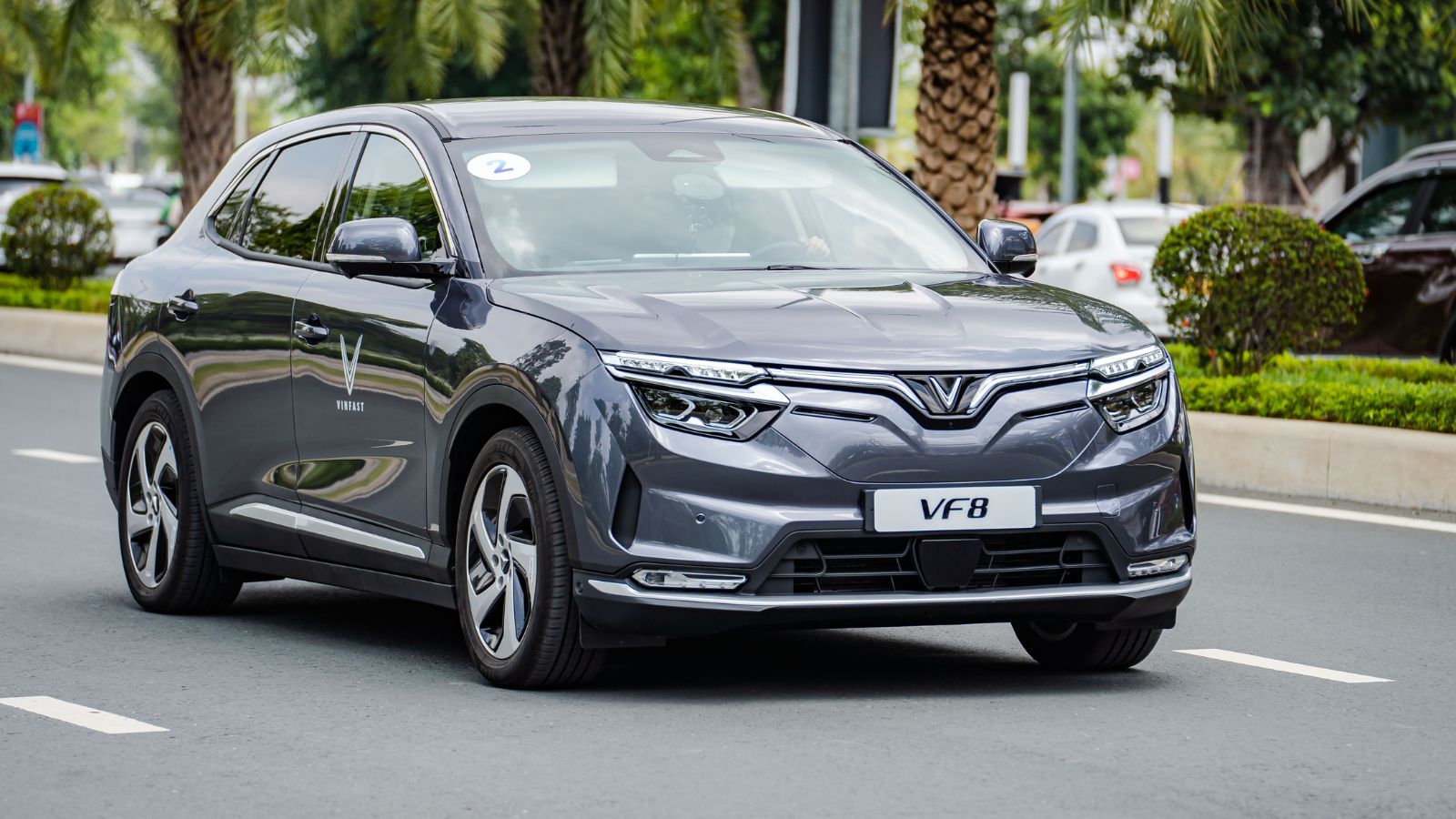
A tiny electric car is putting a very old automotive idea back at the centre of the EV debate: affordability can come from building less car. VinFast’s VF 2, a two-door, four-seat city EV with a claimed 210-kilometre NEDC range, has begun appearing at Vietnamese dealerships after its July launch, giving shoppers their first close look ahead of planned customer deliveries.
At a listed 188 million dong including the battery, the VF 2 is designed to sit closer to the cost of premium two-wheel transportation than to the price of a conventional family car. Its arrival matters beyond Vietnam because the global EV market is wrestling with the same question: should affordable electrification depend on ever-cheaper batteries inside familiar-sized vehicles, or on smaller, lighter cars built around modest urban needs?
The VF 2 Is Finally Reaching Showrooms
VinFast’s VF 2 has moved from launch-stage promise to something customers can inspect. In early September, display vehicles began reaching dealerships in Vietnam after the company’s July 5 unveiling. VinFast had said first customer deliveries were expected in September, although dealership reporting indicated that handover timing was not yet universally available. That distinction matters: the car is now tangible, but its market performance will be judged by deliveries rather than showroom attention.
The proposition is straightforward. The VF 2 is a two-door, four-seat electric city car listed at 188 million dong with the battery included. VinFast says the model was developed for individual buyers and optimized from the Minio Green platform. Instead of imitating a larger crossover at a discount, it embraces a narrow mission: urban trips, tight streets, easier parking and a price intended to bring car ownership within reach of households that might otherwise remain on two wheels.
Its Small Size Is the Point, Not an Apology
The VF 2 measures 3,090 millimetres long and 1,496 millimetres wide, with a 2,065-millimetre wheelbase. It stands 1,663 millimetres tall and rides on 13-inch wheels. Those dimensions explain much of its purpose before a specification sheet is opened. In crowded Vietnamese cities, a smaller footprint can matter every day, from squeezing into narrow lanes to finding space in packed parking areas. VinFast describes the car as tuned for dense urban streets rather than long-distance touring.
That focus runs against a powerful industry habit. Automakers in many markets have concentrated on crossovers and SUVs because buyers like their space, driving position and versatility. The International Energy Agency found that two-thirds of battery-electric models available globally in 2023 were SUVs, pickups or large cars. The VF 2 points the other way: affordability through physical restraint. Less body, less battery and fewer luxury expectations become a product strategy rather than an “entry-level” compromise.
A 210-km Range Changes the Conversation
The headline range figure is 210 kilometres on a full charge under the NEDC test cycle. VinFast pairs that with an 18.3-kWh usable battery, a 30-kW rear-mounted motor and 65 Nm of torque. Maximum speed is 80 km/h, reinforcing the VF 2’s city-first role. For drivers whose routine is built around commuting, school runs, shopping and local errands, 210 kilometres on paper can be more relevant than the much longer ranges marketed by larger EVs.
Charging is scaled to the battery. VinFast says DC fast charging can take the pack from 10% to 70% in about 34 minutes at up to 24 kW. The company cautions that real-world range can be lower because speed, temperature, terrain, traffic, passenger load and driving style matter. That warning is important with a small battery, where cold weather, sustained high speeds or heavy accessory use can consume a larger share of available energy daily.
Price May Be the VF 2’s Most Important Specification
The VF 2’s key specification may be its price rather than its range. VinFast launched it at 188 million dong with the battery included, removing a separate battery-rental calculation. During the initial July reservation campaign, the company offered an 8-million-dong discount for deposits made over a three-day promotional window. Its Vietnamese ordering page has also displayed a lower reference promotional price, showing how aggressively the brand is using price to attract first-time buyers.
VinFast also offered up to 10 free charging sessions per month at V-Green public chargers through February 10, 2029. Promotions can change, but the strategy is clear: cut the upfront barrier and reduce early running costs. Affordability is often decided at the showroom, not over a vehicle’s full lifetime. A car can be cheap to operate yet remain inaccessible if the purchase price or financing burden is too high. The VF 2 attacks that first hurdle directly.
The Equipment List Shows Where Costs Were Controlled
A low sticker price raises the question of what has been left out. The VF 2’s cabin is basic: VinFast lists a 7-inch driver-information display, air conditioning, a four-way manually adjustable driver’s seat and two speakers with FM radio. Outside, it gets LED headlights and 13-inch alloy wheels. It does not disguise the car as a rolling technology lounge. That simplicity may appeal to buyers who care more about shelter, four seats and predictable costs than giant screens or elaborate furniture.
The safety equipment list includes a driver airbag, anti-lock brakes, traction control and electronic brake-force distribution. MacPherson suspension is used at both ends. Those are meaningful features, but an equipment list should not be confused with an independent crash-test result. The physics of small cars still matters greatly: the Insurance Institute for Highway Safety notes that smaller, lighter vehicles are generally disadvantaged when they collide with larger, heavier ones.
VinFast Is Chasing Motorbike Owners, Not Just Car Buyers
VinFast is clear about the customer it wants. VinFast describes the VF 2 as a safer and more comfortable alternative to motorcycles, a logical position in Vietnam. World Bank analysis found that the country had 72.16 million registered two-wheelers in 2022, representing about 94% of its vehicle stock. Passenger-car ownership was far lower, at roughly 22 cars per 1,000 people, compared with about 518 two-wheelers per 1,000. That creates a large pool of first-time car buyers.
For a household accustomed to a scooter, the upgrade calculus differs from replacing a midsize sedan. Weather protection, four seats, a roof, seat belts and cargo space may matter more than highway range or rapid acceleration. The VF 2 therefore competes not only against other cars but against the cost and convenience of two-wheel mobility. Its challenge is to add enough safety and comfort without becoming too large or expensive for its target audience.
VinFast Already Knows Small EVs Can Generate Volume
The VF 2 is not emerging from a vacuum. VinFast says it was refined from the Minio Green platform, another tiny EV aimed at commercial and service use. That shared foundation suggests a familiar low-cost manufacturing playbook: spread engineering and component costs across related vehicles, then tune equipment, styling and marketing for different customers. The approach can be valuable at the bottom of the market, where every added component affects the final price.
There is evidence that compact VinFast products can find buyers at scale. The company reported 21,781 vehicle deliveries in Vietnam in July 2026. The VF 3 was its best-selling model that month with 5,564 deliveries, while the Minio Green recorded 2,429. Across the first seven months of 2026, VinFast reported 137,697 domestic EV deliveries. Those are company-reported preliminary figures, but they show why smaller vehicles matter: city-friendly models are central to VinFast’s domestic volume strategy at home.
Smaller Batteries Can Change the Economics of EVs
Small batteries do more than reduce range; they can reshape vehicle economics. BloombergNEF reported that lithium-ion battery-pack prices fell to a record $108 per kWh in 2025, while battery-electric-vehicle packs averaged $99 per kWh. Even as batteries become cheaper, pack size remains a design and cost decision. A vehicle that can meet its purpose with an 18.3-kWh pack uses far less battery material than an EV built around long-distance capability.
The effects can compound. The IEA has noted that electric SUVs can require substantially larger batteries than medium-sized electric cars offering similar range, while heavier vehicles consume more electricity. In its 2024 outlook, the agency estimated that replacing the electric SUVs sold in 2023 with medium cars could theoretically have avoided about 60 GWh of battery capacity, with limited range impact. The VF 2 takes that logic further: design around short urban missions, then size the battery to the job.
Going Smaller Still Comes With Real Trade-Offs
The choices that make a micro-EV affordable also define its limits. An 80-km/h top speed and 210-km NEDC range make sense for city streets and local roads, but they are not specifications aimed at regular high-speed intercity travel. Buyers who need one vehicle for commuting and long weekend highway trips may find the compromise harder to accept. Smaller cabins and two-door access create trade-offs for adults frequently using the rear seats.
Safety also matters. The VF 2’s driver airbag, ABS, traction control and electronic brake-force distribution provide a baseline of protection, but size cannot be ignored. IIHS explains that, all else equal, larger and heavier vehicles generally protect occupants better in crashes because they provide more structure to absorb energy and experience lower forces when colliding with lighter vehicles. That does not make small cars unacceptable; it means shoppers should evaluate crash performance, restraint systems and intended driving environment carefully.
Affordable EVs Are Becoming a Fight Over How Much Car Is Enough
The VF 2 arrives as the global EV affordability debate sharpens. The IEA says small EVs are especially price-competitive in China: nearly 95% of small-car sales there were electric in 2024, and almost all small BEV models were priced below average small combustion cars. In 2025, electric SUVs and small cars were the main contributors to improving EV affordability globally, even as the shift toward larger, more expensive models partly offset those gains.
Europe is moving similarly, though more slowly. A 2026 study from the International Council on Clean Transportation and Fraunhofer ISI found that battery-electric car prices in Germany fell about 18% in real terms between 2020 and 2025 while model choice quadrupled. The lesson is not every market needs a VF 2-sized car. It is that cheaper EVs may depend as much on asking how much vehicle people need as on waiting for the next battery breakthrough alone.