























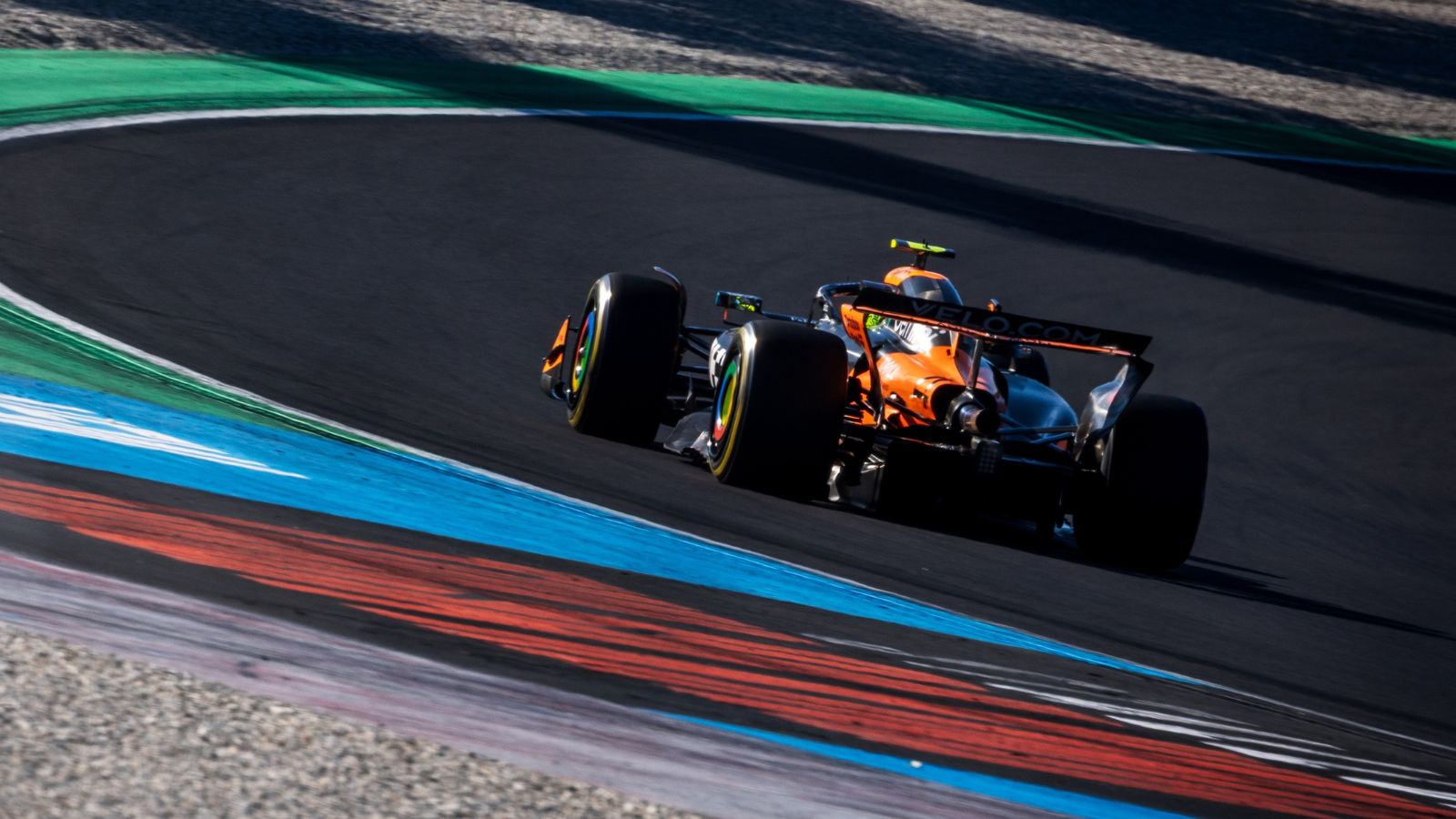
Aston Martin’s difficult Italian Grand Prix weekend took another turn before Sunday’s start when Fernando Alonso was ordered to begin from the pit lane after the team changed power-unit components overnight. The decision reshuffled the back of the grid and handed Canada’s Lance Stroll a small but meaningful promotion to 18th, four places higher than where he qualified.
The move did not solve Aston Martin’s deeper problem at Monza. Both cars had been eliminated in Q1, with Alonso’s final attempt lost to a power-unit fault and Stroll finishing slowest of the 22 drivers. At a circuit built around long straights, low drag and relentless energy deployment, the weekend exposed the areas where the new Aston Martin-Honda partnership remains vulnerable. It also produced an unusual contrast: Stroll moved forward before the race without turning another lap.
Overnight Engine Work Forces Alonso Into the Pit Lane
Aston Martin’s overnight work on Alonso’s AMR26 was not a routine precaution. FIA stewards recorded that the team installed a sixth energy store, a sixth control-electronics unit and a fifth MGU-K. Those components were replaced while the car was under parc fermé conditions and without the approval of the FIA technical delegate. Under the sporting regulations, that combination required Alonso to start from the pit lane rather than take a place on the grid.
The change followed trouble during Saturday qualifying, when Aston Martin and Honda detected abnormal behaviour in power-unit data. Alonso had been unable to complete his final Q1 run. Faced with a suspected technical problem and a race at one of Formula 1’s most power-sensitive circuits, the team chose reliability over starting position. It was a costly trade, but with Alonso already qualified 21st, protecting the car’s ability to run took priority over preserving a back-row slot.
Stroll Inherits 18th After Qualifying Last
Stroll’s final starting position looked better than his qualifying result. The Canadian had finished Q1 in 22nd place with a 1:25.222, just 0.072 seconds behind Alonso. A series of penalties elsewhere then reordered the bottom of the field. Kimi Antonelli and Alex Albon were sent toward the rear for power-unit changes, while Liam Lawson was moved to a pit-lane start after Red Bull altered his car under parc fermé conditions.
Those decisions initially lifted Stroll several places. Alonso’s overnight power-unit changes supplied the final step, leaving Stroll 18th on the grid while Alonso joined Lawson in the pit lane. It was an unusual gain because Stroll had done nothing on track between qualifying and the race to earn it. Yet Formula 1 grids are determined by both lap times and post-session compliance. For Aston Martin, the reshuffle turned an all-green back row into one grid start and one pit-lane departure.
Alonso Lost His Chance at a Final Q1 Attack
Alonso’s qualifying result looked poor, but the session was compromised before he could improve his position. His Q1 time was 1:25.150, placing him 21st and only seven hundredths ahead of Stroll. Reporting from the paddock said Alonso managed just one meaningful flying lap before the problem prevented another attempt. He later explained that the car would not restart, while Aston Martin and Honda identified abnormal behaviour in the power-unit data.
That distinction matters because Q1 at Monza rewards timing, tyre temperature and slipstream as much as outright pace. Alonso’s representative lap came on scrubbed tyres after a long wait in the pit lane, rather than on the fresh set intended for his final attack. There is no guarantee that a second run would have transformed Aston Martin’s afternoon, but it likely would have provided a better benchmark. Instead, the technical fault froze Alonso near the bottom and forced overnight intervention.
Stroll Reaches an Unwanted Qualifying Milestone
For Stroll, Monza produced a statistic he would rather not own. The 2026 Italian Grand Prix qualifying session made him the first Formula 1 driver to reach 100 Q1 eliminations since the sport introduced its three-part knockout qualifying format in 2006. He ended the session 22nd, less than a tenth behind Alonso, and recorded the milestone in his 10th season as an F1 driver.
The number needs some context. Stroll’s career also includes a pole position and three podium finishes, so the century of Q1 exits does not define his whole record. Still, it reflects how often he has had to begin races from difficult positions, during less competitive periods for Williams, Racing Point and Aston Martin. Monza offered a twist to the milestone: hours after qualifying last, penalties and Alonso’s pit-lane start elevated him to 18th. The grid moved in his favour even though his qualifying statistic remained unchanged.
Monza Exposes Aston Martin’s Straight-Line Weakness
Aston Martin arrived at Monza knowing the circuit would expose the AMR26’s biggest weakness: straight-line performance. The team’s own qualifying data listed Stroll’s maximum speed at 313.4 km/h and Alonso’s at 314.7 km/h. Stroll said the car was missing the power needed around the circuit, while Alonso had already warned that tracks dominated by long straights would be particularly difficult for the package.
That weakness was clearly visible throughout the weekend rather than appearing only in qualifying. Stroll ranked 22nd in both FP2 and FP3, while Alonso was 19th in those sessions. Monza does not offer many slow corners where a strong chassis can claw back large amounts of time. Instead, acceleration, efficient energy deployment and low aerodynamic drag matter lap after lap. The result was a harsh comparison point for Aston Martin: recent improvements elsewhere could not hide the car’s deficit once the championship reached its most speed-focused venue.
Why Monza Magnifies Every Power Deficit
Monza’s layout explains why even a modest power or efficiency shortfall becomes expensive. The Autodromo Nazionale Monza is 5.793 kilometres long, has 11 corners and runs for 53 laps in the Italian Grand Prix. Pirelli described it as one of Formula 1’s fastest circuits and noted that the long straights create an added energy-management challenge for the new-generation 2026 power units.
Teams also trim aerodynamic drag aggressively here. Pirelli said Monza requires low-downforce configurations, while Aston Martin highlighted four straight-line mode zones under the 2026 active-aero rules. That means a car repeatedly has to accelerate hard, deploy electrical energy efficiently and stay competitive at high speed before braking heavily for the chicanes. A weakness that might cost only a little time at a twistier venue can be exposed repeatedly at Monza. For Aston Martin, the circuit was therefore both a race weekend and a stress test for the AMR26-Honda package.
Honda’s New Works Partnership Faces a Tough Test
The Monza problem came during the first season of Aston Martin’s works partnership with Honda, built around the 2026 regulations. Honda developed the RA626H power unit for Aston Martin, while the team built the AMR26 as an integrated chassis-and-engine package. The new rules increased the electrical side of Formula 1 power units, with the FIA setting a 350-kilowatt electric output limit and removing the MGU-H.
That makes the partnership more important than a customer-engine deal. Honda Racing Corporation is responsible for development, manufacturing and trackside operation of the power unit, while Aston Martin controls the car around it. Reliability problems therefore become shared engineering problems rather than issues that can be isolated to a supplier relationship. Monza’s overnight component change highlighted that reality. The same partnership intended to give Aston Martin tighter integration also means the team and Honda must solve performance, energy-management and durability weaknesses together under race-weekend pressure.
Alonso Had Already Exceeded Several Component Allowances
The FIA document behind Alonso’s penalty shows why the overnight swap was notable beyond the pit-lane start. For the 2026 championship, Alonso had reached his fifth MGU-K and sixth examples of both the energy store and control electronics at Monza. The stewarding document states that only three new units of each of those components are permitted before the sporting regulations are breached.
However, the immediate reason for the pit-lane start was more specific than simply exceeding an allocation. The stewards said the listed components were replaced during parc fermé without the technical delegate’s approval, which triggered the mandatory pit-lane start under the applicable rule. That distinction matters because Formula 1 penalties can arise from different mechanisms: exceeding a seasonal component allowance can produce grid sanctions, while prohibited changes after qualifying can force a car out of its grid position entirely. Alonso’s case combined both issues in one difficult overnight repair.
Stroll Has Much Better Memories of Monza
Monza has sometimes been kind to Stroll. In 2017, in his rookie season with Williams, he qualified fourth in a rain-soaked session and was promoted to second on the starting grid after penalties for the Red Bulls ahead of him. Formula 1 notes that the result made him the youngest ever to line up on the front row. Three years later, he returned with Racing Point and finished third in the chaotic 2020 Italian Grand Prix.
Those results give the Canadian a strong personal history at a circuit that punished his current car. His 2020 podium came behind Pierre Gasly and Carlos Sainz, and it was the second podium of Stroll’s career. Six years later, he arrived at the same venue with a very different competitive picture, qualifying last before penalties moved him forward. That contrast is useful: Monza can reward opportunity, but it cannot erase a car’s underlying limitations.
Recent Progress Has Not Yet Become All-Round Pace
The Italian setback came after Aston Martin had shown improvement. A major chassis package arrived in Hungary, where Alonso escaped Q1 for the first time in 2026 and qualified 16th. At Zandvoort, he turned an 18th-place start into ninth and scored two points, with Formula 1 crediting the team’s strategy and noting gains from the upgraded Honda power unit.
Monza showed how circuit-dependent that progress remains. The AMR26 can look stronger where cornering performance and tyre management matter, yet still fall backward when long straights dominate the lap. That is why the Alonso repair and Stroll’s inherited grid gain matter beyond one starting order. They captured Aston Martin’s 2026 challenge in a single morning: recent chassis gains are real, but reliability and power-unit performance still determine how much of that improvement can be used. The team’s next step is turning isolated strengths into performance that travels from circuit to circuit.